CPI(M) Bookstall Attack: Another Shock
Oct 17, 2026 - By Ashutosh Roy Current AffairsPoliticsRegional UpdatesWest Bengal Politics
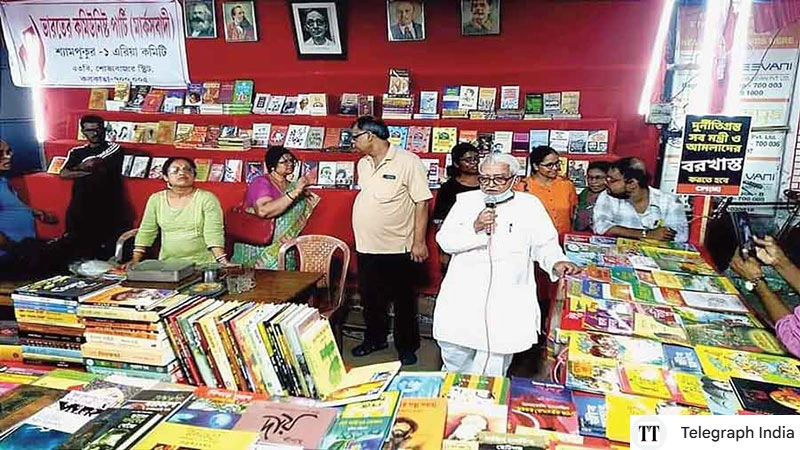
CPI(M) Bookstall Attack: Was it Required?
In the end, another CPI(M) Bookstall Attack! Honestly, I fail to understand what Bengal’s new government considers its real priorities. The party being targeted has almost disappeared from electoral politics. It has no member in the Lok Sabha and just one MLA in the state Assembly. Its public meetings and rallies are now few and far between. Yet, the urge to target it seems far from over.
I have grown up seeing CPI(M) bookstalls during Durga Puja. For decades, these stalls have been part of Bengal’s festive landscape. People stop to browse books, discuss ideas, meet familiar faces and spend some time together. The Left may call itself atheist, but its bookstalls have long been a familiar sight during a festival deeply rooted in Bengali culture.
Now, apparently, even this small space has become difficult to tolerate. Why? What is the point of provoking a party that has already lost so much of its political strength? Is the aim to silence the Left, or to make sure that no alternative political voice can breathe freely in Bengal?
Is the Political Intolerance growing in West Bengal?
How shocking! A bulldozer was brought in to dismantle a CPI(M) bookstall in Jadavpur. This is what happened on the evening of 17 October.
Key Lessons for BJP on CPI(M) Bookstall Attack
- The CPI(M) Bookstall Attack raises serious questions about political tolerance and cultural freedom in Bengal.
- Durga Puja should remain a space for people to celebrate, meet, read and exchange ideas without political intimidation.
- Changing Sharadotsav to Durgotsav will not solve unemployment, reduce cooking gas prices or bring industries back to Bengal.
- Calling Marxism anti-national is not enough. Political leaders should explain which specific books or ideas they believe threaten the nation.
- History offers repeated warnings about the destruction of libraries, monuments and cultural treasures in the name of ideology or power.
- Political ideology cannot justify vandalism or intimidation. Allegations must be investigated fairly, and those responsible should face the law.
- The movement of political leaders between the BJP and Trinamool raises questions about the place of ideology in the pursuit of power.
- Although BJP welfare programmes are not equivalent to Marxism, the state’s role in redistribution and public assistance deserves an honest discussion.
- From food and clothing to books and festivals, personal freedom matters. No political party should dictate how everyone must live or think.
- Bengal’s cultural identity depends on its freedom to debate and disagree. The government should focus on jobs, education, healthcare and development rather than narrowing cultural space.
Is This About Culture or Political Control?
Recent reports of CPI(M) bookstall vandalism and obstruction point to something bigger than a dispute over temporary stalls. Reports have emerged from several parts of Bengal, with Left parties alleging attacks, threats and attempts to stop them from setting up their stalls. The BJP has disputed allegations against its workers in at least some cases.
But one question remains: why should a political bookstall become a battlefield during a festival?
A report by Alt News on attacks on Left bookstalls describes how the issue has become a political flashpoint. Another report by The New Indian Express covers the Calcutta High Court’s intervention over permission for CPI(M) bookstalls.
If a bookstall breaks the law, let the authorities act according to the law. If its location causes a genuine problem, address that problem fairly. But vandalism, intimidation and political pressure cannot replace lawful action.
What are we trying to establish here? A new ideology? A new kind of social dominance? Or a system in which people must follow political instructions even when it comes to culture?
Suvendu Adhikari had reportedly asked people to use Durgotsav instead of Sharadotsav. Fine. That is a political position he is free to argue for.
But does it justify one CPI(M) bookstall attack after another? Will changing the name solve Bengal’s unemployment problem? Will it bring down cooking gas prices? Will it bring factories back, improve hospitals or give young people a reason to stay in the state? Of course not.
The name we use for a festival cannot matter more than the lives of the people celebrating it. Nor should a political slogan become an excuse to bully those who think differently.
Arjun Singh’s Anti-National Argument Needs Answers
Perhaps Arjun Singh or Suvendu Babu have taken a lesson from their former party, the Trinamool Congress, and its leader, Mamata Banerjee. Bengal has seen enough political bullying, intimidation and attempts to control public spaces. A change of government should have brought a change in political culture, not the continuation of old habits under a different flag like an old wine in a new bottle.
I also know that Shamik Bhattacharya is a long-standing BJP leader from the party’s original political stream. So why is he not raising his voice against such incidents? If actions by people claiming to support the BJP raise questions about the party’s principles, why should a leader who knows its history remain silent?
Arjun Singh has reportedly described Marxism as anti-national.
I would like to ask him a simple question: which specific book at a Left bookstall is anti-national, and why? Has he read the books he is condemning? Has he identified the passages that supposedly threaten the nation? Or has the word anti-national become enough to condemn an entire political ideology without offering any explanation?
I know that the BJP and the Left have opposing ideologies. Their economic views, political traditions and ideas about the role of the state differ sharply. Nobody needs to pretend otherwise. But disagreement is not a licence to destroy books or stop people from reading them.
As far as I know, Arjun Babu has built a reputation as a muscular, dabang politician. That describes his public image; it is not a judgment about his education. Nor is there any need to make casual assumptions about the educational or cultural backgrounds of Suvendu Babu or Shamik Babu. The point is much simpler: whatever their personal backgrounds, public leaders should understand the value of books, debate and cultural freedom.
I am genuinely astonished to see even Kunal Ghosh slamming the BJP over the CP(I)M Bookstall Attack. Alas, he seems to have forgotten the 2022 incident, when his own party was in power! Watch reaction of Kunal Ghosh on CP(I)M Bookstall Attack by BJP.
History Has Little Respect for Cultural Vandals
I hope Shamik Babu will remind his colleagues of a little history. Political power may allow people to destroy a building, a book or a monument. It cannot guarantee that history will remember the destruction kindly.
In 2001, the Taliban destroyed the ancient Bamiyan Buddhas in Afghanistan. The destruction became a lasting symbol of the loss of cultural heritage. The Taliban returned to power in Afghanistan in 2021, but that does not undo the loss or erase the condemnation that followed.
History offers other warnings. The armies of Bakhtiyar Khilji are associated with the destruction of the great centres of learning at Nalanda and Vikramashila. During Nazi rule and the Second World War, German forces destroyed or looted cultural treasures, libraries and collections across Europe, including in Poland. These events remind us what can happen when political or ideological power begins to treat knowledge as an enemy.
India, too, has a long and complicated history of temples and monuments being destroyed during different periods of conquest. Those episodes continue to shape historical debates. But the destruction of a place of worship or a cultural treasure does not become noble simply because the perpetrators claim to serve a powerful ruler, religion or ideology.
Cultural destruction leaves a stain that political power cannot easily wash away.
So why should the destruction of a small bookstall be treated as a trivial matter? A bookstall is not Nalanda, and the two should not be compared in scale. But the question behind both remains worth asking: why attack a place where people read, exchange ideas and encounter views they may not share?
If a political party wants to defeat Marxism, let it challenge Marxist arguments through debate. If it wants to question the Left’s interpretation of history, let its leaders present their own evidence and arguments. Breaking or intimidating a bookstall does not win an intellectual debate. It only makes people question the confidence of those who resort to such methods.
Has anyone ever been remembered kindly for deliberately destroying cultural life? Why should Bengal expect a different answer?
When Did the BJP Become So Different?
Let me ask Shamik Babu another question. If someone carrying a BJP flag intimidates or oppresses an ordinary citizen, how is that person supposed to protect themselves by asking whether the offender belongs to the BJP of before 12 noon on 4 May or the BJP of after 12 noon on 4 May?
Shamik Babu has stressed the difference between the party before and after it came to power. But ordinary people cannot be expected to solve a political puzzle every time someone claiming to represent a party behaves badly. If someone uses a party’s name or flag to threaten others, the conduct must be investigated and the person held accountable. The date and time of a change in government cannot become an excuse.
In my view, the Trinamool-isation of the BJP is no longer the only way to describe Bengal’s political situation. The process may also be moving in the opposite direction, as sections of Trinamool’s political establishment find their way into the BJP. The same political culture can survive even when the party scarf changes colour.
Look at the broader pattern of political realignment. A Rajya Sabha member may resign and join another party. Shamik Bhattachrya has been greeting them only. A Lok Sabha leader may join NCPI. At the state level, leaders who once represented Trinamool may find a place in the BJP. Can Shamik Bhattacharya justify each case of unethical political wrongdoing?
Still, these developments raise a fair question: how much importance do political parties really attach to ideology when power is at stake?
If leaders can move from one camp to another so easily, why should ordinary people be asked to treat every book written by their ideological opponents as a threat to the nation?
The BJP’s Welfare Politics and Marx’s Ideas
Consider another contradiction. BJP leaders often attack Marxism as though any strong role for the state in economic life were automatically unacceptable. Yet BJP governments themselves run large welfare programmes and intervene extensively in the economy.
Take Direct Benefit Transfers (DBT), subsidised housing, food-security programmes and other forms of public assistance. These schemes are not the same as Marxism, and it would be wrong to equate the BJP’s economic programme with a socialist system. Their ideological foundations, objectives and methods are different.
Still, these programmes rely on an active state that collects and allocates resources, supports poorer households and tries to reduce economic hardship. In that limited sense, they share one feature with socialist approaches: the state plays a significant role in redistribution and welfare.
So why should Marx’s name alone provoke such hostility? A political party is free to disagree with Marxist theory. It can criticise the record of communist governments and challenge the economic ideas of the Left. But it should also explain its own policies honestly instead of treating every discussion of Marxism as an act against the nation.
And what about the BJP’s own freebie culture, as critics often call its welfare promises and benefits? Cash assistance, subsidised services and other public benefits should be judged on their merits. Are they financially sustainable? Do they improve people’s lives? Do they create jobs, or simply help people cope with the absence of jobs?
These are legitimate questions for any government. Destroying a bookstall answers none of them.
First Clothes, Then Food, Now Books?
Some Hindu nationalist groups and public figures like Bageshwar Baba have tried to influence how people celebrate festivals, what they eat and which cultural practices they follow. I do not believe ordinary people should be bullied into accepting such instructions.
If you want to tell us what clothes to wear, perhaps you should say so openly. But please do not try to tell us what to eat. We are food lovers, and Bengal’s food culture is far too rich to be reduced to political instructions.
Now, apparently, the question of which books people may read has also become a matter for political leaders to decide. Arjun Singh has condemned Marxism as anti-national, while the wider dispute over CPI(M) bookstalls during Durga Puja raises a basic question: who gets to occupy cultural spaces, and who has the right to decide what others may read?
Mr Shamik Bhattachrya and Mr Suvendu Adhikari surely know this, but let me remind them anyway: Hinduism teaches us to live in harmony with people of all faiths, and even with those who do not follow any religion.
What comes next? Will someone decide which songs we may hear, which writers we may read or which ideas we may discuss with friends?
Promoting one’s own culture is one thing. Forcing others to accept a particular interpretation of it is quite another. The same applies to religion. People should be free to celebrate Hindu traditions without claiming the authority to decide what every Hindu must do. Faith can be personal and meaningful without becoming a tool for controlling other people’s lives.
Durga Puja belongs to Bengal’s people. It is a religious festival, a cultural celebration and a time when families, friends, readers, artists and visitors come together. Party politics should not be allowed to narrow its spirit.
Bengal Must Protect Its Cultural Freedom
If everything else in Bengal goes wrong, perhaps we will still have one thing to be proud of: our place among India’s great cultural centres. Kolkata’s literary tradition, theatre, cinema, music, art and public debates have shaped the state’s identity for generations.
Our culture has never depended on everyone thinking alike. Bengal has produced conservatives and radicals, believers and atheists, nationalists and internationalists. They have disagreed, argued and challenged one another. That clash of ideas is part of our intellectual life.
A culture that welcomes only one political viewpoint is not confident. It is being pushed into a corner.
That is why the CPI(M) Bookstall Attack cannot be brushed aside merely by saying that the people responsible were not BJP members. Responsibility for each incident must be established through evidence, not political assumptions. If anyone is found to have vandalised a stall or assaulted a person, the law should take its course. If allegations against a party’s workers are false, that should also be established fairly.
Political leaders cannot, however, escape every difficult question simply by distancing themselves from those involved. They must speak clearly against intimidation, protect lawful cultural activity and remind their supporters that political competition is not the same as political bullying.
The new government has far greater responsibilities than policing the words people use for a festival or deciding which political books deserve space. Bengal needs jobs, investment, better public services, stronger educational institutions and opportunities for its young people. These are the issues that deserve the government’s attention.
Will changing Sharadotsav to Durgotsav create jobs? Will stopping a Marxist bookstall improve the economy? Will intimidating the Left make Bengal’s hospitals work better or bring new industries to the state?
I do not think so.
Let people read Marx, Vivekananda, Tagore or anyone else they choose. Let political parties challenge one another’s ideas in public. Let voters decide which arguments deserve their support. Nobody should have to fear intimidation simply because a book or an opinion does not fit the ruling party’s worldview.
A bookstall may be small, but the freedom it represents is not. If Bengal wants to protect its cultural identity, it must defend that freedom even when the books on a stall express ideas we dislike.
That is the real test of tolerance—not whether we welcome only those who agree with us, but whether we allow others the same freedom we demand for ourselves.