Delhi Police Excess: The Mind-Blowing Truth
Oct 15, 2026 - By Ashutosh Roy National NewsNational PoliticsPoliticsRegional UpdatesWest Bengal Politics
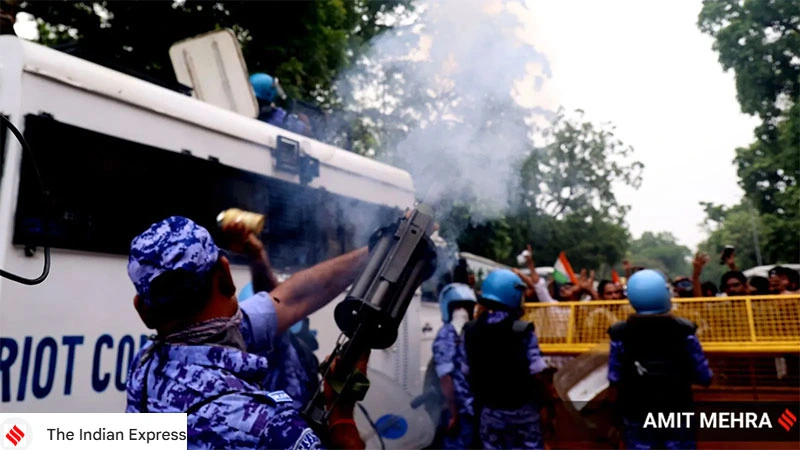
Delhi Police Excess: Repetition of the Same History
To those voicing deep concern over Delhi Police excess, I humbly ask: is this really the first time? Isn’t it an established, unwritten truth that the police almost naturally act as an arm of the ruling party, regardless of who sits in the power corridors of New Delhi?
Why blame only the Delhi Police excess? We see the exact same thing happening in states across India. Even around the world—in places like Nepal, Myanmar, Kazakhstan, and Iran—governments use the same force to crush peaceful protests.
Just a few months ago, the Narendra Modi-led government marked 50 years of the 1975 Emergency with great fanfare. The stated objective was clear: remind the public of those dark days of heavy-handed governance and political suppression. But now look at the state of those same rulers shortly after.
While the Constitution of India guarantees fundamental liberties, the ground reality often tells a completely different story when public anger spills onto the streets. In reality, no one wants to listen to dissents.
Key Takeaways: Delhi Police Excess
- Constitutional Rights vs. Police Action: Although Article 19(1)(b) protects the right to assemble peacefully, recent state crackdowns have effectively bypassed these fundamental safeguards.
- Prohibitory orders under Section 163 of the BNSS (formerly Section 144) were used to turn the capital into a fortress and justify widespread detentions.
- Judicial intervention became necessary when the Supreme Court of India stepped in to scrutinize arbitrary detentions and the routine banning of public gatherings.
- Public life was heavily disrupted as transit corridors, multiple metro station gates, and business hubs were locked down during security operations.
- The state apparatus routinely uses preventive detention tools to round up activists, journalists, and student leaders long before protests occur.
- Dawn arrests and plane detentions of prominent digital content creators often backfire, giving commentators unprecedented viral publicity instead.
- Traders and local business owners suffered massive financial losses, leading trade groups to file legal petitions against urban lockdown measures.
- Historical precedents reveal that modern state suppression closely mirrors the tactics used during the 1975 Emergency under Indira Gandhi.
- State excess cuts across political lines, as ruling parties across Congress, BJP, TMC, and regional governments consistently use police power against dissent.
- In the world’s largest democracy, the ultimate check on authoritarian state action remains the power of the ballot box during elections.
The Constitutional Mirage: Article 19(1)(b) vs Ground Reality
Article 19(1)(b) of the Indian Constitution explicitly guarantees every citizen the right to assemble peacefully and without arms. Showcasing how to suppress citizens while almost flouting that constitutional guarantee, Delhi Police excess over the past weekend made the reality painfully obvious.
The national capital was virtually converted into an open fortress, with massive barricading, metro station closures, and widespread preventive detention drives designed to block protesters long before they could reach designated protest venues like Jantar Mantar.
Reports published by mainstream outlets detailed how hundreds of demonstrators, student leaders, and activists were rounded up across various police stations. For detailed reporting on the ground situation and legal challenges, you can read The Hindu’s coverage on Delhi police detentions and rights violations.
Luckily, we didn’t see similar police action at Rahul Gandhi’s rally on Monday. If we had, given the sheer numerical strength of the crowd, it might have turned into a total bloodbath. Certainly that could rejuvenate the united opposition.
If anyone asks whether the protesting students were armed, who can guarantee that intelligence agencies found any destructive plot or deep-rooted conspiracy in their gathering? In fact, the scale of Delhi Police excess forced the Supreme Court of India to step in and hear emergency petitions challenging arbitrary detentions and the indiscriminate enforcement of Section 163 (formerly Section 144) order mandates.
One can track the legal proceedings and argument highlights via CNBC-TV18’s video report on Supreme Court pleas and protest detentions.
The Silence of the Ruling Class: The Magic of Numbers
No matter how many hard questions senior journalist Rajdeep Sardesai raises in his video commentary, or how strongly top constitutional lawyers like Abhishek Manu Singhvi and Kapil Sibal criticize the crackdown during interviews, the ruling party remains completely unmoved. This non-responsiveness is quite natural because numbers are on their side—the ultimate magic of parliamentary democracy.
Does any of this public outrage really change anything, though? As history repeatedly demonstrates, this is the fundamental nature of political power. Every authoritarian ruler, regardless of party ideology, uses brute state force as their primary tool to crush opposition. In short, the underlying expectation from the state apparatus is simple: live in the country like a compliant subject. Whatever the king or the party says, just nod your head and agree. Step out of line, demand accountability, or hit the streets, and you are in serious trouble.
“In politics, the party in power changes, but the muscle of the state machinery remains tuned to a single objective: preserving control and silencing dissent”.
Dawn Arrests, High-Profile Detentions, and the Media Spectacle
Looking at how prominent digital commentators and activists were picked up from their homes at the crack of dawn makes any observer question the proportionality of state action. The news of high-profile detentions spread like wildfire across digital platforms. The sudden police action against social media creators like Dhruv Rathee and independent journalists like Abhisar Sharma immediately dominated national headlines.
Whether it is Dhruv Rathee or whether any commentator’s actions cross legal boundaries is a matter for the judiciary. But if someone gains massive popularity and there are genuine questions regarding legal violations, citizenship, or foreign ties, the state ought to handle it strictly through standard legal channels. India is certainly no lawless guest house. Instead, what the public witnessed was a series of dramatic dawn arrests from private residences and detentions directly off aircraft runways.
Whether public figures or activists were plotting anything disruptive should be brought to light transparently with clear evidence in a court of law. What did we actually see instead? They were taken into preventive detention, held in security vans or remote police posts, and then granted bail or released the very next day. Didn’t the state’s heavy-handed tactics simply end up giving them extra publicity and converting a routine protest into a global news narrative?
Delhi Police excess has pushed the CJP out into the streets and united opposition parties. It won’t be shocking if figures like M.K. Stalin and Arvind Kejriwal decide to step back into the INDIA alliance. Will severe law and order tactics and police high-handedness inadvertently revive the nearly shaking opposition coalition?
Economic Fallout: Turning the Capital into a Fortress
The impact of Delhi Police excess extends far beyond political debate—it inflicts severe economic harm on ordinary citizens and small businesses. In response to the planned demonstrations, vast swathes of Central Delhi were sealed off with multi-layered steel barricades, concrete blocks, and heavy deployments of paramilitary forces. Metro stations were shut down with minimal advance notice, stranding thousands of daily commuters and office workers.
It is worth noting that a Delhi business association was forced to file a petition in the Supreme Court over the massive financial losses caused by turning the national capital into an inaccessible fortress. Truncated transport routes, blocked trade corridors, and forced market closures cost traders millions of rupees in lost revenue over just a few days.
While the merits of any police charge will be judged on facts, in modern Indian politics, creating a dramatic spectacle of absolute control seems to take priority over civic convenience. The question remains: is holding peaceful public demonstrations completely banned in the nation’s capital now?
Historical Parallels: From the 1975 Emergency to Modern Times
Remember the 1975 Emergency. Didn’t the government back then take the exact same route when faced with widespread civil unrest?
Indira Gandhi, who had reached the absolute peak of her popularity after India’s decisive victory in the 1971 war, still felt compelled to impose the Emergency in 1975 when political opposition consolidated against her administration.
The playbook has remained remarkably consistent across decades: label dissent as a threat to national security, deploy state-sponsored suppression, and rely on police power to maintain order.
To those shedding tears exclusively over recent Delhi Police excess, I suggest taking a broader historical look at Kolkata, the country’s former capital during British rule. Look back at police firings during the historic Food Movement of the 1950s and 60s, or the severe allegations of extrajudicial killings during the height of the Naxalite movement, and compare those historical events to today’s political landscape.
The pattern repeats itself across state borders. In West Bengal, Suvendu Adhikari often complained as Leader of the Opposition about having to move the High Court repeatedly just to secure basic permission for political rallies.
But now, under the newly formed state administration with Suvendu Adhikari as Chief Minister, the government faces similar pushback and criticism for placing strict restrictions on opposition rallies and protest marches, mainly on Mamata Banerjee. The tables have turned, raising the familiar question: does holding power inevitably change how leaders view dissent?
Even when a new government is only months old, citizens quickly start drawing comparisons because administrative behavior remains strikingly familiar.
Let’s quickly examine the root cause. The opposition and CJP protesters are not protesting against the ruling government. They are demanding a transparent voter list and the resignation of Chief Election Commissioner Gyanesh Kumar. Given that the Election Commission is an autonomous body, why should the government defend him so proactively?
The Universal Rule of Power: Political Colors Change, Police Habits Don’t
The political color of the ruler changes constantly in a vibrant democracy like India. Congress, BJP, TMC, AAP, Shiv Sena—they come, rule, and eventually return to the opposition benches. But Delhi Police excess, or police high-handedness in general across various states, remains a constant feature of Indian governance. Why? Because whichever party sits in power becomes equally eager to use police machinery to silence political rivals and crush uncomfortable voices.
As any elected government ages in office, anti-incumbency naturally grows, public discontent rises, and electoral conditions become tougher for the ruling party. That is precisely why, as tenure progresses, administrative policies of suppression grow harsher and tolerance for public critique shrinks.
A threat to journalists is a threat to the foundation of democracy itself. While reports highlight how media figures have been harassed on the ground, let’s not forget that identical complaints were raised during the CJP protests earlier this July.
Conclusion: The Ultimate Test in the World’s Largest Democracy
While state authorities may temporarily succeed in clearing protest sites, erecting barricades, and enforcing widespread detentions, history offers a clear warning to those in power. Everyone knows that to teach any ruler a lesson, the world’s largest democracy has a tough, ultimate test called general elections. We have already expressed our views whether the Oppositions can think of Election Boycott in such calamity of Delhi Police Excess.
Indian voters have consistently demonstrated a keen political sense. When state power overreaches and crosses acceptable boundaries of civil liberty, the electorate responds quietly but decisively at the voting booth. From historic post-Emergency elections to dramatic state assembly shifts, India has never hesitated to throw out any ruler perceived as authoritarian—whether in the corridors of New Delhi or in state capitals like Kolkata.