SIR Deletions: The Shocking Truth in India
Oct 10, 2026 - By Ashutosh Roy PoliticsCurrent AffairsElection AnalysisNational NewsNational PoliticsRegional UpdatesWest Bengal Politics
SIR Deletions: Is the Objective Inclusion or Exclusion?
The first question that comes to my mind when I look at the controversy over SIR deletions is simple: was the objective of the Special Intensive Revision (SIR) to include every eligible voter or to exclude those whose names did not meet the system’s requirements? This is not an argument against cleaning up electoral rolls. It is a question about how the exercise is being carried out and whether the Election Commission of India (ECI) has taken sufficient care to protect genuine voters.
Let me make my position clear. I do not support keeping the names of deceased voters, duplicate entries, people who have permanently shifted away, or otherwise ineligible persons on the electoral roll. Nor should anyone who is not legally entitled to vote in India be allowed to influence who governs the country through an unlawful vote. In areas along international borders, where questions of citizenship and illegal immigration can become politically sensitive, maintaining an accurate electoral roll is particularly important.
But none of this gives the Election Commission a free hand to put genuine citizens through an unnecessary ordeal. Removing an ineligible name and protecting an eligible voter are two sides of the same responsibility. If the Commission can identify one category correctly but fails to protect the other, the exercise cannot be considered a complete success.
SIR Deletions: Technology Cannot Become an Excuse
We live in an age when technology can perform tasks that once took weeks or months. Why should the Election Commission not use modern software to detect duplicate entries, identify deceased voters and flag discrepancies? Of course it should. The real question is whether the system has undergone rigorous testing in accordance with established software-testing guidelines and whether its results are being checked before they affect a citizen’s voting rights. SIR deletions argument can not just come to a stall because of software issue.
A software-generated alert is not proof that a voter is ineligible. A spelling mismatch, an error in family mapping or a discrepancy in old records may justify verification, but it should not automatically put a genuine voter under suspicion. For instance, confusion between the surnames Banerjee and Bandyopadhyay has long been a concern in Bengal.
Technology can help officials identify a possible problem, but it cannot replace their responsibility to examine the facts.
Software glitches cannot be an acceptable excuse for denying an eligible citizen the opportunity to vote. Any system should be tested repeatedly throughout its software development lifecycle before implementation. Errors should then be corrected without forcing ordinary people to run from office to office with documents they may already have submitted.
Supreme Court Justice Ujjal Bhuyan has warned against a process that could deprive large numbers of citizens of their voting rights. He compared the loss of the right to vote to taking the soul out of the body. His remarks were made amid the wider debate over voter disenfranchisement; they should not be treated as a judicial ruling on every disputed SIR case.
Read the Indian Express report on Justice Ujjal Bhuyan’s remarks.
The point is difficult to ignore. An electoral roll is not merely a government database. It is the record through which eligible citizens exercise their democratic choice. We must remember that, in a democracy, citizens become the ultimate authority on election day, once every five years. If a technical system makes a mistake, the citizen should not have to pay the price for it.
Illegal Immigration Must Be Addressed, But Fairly
There is another side to this debate that cannot simply be brushed aside. Duplicate entries, the names of deceased electors, voters who have shifted away and the names of people who are not legally entitled to vote should not remain on the rolls. Politicians who raise these concerns are not automatically wrong, and anyone who demands an accurate electoral roll should not be accused of opposing democracy. It is the ECI’s responsibility to verify every such concern and take appropriate corrective measures.
Kapil Sibal, now a prominent constitutional lawyer and Rajya Sabha MP, had argued for removing duplicate, shifted and deceased voters in 2013. Kiren Rijiju has highlighted a video of the parliamentary speech to attack Kapil Sibal and the opposition. Mamata Banerjee had also raised concerns about immigration and ineligible voters on the electoral roll much earlier, in August 2005. She had thrown papers at the Deputy Speaker.
These positions are important because they show that the demand for accurate electoral rolls is not a new concern confined to one political party. It has been raised by different political leaders at different times. Unfortunately, when a party moves from the opposition benches to the treasury benches, the same allegations can be turned against it. Political parties often change their arguments when their positions change, but the need for an accurate electoral roll remains the same.
The issue becomes even more sensitive in districts that share an international border. Reports and video footage from the Swarupnagar area of West Bengal have drawn attention to people reportedly returning across the border following the SIR exercise. Some individuals were reported to have claimed that they had voted in Indian elections and received benefits under schemes such as Lakshmir Bhandar.
Such claims certainly deserve proper investigation. The Election Commission must establish the relevant facts before excluding anyone from the electoral roll. A statement made in front of a camera, however, is not a substitute for checking citizenship, eligibility and official records. Nor should an individual’s claim be treated as proof against an entire community.
I do not deny that illegal voting and wrongful inclusion must be investigated. But the discovery of some ineligible voters cannot justify treating every doubtful entry as an ineligible voter. The Election Commission must establish the facts in each case and follow the law.
The ASDD Category and the Cost of Exclusion
The controversy becomes more serious when we examine the people placed in the ASDD category—Absent, Shifted, Dead and Duplicate—during the electoral-roll revision. The Election Commission has recently responded by stating that 13.39 crore electors were classified under ASDD, according to the Commission. These categories are intended to help identify entries that may need correction.
If a voter has died, the name should be removed. If a person has permanently shifted and no longer qualifies to remain on a particular electoral roll, the records should be corrected in accordance with the rules. Duplicate entries should be dealt with strict care. Yet what happens when a living, eligible voter is wrongly marked as absent, shifted or a duplicate?
That is the distinction the Election Commission must never lose sight of. A genuine voter who has been incorrectly classified should have a clear and accessible way to correct the mistake. The process must not assume that the software is right and the citizen is wrong.
The figures cited in the debate over West Bengal’s SIR process make this concern difficult to dismiss. More than 23 lakh names were reportedly sent for adjudication, while reports have also pointed to a high proportion of favourable decisions in appeals involving disputed voter status. These figures must be understood in their proper context. A favourable decision does not necessarily establish that every earlier deletion was wrong, just as an initial objection does not prove that a voter was ineligible.
Rajdeep Sardesai insists on every Indian citizen’s right to vote.
But if a very large number of disputed cases ultimately result in voters being recognised as eligible, the Commission must explain what went wrong, how those errors arose and what safeguards will prevent them from happening again.
The purpose of verification should be to establish the truth, not to make eligible citizens prove their innocence indefinitely.
Why Did the Election Commission Act Now?
The timing of the Election Commission’s response raises another uncomfortable question. Following criticism of the SIR process, the Commission announced that Booth Level Officers (BLOs) would visit the homes of people who had received notices because their records were unmapped or contained logical discrepancies. Under the announced procedure, BLOs would collect documents and upload them to ECINet for consideration by the Electoral Registration Officer.
We need not be overly harsh in judging the decision, but what we have seen is enough to fuel further controversy. The first point in the Commission’s release states:
The announcement is significant. If home visits and document collection can help voters complete the process, why was this assistance not made sufficiently accessible from the beginning?
Read the Indian Express report on ECINET and the SIR controversy.
I had raised concerns about the electoral process in my earlier Knowledge Mart article, Murder of Democracy in Bengal. The question now is whether the latest developments reveal weaknesses that should have been identified before the exercise reached this stage.
The controversy has become more visible after prominent people reportedly received notices and questions were raised about names missing from electoral records. Reports about Prannoy Roy, the veteran journalist and psephologist, have also prompted questions about how historical records are being matched. He has reportedly been fighting to get his name restored to the electoral roll.
This raises a larger question: if the system can flag people whose voting histories go back decades, how confidently can ordinary citizens trust it to distinguish a genuine discrepancy from an actual case of ineligibility?
The Commission should explain its methods in plain language. Which discrepancies trigger a notice? How are old records matched? What happens when a spelling error or an incomplete family record causes a mismatch? And how can a voter challenge an incorrect classification without losing days of work?
These are not unreasonable questions. They are basic requirements of a transparent administrative process.
Why Must Citizens Correct the Commission’s Mistakes?
My own experience with a logical-discrepancy notice has made this more than an abstract political argument. I had to stand in a queue for a couple of hours and submit documents to establish my eligibility. Among the tasks I had to undertake was retrieving information from the 2002 electoral roll and submitting my passport and other documents again.
I understand the need for verification. What I fail to understand is why the burden of locating old records and proving one’s eligibility should fall so heavily on the citizen when the government itself maintains the electoral machinery.
Why should a voter have to retrieve information from an old electoral roll and submit documents again when the Commission already has access to official records? If additional proof is necessary, the voter should be told exactly what is required, why it is required and how the case will be resolved. There must also be a reasonable process for people who cannot easily locate documents from decades ago. Is it really reasonable to expect an uneducated citizen to track down such old electoral rolls without adequate assistance?
The Commission has now spoken about BLOs visiting homes to collect documents. That may help people who struggle to attend hearings, but it also raises a question about consistency. Why was this assistance not made available from the start, particularly to elderly voters, people with disabilities and citizens who cannot afford to lose working days?
I cannot help asking whether a citizen’s experience of the system depends on where that person lives. Are voters in Delhi treated as first-class citizens while those in other states must bear a heavier burden? I am not suggesting that the Commission has formally created two classes of citizens. I am asking whether differences in implementation are creating that impression and whether the ECI is prepared to address it.
A voter should not need political influence, public recognition or access to the media to get a clerical error corrected. The same standards must apply to everyone.
Gyanesh Kumar and the Accountability Question
The role of Chief Election Commissioner Gyanesh Kumar and the other two Election Commissioners deserves close scrutiny. The ECI is a constitutional institution, not a personal office. Its decisions must inspire confidence across political lines, particularly when the credibility of the electoral roll is at stake.
Jawhar Sircar, a former Rajya Sabha MP, former Chief Electoral Officer (CEO) of West Bengal and former CEO of Prasar Bharati, has criticised Gyanesh Kumar in unusually harsh language. He compared the task of managing the Commission to handing a cart pulled by wild bullocks to someone unable to handle ponies. We need not adopt that language to recognise the underlying concern: an institution responsible for conducting elections must be able to manage a sensitive exercise competently and transparently.
The more important issue is institutional accountability. The Indian Express has reported allegations that a number of decisions relating to SIR were taken without the concurrence of the other two Election Commissioners. Such claims require careful examination, and allegations should not be treated as established findings. But if there were disagreements or concerns within the Commission, the public deserves a clear account of the decision-making process.
Why should voters learn about possible internal disagreements only after a controversy has grown? If the other commissioners had concerns about these decisions, when were those concerns raised, and what steps were taken to resolve them?
The Election Commission must answer these questions through records, explanations and transparent procedures—not merely through statements defending the institution.
See the Indian Express report on the allegations concerning Gyanesh Kumar and the other commissioners.
Opposition Unity: But What Is the End Result?
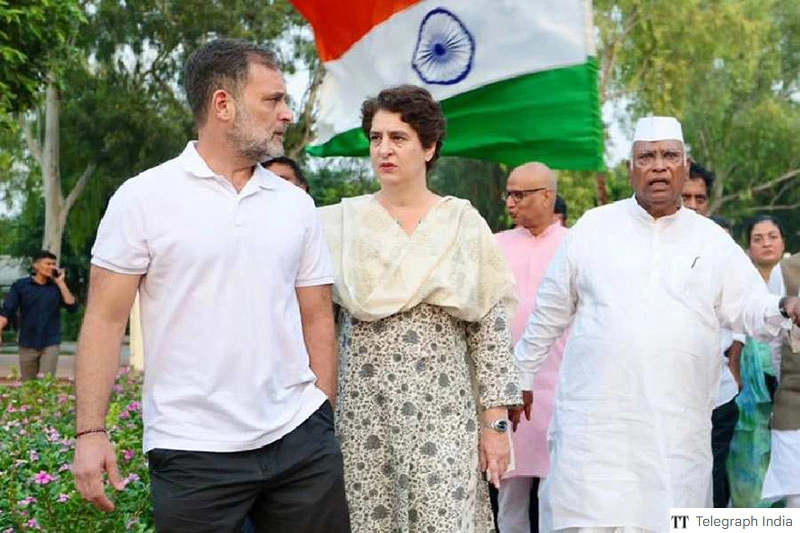
The opposition’s united response to the controversy is politically significant. Rahul Gandhi has repeatedly raised the issue of “Vote Chori”, arguing that electoral processes must be examined for possible irregularities. The Congress and other opposition parties have found common ground on an issue around which they can press for accountability.
For a long time, however, the campaign appeared to be more closely associated with Rahul Gandhi himself than with a sustained, coordinated effort across the opposition. The present controversy offers these parties an opportunity to move beyond speeches and demonstrations. They must produce evidence, pursue legal remedies and demand reforms that protect eligible voters, regardless of which party benefits electorally.
The participation of leaders such as Priyanka Gandhi and other opposition figures may increase public pressure. Civil-society groups, including the Campaign for Judicial Accountability and Reforms (CJAR), have also been involved in raising questions about electoral accountability. Public protest can draw attention to a problem, but it cannot, by itself, correct an electoral roll.
Will demands for Gyanesh Kumar’s resignation resolve the underlying issue? Even if the Chief Election Commissioner were to leave office, what would happen to decisions already taken, voters who may have been wrongly excluded and the procedures that produced the disputed outcomes?
Changing the person at the top is not the same as repairing a system. Accountability matters, but so do correction, compensation where legally appropriate and safeguards against a repetition of the problem. The opposition must explain what institutional changes it wants rather than allowing the entire debate to become a contest over one individual’s future.
Perhaps, for the first time since Sukumar Sen’s tenure as India’s first Chief Election Commissioner, the integrity of the Election Commission is facing such serious questions. The Commission has long been regarded as one of the country’s most trusted independent constitutional institutions. It is now the responsibility of everyone to ensure that public faith in this vital pillar of democracy is not allowed to erode.
Can the Supreme Court Provide a Way Forward of SIR Deletions?
The Supreme Court has an important role in ensuring that the law is followed and that eligible citizens are not arbitrarily deprived of their opportunity to vote. Judicial scrutiny can clarify the safeguards required when names are removed from electoral rolls, the procedures available to people who challenge such decisions and the responsibilities of election officials.
Justice Ujjal Bhuyan’s recent remarks have added weight to the debate about the consequences of mass disenfranchisement. His comments are not a substitute for a judicial ruling on each disputed SIR case, but they underline the constitutional importance of the issue.
The Court should examine the evidence, identify any procedural failures and ensure that voters have an effective remedy. At the same time, political parties should not treat litigation as a substitute for their own responsibility to engage constructively with the Election Commission.
The ultimate objective must be clear: correct the electoral roll, remove genuinely ineligible entries through lawful procedures and ensure that no eligible voter is denied the opportunity to participate because of an avoidable administrative error.
The Government and Opposition Must Put Ego Aside
The country has enough serious problems demanding attention: employment, rising prices, public services, economic insecurity and the daily struggles of ordinary families. Electoral integrity is not a trivial matter, but an avoidable administrative failure should not be allowed to deepen public distrust when practical remedies are available.
Journalist and political commentator Neerja Chowdhury has discussed the growing momentum of the Congress and the united opposition. The discussion also raises questions about the declining strength of Brand Modi, as issues such as unemployment, education scams and other public concerns put pressure on the BJP’s political image.
I have also examined the issue in my Knowledge Mart article, Is BJP’s Popularity Declining?. But the present controversy should not be reduced to a calculation of whether one party’s popularity is rising or falling. The credibility of elections is far more important than the political fortunes of the BJP, the Congress, the TMC or any other party.
The ruling establishment should put aside its ego and sit down with the opposition to find a workable solution on SIR deletions issue. The opposition, in turn, should come prepared with evidence and practical proposals rather than relying entirely on political theatre. If they can come to an unanimous decision, even impeachment motion against Gyanesh Kumar will be successful.
The Election Commission must explain its procedures, correct demonstrable errors and ensure that every eligible voter has access to a fair and timely remedy.
There is no shame in acknowledging that a system needs correction. In fact, refusing to recognise an error is far more damaging than admitting it and putting it right.
SIR Deletions: Clean the Roll But Not Democracy
Let me return to the question with which I began: is SIR meant to include eligible voters or exclude them? The answer should not be difficult. The Commission must perform both parts of its job properly: remove names that do not legally belong on the electoral roll and protect the names of citizens who are entitled to vote.
I am not arguing that every disputed name must remain on the list. I am arguing that every disputed name must be examined fairly, on the basis of reliable evidence, proper notice and an effective opportunity to respond. A software flag should initiate verification, not settle the case. An old record should help establish eligibility, not become an impossible hurdle for someone whose circumstances have changed over two decades. SIR Deletions have to come under serious investigation.
The Election Commission must explain why so many cases required further scrutiny, whether its procedures were applied consistently and what it will do to prevent eligible voters from being wrongly excluded in the future. The government and the opposition must stop treating every administrative question as an opportunity for political combat and begin working towards a credible solution.
The right to vote is too important to be lost in a maze of notices, mismatched records and bureaucratic indifference. A clean electoral roll strengthens democracy; the wrongful exclusion of a genuine voter weakens it. The purpose of SIR should never be to make citizens fear the system that is supposed to protect their democratic voice.
India needs an electoral roll that is accurate, transparent and trusted. The Commission must deliver that result, while the government, the opposition and the courts must ensure that the pursuit of accuracy never becomes an excuse for denying eligible citizens their place in democracy.
SIR Deletions: 10 Key Takeaways
- The central question surrounding SIR deletions is whether the exercise is protecting eligible voters or putting their voting rights at risk. A clean electoral roll must achieve both accuracy and fairness.
- Removing the names of deceased voters, duplicate entries, shifted voters and ineligible persons is necessary, but genuine voters must not suffer because of administrative or software errors.
- Technology should assist the Election Commission, not replace human judgment. Software-generated discrepancies must be verified before they affect a citizen’s right to vote.
- The ASDD category—Absent, Shifted, Dead and Duplicate—requires careful scrutiny because an incorrect classification can create serious difficulties for an otherwise eligible voter.
- Reports of more than 23 lakh names being referred for adjudication raise questions about the verification process. The Election Commission should explain the figures, the reasons for discrepancies and the outcomes of the reviews.
- The decision to send Booth Level Officers to voters’ homes to collect documents raises an important question: why was this assistance not made sufficiently accessible from the beginning?
- My own experience of standing in a queue and submitting old electoral-roll details and identity documents shows how much time and effort the process can demand from ordinary citizens.
- Chief Election Commissioner Gyanesh Kumar and the Election Commission must answer questions about transparency, decision-making and safeguards against the wrongful exclusion of eligible voters.
- Opposition protests and demands for resignation may create political pressure, but changing the leadership alone will not repair a flawed process. Lasting reform requires accountability, legal remedies and institutional safeguards.
- The Supreme Court, the government and the opposition all have a role in protecting electoral integrity. The ultimate objective must be clear: clean the electoral roll without denying genuine citizens their democratic voice.