SRFTI Violence: Fierce Clashes Break Out!
Oct 06, 2026 - By Ashutosh Roy PoliticsCulture & HeritageCurrent AffairsEducationWest Bengal Politics
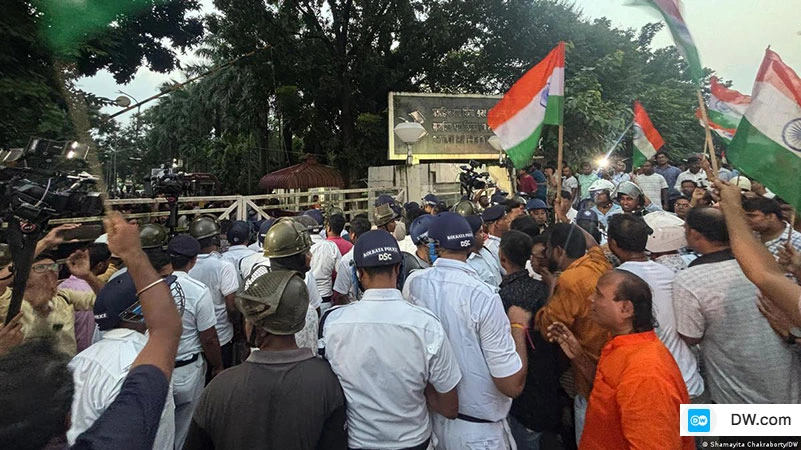
What Happened in the SRFTI Violence on October 4?
The SRFTI Violence on October 4 turned the gates of the Satyajit Ray Film and Television Institute in Kolkata into the scene of a serious confrontation. Members of the Hindu Jagaran Manch marched towards the institute, where police stopped them from entering the campus. Stones and bottles were thrown during the confrontation, while students and protesters gave different accounts of what happened. Police eventually brought the situation under control. The Indian Express reported that protesters tried to enter the campus and that bricks and bottles were allegedly thrown during the confrontation.
Students had already expressed concern about the proposed march and had asked the authorities to ensure security inside the campus. The protesters said they had come to object to alleged disrespect towards Swami Vivekananda and Bharat Mata.
Whatever one’s view of those allegations, the bigger question remains: why should a film institute carrying the name of Satyajit Ray become a place for political organisations to demonstrate their strength?
The Hindu Jagaran Manch came towards SRFTI in a rally, police put up barricades and the situation became increasingly tense near the institute gate. Reports also said that some protesters tried to push through the barricades before the confrontation escalated.
Do We Learn Patriotism from Hindu Jagaran Manch?
I do not know which Hindus the Hindu Jagaran Manch claims to be awakening, but Bengali Hindus have been awake for a very long time. They do not need a political organisation arriving at the gates of an institution in Kolkata to remind them what Hinduism, patriotism or nationalism means.
If the objective was to make students understand the strength of the so-called nationalists, surely there were better ways of doing it than arriving at a campus with a large political mobilisation and ending up in a clash with police and students.
We grew up listening to songs like Amar Sonar Bangla and O Amar Desher Mati. These are not slogans somebody introduced to Bengal yesterday. They are part of the cultural memory of generations. Partition cut Bengal through its own land, and Bengali people experienced the pain, displacement and violence directly.
In 1905, Abanindranath Tagore painted Banga Mata. Bengal had already developed a deep intellectual and cultural relationship with Indian nationalism, patriotism and the idea of Bharat Mata. So when someone comes to Bengal and behaves as if nationalism has just arrived here, the natural question is: what exactly are they trying to teach us?
Another question cannot simply be brushed aside. Why were so many of the people who came to SRFTI Hindi-speaking? Is our Bengali language not sweet enough? Is Bengal’s own cultural tradition not strong enough to express nationalism? This is not an argument against Hindi-speaking Indians. Bengal has always welcomed people from different parts of India. The question is about political mobilisation in Bengal and the strange impression that nationalism has to arrive from outside the state before Bengalis can understand it.
Swami Vivekananda was a son of Bengal. Ramakrishna belonged to Bengal. The message of “Joto Mat, Toto Path” came from this soil. We were also taught the simple idea of coexistence through “Eki Brinte Duti Kusum, Hindu Musalman”. That does not make a Bengali less Hindu. It does not make a Bengali less Indian. If anything, it shows how deeply Bengal has understood the idea of India without needing political organisations to define it for us.
Why Satyajit Ray’s Legacy Matters
The SRFTI episode feels particularly disturbing because the institution carries the name of Satyajit Ray, one of Bengal’s greatest cultural figures and one of India’s most respected filmmakers.
Ray’s films and stories did not need communal hatred to make a point. He observed society, human relationships, poverty, politics, class and changing values with an extraordinarily sharp eye. His work encouraged people to think rather than telling them whom to hate.
That legacy should not be reduced to a political battlefield where competing groups arrive at the gate to demonstrate their strength.
There is also a tendency today to rewrite Bengal’s political history as if every criticism of the BJP or every disagreement with Hindu nationalism is an attack on Hinduism. That is too simplistic. The Left ruled Bengal for decades and its politics could be criticised on many grounds, including its handling of industry, jobs, political violence and administration. But saying that the Left attacked Hinduism is a much bigger claim. Bengali society continued with its temples, pujas, religious traditions and festivals throughout those years. Political criticism of the Left and religious identity are two different things. They should not be deliberately mixed for electoral convenience.
Hinduism does not become stronger because a group of people marches towards a college or film institute and gets involved in a confrontation. It does not become stronger because students are frightened, police barricades are broken or bottles are thrown. If someone genuinely wants young people to understand Hindu civilisation, Bengal’s history provides enough material to fill libraries. Vivekananda, Ramakrishna, Bankim Chandra, Abanindranath Tagore, Rabindranath Tagore and countless others provide a much stronger cultural argument than any street confrontation. The strength of an idea is not proved by the number of people standing behind a barricade. It is proved by whether the idea can survive questions.
Academy of Fine Arts, Jadavpur and Political Showdowns
This is also why the Academy of Fine Arts episode cannot simply be forgotten. We saw a situation where some people put saffron colour over what had been white, turning a cultural space into another political contest. The Indian Express reported on the saffron-white paint controversy at the Academy of Fine Arts. Whatever explanation was offered later, why should outsiders enter a cultural space and decide that its identity needs to be changed?
We have also seen the Jadavpur University SFI–ABVP violence. That was a different confrontation involving different groups, and it should not be confused with the SRFTI incident. But the larger lesson is difficult to miss. Once political organisations start treating educational institutions as arenas for strength-testing, students are the ones who pay the price. The Indian Express reported on the Jadavpur confrontation and the police deployment that followed.
Campuses are supposed to be places where ideas fight with ideas. They should not become places where political groups fight with each other. That principle should apply equally to the Left, BJP, ABVP, SFI, TMC or any other political organisation. The rule cannot change depending on who happens to be holding the flag.
The Bageshwar Baba Episode and Bengal’s Cultural Confidence
Then came the Bageshwar Baba episode, adding another layer to Bengal’s political and cultural debate. Bageshwar Baba, Dhirendra Krishna Shastri, faced controversy in Bengal after remarks concerning non-vegetarian food during Durga Puja. There were political reactions to his visit and comments, and BJP leaders subsequently spoke about bringing him back to Bengal after the Puja period. Knowledge Mart has examined the Bageshwar Baba controversy and its political implications in Bengal.
Again, the issue is not whether someone has the right to express a religious opinion. Of course they do. The question is whether Bengal needs outsiders to arrive and tell Bengalis how their religious and cultural life should be conducted. Bengal has its own religious traditions, arguments and disagreements. People here are perfectly capable of deciding what they want to hear and what they do not want to hear. A visiting religious figure has every right to speak, just as Bengalis have every right to disagree. Turning such visits into political demonstrations is another matter.
The BJP should remember one very simple thing: we brought you to power by voting for you. The voters of Bengal voted for a government. They did not vote to hand over the state to the Hindu Jagaran Manch, Bageshwar Baba, Akhil Bharatiya Grahak Panchayat, ABVP or any other organisation.
Political organisations can campaign. Religious leaders can speak. Social groups can protest. Everybody has rights under the law. But none of these organisations received the people’s mandate to run the government. The mandate belongs to the elected government. That distinction should remain clear.
Does Bengal Really Need to Be Taught Nationalism?
Perhaps this is where the real disagreement lies. Bengal does not reject India. Bengal does not reject nationalism. Bengal does not need to choose between being Bengali and being Indian. We have lived with that combination for generations. Our nationalism has been expressed through literature, music, art, freedom movements, religious thought and social reform. It has come through Rabindranath Tagore’s words, Vivekananda’s message, Abanindranath’s Bharat Mata and the countless ordinary Bengalis who lived through the freedom struggle and Partition.
The veteran journalist, Suman Chattopadhyay has rightly pointed out that Bengal knows nationalism better than those gathered at SRFTI. So, the BJP should take a note of it before passing generic comments on the SRFTI violence.
So when somebody comes here claiming that Bengalis need to be awakened to nationalism, the reaction will naturally be: awakened to what? That question is not anti-national. It is a perfectly legitimate question from a society that has spent generations debating its own identity, politics and place within India.
The October 4 SRFTI Violence should not become another headline that disappears after a few days. SRFTI is a film institute. It is a place for students to learn cinema, television, storytelling and visual culture. It is not a political battlefield where organisations need to demonstrate who is stronger. This concern fits into the wider Bengal Education System crisis, where political interference, campus violence, institutional autonomy and student safety have become increasingly important public questions.
And Bengal certainly does not need to be taught how to be Indian, how to be patriotic or how to be Hindu by anyone arriving from outside and shouting louder than the people who have lived here for generations. If the Hindu Jagaran Manch genuinely wants to awaken people, perhaps it should begin with a more difficult task: understanding Bengal before trying to awaken Bengal.
What the SRFTI Clash Really Raises
- The October 4 SRFTI Violence was more than a clash at an educational campus gate. It brought political mobilisation directly into an important cultural and educational space.
- The Hindu Jagaran Manch marched towards SRFTI and police stopped the protesters from entering. Stones and bottles were thrown during the confrontation, with different accounts emerging from those involved.
- Bengal does not have to be introduced to nationalism. Its history, culture and freedom movement have been closely connected with the idea of India for generations.
- Abanindranath Tagore’s Bharat Mata, Vivekananda’s message and Bengal’s contribution to the freedom movement are hardly recent discoveries that need political organisations to explain them.
- The presence of many Hindi-speaking protesters also raises an uncomfortable question about how nationalism and political mobilisation are being presented in Bengal.
- Satyajit Ray’s legacy belongs to cinema, culture, observation and critical thinking. Turning an institute named after him into a political show of strength sits uneasily with that legacy.
- The Academy of Fine Arts controversy and the Jadavpur SFI–ABVP clashes point to a wider problem: cultural and educational institutions should not become convenient arenas for political confrontation.
- The Bageshwar Baba episode has added to the argument over how religious figures and political organisations are trying to shape Bengal’s cultural conversation.
- The BJP won the mandate from Bengal’s voters. That mandate belongs to the elected government, not to the Hindu Jagaran Manch, ABVP or any other organisation.
- Perhaps the simplest point is also the most important: educational institutions should remain places where ideas clash, not places where political groups clash.