Arrest Gyanesh Kumar? EC Power War Explodes!
Sep 25, 2026 - By Ashutosh Roy Current AffairsElection AnalysisGovernance & AdminNational NewsNational PoliticsPoliticsRegional UpdatesWest Bengal Politics
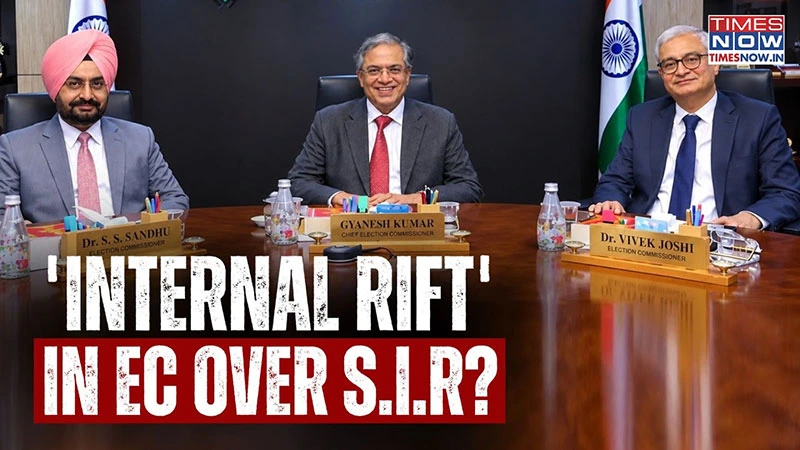
Arrest Gyanesh Kumar: What Is the Legal Basis?
The Election Commission of India is facing an unusual internal controversy. What began with questions over the Special Intensive Revision (SIR) of electoral rolls has now turned into a wider debate about the powers of the three Election Commissioners, the role of Electoral Registration Officers (EROs), changes to Form 6 and the use of electoral software. The demand of Arrest Gyanesh Kumar has reached much beyond the political battlefield.
The controversy became more serious after reports emerged of repeated differences between Chief Election Commissioner Gyanesh Kumar and the other two Election Commissioners, Sukhbir Singh Sandhu and Vivek Joshi. The Indian Express reported that Sandhu and Joshi had recorded objections at least 14 times over ten months on issues including voter additions and deletions, Form 6, SIR and access to electoral-roll data.
Several Opposition leaders have since demanded action against Gyanesh Kumar, with some calling for his arrest. But a political demand and criminal liability are two different things. An arrest requires a legal basis and evidence of an offence. The real issue, therefore, is whether the reported actions amount to a violation of law or reveal a serious institutional dispute that requires further investigation.
Arrest Gyanesh Kumar: Political Demand or Legal Case?
Mamata Banerjee has demanded the arrest and criminal prosecution of Gyanesh Kumar. Arvind Kejriwal has made a similar demand, while Uddhav Thackeray has also called for Kumar to be removed and jailed. These are political demands, not findings by a court.
The Election Commission is a three-member constitutional body. The ECI says all Election Commissioners have an equal say in decision-making, while the law provides for majority decision-making when the members disagree. Section 18 of the 2023 law says the Commission’s business should, as far as possible, be transacted unanimously, with differences decided by majority.
That makes the reported objections of Sandhu and Joshi important. If two members of a constitutional body repeatedly objected to decisions concerning electoral rolls, the public deserves to know what they objected to, how those objections were considered and how the final decisions were reached. But disagreement alone does not establish criminal wrongdoing.
Election Commission Power War: What Happened?
The reported dispute involves several parts of the SIR process. One concerns Form 6, which is used for applications for inclusion in the electoral roll. The Indian Express reported that a new declaration connected with previous SIR rolls was added to the form and that Sandhu and Joshi questioned the legal basis for making the change without amending the relevant rules.
Another issue concerns Electoral Registration Officers. An ERO has statutory responsibilities in preparing and revising electoral rolls. The Indian Express reported that the two Commissioners raised concerns about increasing centralisation of electoral-roll data through the Commission’s IT systems and whether ground-level officials had sufficient control to perform their legal duties.
This raises a larger institutional question. If an ERO has the authority to decide a voter’s case but the software restricts what the officer can record, where does the actual decision-making power lie? Technology should implement the law, not quietly replace the authority given to a statutory officer.
Can Election Software Override an ERO?
The software issue is not merely technical. The Indian Express reported that in Goa, 97 people had satisfied the requirements before the EROs and were found eligible, but the software did not allow the officers to record those decisions.
That does not prove deliberate manipulation. A software restriction could result from a technical limitation, an administrative decision or a problem in the system’s design. Those possibilities need to be separated.
But the incident raises legitimate questions about how election software was tested and approved. When a digital system can affect whether an eligible citizen appears on the electoral roll, the Commission should be able to explain what safeguards were in place, who approved the system and what happened when officials encountered restrictions.
Where Does Seema Khanna Fit Into the EC Row?
Election Commission Director General of IT Seema Khanna has also come under scrutiny because the dispute involves control of the digital electoral-roll system. The Indian Express reported that Sandhu questioned whether Khanna had legal authority to restrict complete access for EROs. India Today has also reported concerns about centralised software access.
That does not establish that the software was manipulated. It does, however, explain why the Commission’s IT structure has become part of the controversy. When technology is used to implement statutory decisions, the chain of authority should be clear.
Kapil Sibal Levels Serious Allegations Against CEC Gyanesh Kumar & EC Functioning in an interview with Rajdeep Sardesai in India Today.
SIR Controversy: Why Form 6 Matters
SIR was controversial well before the latest reports about the EC’s internal disagreements. The Commission has defended the exercise as necessary to maintain accurate electoral rolls, while Opposition parties have raised concerns about wrongful deletion.
The scale is enormous. The Indian Express reported that more than 13 crore names had been struck from draft electoral rolls across 30 States and Union Territories during the exercise.
There is a legitimate reason to remove dead, duplicate or permanently shifted voters. But an eligible voter should not disappear from the roll because of an administrative mistake, documentation problem or technical failure. A credible electoral system has to protect against both bogus entries and wrongful deletion.
What Did the Other Two Election Commissioners Do?
There is another uncomfortable question here. It concerns Election Commissioners Sandhu and Joshi themselves. If they believed that serious procedural or legal problems were developing, why did they allow the dispute to remain within internal correspondence for so long?
The Indian Express reported that the two Commissioners eventually wrote separately to Cabinet Secretary T V Somanathan, raising concerns about administrative arrangements and the concentration of powers.
Putting concerns on record is important. But it also raises a simple question: what did they do next? If they believed the matter involved serious legal or constitutional issues, why did they not seek judicial intervention? Whether approaching the Supreme Court was legally necessary or appropriate would ultimately be for the courts and constitutional experts to determine. But serious concerns inside a constitutional body naturally raise questions about what further remedies were pursued.
Disagreements among Commissioners are not new. Constitutional institutions have witnessed internal differences before. Even the judiciary has seen judges publicly raise concerns about its functioning. So, disagreement itself does not prove institutional failure.
But prolonged silence creates a different question. The Election Commission is responsible for protecting the integrity of the electoral process. It must ensure that an ineligible person does not enter the electoral roll while an eligible voter is not wrongly excluded.
If the two Commissioners believed that this balance was being threatened, did they exhaust the available institutional and legal channels? Did they clearly record their objections and challenge the decisions they considered problematic? Had they been vocal on time, perhaps the question of “Arrest Gyanesh Kumar” would not arise.
Ultimately, this is not simply a case of one Commissioner versus two Commissioners. The larger issue is institutional accountability. When senior members of a constitutional body believe that something is going seriously wrong, the public has a legitimate interest in knowing not only what they wrote, but also what action they took after writing it.
Indian Express Investigation and the EC Rift
The Indian Express investigation has brought internal correspondence and administrative decisions into public view. The Commission has expressed its views. The Commission has offered a different account. In its response, it did not dispute the existence or dates of the 14 notes but described them as suggestions and maintained that its decisions during the relevant period were ultimately unanimous.
That response matters. So does the documentary record reported by the newspaper. The controversy should therefore be examined through the actual documents and legal framework rather than settled by competing political narratives.
Rahul Gandhi, Kejriwal and the SIR Campaign
The political campaign around SIR also predates the latest EC controversy. Rahul Gandhi and the Congress had already raised allegations concerning electoral rolls and used “Vote Chori” as a major political slogan. Other Opposition parties, including Tejashwi Yadav in Bihar, had also criticised aspects of the SIR process.
Kejriwal later demanded the arrest of Gyanesh Kumar and called for cancellation and repolling of recent elections. These demands have intensified the political battle, but political allegations should not be confused with established facts.
Readers can also see Rahul Gandhi’s earlier presentation on electoral-roll allegations here on YouTube.
The chronology is worth remembering. SIR had already become a major political issue before the present EC rift became public.
Mamata Banerjee Demands Arrest of Gyanesh Kumar
Mamata Banerjee and Abhishek Banerjee have now taken the controversy further by demanding the arrest and criminal prosecution of Gyanesh Kumar and calling for fresh elections in Bengal using the pre-SIR voter list. She has linked the demand to allegations of large-scale voter deletion and irregularities in the electoral process.
Political parties are naturally going to use a controversy involving the Election Commission to attack the poll panel. But claims about who opposed SIR first should be checked against dates, statements and public records. Rahul Gandhi and the Congress had already made SIR and alleged voter-list irregularities a major political issue before the present EC dispute became public.
The important thing is not which party gets political credit. It is whether the underlying allegations can be supported by evidence.
CJP Joins the Gyanesh Kumar Controversy
The controversy has even attracted the Cockroach Janta Party, or CJP, which has announced a press conference focusing on the Election Commission and Gyanesh Kumar.
The development shows how quickly the issue has spread beyond the established Opposition parties. But every new political statement is not another piece of evidence. Allegations about the electoral process still need to be tested against documents, law and facts.
If courts examine the matter, that process will ultimately move the debate away from slogans and towards the evidence surrounding the decisions.
Cockroach Janata Party (CJP) issue a ultimatum on 24 September: Gyanesh must step down within 48 hours or face nationwide demonstrations.
Arrest Gyanesh Kumar Is Not the Whole Issue
So where does the demand to Arrest Gyanesh Kumar stand? At present, it is a political demand arising from allegations and reported internal disagreement. It should not be presented as an established finding of criminal liability unless a competent authority or court reaches that conclusion on the basis of evidence.
But dismissing the entire controversy as political drama would also miss the important issues. The reported objections of two Election Commissioners, the dispute over Form 6, the powers of EROs, centralised access to electoral data and the functioning of election software all deserve proper examination.
The Election Commission maintains that differences of opinion and written notes are normal parts of internal deliberation and that its decisions were ultimately unanimous. That explanation needs to be considered alongside the objections reported by The Indian Express.
The dispute therefore cannot be settled simply by repeating either “Arrest Gyanesh Kumar” or “Everything is fine”.
Election Commission and the Trust Question
The Election Commission’s credibility depends not only on conducting elections but also on public confidence in the electoral process. If an eligible voter is removed, there must be an explanation and a meaningful remedy. If an ineligible voter remains, that problem also needs to be corrected.
The software issue deserves the same transparency. If an ERO makes a decision but cannot enter it into the system, the Commission should explain why. If two Commissioners repeatedly object to the functioning of the institution, the public should know how those objections were handled.
None of this means that every allegation against the Commission is true. Nor should every defence from the Commission be accepted without examination. The sensible approach is to look at the documents, legal provisions, technical records and decisions themselves.
If wrongdoing is established, accountability should follow. If allegations fail to stand up to scrutiny, that should also become clear.
The present EC Power War should therefore not be reduced to “Arrest Gyanesh Kumar” on one side and “Everything is fine” on the other. Democracy needs evidence more than slogans.
Knowledge Mart Final Thoughts
The demand to Arrest Gyanesh Kumar has transformed an internal Election Commission dispute into a national political controversy. Yet the larger story is about more than one individual. It concerns how a three-member constitutional body takes decisions, how ERO powers are exercised and how electoral software interacts with those statutory responsibilities.
The Opposition has every right to demand answers, while the Election Commission has the right to defend its decisions. But neither political speeches nor press conferences can establish criminal liability. That requires evidence and proper legal scrutiny.
The reported objections need to be examined, the Commission’s explanation needs to be heard and the law needs to be applied to the facts. If there has been wrongdoing, the evidence should establish it. If the allegations do not survive scrutiny, that should be established just as clearly.
In the end, the loudest political slogan will not settle this controversy. Documents, law, technical evidence and judicial scrutiny will matter far more.
10 Key Takeaways on the Gyanesh Kumar EC Row
- The demand to Arrest Gyanesh Kumar is currently a political demand, not a judicial finding of criminal liability.
- The Election Commission is a three-member constitutional body, with the ECI saying all three Commissioners have an equal say in decision-making.
- Sandhu and Joshi reportedly recorded 14 objections over ten months on issues linked to electoral-roll management.
- Form 6 is a key point of dispute because it is directly connected with applications for inclusion in the electoral roll.
- The ERO controversy matters because electoral officers have statutory responsibilities in preparing and revising voter lists.
- The reported Goa case involving 97 voters has raised questions about software restrictions and ERO decision-making.
- Seema Khanna’s role has attracted scrutiny because the controversy also concerns control of the electoral IT system.
- The two Election Commissioners reportedly raised their concerns repeatedly before writing to the Cabinet Secretary about administrative arrangements and concentration of powers.
- The Election Commission has maintained that the notes were part of internal deliberation and that its decisions were ultimately unanimous.
- The controversy will ultimately depend less on political slogans and more on documents, law, technical evidence and judicial scrutiny.