Horse-Trading in Politics Exposed: Vote Sold
Sep 30, 2026 - By Ashutosh Roy PoliticsCurrent AffairsNational NewsNational PoliticsRegional UpdatesWest Bengal Politics
Horse-Trading in Politics: How It Works
Let us first throw political principles into the Yamuna, send shame floating down the Ganga and keep the voters’ verdict safely inside a cupboard. Once all this is done, Indian politics becomes much easier to understand. What we are watching today is basically Horse-Trading in Politics, with a little ideology sprinkled on top to make the whole exercise look respectable.
We are used to political lies and half-truths. Nobody is particularly shocked anymore when a leader says something in the morning and explains it differently in the evening.
But party switching has taken this habit to another level. It has almost become an art. A politician changes sides and then comes up with a reason so noble that, for a moment, you may even wonder whether the person has made the sacrifice of a lifetime. But they hardly leave the position of MLA/ MP and want to take fresh mandate from the people.
There is an old saying that in war, love and politics, lying is not always treated as a serious crime. We have accepted this to a large extent. But changing parties has developed its own language, its own explanations and, most importantly, its own calculations. A politician may attack another party for months and then suddenly appear beside its leaders, explaining that the move has been made in the larger interest of the people. Apparently, political enlightenment can arrive rather quickly.
Gaya Lal and the Birth of “Aaya Ram, Gaya Ram”
Whenever we talk about political defection in India, we cannot forget Gaya Lal. In 1967, the Haryana MLA became famous for changing political sides several times. At one point, he reportedly changed sides three times in a single day. That is how Indian politics got the expression “Aaya Ram, Gaya Ram”, which is still used for politicians who keep moving from one party to another. The history of the phrase has also been documented by The Indian Express.
Gaya Lal probably could not have imagined that his political adventure would become such a trend-setter in India’s political vocabulary.
What looked unusual at that time has gradually become much more familiar. Today, a politician can leave one party, join another, stand beside its leaders, hold its flag and explain the decision within a few hours. Perhaps Gaya Lal would look at today’s politics and wonder whether his little experiment in party switching has now become a full-time profession.
Of course, politicians can change their minds. They can leave a party because of genuine disagreements over ideology, leadership or policy. There is nothing unusual about that. A political party is not a prison, and nobody is legally required to remain in the same organisation forever. The problem begins when every defection is presented as a noble decision taken only for development, public interest and the welfare of the constituency.
Anti-Defection Law and Political Party Switching
The problem was serious enough for Parliament to act. In 1985, during Rajiv Gandhi’s government, the 52nd Constitutional Amendment added the Tenth Schedule to the Constitution. This became known as the Anti-Defection Law. Its basic purpose was to discourage elected representatives from changing parties and using defections to destabilise governments.
One would expect such a law to put a serious brake on party switching. But politics has its own way of dealing with laws. We keep making rules, and politicians keep discovering where those rules leave some room.
The law itself was later changed. The earlier one-third provision was removed by the 91st Constitutional Amendment. Under the present framework, a merger can avoid disqualification when at least two-thirds of the members of a legislature party agree to it.
Why Two-Thirds Matters in Political Defection
And this is where the fun with numbers begins. Once the two-thirds figure enters the picture, counting MLAs becomes almost as important as counting votes. A single politician changing sides may create headlines, but a sufficiently large group can have much wider constitutional and political consequences.
This is why defections are not always just about personal political choices. Numbers matter. Political parties watch the strength of their own group, the strength of the opposition and the possibility of a government losing its majority. In such situations, an MLA can suddenly become much more important than his or her individual political profile might suggest.
Indian politics, in other words, sometimes becomes less about speeches and more about counting heads. The Indian Express has also explained this constitutional provision.
Why Politicians Change Parties
The same politician may have joined the old party willingly, accepted its ticket and campaigned under its symbol. At that time, there was apparently no serious problem with its ideology or internal democracy. Then, one fine morning, the politician discovers that the party has become impossible to work with.
That is where voters may have a legitimate question: what exactly changed — the party or the politician?
The reasons given by party switchers are also surprisingly familiar. One says, “I have joined the ruling party’s development mission”. Another says, “I changed parties for the development of my constituency”. Then comes the familiar complaint that there was no democracy in the old party. Someone else says there was no scope to work properly. Finally, there is the respectable explanation about differences in ideology, humiliation or personal dignity.
All these things can happen inside a political party. Parties can become undemocratic. Leaders can ignore workers. Internal disputes can become serious. A politician can genuinely feel that he or she has no future in the organisation. There can also be genuine ideological disagreements.
But the timing often makes people suspicious. If everything was so bad, why was the party good enough when the election ticket was being offered? Why campaign under its symbol? Why ask voters to support the party? These are not unreasonable questions, especially when the change comes soon after an election.
The voter may not have been voting for an individual alone. The party, its leadership, its promises and its political position may all have played a part in that decision.
Horse-Trading and the Mathematics of Power
The people involved in this business also seem to know their medicines rather well. The old political pharmacy has a familiar collection — money, power, position, rivalry, pressure and division. The medicine depends on the political patient. Sometimes one is enough; sometimes several have to be used together. West Bengal has seen its own share of political switching and allegations surrounding such deals over the years. Now, the political tables have turned, and Mamata Banerjee’s camp is also facing the consequences of legislators moving across political lines.
Here, however, one needs to be careful. Allegations of bribery, pressure or financial inducement are political allegations unless supported by evidence. A politician changing parties, by itself, does not prove that money or pressure was involved.
Still, the term horse-trading did not become popular in Indian politics without reason. It is commonly used when parties negotiate over legislators and numbers, particularly during government formation or when a government is struggling to retain its majority. The horse changes its stable, and the politicians then start checking the paperwork.
This entire game works because numbers matter enormously in parliamentary politics. A government can have a comfortable majority and yet face a serious crisis if enough legislators change sides. The balance of power can shift with surprisingly little movement.
When One Vote Can Change a Government
We saw the importance of numbers dramatically in 1999, when Atal Bihari Vajpayee’s government lost the confidence vote by just one vote. The final tally was 269 in favour and 270 against, after which Vajpayee resigned.
That single vote showed the real value of numbers. An MLA who looks relatively unimportant when a government has a comfortable majority can suddenly become extremely important when the numbers are tight. This is why a few legislators changing sides can create a much bigger political problem than one might imagine.
It is not simply about one person’s political career. The balance of power in an Assembly or Parliament can change with a relatively small number of defections. In politics, therefore, mathematics can sometimes be more important than speeches.
What Party Switching Does to the Opposition
There is another question which is often lost in the excitement over party switching. What happens when the opposition gradually becomes weaker and weaker?
A government with a majority has every right to govern. But a functioning democracy also needs questions, criticism and scrutiny. The opposition does not have to oppose everything merely for the sake of opposing it. Its job is also to question legislation, examine government decisions and offer another point of view.
If opposition leaders and legislators keep moving to the ruling side, the government may become stronger numerically. But the legislature can lose some of its political balance. And there is an obvious advantage for those in power: if fewer people are asking questions, fewer people have to answer them.
We are very happy to call India the world’s largest democracy. But democracy is not only about elections and majorities. It is also about listening to disagreement, allowing criticism and accepting that the government cannot have the last word on every subject.
A House where everyone agrees may be easier to run. Whether it is better for democratic debate is another question.
Horse-Trading in Politics and the Voter’s Mandate
In all this discussion about MLAs, parties, numbers and government formation, there is one person who is often forgotten — the voter.
An MLA is elected under a particular party symbol. Of course, voters also consider the individual candidate. But the party matters too. Its leadership, promises, ideology and political record can influence the decision at the ballot box.
So when an MLA changes sides after winning, voters are entitled to ask what happened to the mandate they gave. Did they vote only for the person? Or did they also vote for the political party under whose symbol that person contested?
There is no simple legal answer to the broader question because the Constitution and election system deal with candidates, parties and defections in different ways. But politically, the question of trust remains. A politician may find a legal route to change sides. The voter may still find the explanation difficult to accept.
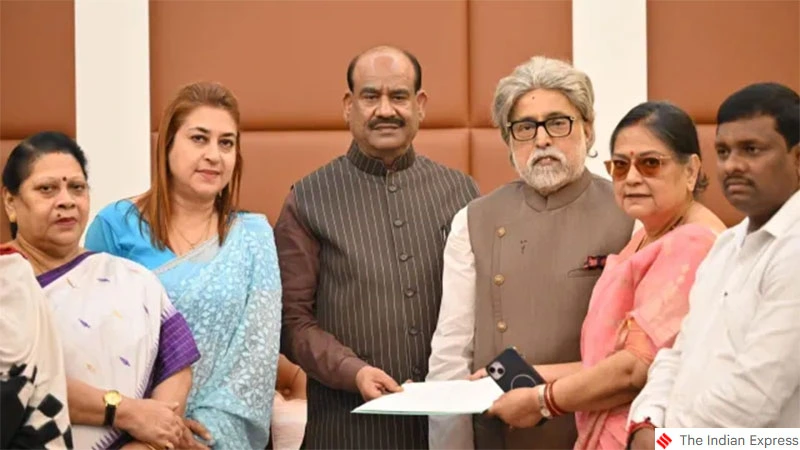
There is an interesting example of this continuing political drama. The NCPI MPs have reportedly sought more time from the Speaker to explain their position.
Did the Voter Elect the MLA or the Party?
This question becomes particularly important when a politician changes parties soon after winning an election. A candidate may be personally popular, but the party symbol is also part of the electoral contest. Some voters may be influenced mainly by the candidate, while others may be voting largely for the party. For many, both may matter.
So it would be too simplistic to say that every voter gives the same kind of mandate. But it is equally difficult to pretend that the party has no role at all.
When an elected representative changes sides, the political question therefore remains. The politician can explain the decision. The voter can decide whether that explanation makes sense.
The Political Mirror and the Defection Game
Now comes the part that perhaps deserves a little more attention.
But there is one thing that every party switcher should perhaps avoid looking at too closely — the mirror. Just as a dog bite can cause rabies, perhaps this particular variety of political horse-trading causes another problem — mirror-phobia.
The cure is quite simple: remove the mirror from the house.
Why look at yourself when you can explain that you left the old party because there was no democracy, no respect, no opportunity to work and no match of ideals? Why examine your own political journey when the new party has suddenly become the home of development, democracy and a bright future?
This is where political explanations sometimes become almost theatrical. Yesterday, the old party may have been described as the only force capable of saving democracy. Today, the same organisation can suddenly be portrayed as undemocratic, corrupt or incapable of delivering development. Yesterday, its symbol was good enough to seek votes. Today, the politician standing under another symbol may explain why the old one had become unacceptable.
The mirror, therefore, becomes a rather inconvenient object.
It may ask questions that a press conference does not. Why did you join the old party in the first place? Why did you accept its ticket? Why did you campaign under its symbol? When exactly did your principles change? And if the problems were already there, why did you discover them only after the election?
Of course, not every politician who changes parties deserves such questions. Sometimes political circumstances genuinely change. Sometimes internal disputes become unbearable. Sometimes a politician may genuinely believe that another political platform is better suited to serving the constituency.
But when every defection is wrapped in the same language of public service and development, a little mirror-gazing would not hurt.
Perhaps that is why the mirror is so dangerous in politics. It does not care which party flag you are carrying. It simply shows who is standing in front of it.
Horse-Trading in Politics: The Question That Remains
Gaya Lal may have started the “Aaya Ram, Gaya Ram” chapter of Indian politics, but the business has travelled a long way since then. The language has become more sophisticated, the legal calculations have become more complicated and the explanations have become much more polished.
Still the basic question has not changed. When an elected representative changes sides, what happens to the trust of the voter who elected that person?
A new party flag can be arranged, a new slogan can be written, and a press conference can explain everything. Even a legal argument can be prepared. But the voter still remembers the symbol on which the vote was cast.
And perhaps that is the one thing in this entire horse-trading business that politicians cannot so easily buy or sell.
10 Key Takeaways on Horse-Trading in Politics
- Horse-Trading in Politics has become a familiar part of political calculations, particularly when parties are trying to protect or increase their numbers.
- The phrase “Aaya Ram, Gaya Ram” dates back to Haryana MLA Gaya Lal and his repeated party switching in 1967.
- India introduced the Anti-Defection Law in 1985 to discourage elected representatives from changing parties and destabilising governments.
- The present defection rules make the two-thirds figure important when legislators seek protection through a recognised merger.
- Development, ideology, internal democracy and constituency interests are among the reasons politicians give when explaining a party switch.
- Political allegations about money, pressure or inducements should not be treated as established facts without supporting evidence, even when horse-trading is alleged.
- The 1999 Vajpayee confidence vote showed how one vote can matter when the numbers in a government become extremely tight.
- Frequent defections can change the balance between the government and the opposition, making legislative scrutiny and political debate an important part of the discussion.
- When an elected MLA changes parties, the uncomfortable question remains: did voters choose only the individual, or did the party and its symbol also influence their mandate?
- Perhaps the biggest problem for a party switcher is the political mirror — because changing the party flag is easy, but explaining the journey to the voters can be much harder.