ECI vs Opposition: Democracy Under Attack?
Oct 13, 2026 - By Ashutosh Roy PoliticsElection AnalysisNational NewsNational Politics
ECI vs Opposition: Is Democracy Under Threat?
Aren’t you completely exhausted by this endless cycle of political theater between the ECI vs opposition playing out on the streets of Delhi?
Watching this ongoing, endless tug-of-war between the Election Commission and the opposition brings back vivid memories of international cricket in the old days. Back then, host countries used to appoint their own local umpires. Whenever a controversial decision went against a visiting team, it inevitably triggered massive outrage on the field. Captains argued, media outlets dissected every frame, and fans openly questioned the referee’s honesty.
Over time, cricket realized that the integrity of the game depended on having neutral umpires. Today, cricket has successfully moved past that credibility crisis. But in Indian politics, serious questions are once again hovering around our electoral “umpires”.
To be entirely fair, allegations of partiality against Election Commissioners are nothing new in Indian history. Plenty of chief commissioners and poll officers have faced sharp accusations of political bias from aggrieved opposition parties in past decades. Institutional tension inside Nirvachan Sadan has always flared up during heated elections.
In recent memory, senior officials like Ashok Lavasa and Arun Goel even resigned from the Election Commission altogether before completing their full tenures. Reports at the time strongly suggested that Lavasa had voiced formal dissent over how Model Code of Conduct violations were being handled. So, administrative friction inside the poll panel is certainly not unprecedented.
However, even though claims of partiality against the Election Commission have existed before, the current situation has reached an unprecedented, extreme level.
The biggest trigger behind this explosion is the sudden, large-scale exclusion of genuine voters’ names from the electoral rolls across several states.
The second major factor turning this into a firestorm is the active intervention of youth-led political satire movements like CJP (Cockroach Janata Party, founded by Abhijit Dipke following the Supreme Court’s controversial remarks comparing youth activists to cockroaches), which brilliantly mobilized public defiance. The CJP Protest has already forced the Government bow down in Dharmendra Pradhan Case.
The third catalyst is, without doubt, social media, where pictures of deleted receipts, portal errors, and public outrage circulate within minutes.
But towering above all these factors is the explosive investigative report published by The Indian Express, which brought the sharp internal disagreement between the sitting Election Commissioners straight out into the open. That revelation acted as a major turning point in the intensifying ECI-versus-opposition battle.
Gyanesh Kumar Episode
Following those revelations, the official press release issued by Chief Election Commissioner Gyanesh Kumar—or the Election Commission as a body—became even more significant. Rather than offering a clear, reassuring clarification that could soothe public anxiety, the panel essentially declared that “this is how things will be done from now on”. That rigid stance only added fuel to the fire, convincing opposition leaders that the commission had no intention of reviewing its unilateral choices.
Amidst these growing tensions, YouTuber Dhruv Rathee held a press conference detailing the tense ground situation and describing the heavy-handed police actions against activists.
Protests on the Streets, Arrests, and the Legal Clashes
In the initial phase of this movement, top Congress leaders like Rahul Gandhi and Priyanka Gandhi were leading street rallies, press conferences, and public marches alongside other opposition figures. To an outside observer, there was perhaps a small touch of political drama to those early demonstrations, as parties tried to gain political optics. But the moment tech-savvy youth networks like CJP stepped onto the field with viral momentum and sharp counter-narratives, the entire dynamic of the protest shifted.
The aggressive street mobilization and subsequent heavy-handed police crackdowns in Delhi have raised serious eyebrows among civil rights observers.
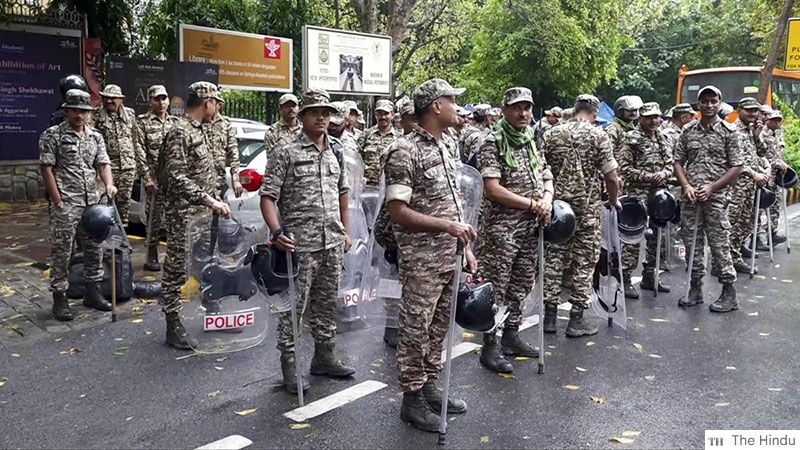
On the 10th, national capital Delhi was turned into a virtual fortress by security personnel, who deployed heavy barricades to block marching protesters, leading to a massive wave of detentions and arrests. Seasoned constitutional experts and senior lawyers like Kapil Sibal came forward to declare these police detentions completely illegal.
Of course, one must keep in mind that Kapil Sibal is politically aligned with the opposition, but his legal argument carried significant weight. Simultaneously, senior leader Abhishek Manu Singhvi stepped forward, firing sharp legal and political criticisms at the administration’s high-handed response.
During these intense street protests, whenever national media reporters from outlets like India Today pressed Congress leader Sachin Pilot with questions about whether this whole push was merely an attempt at a Congress party revival, Pilot consistently brushed aside the narrow political framing. Instead, he repeatedly emphasized that this was not about electoral revival at all, but about a much larger constitutional issue—that democracy itself was under severe attack.
The controversy soon spread across state borders, with political developments in West Bengal being brought directly into the debate as well.
How Can ECI vs Opposition Turn to ECI & Opposition?
Taking a bird’s-eye view of the entire scene, the Election Commission and the opposition now stand at completely opposite poles. Their relationship has broken down to a point where it is almost impossible to imagine them sitting down for constructive, amicable dialogue anytime soon.
The opposition has now consolidated its stance into a firm, single-point demand: the immediate resignation of Chief Election Commissioner Gyanesh Kumar. Rahul Gandhi took things a step further by pointing his finger directly at those who appointed Gyanesh Kumar in the first place—meaning the top executive leadership of Prime Minister Modi and Home Minister Shah.
Institutional Integrity and the Core Problem of Governance
Yet, beyond the noisy political speeches and street battles, we must keep one basic truth in mind: the true independence, fairness, or bias of any autonomous constitutional body depends fundamentally on the character and actions of the people running it. If the individuals placed at the helm fail to act with strict neutrality, no institution—no matter how grand its history or constitutional backing—can preserve its integrity.
History reminds us that even during periods like the Emergency, executive pressure tested our institutions. We should not forget that the authority that appointed Gyanesh Kumar is the exact same authority that appointed fellow commissioners Sandhu and Joshi, with all three officers entering Nirvachan Sadan under the provisions of the exact same newly passed appointment law.
Therefore, the core debate here goes far beyond abstract concepts of statutory independence or routine administrative friction. The vital question that demands an answer is this: why did Gyanesh Kumar proceed with unilateral decision-making on critical policy matters, and why didn’t the other two commissioners voice their objections far more forcefully right from the start?
Reports revealed that as many as 14 formal objections were logged over a 10-month period. Ten months is a remarkably long time in politics, during which crucial assembly elections were conducted across multiple states. What happens to the constitutional legitimacy of those completed elections is a troubling question that the Supreme Court will inevitably have to grapple with.
In his recent video, “Is the Supreme Court Under Pressure?”, veteran political journalist Suman Chattopadhyay touches upon senior lawyer Gopal Sankaranarayanan’s submissions regarding police overreach.
His analysis points to a far more concerning question: if autonomous constitutional institutions fail to deliver accountability to the public, what recourse do citizens actually have left?
The Form 6 Impasse and Finding a Practical Way Out
For the time being, the heated controversy surrounding modifications to Form 6—the application meant for registering voters—seems to have been pushed onto the back burner. Nevertheless, the Election Commission will still have to convince and satisfy the Supreme Court that its voter registration processes and software updates strictly adhere to the law.
While the poll body’s decision to launch a special registration drive for left-out voters is certainly a welcome step, one cannot help but ask: hasn’t this corrective measure come far too late for thousands who were already left out?
Looking at the bigger picture, my view is that the central government and the Election Commission should immediately initiate formal talks with the opposition. Common sense dictates that you cannot hold a meaningful, structured discussion with a chaotic crowd of 300 people in one room.
A practical approach would be to invite a small, organized delegation of around 10 key opposition representatives—very much like the representative group that recently marched to Rashtrapati Bhavan to submit their memorandum.
In the end, street politics and mass rallies can certainly yield short-term political optics and dominant news headlines. But when the credibility of our democratic process is on the line, street optics are not enough. All political stakeholders, the government, and the poll panel must urgently come together at the negotiating table to find a lasting, transparent solution that protects every single citizen’s right to vote.
10 Key Takeaways: ECI vs Opposition Standoff
- The ongoing clash between the poll panel and political parties brings back memories of cricket’s old era before neutral umpires were introduced.
- While past poll panels faced bias allegations, the current crisis surrounding the Election Commission has reached an unprecedented peak.
- Mass voter roll deletions, active Gen-Z civil mobilization by CJP (Cockroach Janata Party), and viral social media posts acted as primary triggers for this outrage.
- A landmark investigative report published by The Indian Express brought deep internal rifts between sitting commissioners into the public domain.
- Protests escalated rapidly after police deployed heavy barricades, leading to widespread detentions across Delhi on the 10th.
- Opposition leaders like Rahul Gandhi and Priyanka Gandhi spearheaded street demonstrations, demanding the immediate resignation of Chief Election Commissioner Gyanesh Kumar.
- Legal experts including Kapil Sibal and Abhishek Manu Singhvi challenged the crackdown, declaring the administrative detentions completely illegal.
- In an interview with India Today, Sachin Pilot stressed that the core issue was not a Congress party revival, but that democracy itself was under attack.
- Reports revealed that as many as 14 formal objections were raised internally over a 10-month period, raising serious questions for the Supreme Court.
- To resolve this crisis, the government and the ECI must urgently hold structured talks with a small delegation of around 10 opposition representatives.
Frequently Asked Questions (FAQ)
1. What is the core issue behind the ECI vs Opposition conflict?
The conflict centers on allegations of bias and unilateral decision-making by the Election Commission of India (ECI). Key drivers include the large-scale deletion of eligible voters from electoral rolls, controversial software updates to Form 6 registration, and reports of internal dissent among Election Commissioners that were kept from the public. The ECI vs Opposition row has made the oppositions united and brought CJP on the street.
2. Who is CJP and what role do they play in this controversy?
CJP stands for Citizens for Justice and Peace, a human rights and civil society organization. CJP intervened by gathering ground-level data on mass voter deletions, assisting disenfranchised voters, and bringing legal petitions forward to challenge administrative errors in the electoral rolls.
3. Why are opposition parties demanding Chief Election Commissioner Gyanesh Kumar’s resignation?
Opposition leaders allege that Chief Election Commissioner Gyanesh Kumar acted unilaterally on critical administrative decisions, bypassing consultations with fellow commissioners. Reports indicating 14 internal objections over a 10-month period led the opposition to claim the commission’s neutrality has been compromised under his leadership.
4. Why are the resignations of Ashok Lavasa and Arun Goel significant?
Ashok Lavasa resigned in 2020 after dissenting against clean chits granted for Model Code of Conduct violations during the 2019 general elections. Arun Goel abruptly resigned in March 2024 right before national elections. These high-profile exits highlighted growing concerns about internal consensus being suppressed inside the poll body. When will this ECI vs Opposition drama end?
5. What is the Form 6 controversy about?
Form 6 is the application used by new voters to get onto the electoral rolls. The controversy arose when additional verification requirements and digital hurdles were introduced onto the portal without transparent public consultation, making it difficult for young, mobile, and marginalized citizens to enroll.
6. What role is the Supreme Court expected to play in this standoff?
The Supreme Court is scrutinizing petitions regarding voter deletions and internal commission procedures. The court must evaluate whether administrative directives violated constitutional mandates or led to illegal voter disenfranchisement, and determine what corrective measures the ECI must implement.
7. How can the government and the ECI resolve this institutional crisis?
Rather than relying on street protests or police blockades, the government and ECI should hold structured talks with a small, representative opposition delegation (similar to the 10-member group sent to Rashtrapati Bhavan) to establish transparent voter roll verification, log internal commission votes publicly, and restore neutral oversight.