Abhishek Attack: The Ultimate Warning?
May 31, 2026 - By Ashutosh Roy Current AffairsElection AnalysisGovernancePoliticsRegional UpdatesWest Bengal Politics
Abhishek Attack: The Warning or Revenge?
Was the recent Abhishek attack in Sonarpur a final warning, or was it a sudden burst of public anger? This question is now fueling intense West Bengal political showdowns. As citizens who value democracy, we cannot support public rage. We must never agree with people taking the law into their own hands.
Leaders like Sukanta Majumdar, Shamik Bhattacharya from the opposition party, BJP also condemned this act. Surprisingly, this marks a big shift in Bengal politics.
In the past, when opposition leaders faced attacks, ruling party spokespersons always called it “spontaneous public anger”. According to reports on the The Hindu, the incident occurred while he was visiting the family of a deceased party worker.
Major Opposition Attack Incidents in West Bengal (2021-2026
| Year | Incident / Event | Location | Target / Victims | Brief Description |
|---|---|---|---|---|
| 2021 | Post-Assembly Election Violence | Multiple districts | BJP, CPI(M) workers | Widespread violence after election results; dozens killed, houses vandalised (widely reported pattern) (NewsBytes) |
| 2022 | Birbhum (Bogtui) Massacre | Birbhum | Local political families | 10 people killed after a political murder triggered revenge arson (www.ndtv.com) |
| 2022 | Civic Poll Violence | Kolkata & districts | Opposition candidates & journalists | Booth capturing, attacks on candidates, and journalists assaulted during municipal polls (VSK Telangana) |
| 2023 | Panchayat Election Violence | Statewide | Multiple parties (BJP, TMC, others) | Over 40 deaths reported during rural polls; clashes across districts (NewsBytes) |
| 2023 | Pre-Poll Killings & Clashes | Malda & others | TMC & Opposition workers | At least 10 killed during nomination phase violence (Scroll.in) |
| 2024 | Election-related Clashes | Various districts | Political workers | Several deaths (5–6) linked to political clashes during elections (NewsBytes) |
| 2025 | Attack on Suvendu Adhikari Convoy | South 24 Parganas | BJP Leader of Opposition | Convoy vandalised; BJP workers attacked; statewide protests followed (The Economic Times) |
| 2025 | Political Murder (TMC worker) | Murshidabad | TMC activist | Worker hacked to death; family alleged political rivalry (The Times of India) |
| 2026 | Killing of BJP Leader’s Aide (Chandranath Rath) | North 24 Parganas | BJP associate | Shot dead after election results; major political flashpoint (www.ndtv.com) |
| 2026 | Post-Poll Violence (Assembly Election) | Multiple districts | BJP & TMC workers | Killings, arson, and intimidation reported after results (The Guardian) |
Did outsiders plan the Abhishek Banerjee attacked in Sonarpur?
Abhishek Banerjee claimed that outsiders came to Sonarpur to target him. However, the local residents completely rejected this claim. Instead, the ground reality of this political flashpoint tells a different story.
The Trinamool leader visited the area because a party supporter named Sanju died. But local residents had serious complaints against Sanju.
- Local allegations: Residents claimed Sanju was a local criminal.
- The real issue: Locals wanted answers about the terrible condition of their roads.
- The trigger: Abhishek reportedly answered them with heavy arrogance, which made the public furious.
What do the videos reveal about the Sonarpur incident?
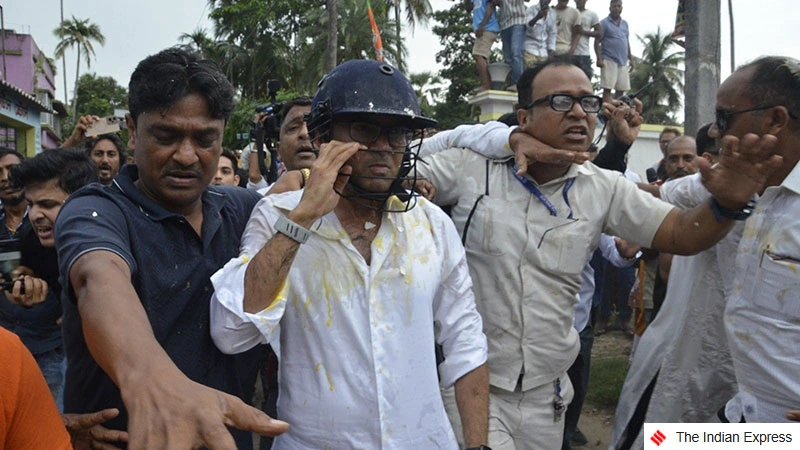
Since we were not present at the spot, we must rely on video evidence. Viral videos of the assault on the TMC MP show a chaotic scene:
- A shirt with open buttons and torn clothes.
- Broken eggs and mud smashed on the body.
- A face without its usual spectacles.
As detailed by The Indian Express, the leader had to wear a helmet to protect himself from the mob. It is hard to tell how much of this is real and how much is exaggerated.
Nevertheless, the police have already conducted overnight raids and arrested a few individuals.
Was the Sonarpur political violence a Public Explosion or a Final Warning?
People always disliked the arrogance and pride of the Trinamool leader. In addition, the public hated his aggressive, bully-like statements. The recent Sonarpur political violence has completely changed the conversation around his political dominance in the region.
Previously, he won the Diamond Harbour seat by over 7 lakh votes. However, his political grip is slipping fast. For instance, he did not even dare to campaign for Jahangir Khan, the main brain behind his famous “Diamond Harbour Model“.
During the recent repoll, Jahangir Khan suddenly withdrew from the race just 48 hours before the voting began. When the results came out, he even lost his electoral deposit.
Why do experts compare this to historical downfalls?
Political analyst Biswanath Chakraborty shared a sharp perspective on this incident. He compared this sudden rise of public rage to the tragic downfall of historic rulers like Siraj-ud-Daulah. He explicitly warned that medieval-style governance has no place in modern democracy.
However, the analyst also highlighted a crucial reality check.
He reminded the public of past violence directed at opposition figures like JP Nadda, Suvendu Adhikari, Dilip Ghosh, and Sukanta Majumdar.
Even Election Commission observers faced hostile environments in the past. Essentially, many see this violent shift as a case of being paid back in the same coin.
What violent remarks triggered public anger?
The Trinamool leader frequently used highly aggressive language to target his political opponents. Over the months, several controversial statements added fuel to the fire:
- The Falta Threat: He openly claimed that he would build an electric crematorium in Falta to cremate opposition leaders who suffer heart attacks after the election results on the 4th.
- The Arambagh warning: He openly declared a mission of political revenge right after midday.
- The Amit Shah challenge: He aggressively challenged Union Home Minister Amit Shah during state rallies.
- The DJ music threat: He continuously threatened opponents with loud DJ music celebrations to mock their defeats.
These actions systematically denied any democratic space to the opposition. Yet, during a late-night press interaction at 11 PM, the leader Mamata Banerjee suddenly began talking about the high values of democracy.
She even alleged that higher authorities pressured the hospital to deny him proper medical treatment. Unfortunately, Abhishek Banerjee could not master the art of political theatrics of hospitalization drama from his predecessor.
Rather, BJP leader Debjit Sarkar alleged that Mamata Banerjee tried to pressurize the hospital authorities to admit her nephew
On the other hand, Abhishek Banerjee has gone up to the extent of saying, “State-Sponsored Terrorism“, perhaps notwithstanding the true gravity of the word.
Many citizens quickly pointed out his hypocrisy. They asked why this respect for health systems and democracy did not awaken during the high-profile R G Kar Hospital protests.
Ultimately, a deep fear remains among the public. If the ruling party had gained absolute power, the brutal post-poll violence of 2021 could have easily multiplied ten times over.
Is the Sonarpur incident a True Test of Political Leadership?
Senior journalist Suman Chattopadhyay shared a unique analysis on this situation. He claimed that the recent Abhishek Banerjee attacked in Sonarpur gives the Trinamool leader a golden opportunity to prove himself as a true leader. However, a deeper look into Bengal politics reveals why many citizens strongly disagree with this view.
True political leadership is an inborn quality. A leader does not earn respect merely by stepping out of a helicopter as a royal family member. Winning a Lok Sabha seat by using police forces, state administration, and local musclemen does not build genuine authority.
If he were a real grassroots leader, he would not travel with an enormous fleet of police security. He would not spend massive resources on luxurious political camps. Instead, he would live directly among the common people.
Why did the Diamond Harbour model collapse?
The highly publicized “Diamond Harbour model collapse” is a signal of end of an era and fear politics. The sudden downslide of the ruling party’s strongmen shows how fast public support is fading.
- The Jahangir Khan surrender: Jahangir Khan was the chief architect of the Diamond Harbour model. Yet, the top leader lacked the courage to campaign for him during the crucial Falta repoll.
- The sudden retreat: Facing immense public anger, Jahangir Khan completely withdrew from the electoral contest just 48 hours before the voting began.
- The historic defeat: When the election results came out, the ruling party candidate miserably lost his security deposit.
Was the public rage in Sonarpur spontaneous?
Rather than an organized conspiracy, the recent confrontation looks like a spontaneous explosion of public anger. People reacted after suffering under years of local corruption and heavy administrative oppression.
The public anger did not target a single person; it targeted a system of corruption. For instance, local residents alleged that Sanju, a controversial party worker, actively extorted money from poor villagers by promising them drinking water lines.
This public rejection is not entirely new for the ruling camp. Even the former Chief Minister Mamata Banerjee previously faced intense “chor-chor” (thief) slogans directly inside the High Court premises.
However, looking at the security breakdown, the state police department should have remained highly alert. The Abhishek attack took place immediately after the authorities scaled down his excessive security cover. The local police failed to assess the rising ground-level public anger.
Will the Sonarpur political violence End the Reign of Fear in Bengal?
The current political reality proves an old truth: time changes for everyone, and absolute power never lasts forever. The recent Diamond Harbour model collapse strongly signals that the era of uncontested ruling power is drawing to a close. Citizens are finally demanding a strict accounting for years of unchecked corruption and institutional decay.
As a result, a new wave of hope is rising across the state. Common people no longer tremble in fear before ruling party musclemen. Instead, angry citizens are directly confronting local political bosses in various neighborhoods.
Today, the public respects the rule of law, but they deeply distrust the partisan state administration.
Is democracy returning to the grassroots?
The shifting ground reality shows that citizens are desperate for a massive political cleanup. The public wants a peaceful state governed by fairness rather than intimidation.
- End of intimidation: Villagers and urban residents are openly standing up against local extortion networks.
- Demand for justice: The public expects the legal system to punish corrupt officials and public trust.
- Desire for peace: Above all, ordinary families want a return to democratic normalcy ahead of the crucial 2026 West Bengal assembly elections.
According to latest updates on Anandabazar Patrika, the political temperature remains highly volatile as communities demand safer neighborhoods. Every citizen hopes that true peace and constitutional governance will permanently return to West Bengal.
10 Key Takeaways:
- The Incident: Yesterday, a sudden and violent Abhishek attack shook the town of Sonarpur during a political visit.
- Public Reaction: Consequently, citizens are debating whether this clash represents a final warning or a spontaneous burst of public anger.
- Democratic Values: Clearly, democracy-loving citizens and opposition leaders completely condemn people taking the law into their own hands.
- Political Shift: Interestingly, this incident marks a major shift in Bengal politics because the ruling party usually blames such events on “public rage”.
- Local Denials: Meanwhile, local residents firmly rejected claims that outside political workers planned and executed the targeted assault.
- The Root Cause: Specifically, furious locals confronted a controversial party worker named Sanju over corrupted road conditions and heavy arrogance.
- Slipping Control: Moreover, the ruling party’s political grip is weakening fast, as seen by their candidate’s recent electoral surrender in Falta.
- Past Hypocrisy: For context, critics quickly contrasted the leader’s sudden plea for democratic values with his own past aggressive threats against opposition figures.
- Security Failure: Unquestionably, local police forces failed to maintain proper vigilance right after the administration scaled down the leader’s excessive security cover.
- Future Fears: Ultimately, ordinary citizens deeply fear that unchecked political intimidation could easily multiply the state’s post-poll violence ten times over.
[…]Abhishek Attack: The Ultimate Warning? Following the Abhishek attack, is public fury over corruption a natural retaliation or a calculated political stunt? Discover who gains the ultimate mileage.[…]
[…]Abhishek Attack: The Ultimate Warning? Following the Abhishek attack, is public fury over corruption a natural retaliation or a calculated political stunt? Discover who gains the ultimate mileage.[…]