Kolkata Durga Puja Stampede 2026: 19 Dead
Oct 18, 2026 - By Ashutosh Roy SocietyCurrent AffairsPoliticsRegional Updates
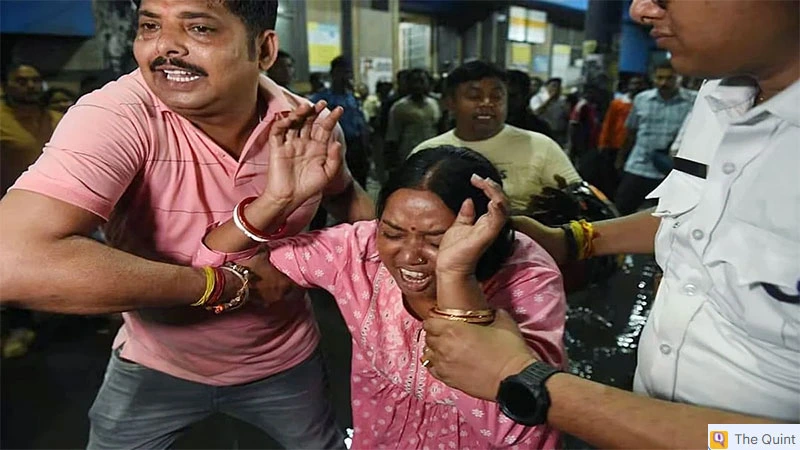
How Political Hegemony and Neglect Led to the Kolkata Durga Puja Stampede 2026
Durga Puja in West Bengal has historically been a celebration that transcends religion, serving as an unmatched cultural confluence. For decades, the streets of Kolkata turned into an open-air art gallery during Autumn.
Millions walked through narrow city lanes, marveling at the craftsmanship of pandals, listening to the rhythmic beat of the dhak, and partaking in community feasts.
However, on Maha Saptami evening, October 17, 2026, the festive grandeur collapsed into horror at the Chorbagan Sarbojanin Durga Puja pandal in North Kolkata.
Read full coverage on the Hindustan Times Kolkata Stampede Live Updates.
A sudden downpour triggered panic, and inside the narrow approach roads off Chittaranjan Avenue, a deadly crowd crush ensued. At least 19 lives were lost, and over 25 people were left injured. What was supposed to be an evening of divine worship and joyful togetherness turned into an agonizing scene of scattered footwear, crushed barriers, and frantic cries for help.
As news of the Kolkata Durga Puja Stampede 2026 spread across the nation, state authorities scrambled to issue ex-gratia compensation and initiate probes. Still, for citizens observing the socio-political trajectory of West Bengal in recent years, this disaster was not merely an unfortunate act of weather or bad luck.
It was the direct, predictable outcome of a government and state apparatus that spent months focusing on political engineering, ideological polarization, and suppressing dissent while leaving basic pandal crowd management and public safety completely unmanaged.
We must mention that a record win in Nandigram may make Suvendu Adhikari happy, but that does not ensure good governance. Rather, such a historic win demands high-level responsibility and administrative accountability.
Core Breakdown and Critical Highlights of the Incident
- The tragedy on Maha Saptami evening at the Chorbagan Sarbojanin pandal resulted in at least 19 fatalities and left more than 25 worshippers injured.
- Heavy rainfall forced thousands to seek sudden shelter, creating a massive crowd surge down narrow approach lanes off Chittaranjan Avenue.
- Misleading announcements over the public address system regarding a potential structure failure triggered widespread panic among visitors trapped near exit pathways.
- Authorities registered a criminal case under Section 105 of the BNS, quickly placing seven key organizers and security heads under arrest.
- The government announced ₹25 lakh ex-gratia compensation alongside government job offers for the immediate family of each deceased victim.
- Intense political sparring erupted over committee control, highlighting how local club ownership shifts impacted ground governance.
- Reports surfaced drawing sharp contrasts between extensive political campaigns and the neglect of basic civic safety and free expression, such as bookstall attacks.
- Citizens and opposition leaders demanded a tight, court-monitored probe to prevent procedural loopholes like those seen in previous high-profile cases.
- Kolkata Police sealed the site and clamped prohibitory orders under Section 163 of BNSS around the immediate vicinity.
- The calamity underscores an urgent requirement for mandatory, independent audits focusing on human life over decorative themes.
The Politics of Distraction: Ideological Theatre over Administrative Duty
In the months leading up to Durga Puja 2026, the state government appeared absorbed in ideological displays and political theater rather than the rigorous logistical planning required for managing millions of pandal-hoppers.
Read official casualty figures from The New Indian Express Report.
1. Attacks on Dissent: The CPI(M) Bookstall Intimidation
For decades, political parties—most notably the Left—have set up bookstalls outside Durga Puja pandals across Bengal. These stalls were a traditional fixture of the festival, offering literature, socio-economic commentary, and critical political text to passersby.
In recent times, these stalls faced unprecedented violence and vandalism. Reports across local news outlets highlighted how goons systematically targeted, attacked, and ransacked CPI(M) bookstalls.
Instead of upholding democratic space and ensuring police protection for constitutional free speech, state agencies turned a blind eye. The message was clear: no platform for dissent would be permitted, even during a festival rooted in inclusivity.
2. Symbolic Politics and “Ramdhanu” Rainbow Branding
While critical public safety infrastructure languished, the government directed vast administrative energy toward cosmetic symbolic projects. Public thoroughfares and dividers were systematically repainted in “Ramdhanu” (rainbow) colors and specific party-aligned palettes as part of high-decibel beautification drives.
Millions of public funds were poured into surface-level paint jobs, superficial light installations, and political branding exercises across major thoroughfares. While the streets glowed with decorative light displays, basic emergency exit routes, narrow alleyway traffic assessments, and structural safety audits for high-density pandals were treated as secondary paperwork.
3. Opposition Splitting and Political Hegemony
Behind the scenes, the state machinery remained obsessed with engineering defections, breaking opposition blocs, and securing total political control over civic boards and local clubs. The drive to engineer political splits and absorb local leadership consumed the daily bandwidth of political leaders and administrative handlers alike.
When state focus is monopolized by realpolitik and consolidation of power, the unglamorous work of governance—civic planning, police deployment drills, medical emergency readiness, and Kolkata disaster management—inevitably falls apart.
4. The Aggressive Push to Spread Hindutva
Alongside political maneuvers was a concerted effort to impose a rigid, aggressive brand of Hindutva politics onto the cultural ecosystem of Bengal. Durga Puja, historically a secular, artistic celebration organized by neighborhood committees of all faiths and views, became an arena for ideological flag-waving and aggressive polarization. Sloganeering, political signaling, and territorial dominance took precedence over community service and public welfare.
The Forcible Takeover of Puja Committees: Regime Shift Dynamics
The tragedy at Chorbagan Sarbojanin cannot be separated from the systemic shift in how Durga Puja committees are run across Kolkata. Following recent shifts in the political landscape, news reports and local reporting revealed a disturbing trend: traditional, neighborhood-run club committees were being forcibly taken over by political figures tied to the ruling establishment.
Historically, community pujas were managed by local seniors, cultural activists, and youth volunteers who knew the geography of their neighborhoods inside out. However, under the new regime, control of major budget pujas—which draw massive crowds and corporate sponsorships—became political trophies.
In the case of Chorbagan, reports indicated that political functionaries, including local legislative members and politically connected individuals, assumed dominant positions on the organizing committee. When club ownership is seized by force or political muscle rather than organic community representation, administrative accountability vanishes.
- Loss of Ground Expertise: Experienced local organizers who understood crowd flow in narrow lanes were pushed aside in favor of political appointees.
- Commercial and Political Posturing: Priorities shifted from visitor safety to grandstanding, high-profile VIP visits, and commercial display.
- Reliance on Inexperienced Private Security: Rather than coordinating closely with Kolkata Police for professional crowd management, committees relied heavily on untrained private security guards and inexperienced volunteers who panicked under pressure.
It is truly shocking that if a 20 or 22-year-old young woman could foresee that the entrance gate of the Chorbagan Durga Puja pandal could trigger a stampede, why couldn’t our state police department, administration, or the high-profile organizers of the puja committee understand it? While this young girl had the foresight to publish a reel warning about the impending hazard, our top officials completely failed to grasp the situation.
You can watch senior journalist Suman Chattopadhyay’s video, where he explicitly references this viral Facebook reel and the administrative failure.
In this context, another critical point must be raised. Durga Puja is celebrated as a universal, community festival open to all. Commercialization has its place, but why should there be a separate VIP gate? If that narrow entrance pathway at Chorbagan had not been blocked by an exclusive VIP gate, the catastrophic Kolkata Durga Puja Stampede 2026 could have likely been averted! I urge the puja organizers and the city administration to seriously reflect on this issue.
When heavy rain lashed North Kolkata on Maha Saptami evening, this structural incompetence proved fatal. Misleading announcements blared through the public address system, warning of structural collapses and triggering immediate mass panic in a congested lane. With entry and exit gates choked, 19 innocent people paid with their lives for the vanity and negligence of a politically hijacked committee.
Watch media reports on NDTV Video Coverage of Kolkata Stampede.
The Anatomy of Failure: Investigative Reports and Ground Truths
Investigative reports and ground accounts published following the tragedy revealed a series of critical lapses.
Catastrophic infrastructure bottlenecks severely constrained movement; the Chorbagan pandal was erected in a tight residential lane off Chittaranjan Avenue where the entrance and exit pathways were shockingly narrow despite expecting hundreds of thousands of visitors.
An absence of professional police control left the venue vulnerable, as eyewitnesses reported little to no active Kolkata Police presence on the ground to regulate crowd density prior to the surge, leaving traffic and crowd management almost entirely to private security personnel.
Misleading public announcements compounded the danger—instead of calming the crowd during the downpour, panic-inducing messages broadcast over the pandal loudspeakers instructed people to rush out immediately, causing a fatal bottleneck at the exit steps.
To examine breaking news reporting and live coverage regarding the incident, check analytical updates on Times of India Coverage on Chorbagan Tragedy.
The Shadow of R G Kar: Why the Public Demands Real Transparency
The outrage following the Chorbagan stampede is amplified by a deep, systemic distrust in the state’s investigative and judicial process. The ghost of the notorious R G Kar Medical College episode hangs heavy over Bengal’s public consciousness.
We can see how the present ruling dispensation can allow an alleged top-ranking officer of Swasthya Bhaban to remain in power. Look at RG Kar Mystery: How Nigam Is Still in Power.
During the R G Kar tragedy, citizens witnessed a masterclass in institutional cover-ups, delayed procedural action, compromised evidence gathering, and deliberate investigative loopholes. The ultimate humiliation to justice occurred when key accused individuals walked out on bail – not because they were proven innocent, but because investigative agencies failed to submit a watertight charge sheet within the legally mandated timeframe.
The citizens of West Bengal refuse to let the Kolkata Durga Puja Stampede 2026 meet the same compromised fate.
We have seen this script play out far too many times:
- A high-profile tragedy occurs due to administrative failure.
- The government immediately announces monetary compensation (₹25 lakh for the deceased, jobs for kin) to quiet public anger.
- High-profile announcements of SIT probes and fact-finding committees are made for the cameras.
- A few low-level committee members, bamboo contractors, or security guards are arrested as scapegoats.
- Weeks pass, public attention fades, charge sheets are deliberately weakened or delayed, and those with political clout walk away completely unpunished.
This compromised playbook can no longer be tolerated. We demand strict accountability without legal loopholes.
Watch the live telecast of Chorbagan Sarbojanin, Kolkata Durga Puja Stampede 2026.
What We Demand: Judicial Probe, Punishment, and Systematic Reform
The 19 victims of the Chorbagan stampede were not mere statistics; they were sons, daughters, parents, and friends who stepped out to celebrate a festival and never returned home. Money cannot replace human life. Financial compensation without legal accountability is nothing short of blood money used to buy silence.
We should not let it wait for infinite time like the RG Kar case.
We put forward the following clear, non-negotiable demands to the West Bengal Administration, Kolkata Police, and Judicial Authorities:
1. A High-Court-Monitored Judicial Probe
The investigation must not be left to state police units that report to the very political bosses involved in puja committee management. The probe must be directly monitored by a sitting judge of the Calcutta High Court to ensure impartiality.
2. Strict Time-Bound Filing of Charge Sheets
Investigative authorities must be held legally accountable for filing comprehensive, loophole-free charge sheets within 60 days. There must be zero room for procedural delays that allow influential accused parties to secure automatic bail—as seen in the R G Kar case.
3. Punishment for the Real Offenders at the Top
Arresting minor contractors and hired security guards is an eyewash. Legal action under charges of culpable homicide must extend to the political patrons who took over the Chorbagan Puja committee by force, senior Kolkata Police officers responsible for approving unsafe blueprints, and civic authorities who issued safety clearance certificates.
4. Complete Public Transparency
All CCTV footage, emergency response logs, pandal structural approval documents, and police deployment rosters for the Chorbagan pandal must be made accessible to the public and the court. The public has a right to know who authorized crowd capacity limits and who failed to act when density reached critical levels.
5. Independent Audits for All Mega-Pujas
The state must establish an independent, non-political Commission for Public Event Safety. Every puja pandal expecting high footfalls must undergo mandatory, published safety audits covering exit capacities, emergency medical access, and professional crowd management standards. Decorative themes must never again take priority over human life.
We must remember that a few arrests will not help like the RG Kar notorious rape and murder incident. We want a complete, timely, transparent investigation and justice.
Knowledge Mart Final Thoughts
The tragic loss of 19 lives at the Chorbagan Sarbojanin pandal stands as a painful reminder that public safety must never be compromised for grandiosity, political maneuvering, or cosmetic optics. A cultural festival as grand as Durga Puja demands uncompromising administrative discipline, transparent governance, and rigorous crowd safety measures.
At Knowledge Mart, we firmly believe that monetary relief alone cannot substitute for accountability. We must remind that a mere warning may suit well in political theater, but can hardly yield any tangible result. The administration must ensure an impartial, time-bound judicial investigation, prosecute every negligent party regardless of political clout, and institute strict safety protocols so that human lives are never again sacrificed during Bengal’s biggest festival.