Rahul Gandhi Shines but Congress Trapped!
Sep 04, 2026 - By Ashutosh Roy PoliticsCurrent AffairsNational NewsNational PoliticsRegional UpdatesSocial IssuesWest Bengal Politics
Why Rahul Gandhi Shines in Current Opposition Politics
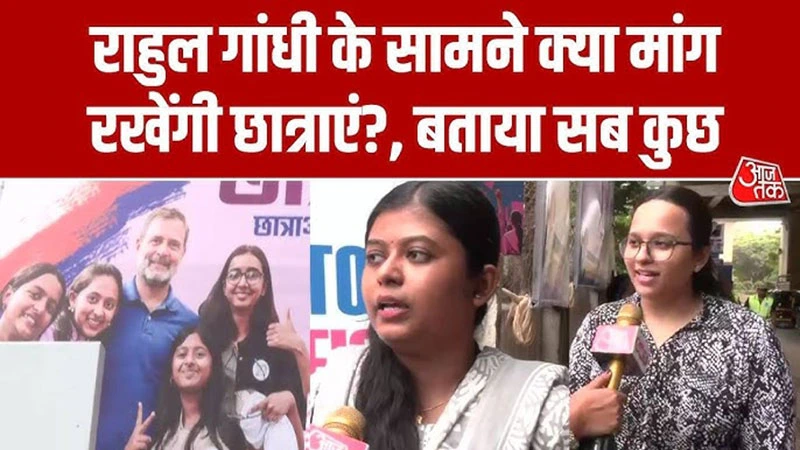
Rahul Gandhi Shines on the large banners spread across Pune, standing out amid the crowded streets, roadside tea stalls and the everyday chaos of city traffic. This was clearly evident at the Chhatron Ki Goonj student rally in Pune. Perhaps the Congress had devoted all its energy to make it a success.
The banners certainly attract attention. But the real political question starts after the publicity is over. Can the Congress organisation actually match the image Rahul Gandhi is creating? Or is the party still depending on an old organisational structure while facing a new generation of voters?
Forget the usual television studio arguments and carefully rehearsed political exchanges. The real test of Indian politics is what happens outside the cameras. And that is where Congress continues to face a serious problem. The party wants to project itself as a modern political force, but much of its organisational culture still belongs to another era.
Rajdeep Sardesai explains this gap nicely.
Is Rahul Gandhi Congress strategy: Just a Brand or Real Change?
Anyone passing through Maharashtra’s academic hub during the recent Chhatron Ki Goonj student rally could hardly miss the huge hoardings carrying Rahul Gandhi’s face. But those hoardings were not what made the event politically interesting. The real significance was visible on the stage.
Gandhi did something that is still unusual at Indian political rallies. Instead of speaking continuously for 45 minutes from a raised platform, he handed microphones to young women and listened to their problems.
The difference was obvious. Most political rallies follow a familiar script. A senior leader speaks, the crowd listens, promises are made, opponents are attacked and the event ends. The Pune gathering broke that pattern. After a short opening, students were given most of the space to speak for themselves.
That matters in a political system where senior politicians often dominate every public meeting. Young women studying law, media and public policy were able to discuss their own experiences, including prejudice, institutional problems and barriers in higher education. It was an attempt to create a new political dialogue in India, rather than another one-way political lecture.
For a younger audience used to seeing politicians through television screens and social media clips, the direct interaction had a different feel. There was less distance between the politician and the people in the room. Congress booth-level organisation can be charged up with this overwhelming response.
But this is where the larger political challenge begins. One successful meeting cannot repair a weak organisation. National politics demands much more than a good speech or an impressive interaction. It needs candidates, workers, local networks and an organisation that remains active long after the cameras have gone.
There is, however, one encouraging sign for Bengal Congress. The party has shown some signs of survival at the 21st July Martyrs’ Day programme and the Chatra Parishad Foundation Day. Whether this can turn into a genuine revival is another question. For now, at least, the party has shown that it is not completely out of the political picture. The leader could come out of ever-cherished Congress organisational problems and show the unity.
That sudden surge of nerve from the state Congress leadership would have been almost unthinkable while the TMC held firm control. It looks far more like a calculated move by the BJP to give secondary opposition groups enough breathing room to chip away at the TMC, their primary roadblock in West Bengal. In politics, after all, the enemy of your enemy is always useful territory.
Can Rahul Gandhi Turn Women Empowerment Into Political Capital?
The Pune event soon became controversial after Gandhi’s comments on traditional social codes drew national attention. Political opponents quickly jumped on his quotes about ancient texts such as the Manusmriti.
“A woman is not the property of her father, her husband, or her son. She belongs to nobody but herself”. – Rahul Gandhi in Pune
His opponents were quick to describe the remarks as an attack on tradition. But the political argument behind them was quite clear. Gandhi was talking about women empowerment in India and the right of women to define themselves independently of family relationships.
That message is bound to provoke a political response in a country where questions about tradition, patriarchy and individual freedom remain deeply contested.
It also explains why the speech travelled well beyond the Pune event and became part of a much wider online debate.
Notably, the BJP appears keen to bring the Women’s Reservation Bill to Parliament and get it passed. To do that, it needs the numbers, and the party seems ready to explore every possible political route to strengthen its position. The recent developments involving the TMC split and the AAP Rajya Sabha split could well be part of a larger strategy to move closer to the crucial two-thirds majority.
Critics may call these moves unethical. But in the end, parliamentary politics is also a game of numbers. There is an old saying that everything is fair in love and war. If politics is treated as a battlefield, perhaps political parties will always try to use every available advantage. Whether those methods are acceptable or not is something the people will ultimately decide.
For a government, the final judgement should not rest only on how it achieved its numbers. Voters will eventually look at what was delivered – the laws passed, the promises fulfilled and the tangible results on the ground. The methods may remain controversial, but the people will have the final word.
Why the Ideological Battle Runs Deep
Any challenge to traditional ideas about patriarchy is going to generate controversy. Gandhi’s argument was not simply about one ancient text. It raised a much broader question: should social customs inherited from previous generations continue to determine how women are expected to live today?
But there is another question that Congress cannot easily avoid.
If a political party speaks loudly about equality outside its organisation, people will naturally ask whether the same principles are visible inside it. That is where the Congress leadership faces a credibility test.
Structural Bottlenecks: Where Congress Remains Trapped
And this is where Congress faces its real problem. The message may sound modern, but the organisation often tells a different story.
While Rahul Gandhi Congress strategy becomes apparent when talking about progressive ideals, questioning patriarchy and demanding social change, the Congress organisation continues to carry many of the habits that have defined it for decades.
One does not have to look very far. Examine state committees, working groups or important campaign teams and the same established networks keep appearing. Congress talks about renewal, but its internal power structure often looks remarkably familiar.
Congress talks repeatedly about gender equality, younger leaders and organisational reform. Yet when one looks at who actually controls the organisation, the picture is not so different from the past.
The contradiction becomes sharper during elections. Candidate selection often brings caste calculations, local equations and personal loyalties back to the centre of the discussion. Progressive political language can quickly give way to old electoral arithmetic.
Gandhi’s own position also raises a difficult question. Why does Congress continue to revolve so heavily around one political family when Priyanka Gandhi carries the same political legacy as Indira Gandhi, one of India’s most powerful women leaders? That is at the core of Congress organisational problems.
The problem is not that Rahul Gandhi is the party’s public face. The problem is what happens when the organisation behind that face refuses to change.
A progressive speech can attract attention. It cannot hide an outdated structure forever.
Why Is Indian Politics Obsessed With Seniority?
The organisational problem is not limited to gender. India’s obsession with seniority is another major barrier.
Though Rahul Gandhi Shines when connecting with Gen-Z and university audiences, the political system around him still gives enormous weight to age.
In Indian politics, a politician in the late 40s or early 50s can still be introduced as a “young leader”. Someone below 35 is more likely to be asked to organise a rally or run a social media campaign than to help shape major policy.
Even politicians in their 40s can find themselves waiting for approval from leaders who have already spent several decades in politics. They are often called as “Promising Leaders”.
This is hardly unique to Congress. Across parties, younger leaders are often given responsibility without being given real power. Just glance at the CPI(M) Politburo for a second. Can you spot even a single face under fifty? Up in West Bengal, Md. Salim is still steering the party’s entire state unit past the age of 70.
People may argue endlessly over whether politicians should step down because of a number on their birth certificate or if it comes down to health and mental sharpness. But setting that debate aside, one thing is beyond question: key decision-making bodies and governments need far more young faces and women at the table.
Young workers are useful when a party needs crowds, digital campaigns and election-day mobilisation. Giving them a genuine role in strategic decisions is another matter.
This gap is becoming difficult to hide. Today’s young voters are used to instant information and quick responses. Political parties, however, still take decisions through structures where seniority often matters more than age, ability or new ideas. Political organisations, meanwhile, continue to operate through structures built around seniority and personal authority.
At some point, that mismatch will have political consequences.
Converting Popularity to Votes: The Electoral Gap
There is nothing politicians enjoy more than a packed rally. Huge crowds look impressive in photographs, television reports and social media posts. They create the impression that a political wave is building.
But elections have a habit of exposing the difference between appearance and reality.
Indian political history contains plenty of examples of huge gatherings that failed to produce the expected electoral result.
| Historical Rally Event | Venue & Context | What Happened at the Ballot Box? |
|---|---|---|
| 2011 Left Front Brigade Rally | Kolkata’s historic Maidan | Massive turnouts filled the grounds, yet the 34-year Left rule collapsed soon afterwards. |
| 2026 Assembly Campaign Rallies | West Bengal Assemblies | Packed and energetic meetings created an impression of strength, but the final electoral outcome showed that crowds alone could not tell the full story. |
A crowd can show enthusiasm. It can show curiosity. It can even create a temporary sense of momentum. But electoral vote conversion requires something very different. Can the Congress booth-level organisation keep up the momentum?
It requires workers who know the locality, voters who are regularly contacted, accurate booth-level planning and people who can actually mobilise supporters when polling day arrives.
That work is not glamorous. It rarely produces viral photographs. Yet that is precisely the work that can decide an election.
Without it, a party can have enormous rallies and still find itself short of votes.
Can Congress Overcome Factionalism Before 2029?
Congress also has to deal with a problem that has damaged opposition parties repeatedly: Congress factionalism.
Even when Rahul Gandhi Shines during public outreach programmes, internal political battles can quickly dilute that momentum. Rather Rahul Gandhi Congress strategy should be clear.
Every major political party has factions. The difference is what holds those factions together.
When a party is in government, power provides a strong reason for competing leaders to remain together. There are positions to protect, influence to retain and political interests to manage.
Opposition parties do not enjoy the same cushion.
After an election defeat, local leaders can begin looking after their own political interests. Regional rivalries become sharper. Leaders who previously shared a common platform may start blaming one another. Moreover, they should first address the core Congress organisational problems.
Recent election setbacks have shown how quickly these tensions can emerge.
Congress cannot afford to spend its political energy fighting itself. If state and district leaders are more interested in settling internal scores than taking on political opponents, the party’s larger campaign will suffer.
A serious political election strategy needs discipline from the top down. Without that discipline, even a popular national leader can be left fighting with one hand tied behind his back.
How Can Congress Beat the Modi-Shah Engine by 2029?
Challenging the Modi-Shah electoral machine will be far harder than organising a few high-profile rallies.
Congress may get another opportunity in 2029 if anti-incumbency creates political space. But dissatisfaction alone does not win elections. Voters need a credible alternative, and that alternative needs an organisation capable of reaching them.
Congress therefore has some difficult decisions to make.
Women need more than symbolic visibility. They need meaningful representation in executive committees, candidate lists and policy-making bodies.
The party also needs to stop using age as a substitute for ability. Leaders in their thirties and forties should be trusted with real responsibility now, not told to wait for the next generation. Congress booth-level organisation has to gear up.
Then comes Congress factionalism. State units cannot spend election years fighting among themselves while their opponents build stronger networks on the ground.
And finally, there is the booth. This is where elections are finally won or lost. A national campaign may create the noise, but someone has to bring the voter to the polling station.
Rahul Gandhi clearly knows how to attract attention. His speeches generate debate and his interaction with young voters gives him a different image. But elections are not won by image alone. That is the challenge Congress cannot escape.
If the message from the national leadership does not translate into work at the booth level, Congress will continue to struggle to convert public interest into electoral strength.
Knowledge Mart Exclusive
The Tactical Takeaway
Personal popularity cannot outrun organisational weakness.
- The Core Problem: A popular leader can generate headlines and enthusiasm, but that advantage can disappear by election day when the organisation below him is weak.
- The Real Test: The real test of reform is not whether a leader delivers a progressive speech. It is whether the party changes who gets tickets, who gets power and who controls the organisation at the booth level.
Rahul Gandhi may continue to shine on the political stage. But unless the grand old party changes the machinery behind him, Congress risks repeating the same old mistakes with a newer political message.
This news clip captures Rahul Gandhi’s speech at the Chhatron Ki Goonj rally in Pune, where he spoke to young women about individual autonomy and criticised traditional social codes.
‘Women Belong To Nobody But Themselves’ | Rahul Gandhi Slams Manusmriti In Pune
10 Key Takeaways: Rahul Gandhi Shines but Congress Trapped!
- A Different Speech Format: At the Chhatron Ki Goonj student rally in Pune, Rahul Gandhi moved away from the usual political monologue and gave young women an opportunity to speak directly.
- Women’s Autonomy: By raising the Manusmriti and traditional social expectations, Gandhi placed women empowerment in India at the heart of his argument and challenged the idea that women should be defined mainly through family relationships.
- The Organisational Gap: The progressive message from the stage sits uneasily beside a Congress organisation where established political networks still hold considerable influence.
- The Succession Question: Rahul Gandhi’s position at the centre of Congress raises questions about political succession and the continuing influence of family-based leadership, even with the legacy of Indira Gandhi.
- Too Much Seniority: Indian politics continues to give older leaders disproportionate authority, while politicians in their 30s and 40s are often still treated as “youth”.
- Rallies Are Not Votes: The 2011 Left Front Brigade rally and more recent campaigns demonstrate that massive crowds do not automatically translate into victory at the ballot box.
- Factional Politics: Opposition parties often find internal rivalries harder to control after losing power, making Congress factionalism a major threat to any political election strategy.
- Booth-Level Organisation: To challenge a disciplined electoral machine in 2029, Rahul Gandhi’s popularity will have to be backed by serious booth-by-booth voter mobilisation.
- Learning From Setbacks: Recent assembly contests show how quickly internal divisions can damage a party when local coordination begins to break down.
- The Real Reform Test: Congress’s revival will depend on whether its progressive public message finally reaches its candidate selection, leadership structure and grassroots organisation.
[…]Rahul Gandhi Shines but Congress Trapped! Rahul Gandhi Shines, yet Congress remains trapped in organizational bottlenecks. Read how individual leadership momentum faces ground-level party hurdles.[…]
[…]Rahul Gandhi Shines but Congress Trapped! Rahul Gandhi Shines, yet Congress remains trapped in organizational bottlenecks. Read how individual leadership momentum faces ground-level party hurdles.[…]
[…]Rahul Gandhi Shines but Congress Trapped! Rahul Gandhi Shines, yet Congress remains trapped in organizational bottlenecks. Read how individual leadership momentum faces ground-level party hurdles.[…]