Political Control Over Police: Power Trap
Sep 05, 2026 - By Ashutosh Roy PoliticsCurrent AffairsGovernanceRegional UpdatesWest Bengal Politics
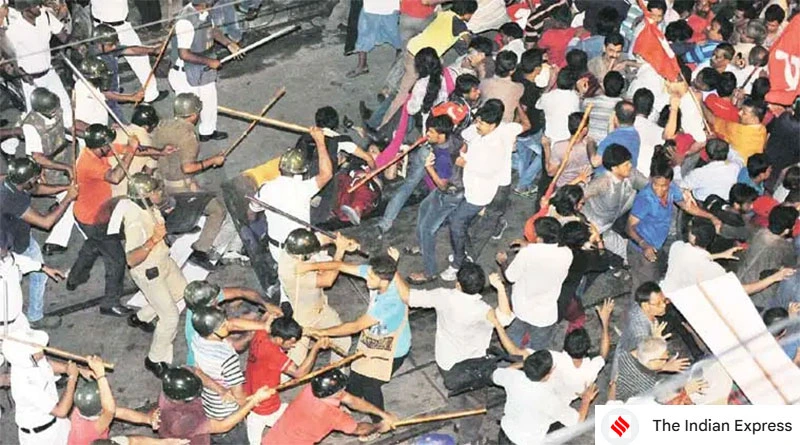
Political Control Over Police in Bengal
Political Control Over Police remains one of the most uncomfortable questions in Indian democracy. Governments change, chief ministers change and political parties move from power to Opposition. Still the relationship between political power and the police often remains remarkably unchanged. The faces may be different, but the system frequently behaves in a familiar way.
This is not an argument against every police officer. Thousands of police personnel work under difficult conditions, deal with violent criminals, work long hours and perform duties that most ordinary citizens would not want to undertake. The criticism is directed at the system that allows political power to influence policing, whether through transfers, postings, investigations, pressure or informal instructions. Once an officer starts believing that his career depends more on political approval than professional performance, the independence of the police becomes questionable. That’s where the political interference in police administration comes in fore.
That is why the real question is not whether one political party is better or worse than another. The question is whether the police institution itself is sufficiently independent to remain neutral when the political wind changes. West Bengal provides a particularly important case study because the state has experienced decades of highly competitive politics, political violence and allegations of administrative bias. The experience of the last fifteen years under the Trinamool Congress has added another layer to that debate, but changing the ruling party alone will not solve the problem.
Why Does Political Control Over Police Matter?
A government is temporary, while the state is permanent. A Chief Minister may remain in office for five years or may return for several terms, but the police institution continues regardless of who occupies Writers’ Buildings or Nabanna. Therefore, the basic loyalty of the police should be towards the Constitution and the law, not towards the government of the day.
In practice, however, political influence over police can become difficult to separate from normal administration. Transfers and postings are particularly sensitive. An officer who believes that an inconvenient investigation could lead to an undesirable posting may naturally become cautious. A senior officer who expects political support for a future promotion may also hesitate before taking an action that could embarrass the government. None of this requires a written order. Institutional pressure can work quietly.
That is where police accountability becomes crucial. A politically independent police force is not one that refuses to cooperate with the elected government. The government has every right to establish policy and demand effective law and order. The problem begins when political preference starts determining who gets investigated, whose complaint receives attention, which protest is permitted and which one is treated as a threat.
Why Can Political Protest Become So Difficult in Bengal?
Political protest is not a favour granted by a government. It is an essential part of democracy. Of course, no protest has an unlimited right to block roads, damage property or threaten other citizens. Police authorities have a legitimate responsibility to regulate routes, manage traffic, prevent clashes and intervene when violence occurs. The difficulty begins when peaceful political mobilisation itself is treated as a law-and-order problem.
For years, Opposition parties in West Bengal have complained about difficulties in obtaining permission for rallies and meetings, police cases following demonstrations and the use of administrative restrictions. It would be inaccurate to claim that every Opposition rally was stopped during the last fifteen years. Major Opposition meetings did take place. However, the repeated need for political parties to approach the courts over permission for demonstrations raises a legitimate institutional question.
The Calcutta High Court has itself dealt with the issue of rally permissions and issued guidelines for police authorities regarding applications for political meetings and processions. The guidelines dealt with matters such as routes, crowd estimates, timing, sound systems and maintenance of public order. The fact that judicial intervention became necessary in such disputes shows how easily the administration and political parties can end up on opposite sides of the same democratic right.
The sensible approach should be straightforward. If a political party wants to hold a peaceful meeting, the administration should facilitate it subject to reasonable restrictions. If there is a genuine security threat, the police should explain the grounds and suggest an alternative arrangement wherever possible. If protesters become violent, the police should act. What should not happen is the transformation of political disagreement into a reason for suppressing political activity.
What Can Bengal Learn From the No Kings Movement?
The comparison with the United States is useful, although it should not be exaggerated. American policing has its own serious problems. There have been controversies over excessive force, arrests, racial profiling and police accountability. It would therefore be wrong to suggest that American protesters never face police action.
The more relevant comparison concerns the culture of dissent. The No Kings Movement in the United States provided a striking example of large-scale public opposition to a sitting President. In 2025, millions of people participated in demonstrations across the country against Donald Trump’s administration and what organisers described as an increasing concentration of political power. Police did intervene in some places, particularly when officers said protesters had violated laws or lawful orders, but the existence of opposition to the President was not itself treated as sufficient reason to prevent people from gathering. AP reported extensively on the nationwide No Kings demonstrations.
That distinction matters. A democracy does not become stronger because the government prevents criticism. It becomes stronger when criticism can take place without fear, provided that protesters remain within the law.
The No Kings demonstrations therefore offer an interesting question for Bengal. If millions of people can publicly challenge a sitting American President, why should a political rally in West Bengal so often become a confrontation over permission, barricades, police cases and restrictions? The circumstances are obviously different, and no two countries have identical legal systems. But the democratic principle is universal: peaceful dissent should be accommodated, while violence should be punished.
For readers who want to see the scale and atmosphere of the demonstrations, WFAA’s live coverage of the No Kings protests provides extensive on-the-ground footage.
Mamdani and Mohan Bhagwat Show Another Side of Democracy
The recent controversy involving New York Mayor Zohran Mamdani and RSS chief Mohan Bhagwat offers another interesting example. Mamdani publicly opposed Bhagwat’s appearance in New York and criticised the RSS ideology. His political opposition was clear. There were also protests surrounding the event. Yet the event was held at Madison Square Garden despite that opposition. Reports noted that the city administration faced legal limitations on simply preventing a privately organised event from taking place.
Watch Mamdani’s criticism against Mohan Bhagwat in CNN-News18.
The lesson is not that Mamdani was right or Bhagwat was right. The lesson is that political disagreement does not automatically give the state a licence to suppress lawful expression. Mamdani could criticise Bhagwat. His opponents could protest. Bhagwat’s supporters could attend his programme. Each side could make its political argument. Reuters reported on Mamdani’s opposition to the Mohan Bhagwat event and the controversy surrounding it.
That is what democratic maturity should look like. You do not have to agree with a speaker to defend his legal right to speak. Similarly, you do not have to agree with protesters to defend their right to protest peacefully.
This is where the question of police neutrality in politics becomes important. The police should not determine which political opinion deserves protection. Their job is to maintain the conditions under which lawful political expression can take place. If violence occurs, they should act. If property is damaged, they should investigate. But the mere fact that an opinion is unpopular, controversial or hostile to the government should not turn it into a policing issue.
Where Was the Police During the RG Kar Vandalism?
The RG Kar Medical College and Hospital vandalism on the night of August 14, 2024 remains one of the most troubling episodes in recent Bengal politics. The state was already dealing with widespread public anger following the rape and murder of a junior doctor. Thousands of people had gathered in different parts of Kolkata and elsewhere to express their anger. During the night, a mob entered the hospital premises and damaged property.
Kolkata Police subsequently arrested people in connection with the vandalism and announced an investigation. But the incident raised a much larger question about preventive policing.
When an institution as sensitive as RG Kar was surrounded by public anger and large gatherings, was adequate security deployed?
Could the violence have been prevented?
Were warning signs ignored?
These questions deserve answers irrespective of political affiliation.
Police effectiveness cannot be judged only by the number of arrests made after a violent incident. Prevention is equally important. If a police force is highly visible and extremely active when dealing with an Opposition procession but appears incapable of preventing a mob from entering a sensitive hospital, people will naturally question whether the same standards are being applied everywhere.
That does not automatically prove political bias. It does, however, create a perception problem, and a police institution cannot afford to ignore a serious loss of public confidence.
For readers interested in the controversy surrounding the police response, Times Now’s video coverage of the RG Kar vandalism and the police response provides contemporary footage and discussion.
The Anis Khan Case Raised Similar Questions
The death of student activist Anis Khan in February 2022 became another major controversy in West Bengal. His family and supporters raised serious allegations concerning the circumstances of his death, while the case eventually reached the Calcutta High Court. The court directed an investigation by the Criminal Investigation Department and later dealt with several aspects of the matter.
The important issue here is not to pronounce someone guilty before the judicial process is complete. The larger concern is what happens when citizens lose confidence in the police investigation itself. When a family believes that the local police cannot investigate a case impartially, the credibility of the entire system suffers.
This is why independent police investigation matters. An investigation should not have to acquire political credibility before people believe it. Evidence, procedure and professional standards should be sufficient.
The Ordinary Citizen Faces a Different Police
Political policing is not only about rallies and arrests. It is also visible in ordinary police stations. Many citizens complain that getting an FIR registered can itself become a struggle, particularly when the accused has local influence. Sometimes the complainant is asked to compromise or resolve the matter privately. In minor disputes, mediation may be sensible. But when a genuine criminal offence is involved, the decision cannot simply depend on whether the police officer thinks the matter is worth pursuing.
It is deeply embarrassing for West Bengal that the Election Commission itself had to suspend five police officers after they were found failing to maintain political neutrality.
This creates a dangerous divide. A politically connected person may know whom to call, while an ordinary citizen may not even know what procedure to follow. The person without influence can end up feeling that the police station is not a place where justice begins but a place where he must first prove that he deserves attention.
That is not what the rule of law should mean.
Police stations should be among the most accessible institutions in a democracy. A citizen should not require a recommendation from an MLA, councillor or political party worker to have a legitimate complaint properly recorded.
What About Journalists and YouTubers?
The relationship between the police, politicians and the media also deserves attention. During the last 15 years of Mamata Banerjee regime, West Bengal has seen repeated controversies involving journalists, YouTubers and independent media platforms. Some journalists had faced police complaints, arrests or physical attacks while covering politically sensitive events. There had also been accusations that some media organisations became excessively close to the government and were rewarded through access, advertising or favourable treatment. They used to get the pass to fly abroad with the Chief Minister, Mamata Banerjee.
It is important not to make a blanket accusation against every media organisation. Bengal has a large and diverse media ecosystem, and journalists working for both mainstream and digital platforms have produced strong investigative reports. But the perception of a divide between government-friendly and government-critical media has become impossible to ignore.
That perception became even more serious when access to the Chief Minister’s press briefings or government events seemed to be selective. A government should welcome difficult questions rather than surround itself with only journalists who are unlikely to challenge its narrative. The job of a journalist is not to applaud the government. It is to ask what the government may prefer not to answer. But we have seen such a routine telecast of such biased one-sided press briefings during Mamata Banerjee regime.
Police protection is particularly important in such circumstances. If journalists covering protests are attacked by political workers, the police should protect them. If journalists are attacked by protesters, the police should protect them. If police officers themselves assault journalists, there must be accountability. The principle cannot change according to the political identity of the journalist.
The Committee to Protect Journalists reported in January 2026 that at least four journalists were assaulted while covering protests in Murshidabad. The journalists were reportedly attacked while covering unrest, with some suffering physical injuries and damage to equipment. The Committee to Protect Journalists report can be read here.
CPJ later reported that violence and intimidation against journalists in politically polarised parts of West Bengal had become a broader concern, with journalists describing situations in which they felt caught between protesters, political groups and an inadequate police response. Its April 2026 investigation on journalists in West Bengal provides further details.
Finally, May 4 could mark the beginning of a new chapter for Bengal, as Mamata Banerjee suffered a major electoral setback and the BJP won the West Bengal Assembly election for the first time, paving the way for its first government in the state. Though it’s too early to come to any conclusion, but we can see at least most of the media representatives are attending the press meetings.
But Can BJP Escape the Same Question?
No.
If the BJP wants to establish a new political culture in Bengal, it must face exactly the same test that the TMC faced. It is not enough to say that the previous government politicised the police. The real question is whether the new government is willing to give the police enough independence to act even when the accused belongs to the ruling party.
The BJP has spoken about allowing press conferences, strengthening law and order and acting against corruption and extortion irrespective of political affiliation. There have also been instances in which the party has taken organisational action against its own members over allegations of wrongdoing. Those steps are welcome.
But party discipline and criminal investigation are two different things.
If a person is accused of extortion, the police should investigate because extortion is a criminal offence. It should not matter whether the accused belongs to the TMC, BJP, Congress, Left or any other organisation. Similarly, if a local BJP leader (Local BJP Yuva Morcha functionary Vivek Tripathi) threatens the famous Gupta Brothers sweet shop outlet located on Ballygunge Park Road, the police must respond with the same seriousness with which it would respond to a TMC leader making the same threat.
That is the real test of equal law enforcement.
Why Do Political Connections Create Suspicion?
One of the biggest problems with political policing is that it creates suspicion even when there may be a perfectly legitimate explanation for police action. Suppose an investigation against a politician moves quickly while another investigation involving a politically influential person moves slowly. Citizens immediately begin comparing the two cases.
The situation becomes even more suspicious when politicians change political camps. If someone who was previously described as a major target suddenly becomes politically useful to another party, people naturally ask whether the investigation will continue with the same intensity.
The irony is hard to miss. Suvendu Adhikari had alleged that Javed Khan’s son had amassed around 90 properties through corruption. But after he reportedly moved to the Ritabrata camp, the police action appears to have slowed down. If the allegations are serious, changing political camps should not make the law suddenly lose interest.
The answer should always be visible in the evidence and the legal process. If an investigation slows down, the police should be able to explain why. If an accused is not arrested, the police should be able to explain why an arrest was unnecessary. If evidence is insufficient, that should be recorded. Transparency is the best defence against the accusation of political interference.
Otherwise, every police decision becomes a political story.
Police Reform Cannot Depend on the Ruling Party
India has discussed police reform for decades. The problem has never been a shortage of committees or recommendations. The difficult part is implementation.
Police officers need professional security. Their transfers and postings should not become instruments of political punishment. Investigation should be insulated as far as possible from day-to-day political pressure. Citizens need an independent mechanism to complain about police misconduct. There must also be consequences when officers knowingly refuse to follow the law.
None of this means that the police should become completely unaccountable to an elected government. That would create another problem. The objective should be professional independence combined with institutional accountability.
A police officer should be able to tell a minister, politely but firmly, that an instruction cannot be followed because it violates the law. That is not disobedience. That is professional policing. Nitish Kumar has shown how the logical bureaucrats and efficient Police Officers can add value to the Government.
Why Bengal Needs System Change
This is perhaps the most important part of the entire debate. Bengal does not merely need one political party to replace another. It needs to change the relationship between political power and the police.
If the TMC loses power and the BJP simply takes control of the same police machinery, the underlying problem remains. If the BJP eventually loses power and another party repeats the same practice, the cycle continues. The political flag changes, but the institutional culture survives.
That is why the demand should be for system change, not merely a change of ruler. We may strongly demand that political interference in police administration must be restrained.
The police should have clear and transparent procedures for political rally permissions. Complaints should be handled according to law rather than political influence. Police transfers should follow objective principles. Investigations should be evidence-based. Journalists should be protected while doing their work. Peaceful protesters should not be intimidated. At the same time, people who engage in violence, vandalism or intimidation should face action regardless of their political affiliation.
Such reforms would actually strengthen the police. Honest officers would become less vulnerable to political pressure, while citizens would have greater confidence in the institution.
Rulers Change, But Will the Police Change?
This is the question that should remain at the centre of the debate.
Political leaders will come and go. Governments will be elected and defeated. Political parties will make promises while sitting in Opposition and face completely different pressures after entering government.
The police, however, will remain.
That is why the police cannot be allowed to become an extension of whichever political party occupies power. The police must be strong enough to investigate the ruling party, protect the Opposition, defend journalists, register complaints from ordinary citizens and control violent protesters without treating peaceful dissent as a crime.
The examples from the United States are not proof that America has solved policing. It has not. The No Kings Movement itself saw instances of police intervention and arrests. The Mamdani-Bhagwat controversy also involved strong political disagreement. But these examples demonstrate something worth discussing: a democracy can allow people to disagree fiercely without making disagreement itself a police offence.
That is the standard India should aspire to.
In Bengal, the debate should therefore move beyond the familiar question of whether Mamata Banerjee politicised the police, whether the BJP will do better, or whether the Opposition is exaggerating police excesses. Those are political questions. The larger institutional question is much more important: can the police remain neutral when neutrality becomes politically inconvenient?
If the answer is yes, then the institution deserves public trust. If the answer is no, then changing the government will only change the person who exercises influence over the system.
A democratic police force should not ask which party a complainant supports before deciding whether to protect him. It should not ask which leader is organising a rally before deciding whether the rally can be held peacefully. It should not ask whether a journalist is friendly or hostile to the government before protecting that journalist from attack. And it should not decide whether an alleged criminal offence deserves investigation based on the political connections of the accused.
The law must be the common denominator.
The problem is not simply Political Control Over Police in West Bengal but the wider issue of political interference in police administration. The problem cannot be solved merely by replacing one political party with another. Unless the institutional incentives change, the same pattern can return under a different colour.
West Bengal has changed rulers before, and it will change rulers again. The real measure of democratic progress will be whether the police change with them—not by becoming loyal to the new government, but by becoming less dependent on any government.
Until that happens, the uncomfortable question will remain: when the ruler changes, does the police system really change, or does it simply learn the name of its new master?
Democracy does not need a police force that protects rulers from citizens. It needs a police force that protects citizens under the law, whoever happens to be ruling.
10 Key Takeaways
- Political Control Over Police remains a serious threat to neutral and independent policing in West Bengal.
- Governments and political parties may change, but the police system often continues to operate in much the same way.
- Political influence over police can affect transfers, postings, investigations and the handling of complaints.
- Peaceful political protests should be protected as a democratic right, while violence and vandalism should be dealt with firmly.
- The No Kings Movement in the US shows how large-scale opposition to a sitting government can exist within a democratic system without treating dissent itself as a crime.
- The Mamdani–Mohan Bhagwat controversy raises an important question about protecting lawful political expression despite strong ideological differences.
- The RG Kar vandalism and the Anis Khan case raised serious questions about police accountability and public trust in Bengal.
- Journalists and YouTubers covering politically sensitive issues need protection regardless of whether their reporting supports or criticises the government.
- The same standards must apply to ruling-party and Opposition leaders; equal law enforcement cannot depend on political affiliation.
- West Bengal needs police reform and institutional change, not merely a change of political masters. The police must ultimately remain accountable to the law and the Constitution.
[…]Political Control Over Police: Power Trap Political Control Over Police exposes Bengal’s long-running police-politics nexus, political interference in police, selective action and the urgent need for reform.[…]
[…]Political Control Over Police: Power Trap Political Control Over Police exposes Bengal’s long-running police-politics nexus, political interference in police, selective action and the urgent need for reform.[…]
[…]Political Control Over Police: Power Trap Political Control Over Police exposes Bengal’s long-running police-politics nexus, political interference in police, selective action and the urgent need for reform.[…]
[…]Political Control Over Police: Power Trap Political Control Over Police exposes Bengal’s long-running police-politics nexus, political interference in police, selective action and the urgent need for reform.[…]