Bageshwar Baba Attacks Bengal's Non-Veg Puja
Sep 09, 2026 - By Ashutosh Roy Current AffairsCulture & HeritageElection AnalysisPoliticsRegional UpdatesWest Bengal Politics
Why Did the Government Give Bageshwar Baba Such a Platform?
The Bageshwar Baba controversy in Bengal has become much bigger than a dispute over vegetarian and non-vegetarian food. It has raised a more uncomfortable political question: why did the newly elected West Bengal government give such a prominent platform to a religious preacher who then chose to comment on the food habits and religious practices of Bengalis?
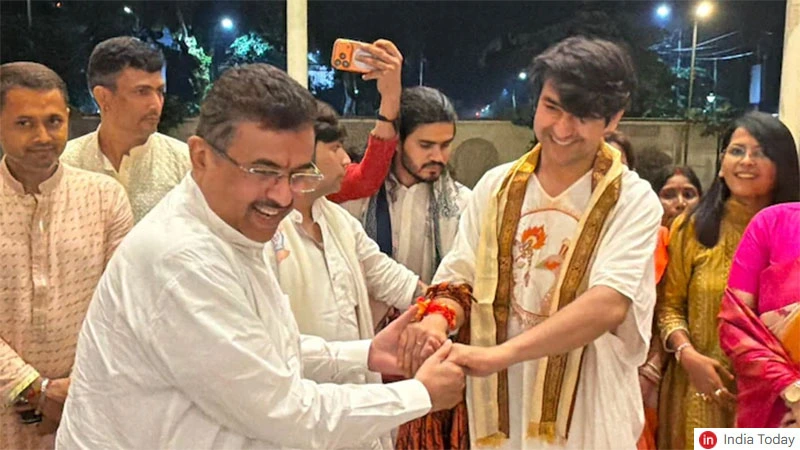
Bageshwar Baba is the popular name of Dhirendra Krishna Shastri, head of Bageshwar Dham in Madhya Pradesh. His recent visit to Bengal attracted considerable political attention. Chief Minister Suvendu Adhikari met him, appeared with him at a religious programme and publicly welcomed the idea of having a Bageshwar Dham centre in Bengal. The visit therefore did not remain a private religious affair. It acquired a political colour. That really matters, mainly when that party remains in the government.
There is nothing wrong with Bageshwar Baba coming to Bengal. There is nothing wrong with people attending his religious programmes either. A preacher has every right to express his beliefs, and citizens have every right to listen to him.
But the same freedom works both ways. Bengalis also have the right to reject what he says. That is where the Bageshwar Baba controversy has become politically uncomfortable for the state government.
What Did Bageshwar Baba Actually Say?
During his Bengal visit, Dhirendra Krishna Shastri appealed to Hindus in Bengal not to sell non-vegetarian food near Durga Puja idols during Navratri. He also criticised those who continued the practice and used the term “pakhandi” for people he considered hypocritical. The remarks immediately struck a nerve of conscious and politically aware West Bengal.
Senior Journalist Sumon Chattapadhyay has mocked him by calling “Bagarombor Baba“, which means Baba of Empty Rhetoric.
Bengal is not a state where religion and food have historically existed in two separate boxes. Food is part of Bengali culture. Fish is not some recent addition to Bengali life. Meat during particular festivals is also not an alien practice. Different families follow different customs, and different temples have different traditions.
That is why the issue cannot simply be dismissed as a debate between vegetarians and meat eaters. It is about who gets to define Bengali religious culture in West Bengal, which has produced so many saints, sages, scientists, and famous personalities. He may not know that at many temples, including Dakshineswar and Kalighat, fish is offered as bhog during the worship of the Goddess. In some places, goat meat from ritual sacrifice is also offered as bhog.
And that is where Dhirendra Krishna Shastri got exactly what the controversy could give him: massive publicity, millions of viewers and a sharp rise in his popularity. What began as a provocative remark turned into a publicity bonanza.
But that triggers a much bigger question.
The Issue Is Not Vegetarianism
It is important not to distort the argument. Let us call a spade as a spade. There is nothing wrong with being vegetarian. There is nothing wrong with someone believing that vegetarian food is more appropriate during a religious festival. A person is free to change his or her own diet for religious reasons.
The trouble starts when personal belief becomes a moral certificate for judging everyone else. When anyone speaks in a meeting in front of huge crowd, one should not impose the personal opinion on the crowd. Moreover, when such Baba appears, he has to be more careful. I clearly remember that Mohan Bhagwat also visited Bengal a couple of months back, but did that create any controversy?
A Bengali family eating fish during Durga Puja does not automatically become less Hindu. A family eating meat does not lose its religious identity. Likewise, a vegetarian family does not become less Bengali because it chooses not to eat fish.
Faith cannot be measured by a dinner plate. This is where the tone of the Durga Puja non-veg controversy became unnecessarily provocative. Instead of saying that devotees should follow a particular religious discipline if they personally wish to do so, the message moved towards telling Bengalis what they should not eat. Such remarks were bound to face resistance, and they did.
Does Bengal Need Someone From Outside to Explain Durga Puja?
Bengal has its own relationship with Durga Puja. It is religious, cultural, social and deeply personal at the same time. For many Bengali families, Durga Puja means prayers and rituals. It also means relatives coming home, new clothes, pandal visits, adda and food. The traditions vary from family to family and from one part of Bengal to another.
There are vegetarian households. There are families that eat fish. There are families that eat meat on particular days. There are temples where different forms of offerings have existed for generations. None of this needs a certificate from a visiting preacher. That is the point that seems to have been missed.
Bageshwar Baba may have his own understanding of Navratri. He is entitled to it. But Bengal has its own religious history. Its Hindu traditions have developed over centuries and cannot be squeezed into one uniform template. This is exactly the rhetoric we warned the BJP about repeatedly before the election: one size does not fit all, and Bengal cannot be forced into a political mould made elsewhere.
Why Did the Government Give Him Such Importance?
This is where the West Bengal government deserves criticism. The government did not merely allow a religious personality to visit Bengal. The political leadership gave the visit considerable visibility. Suvendu Adhikari met Dhirendra Krishna Shastri and sought his blessings. The Chief Minister also invited him to establish a Bageshwar Dham centre in Bengal, according to reports.
Again, there is nothing inherently wrong with meeting a religious leader. But political leaders are not ordinary citizens. Every public appearance sends a message.
When a Chief Minister gives a visiting preacher a high-profile welcome, people naturally assume that the government considers the person important. If that same preacher later comments on Bengal’s food and religious practices, the political optics become difficult to ignore.
The government cannot welcome a personality with great enthusiasm and then pretend that everything surrounding the visit is completely unrelated to politics. That is not how public life works. It should be also remembered that when one becomes the chief minister, his personal life becomes public as he remains as an icon to the entire state. After all, Government is run by the people.
Religious Hospitality vs Political Promotion
The state government is free to maintain cordial relations with religious leaders. It should also ensure that religious programmes can take place peacefully. But there is a line between hospitality and political promotion.
A government should not create the impression that a religious preacher has some special authority to pronounce on how the people of Bengal should live. That becomes particularly important in a state as politically and culturally conscious as Bengal.
The government may disagree with this interpretation. It may argue that the meeting was simply a gesture of respect. Fine. Then it should say so clearly. Because silence creates another impression. And politics is often about impressions.
The BJP leader knows even better that Durga Puja is not only a ritual of Hindus, but Bengalis from other religious also join the festive.
Even Bengal BJP Had to Draw the Line
The most interesting part of the controversy is that the strongest political pushback did not come only from opponents of the BJP.
West Bengal BJP president Shamik Bhattacharya publicly rejected the idea that Bageshwar Baba could dictate what Bengalis eat. He described the preacher’s views as personal and insisted that Bengali food habits and traditions could not be changed at the instruction of an outsider. His response was politically significant. Bhattacharya pointed to the long-standing Bengali tradition of eating luchi on Ashtami and meat on Navami and invoked Swami Vivekananda while defending Bengali food habits.
That response was necessary.
It showed that even within the BJP there was an understanding that Bengal cannot simply be asked to copy another region’s religious habits. A Bengali Hindu does not stop being Hindu because he eats fish. Worshipping Durga does not require every Bengali to give up meat. And supporting the BJP does not mean accepting every opinion expressed by a religious preacher. These are perfectly compatible choices, rooted in Bengal’s own culture and way of life.
If Maharashtra could force Bageshwar Baba to apologise for his remarks on Shivaji, and Nitish Kumar could make him bow down, why should Bengal be expected to remain silent when he comments on Bengali traditions?
Bengali Hinduism Has Never Been a Single-Cuisine Religion
This is something political leaders should remember before making cultural statements. Bengal has produced different streams of Hindu thought. Shakta traditions, Vaishnav traditions, reform movements, temple traditions and folk practices have existed side by side.
The state has also produced figures such as Ramakrishna Paramahamsa, Swami Vivekananda, Raja Rammohan Roy and Ishwar Chandra Vidyasagar. They came from different intellectual and religious backgrounds, but none of them reduced Bengali Hindu identity to one food rule.
That complexity is Bengal’s strength. The danger comes when someone tries to turn a diverse religious culture into a single political formula. Bageshwar Baba has every right to follow his own religious discipline. His followers can do the same. But that does not make his personal interpretation the official cultural standard for Bengal.
Listen to the speech of Bageshwar Baba and the criticism.
Why Does the “Outsider” Question Matter?
The BJP has spent years building itself into a serious political force in Bengal, but winning elections is only one part of that journey. The harder task is understanding the state, its people and the culture that shapes their political choices. Bengalis are not simply voters who can be fitted into a ready-made national template. Their identity is closely tied to their language, literature, food, religious practices and long cultural memory.
That is what makes the Bageshwar episode politically uncomfortable. A religious preacher from Madhya Pradesh came to Bengal and chose to comment on what Bengali Hindus should eat during Durga Puja. At the same time, Chief Minister Suvendu Adhikari gave him a warm and highly visible welcome. The two developments together created an awkward political picture, because they allowed critics to argue that Bengal’s own traditions were being treated as something that needed to be corrected from outside.
For a government trying to build a lasting political base in Bengal, that is not an impression it should take lightly.
Bengal Does Not Need a Food Police
Bengal does not need a “food police” to tell people how to observe their religious festivals. Families have followed their own customs for generations. During Puja, one household may remain strictly vegetarian, another may cook fish, while another may serve meat on a particular day. Some may choose to fast. None of these choices makes one family more religious than another.
That variety is part of Bengal’s social and cultural fabric, not something that needs to be controlled. If a religious leader believes people should give up non-vegetarian food, he is free to make that argument and those who agree with him are free to follow it. The government, however, should not allow such personal religious views to acquire the weight of an official directive.
What people cook in their homes is ultimately their own decision. It is not the government’s business, and certainly not something a visiting Baba should be allowed to dictate.
Was the Government Careless About the Political Optics?
One basic distinction has been lost in this debate: respecting a religious figure does not require accepting everything he says. People can attend Bageshwar Baba’s programme, seek his blessings and still disagree with his views on food. There is nothing disrespectful about that. It is a normal part of living in a society where people are free to hold different beliefs.
The same distinction applies to Chief Minister Suvendu Adhikari. He was free to meet Bageshwar Baba, welcome him to Bengal and show him the courtesy normally extended to a religious leader. But such a meeting does not automatically mean that the Chief Minister or the state government agrees with every statement made by him.
At the same time, the government’s prominent association with the visit makes political judgment important. Once the Chief Minister publicly welcomes a visiting preacher, the government should be careful to ensure that the preacher’s personal views are not mistaken for the position of the state. That distinction becomes particularly important when those views touch Bengal’s food habits and religious traditions.
What Should the Suvendu Government Do Now?
There is no need for the government to turn this into another political confrontation. It does not have to attack Bageshwar Baba, nor does it need to apologise for meeting him. The sensible course is much simpler: make it clear that his views on non-vegetarian food are his personal religious beliefs and have no status as a government directive.
The government should also reassure people that traditional Bengali food practices remain a matter of personal and family choice. If someone wants to follow a vegetarian diet during Durga Puja, that is perfectly legitimate. If another family follows its traditional food customs, that should also be respected.
Religious leaders are entitled to preach. Citizens are entitled to agree or disagree. The government’s role is to maintain that distinction and ensure that a visiting preacher’s personal views are never confused with the policy of the West Bengal government.
The Larger Problem Is Cultural Confidence
The Bageshwar Baba controversy has turned out to be about more than what people eat during Durga Puja. At its core is a clash between a broad political idea of Hindu identity and the very local traditions that have shaped Bengali Hindu life for generations.
That tension is difficult to ignore in Bengal. Religion here has always existed alongside debate, argument and cultural expression. Devotion is important, but so are music, literature, food, family customs and everyday life. Bengali Hindu traditions have developed through all of these influences rather than through one fixed formula.
That is why attempts to define Bengali religious life through a single set of rules are unlikely to find universal acceptance. Bengal’s traditions are too diverse and too deeply rooted in local practice. Its Hindu culture cannot simply be reduced to a question of what should or should not appear on a Puja plate.
Why Bageshwar Dham to Bengal?
Bageshwar Dham can have followers in Bengal. Dhirendra Krishna Shastri can hold religious programmes here, and people are free to attend them, seek his blessings or follow his teachings. None of that is a problem.
The problem begins when respect for an outside religious figure is allowed to overshadow Bengal’s own cultural choices. A Bengali family does not have to abandon its traditions simply because a visiting preacher follows a different religious practice.
For the BJP government, this distinction matters. If the party wants to build a lasting relationship with Bengali voters, it has to understand more than their religious identity. Bengal’s language, food, customs and regional culture also shape how people see themselves.
A Bengali voter may be deeply religious, worship Durga with complete faith and still want to decide independently what the family eats during Puja. There is no contradiction in that. It is simply part of the way Bengali society has evolved.
Political Analyst, Biswnath Chakraborty has compared it with, Buy one get one free in ABP Ananda.
Knowledge Mart Final Thoughts
The Bageshwar Baba episode called for more political sensitivity than it received. The controversy did not begin merely because a religious leader came to Bengal. It grew after his remarks entered an area that is deeply personal for Bengalis: their food and their way of observing Durga Puja. His visit had also received significant political attention, which made the remarks far more politically consequential.
The government cannot control what a religious preacher chooses to say. Nor should it try to. But it can decide how much political importance it gives to a visiting religious figure and how clearly it separates his personal beliefs from the position of the state.
That is where the Suvendu Adhikari government needs to be careful. Welcoming Bageshwar Baba is one thing. Allowing his personal views to appear as though they carry some special authority in Bengal is quite another.
Bageshwar Baba has the right to preach according to his beliefs. His followers have the right to accept those teachings. Bengalis have the same right to listen, disagree or simply ignore them.
What they do not need is an outside authority deciding which parts of their own culture are acceptable.
Bengal does not need permission to remain Bengali. It does not need permission to worship Durga, follow its family traditions or celebrate Puja in its own way. And it certainly does not need permission to decide what a Bengali household puts on its Puja plate.
A government can welcome a guest and show respect to a religious leader. But political hospitality should never be confused with handing over Bengal’s cultural voice.
10 Key Takeaways:
- Bageshwar Baba’s Bengal visit became controversial after his remarks on non-vegetarian food during Durga Puja.
- The main issue is not vegetarianism, but the attempt to judge Bengali Hindus over their traditional food choices.
- Bengali Hindu traditions are diverse and cannot be reduced to one dietary rule imposed from outside.
- Fish and meat have a long place in Bengali food culture, including traditions associated with particular temples and families.
- Bageshwar Baba is free to express his religious beliefs, but Bengalis are equally free to disagree with them.
- The Durga Puja non-veg controversy became politically sensitive because of the prominent welcome given to him by the state leadership.
- Suvendu Adhikari and the government should have considered the cultural and political impact of giving such visibility to a visiting preacher.
- West Bengal BJP chief Shamik Bhattacharya rightly rejected the idea that anyone from outside Bengal should dictate what Bengalis eat.
- The government must clearly separate religious hospitality from political endorsement and make clear that the preacher’s dietary views are not state policy.
- The larger lesson is simple: Bengal can welcome religious leaders without surrendering its own cultural traditions.
[…]Bageshwar Baba Attacks Bengal’s Non-Veg Puja Explore the Bageshwar Baba Durga Puja controversy. Discover why Dhirendra Shastri’s remarks on non-vegetarian food sparked intense backlash in Bengal.[…]
[…]Bageshwar Baba Attacks Bengal’s Non-Veg Puja Explore the Bageshwar Baba Durga Puja controversy. Discover why Dhirendra Shastri’s remarks on non-vegetarian food sparked intense backlash in Bengal.[…]
[…]Bageshwar Baba Attacks Bengal’s Non-Veg Puja Explore the Bageshwar Baba Durga Puja controversy. Discover why Dhirendra Shastri’s remarks on non-vegetarian food sparked intense backlash in Bengal.[…]
[…]Bageshwar Baba Attacks Bengal’s Non-Veg Puja Explore the Bageshwar Baba Durga Puja controversy. Discover why Dhirendra Shastri’s remarks on non-vegetarian food sparked intense backlash in Bengal.[…]
[…]Bageshwar Baba Attacks Bengal’s Non-Veg Puja Explore the Bageshwar Baba Durga Puja controversy. Discover why Dhirendra Shastri’s remarks on non-vegetarian food sparked intense backlash in Bengal.[…]