Cabinet Secretariat Inaction: RTI Reveals
Oct 23, 2026 - By Ashutosh Roy Current Affairs
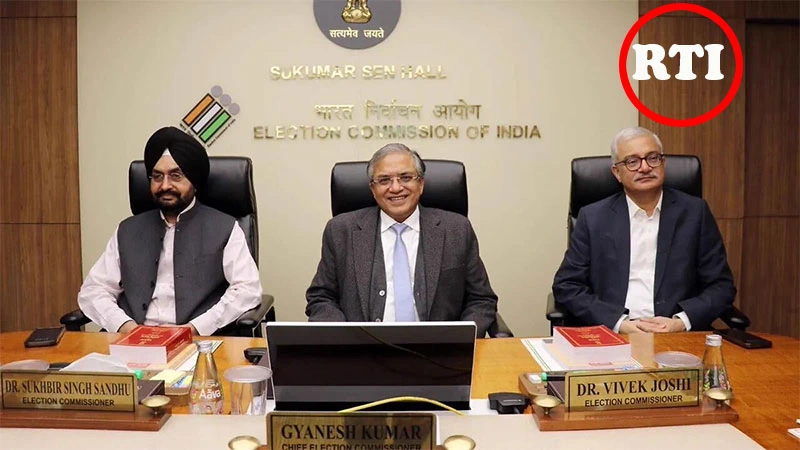
Cabinet Secretariat Inaction: What RTI Reveals
The controversy surrounding the Election Commission of India (ECI) has taken another turn. A Right to Information (RTI) disclosure has revealed how the Cabinet Secretariat dealt with letters sent by two Election Commissioners, Sukhbir Singh Sandhu and Vivek Joshi, raising concerns about the functioning of a senior officer in the Commission.
The letters were addressed to Cabinet Secretary T. V. Somanathan on 29 July 2026. The officer at the centre of the dispute was Maneesh Garg, a Senior Deputy Election Commissioner. The matter reportedly arose after Garg issued an order revising the allocation of work among senior officers in the Election Commission.
What happened next raises an important question: when members of a constitutional body raise concerns about its internal functioning, who should examine those concerns, and how should the matter be resolved?
According to the file notings disclosed through the RTI process, the Cabinet Secretariat considered whether it was appropriate to act on letters submitted by two individual Election Commissioners. It concluded that taking action without an official communication from the Commission as a whole could be inappropriate and might be seen as interference in the functioning of a constitutional body.
The Secretariat acknowledged the letters and forwarded copies to the Chief Election Commissioner’s office and the Department of Personnel and Training (DoPT). It did not initiate direct action against the officer on the basis of those letters.
This distinction matters. The disclosure does not establish that the officer committed misconduct, nor does it prove that the Cabinet Secretary deliberately suppressed the complaints. But it does reveal how the government handled concerns raised by two senior members of an institution responsible for conducting India’s elections.
The real issue is not whether the Cabinet Secretariat should control the Election Commission. It is whether concerns raised within the Commission were properly examined and whether the public can obtain a clear account of what happened.
What the RTI Disclosure Actually Reveals
The RTI response has brought an official paper trail into public view. Reports by India Today, The Indian Express and Business Standard describe the handling of the two Commissioners’ letters and the reasoning recorded by the Cabinet Secretariat.
However, one factual distinction must be kept clear. India Today’s report stated that the full letters had not yet been supplied with the initial RTI response because a fee was pending.
The reported chronology is relatively clear. Sandhu and Joshi wrote separate letters dated 29 July. The Cabinet Secretariat received them on 30 July. File notings dated 3 and 4 August discussed how the complaints should be handled. On 5 August, the Cabinet Secretary acknowledged the letters and copies were forwarded to relevant offices, including the office of Chief Election Commissioner Gyanesh Kumar and the DoPT.
The records indicate that the Secretariat did not regard the letters as a formal communication from the Election Commission as a whole. Its concern was that executive action on complaints made by individual Commissioners could be interpreted as interference in the Commission’s independent functioning. Unfortunately, We have witnessed Shocking FIR for the Protest against Gyanesh Kumar.
That explanation is central to understanding the case. The Cabinet Secretariat was not simply dealing with a routine complaint against a government employee. It was considering representations involving an officer working in a constitutional body that must remain independent of the executive.
At the same time, the fact that the letters were acknowledged and forwarded does not answer every question about the substance of the complaints. The public still needs to know whether the concerns were examined through the Election Commission’s own procedures and whether a satisfactory explanation was provided to the Commissioners.
What Were the Two Commissioners Concerned About?
The reported dispute concerned a work-allocation order issued by Maneesh Garg after he took charge as the link officer for the Deputy Election Commissioner (Administration). Get the details in Arrest Gyanesh Kumar? EC Power War Explodes!
According to the file notings described in news reports, Sandhu and Joshi alleged that Garg had changed the allocation of work among senior deputy election commissioners, deputy election commissioners, directors general and officers of equivalent rank without prior discussion with the Commission or the officers concerned.
They reportedly said that such changes were made despite oral and written instructions that revised work allocation should not take place without prior discussion or approval from the Commission. Both Commissioners also alleged that the action was contrary to established practice and violated provisions of the Chief Election Commissioner and Other Election Commissioners (Appointment, Conditions of Service and Term of Office) Act, 2023.
Joshi additionally raised a concern that the relevant file had not been provided to him when he sought it from the Administration Division.
These are serious allegations, but India wants evidence. The disclosure does not by itself establish that Garg broke the law or deliberately bypassed the Commission.
The wider background also matters. Earlier reporting suggested that the dispute involved the distribution of responsibilities connected with electoral-roll administration and the Commission’s IT systems. Those systems are important because they support the maintenance and updating of voter records.
The Election Commission issued a statement on 26 September saying that the work-redistribution orders had not been implemented after directions from the two Commissioners. It also said that the matter concerned the functioning of an officer on deputation, rather than a policy matter of the Commission or its IT division.
That statement is important. If the disputed orders were never implemented, the immediate administrative consequences may have been limited. But the underlying questions about how the order was issued, how the objections were handled and what procedures apply to such decisions remain relevant.
RTI reveals why two election commissioners wrote to the Cabinet Secretary. Look at The Hindu Report.
Why Did the Cabinet Secretariat Avoid Direct Action?
The Cabinet Secretariat’s recorded reasoning centred on the constitutional independence of the Election Commission.
The Commission is not an ordinary department under a ministry. It is a constitutional body entrusted with supervising elections under Article 324. Its independence is essential because the government of the day must not be able to dictate how elections are conducted or how electoral decisions are made.
The Secretariat therefore considered whether acting on complaints from two Commissioners, without a formal communication from the Commission as a whole, would be appropriate. The file notings reportedly concluded that such action could be viewed as executive interference.
There is a legitimate principle behind this concern. If the executive could intervene whenever individual members of an independent constitutional institution complained about a colleague, the institution could become vulnerable to outside pressure. A government might use an internal disagreement as an excuse to influence the institution’s work.
But the opposite danger also deserves attention. What happens when individual members raise concerns that they believe require examination, yet the matter does not move forward because the complaint has not come from the institution as a whole?
The Cabinet Secretariat’s approach may have been intended to protect the Election Commission’s independence. Still, the public deserves to know whether another appropriate mechanism was used to examine the complaints.
Protecting an institution from executive interference and ensuring accountability within that institution are not contradictory goals. Both are necessary if public confidence is to be maintained.
The important question is therefore not whether the Cabinet Secretary should have taken over the Commission’s internal affairs. It is whether the decision to avoid direct action was followed by a credible process for resolving the concerns.
Can Procedure Become an Excuse for Inaction?
Administrative procedure exists for a reason. It helps public institutions make decisions consistently, limits arbitrary action and clarifies who is responsible for what. In a constitutional institution, procedure can also protect independence by preventing outsiders from exercising powers that do not belong to them.
But procedure can become a problem if officials rely on it to avoid answering a legitimate question.
In this case, the Cabinet Secretariat recorded why it considered direct action inappropriate. It acknowledged the letters and sent copies to the Chief Election Commissioner’s office and the DoPT. Those steps created a paper trail, but they do not, by themselves, prove that the substantive concerns were resolved.
There is a difference between forwarding a complaint and investigating it. There is also a difference between placing a matter on record for possible future consideration and reaching a reasoned conclusion about what happened.
The available reporting does not establish that the complaints were deliberately buried or that the Cabinet Secretary acted unlawfully. It would be irresponsible to make either claim without further evidence. But the same caution applies in the opposite direction: the existence of a formal acknowledgement should not automatically be treated as proof that the matter was adequately addressed.
The next questions are practical.
- Did the Chief Election Commissioner’s office examine the concerns?
- Was the work-allocation order reviewed under the applicable rules?
- Were the Commissioners informed of the outcome?
- Did the DoPT take any step, or was the matter merely retained on record?
The public should not have to rely on speculation to answer these questions. Where disclosure is legally permissible, the relevant authorities should explain the procedure followed and the outcome reached.
Why the Election Commission’s Independence Matters
The Election Commission’s credibility depends on more than its legal authority. It also depends on whether citizens believe that electoral decisions are made fairly, consistently and without political pressure.
That is why internal disagreements in the Commission deserve careful attention. A difference of opinion between Commissioners is not, in itself, evidence of institutional failure. Large public bodies often contain competing views, and discussion can improve decisions. But when disagreements concern the allocation of authority or the administration of electoral rolls, the public has a legitimate interest in understanding how they were resolved.
This issue has become particularly sensitive because of the wider controversy surrounding the Special Intensive Revision (SIR) of electoral rolls. The SIR exercise has generated questions about voter deletions, the process for including eligible voters and the way electoral data is managed.
Knowledge Mart has examined those concerns in SIR Deletions: The Shocking Truth in India. The article discusses the need to distinguish legitimate removal of ineligible entries from errors that may affect eligible voters.
Readers can also see CEC Gyanesh Kumar: Students Rage & SC Fired, which examines the wider debate over the Commission’s decision-making and the questions raised by its critics.
These related controversies should not be treated as proof that the complaints against Garg were justified. Each issue requires its own evidence. But they explain why transparency within the Commission matters so much at this moment.
When a body is responsible for deciding who can vote and how elections are conducted, public confidence cannot be maintained by authority alone. It must be supported by clear procedures, explanations and accountability.
What Does the Law Say About Internal Differences?
The file notings reportedly referred to Section 18 of the Chief Election Commissioner and Other Election Commissioners (Appointment, Conditions of Service and Term of Office) Act, 2023. The provision deals with how the Commission conducts its business, stating that it should, as far as possible, act unanimously, while differences of opinion are resolved by majority.
This legal framework is relevant because it recognises that differences can arise within the Commission. The existence of disagreement does not automatically make a decision unlawful, nor does it necessarily mean that the institution has failed to function.
The key issue is how those differences are handled. Were the views of the Commissioners considered? Were the relevant procedures followed? Was the final decision taken by the proper authority? If an officer changes work allocations, what rules govern that action, and who has the power to approve or reverse it?
These are questions that should be answered through the applicable law and the official record, not by political assumptions.
The Cabinet Secretariat’s note also reportedly stated that although Garg had been appointed through the Appointments Committee of the Cabinet, his work and conduct within the Election Commission were governed by the Commission’s rules and guidelines. That distinction is important: an officer’s appointment and the day-to-day supervision of the officer’s work are not necessarily the same matter.
The full legal position should be assessed against the actual orders, rules and correspondence. It would be premature to claim that Section 18 conclusively proves either the Commissioners’ allegations or the Cabinet Secretariat’s position. The provision forms part of the context, but the facts of the particular dispute still matter.
RTI: Why Transparency Matters
The RTI disclosure is important because it gives the public access to information about how a decision was handled inside the government. Without the file notings, citizens might have known only that two Commissioners had written to the Cabinet Secretary and that the letters had been forwarded.
The disclosure offers more detail about the reasoning behind the response. It allows the public to examine whether the Cabinet Secretariat’s approach was consistent with its stated concern for the Commission’s independence.
However, the limits of the disclosure must also be acknowledged. India Today’s report stated that the complete letters had not been supplied with the initial response because a fee was pending. The published accounts therefore do not necessarily provide the full picture of what the two Commissioners wrote or every detail of the exchanges that followed.
An RTI response should not be treated as a final verdict on a dispute. It provides information that can help citizens evaluate official conduct, but the conclusions drawn from that information must remain proportionate to what the documents establish.
This is the strength of the Right to Information Act. It enables people to ask how public authorities make decisions and to examine the reasons given for those decisions. It does not guarantee that every disclosed document will settle a controversy, but it makes public scrutiny possible.
In a democracy, transparency is not an inconvenience to be tolerated reluctantly. It is part of the accountability expected from public institutions.
What Questions Still Need Answers?
The most useful next step is to seek clarity on the unresolved issues rather than repeat the same allegations.
First, the full contents of the two letters should be examined when the documents are available. Their precise wording matters because summaries in news reports cannot always capture the complete argument or context.
Second, the public should know what happened after the letters were forwarded to the Chief Election Commissioner’s office and the DoPT. Did either office review the matter? Was a response sent? Was any formal conclusion recorded?
Third, the relevant work-allocation order should be assessed against the applicable rules. If the order was not implemented, as the Election Commission stated, the Commission should explain how that decision was reached and whether any procedural concern remained unresolved.
Fourth, the authorities should clarify what mechanism exists for handling complaints by individual Election Commissioners when the matter concerns the conduct of an officer within the institution. If the complaint cannot be treated as a formal communication from the Commission as a whole, there should still be a clear way to establish whether the concern deserves examination.
Finally, the public needs to know whether the matter has been closed, remains under consideration or was simply placed on record for future reference.
These are reasonable questions. They do not presume guilt or demand that the executive take control of a constitutional body. They ask for a clear account of how the system worked.
What the Debate on Cabinet Secretariate Inaction Tells Us
The controversy highlights a difficult balance between independence and accountability. The Cabinet Secretariat was concerned that direct action on individual complaints could be seen as interference in the Election Commission. That concern deserves to be taken seriously. But the need to protect independence should not end the inquiry into whether the underlying concerns were properly handled.
The best outcome would be a process that protects the Commission from external pressure while allowing legitimate complaints to be examined under its own rules. Such a process should identify who is responsible for reviewing the matter, how the review is conducted and how the outcome is recorded.
That would protect both principles. The executive would not be free to interfere in the Commission’s decisions, and the Commission would not be left without a credible method for resolving internal disputes.
This is not only about one officer or two Commissioners. It is about how public institutions deal with disagreement when the stakes are high. An institution that can examine concerns openly and explain its decisions is more likely to earn public trust than one that relies on general assurances.
The same principle applies to political parties and governments. No institution should be declared guilty merely because an allegation has been made. But no institution should expect its authority alone to silence reasonable questions.
Knowledge Mart Final Thoughts
The RTI disclosure has revealed a significant administrative decision. Two Election Commissioners wrote separately to the Cabinet Secretary about the working of a senior officer. The Cabinet Secretariat considered the letters, concluded that direct action without a formal communication from the Commission as a whole could be inappropriate, acknowledged the complaints and forwarded copies to relevant offices.
The record provides a basis for asking questions, but it does not justify every conclusion that has been drawn from the controversy. The complaints should not be treated as proven misconduct, and the Cabinet Secretariat’s decision should not automatically be described as deliberate suppression.
At the same time, the matter should not be dismissed simply because the Secretariat cited the Election Commission’s independence. That independence is essential, but it must work alongside proper internal procedures and a credible way to address concerns.
My view is straightforward: the public deserves to know whether the complaints were examined and what conclusion was reached. If the relevant authorities followed the rules, they should explain how. If there were procedural shortcomings, they should identify them and take corrective steps.
The purpose of transparency is not to embarrass an institution. It is to help ensure that the institution performs its duties properly. The Election Commission’s role in Indian democracy is too important for public confidence to depend on assumptions or competing political claims.
The way forward is not to declare anyone guilty in advance. It is to examine the documents, clarify the sequence of events and make the outcome clear. That is how accountability and institutional independence can reinforce each other rather than remain in conflict.
Key Takeaways: What the RTI Case Puts in Question
- Election Commissioners Sukhbir Singh Sandhu and Vivek Joshi wrote separate letters to Cabinet Secretary T. V. Somanathan on 29 July 2026 concerning the functioning of Senior Deputy Election Commissioner Maneesh Garg.
- The dispute reportedly followed a work-allocation order that the two Commissioners said had been issued without proper consultation.
- The Cabinet Secretariat’s file notings said that direct action on individual letters, without a formal communication from the Commission as a whole, could be inappropriate and could be viewed as executive interference.
- The Secretariat acknowledged the letters and forwarded copies to the Chief Election Commissioner’s office and the Department of Personnel and Training.
- The full letters were not available in the initial RTI disclosure described by India Today; the published file notings should not be confused with the complete original correspondence.
- The Election Commission said the disputed work-redistribution orders were not implemented after directions from the two Commissioners.
- The allegations against the officer are not, by themselves, proof of misconduct or a violation of law.
- It remains important to establish what examination, if any, followed the forwarding of the complaints and whether the concerns were resolved.
- The SIR controversy makes transparency and public confidence especially important, but the different issues should be assessed on their own evidence.
- Institutional independence must be protected, and accountability must not be abandoned in its name.