Annapurna Bhandar Issues: Shocking Failure?
Aug 26, 2026 - By Ashutosh Roy Current AffairsGovernancePoliticsRegional UpdatesSocial IssuesSocietyWest Bengal Politics
What Is Behind the Annapurna Bhandar Issues?
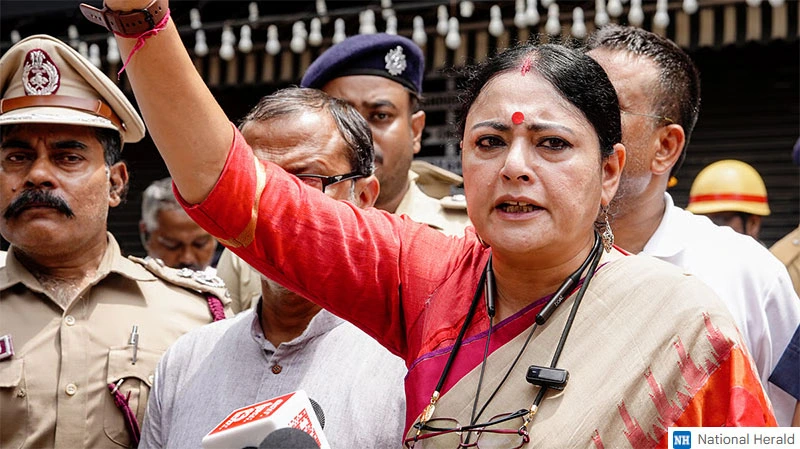
The Annapurna Bhandar Issues are now being heard across West Bengal. From Medinipur to Malda, protests have broken out in different places. In the middle of all this, BJP minister Agnimitra Paul has also faced protests.
What was supposed to be a major welfare initiative is slowly turning into a political and administrative headache for the new government.
From the BJP camp, the word “sabotage” is being heard. The suggestion is that someone may be deliberately creating trouble around the scheme. But there is an obvious question here. Is the Trinamool Congress really in a position to carry out such sabotage today?
After the BJP’s massive electoral mandate, TMC itself is dealing with its own party infighting and TMC Splits. Its organisational situation is not what it was in the past. So, can the party really be blamed for everything that is going wrong with Annapurna Bhandar?
Watch the protest against Agnimitra Paul and her sabotage theory in the media.
That question deserves a serious answer. Political allegations are easy to make, especially when protests are taking place. But if we want to understand the Annapurna Bhandar Issues properly, we have to look beyond the political blame game.
What exactly went wrong? Was the government prepared? Was the beneficiary data accurate? Were people properly informed about the rules? These are the questions that matter now.
Why Did the Annapurna Bhandar Issues Begin?
Shamik Bhattacharya has already admitted that there were system errors. But the problem seems to be much bigger than a few technical glitches. One important part of the story goes back to the BJP’s pre-election commitment: if someone was receiving Lakshmir Bhandar, that person would also receive Annapurna Bhandar.
That promise created a very high expectation among people. Once a benefit is announced in such a clear manner, people naturally start believing that they will receive it. And when they have already been receiving a government allowance for years, suddenly finding their name missing from another promised scheme is bound to create anger and confusion.
A large number of Lakshmir Bhandar beneficiaries have reportedly been left out of the new scheme. Some exclusions may have happened because the government was trying to verify eligibility.
Some people may not meet the new criteria. Others may have problems with their documents or bank details. But from the point of view of an ordinary beneficiary from a remote village, the distinction is not always easy to understand.
There were also allegations in the previous regime that even illegal immigrants from Bangladesh had received Lakshmir Bhandar benefits. Whether every such allegation is correct is a separate question and requires proper verification. But the broader point remains: beneficiary databases need to be checked carefully before a new welfare programme is rolled out on a much larger scale.
At the same time, the administration has had to identify new and genuine beneficiaries. In that exercise, some people who were receiving one benefit may have been excluded from another. This is where the question of data collection, verification and consolidation becomes important.
Questions about the BJP government’s bureaucracy are therefore unavoidable. Bureaucrats are supposed to provide governments with accurate and updated information. They are also expected to help in preparing beneficiary lists and checking whether the available records are reliable.
So, was there a gap in the information available to the government? Was the data properly consolidated before the scheme was launched? Did the administration have enough time to cross-check Aadhaar details, bank accounts and beneficiary records?
If not, then a part of the present Annapurna Bhandar Issues may have been created by administrative weakness rather than political sabotage.
Why Are Annapurna Bhandar Issues Escalating?
Then came another problem. The scheme appears to have been launched in a hurry, and the beneficiary list has continued to change after the launch. More names are being added gradually. That itself tells us something about the lack of preparedness of the system.
Look at the numbers being discussed. Suvendu Adhikari has spoken about additional 20 lakh beneficiaries, while Shamik Bhattacharya has mentioned a figure of 50 lakh.
Whatever the final number may be, the difference raises an obvious question: does the government yet have a completely clear picture of the beneficiary base?
If the answer is no, then this is primarily an issue of administrative preparedness. A welfare scheme involving a large amount of taxpayers’ money cannot depend on an incomplete or constantly changing database. The list needs to be checked before people are told that they will receive the benefit.
There is another major problem. Aadhaar-related problems have added another layer of confusion to the Annapurna Bhandar Issues. If the Aadhaar details do not match, or if the bank account is not properly linked, a genuine beneficiary may still fail to receive the money.
From the government’s point of view, such verification may be necessary. But from the beneficiary’s point of view, the situation of Annapurna Bhandar Delay can be extremely frustrating. A poor marginal woman may not understand why a benefit has stopped simply because of a technical mismatch between Aadhaar and a bank account.
And what happens next? People come down to the street to protest.
Those who are not receiving Annapurna Bhandar benefits have started taking to the streets. In some places, there have been road and rail blockades. In Bengal politics, unfortunately, a blockade is hardly a new phenomenon. There is no tax on a road blockade, and the political incentive can sometimes be quite high.
There is also the media factor. Once a protest starts, cameras arrive. A person who blocks a road or railway line can suddenly find himself or herself on a 24/7 news channel. That visibility can encourage more protests. The BDO and SDO offices also become natural centres of public anger because people believe that these offices can provide an immediate solution to their problems.
We have seen similar scenes before. During protests over SIR, there were incidents involving vandalism at BDO offices. There were also allegations that an MLA stood nearby and encouraged such behaviour. The images involving Monirul Islam remain fresh in public memory. In earlier periods too, there were accusations that the police remained silent when ruling-party leaders or MLAs were involved in political disorder.
But the mistakes of the past cannot become an excuse for the present government. Protesters must remain within the law, and the administration must maintain order. At the same time, the government cannot simply blame political opponents whenever people protest.
If the Annapurna Bhandar Issues have reached this stage, the administration has to answer some uncomfortable questions.
- Was the launch properly planned?
- Was the beneficiary data ready?
- Were Aadhaar and bank details checked?
- Were local officials given clear instructions?
- Most importantly, were ordinary people told exactly what they needed to do to receive the benefit?
Could Better Ground-Level Outreach Have Prevented the Crisis?
Now let’s look into the Aadhaar and bank account linking problem. This is where booth-level organisations of a political party have a role to play as well.
Are local BJP workers going from house to house and explaining these issues to beneficiaries? Are they telling people what documents they need, where they should go and how they can correct a mismatch?
Despite the organisational challenges within the BJP, I would still argue that this is precisely the moment when its ground-level workers need to be active.
If party workers had been regularly communicating with people, some of the confusion might have been reduced. Perhaps not every protest could have been prevented, but at least many beneficiaries would have understood why their names were missing or why their payments were delayed.
The people most affected are often the poorest sections of rural Bengal. They cannot always understand government circulars or technical instructions. We must not forget that Bengal is not a state like Kerala. The people are to be explained the need of Aadhaar seeding to their bank accounts for the Direct Benefit Transfer or DBT subsidies. Someone has to explain these matters in simple language. This is where a party’s booth-level organisation really matters.
The RSS played a significant role in the 2026 Bengal elections. That role is well known in political circles. So why is there not a similar effort now to help people understand the problems surrounding the scheme? I do not know. But if the organisation helped build political support at the grassroots, it can also help communicate with people when a welfare scheme faces difficulties.
However, the government cannot put all the responsibility on political workers. The administration has its own duty. It must provide clear information, simple instructions and accessible grievance mechanisms.
Are BDO offices displaying a transparent list of excluded beneficiaries along with the reasons for their disqualification? This transparency could avoid a lot of confusion.
And this brings us to another weakness: indecision and repeated changes in government decisions.
We saw a similar pattern in the rules concerning college governing bodies, where the rules were changed three times. A similar impression is now emerging around Annapurna Bhandar. Lists are being released, then revised. More names are being added. People are being asked to wait, check again and sometimes approach local offices.
That creates uncertainty. A government does not necessarily have to get everything perfect on day one. But it should have a clear plan for correcting mistakes. What people dislike most is uncertainty. They want to know whether they are eligible, when they will receive the money and what they need to do if their name is missing.
Would a Slower Launch Have Worked Better?
This raises a basic question: would it have been better to continue Lakshmir Bhandar for some more time, use that period to verify the data properly and then launch Annapurna Bhandar with a reasonably accurate beneficiary list?
There was no need to rush into a situation where the list had to be repeatedly corrected after the scheme had already started. A little more preparation might have prevented a lot of the present confusion.
Of course, no beneficiary database will ever remain perfect forever. People die. Families change. Bank accounts change. Aadhaar details can be changed. New beneficiaries become eligible. Some existing beneficiaries may no longer qualify. So, corrections and additions will always be necessary.
But there is a difference between routine corrections and launching a major welfare scheme without having a reasonably reliable database in the first place.
The financial benefit under Annapurna Bhandar is also significant. It is twice the amount offered under Lakshmir Bhandar. That gives the scheme considerable political and social importance. If implemented smoothly, it could have become a major source of goodwill for the BJP government.
Instead, the party is now facing criticism over the scheme. This is the irony.
A programme that could have become a major political advantage is currently contributing to the Annapurna Bhandar Issues and putting the government on the defensive.
The BJP government should take note of how the Mamata Banerjee government turned West Bengal into an allowance-driven state. From birth to death, there is a scheme or allowance for almost every stage of life. Take the benefit, secure the caste vote, and move on, while long-term development and the state’s economic health often take a back seat.
The West Bengal government officially launched lists of schemes such as Kanyashree, Rupashree, Lakshmir Bhandar, pensions and other financial-support programmes.
Is Administrative Failure Bigger Than Political Sabotage?
This is perhaps the most important question in the entire controversy.
It is convenient to blame sabotage whenever a government scheme runs into trouble. Political parties have done this many times. But before pointing fingers at opponents, the government should examine its own systems.
If the beneficiary database was incomplete, that points to a failure in the administrative process. If Aadhaar and bank account mismatches were not caught beforehand, the system clearly had a management problem. If local officials were not given proper instructions, there was a communication gap. And if beneficiaries were left unsure about where to go or what to do to resolve their problems, the administration has to take responsibility for that as well.
None of this proves that there is no political interference. Nor does it rule out the possibility of political mobilisation around the protests. But the government should first fix the weaknesses that are within its own control.
The Annapurna Bhandar crisis should therefore be examined from both sides. Political parties must behave responsibly, while the administration must accept responsibility for its own mistakes.
On August 24, Bengal saw quite a political face-off. Former Chief Minister Mamata Banerjee went live on Facebook and raised several questions about the current government. Not long after, Suvendu Adhikari held a press conference and responded to her allegations.
One of Mamata’s major charges was that minority beneficiaries were being deliberately left out of Annapurna Bhandar. Suvendu rejected the allegation and tried to counter it with figures and data.
What makes this interesting is that Mamata Banerjee is now speaking about religious polarisation in the implementation of a welfare scheme. Given the political battles and accusations of polarisation that have surrounded Bengal politics for years, this certainly makes for an interesting turn in the debate.
Who Will Take Responsibility for Annapurna Bhandar Issues?
Our position is straightforward. We want the genuine beneficiaries to receive Annapurna Bhandar. Public money comes from taxpayers, and it cannot be distributed casually. The government has every right to create strict and transparent eligibility criteria.
Regarding Annapurna Bhandar Issues, Suvendu Adhikari, the Chief Minister of West Bengal has claimed that Mamata Gave Lakshmir Bhandar Yojana to 30 Lakh Fake Beneficiaries? Watch the video of NewsX Live.
In fact, strict verification is necessary. A welfare scheme becomes meaningful only when the money reaches the people who genuinely need it. If there are fake beneficiaries, duplicate records or incorrect entries, those problems must be removed. Even if the beneficiary is not a proper Indian citizen, the name should be immediately eliminated.
But strict verification should not become an excuse for administrative confusion. Genuine beneficiaries should not be forced to run from one office to another simply because the government did not have the correct information when the scheme was launched.
The government therefore has a dual responsibility. It must protect public money and, at the same time, make sure that legitimate beneficiaries are not denied their rights because of avoidable administrative errors.
The government cannot simply watch the controversy grow. It has to take responsibility for fixing the Annapurna Bhandar Issues. That means checking the database, resolving Aadhaar and bank-linking problems, explaining the rules clearly and creating a simple mechanism through which genuine beneficiaries can raise complaints.
What Should the Government Do Now?
The immediate priority should not be another political narrative. Bengal has watched enough political narratives and counter-narratives. It should be a proper review of the entire implementation process.
First, the government should conduct a fresh check of the beneficiary database.
Second, it should identify how many cases are being held up because of Aadhaar or bank-account problems.
Third, local officials should be given clear instructions about how to deal with complaints.
Fourth, people should be told exactly where they can go if their names are missing.
There should also be a clear timeline for resolving genuine cases. People cannot be expected to keep visiting BDO or SDO offices without knowing when their problem will be solved.
Most importantly, the government should communicate directly with people. A welfare scheme cannot succeed only through official notifications. The message has to reach the villages, the poorer households and the people who may not regularly follow political news.
Knowledge Mart Final Thoughts: The Government Must Get It Right
The Annapurna Bhandar Issues are not merely about names appearing or disappearing from a beneficiary list. They reveal a bigger problem in the way a major welfare programme is planned and delivered.
A government has every right to check beneficiaries and prevent misuse of taxpayer money. Nobody should object to that. But verification must be backed by reliable data, clear rules and enough preparation. Otherwise, even a good welfare idea can become a source of public anger.
People who genuinely qualify should not have to block a railway line or a major road just to get an answer. At the same time, political parties should not treat every administrative problem as an opportunity for confrontation. There is a difference between legitimate protest and creating public disorder.
The government, the local administration and the political organisation supporting the scheme all have a role here. The administration has to fix the system. Party workers need to explain the process at the grassroots. And protesters must remain within the law.
Annapurna Bhandar can still become a useful welfare programme. But it needs a course correction. Repeated changes in lists, unclear communication, Aadhaar problems and uncertainty over eligibility can quickly turn a well-intended scheme into a political liability.
Instead of dealing with every protest separately, the government should look at the problem as a whole.
Where did the data go wrong? Why were the lists not ready? How many people are genuinely eligible? How many cases are stuck because of technical issues? These questions need clear answers.
At the end, the issue is quite simple. The benefit should reach the person who genuinely deserves it, and it should reach them without unnecessary delay. If the government can achieve that, much of the present controversy can be brought under control.
The Bengal will keep on watching.
Resolution on Annapurna Bhandar Issue:
Women may visit Annapurna Bhandar Portal and check the status online. Otherwise, one can physically enquire at nearest Block Development Office (BDO) for Rural Areas and visit to local Municipality Office for Urban Areas. One may also reach at Gram Panchayat offices or active Duare Sarkar camps.
10 Key Takeaways on Annapurna Bhandar Issues
- Annapurna Bhandar Issues have triggered protests in different parts of West Bengal and created a political challenge for the BJP government.
- The admission of system errors suggests that the controversy cannot simply be dismissed as political sabotage.
- The BJP’s pre-election commitment linking Lakshmir Bhandar beneficiaries with Annapurna Bhandar created high expectations among people.
- A major concern is whether the government had sufficiently accurate beneficiary data before launching the scheme.
- Aadhaar and bank account linking problems appear to have added another layer of difficulty for genuine beneficiaries.
- Repeated changes and additions to beneficiary lists have raised questions about administrative preparedness.
- Better ground-level communication could have helped rural beneficiaries understand eligibility, verification and Aadhaar-related problems.
- The BJP’s local organisation also has a responsibility to explain the scheme to people rather than leaving beneficiaries confused.
- The government needs strict but transparent eligibility criteria so that taxpayer money reaches genuine beneficiaries without unnecessary exclusion.
- The future of Annapurna Bhandar will depend on accurate data, proper verification, clear communication and timely delivery. Fixing the present Annapurna Bhandar Issues should now be the government’s priority.