Jadavpur Campus: Why Is It Always on Fire?
Aug 27, 2026 - By Ashutosh Roy Current AffairsEducationGovernancePoliticsRegional UpdatesWest Bengal Politics
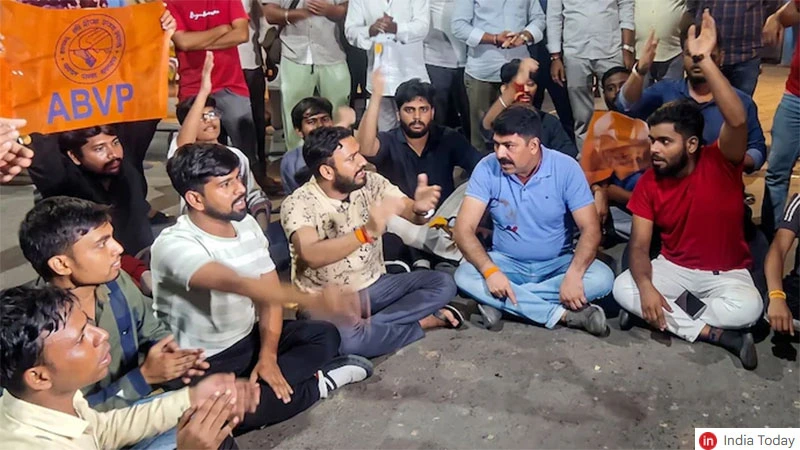
Jadavpur Campus has repeatedly become a centre of student politics, protest and political controversy. But the bigger question is whether political interference is slowly damaging the freedom and academic culture that made Jadavpur one of Bengal’s most respected institutions.
Why Jadavpur Campus Is Always Controversial?
Jadavpur Campus has once again become the centre of a heated political and academic debate. What should have remained a disagreement among students has spilled beyond the university gates, brought political leaders into the discussion and raised uncomfortable questions about outsiders, student organisations and the role of governments in education.
But the latest episode is not really about one clash. It points to a much bigger problem that Jadavpur has been facing for years.
Why does Jadavpur University repeatedly find itself at the centre of controversy? Why does every political change in Bengal eventually seem to bring a new attempt to influence the campus? And why do political parties find it so difficult to leave universities alone?
Jadavpur University Student Politics has come into the limelight over decades. Perhaps the merit and the ambiance creates an congenial environment for the students to express their views at the most vulnerable age of life.
These questions deserve more attention than another routine account of who shouted what, who pushed whom or which group held which flag.
Why does Jadavpur keep making headlines?
Jadavpur University has always been different from many other institutions in Bengal. It has a strong tradition of student politics, debate and protest. Students have historically questioned governments and challenged established political ideas. That is not necessarily a bad thing.
In fact, a university without dissent would be a rather strange place.
The problem starts when political disagreement crosses the line into intimidation or violence. It becomes even more worrying when outsiders allegedly enter the campus and when political organisations begin treating university grounds as an extension of their party offices.
The recent confrontation involving ABVP and Left-leaning student groups has once again brought this issue into focus. Reports said that clashes broke out around a General Body meeting and later spilled outside the campus. Both sides made allegations against each other, while police began examining CCTV footage and other evidence. India Today report on the Jadavpur clash
What concerns me is not which political group eventually claims victory, but whether Jadavpur Campus is slowly losing the space where students can disagree without fear.
Professor Abhijit Chakrabarti, the former Vice-Chancellor of Jadavpur University, has demanded an NIA probe. Watch his interview in Ei Samay.
What are Jadavpur alumni saying?
The reactions of Jadavpur’s well-known alumni are worth examining because they do not all come from the same political or professional background.
Singer Anupam Roy, theatre personality Suman Mukhopadhyay, actor Anindya Bose and others have expressed concern about the situation. Their individual views are different, but there is a common thread in their reactions: the university should not become a place where political confrontation destroys the academic environment. Anandabazar report on Jadavpur alumni reactions
Anupam Roy’s comments are particularly relevant to the larger debate. The ability of students to question those in power is an important part of university life. Students should not be expected to agree with a government simply because it has won an election.
At the same time, criticism does not give anyone the right to damage university property or threaten another student.
That distinction seems to be disappearing from our political conversation.
Madhumita Sarcar’s comments also point towards another side of the problem. Not every student wants to become a political activist. Some simply want to study, complete their courses, build a career and move on with their lives. Their right to remain outside political confrontation deserves equal protection.
This is why the alumni debate matters.
They are not merely commenting on one day’s incident. They are asking what kind of university Jadavpur should become.
But what about the alleged outsiders?
This is perhaps the most serious part of the entire controversy.
If outsiders actually entered Jadavpur University during the night, the administration must explain how it happened. A university campus has gates, security personnel and CCTV cameras. It is therefore reasonable to ask how people who were not supposed to be there managed to enter.
The police have reportedly been examining CCTV footage and identifying people who were allegedly involved. A Times of India report said police had identified some alleged intruders but arrests had not immediately followed while verification was continuing. Times of India report on the alleged Jadavpur intruders
This clearly calls for a proper investigation, without any political shortcut or selective approach.
If someone unlawfully entered the campus, establish it. If someone attacked students, establish it. If someone damaged property, establish it. If the allegations are false, establish that too.
The same standard should apply to everyone.
That is particularly important when the phrase anti-national activities enters the debate. The outsiders in Jadavpur University campus has raised concerns for many.
If the administration or the government has solid evidence of anti-national activity inside Jadavpur, why should it remain silent? Investigate the matter and place the facts before the public.
But if there is no evidence, then throwing around such labels simply because a student holds an unpopular political opinion is equally dangerous.
A university cannot function on political suspicion; it needs evidence before serious allegations are made.
There will always be allegations and counter-allegations, and the debate over “outsiders” is certainly not new. We have heard this argument for years. There can be a much wider discussion about who should be allowed inside a university campus and under what circumstances. But the basic question remains: why should a university campus be completely closed to outsiders?
I have personally visited Jadavpur Campus several times and never faced any such problem. Even about five years ago, I knew of a student from Shibpur B.E. College who visited Jadavpur University during a college fest. Such visits are quite common in student and campus life. I also remember visiting the Visva-Bharati campus during Holi. Nobody treated such visits as something extraordinary.
So where exactly is the problem?
The problem begins when someone enters a campus with the intention of creating trouble, disrupting academic activities or getting involved in violence. That is a completely different matter. Universities today have adequate security personnel, CCTV cameras and other safeguards. If someone misuses the openness of a campus to create disorder, the administration should identify that person and take action. But simply calling someone an “outsider” should not, by itself, become an excuse to shut the doors of a university.
Why did the MLA go there?
The presence of BJP MLA Sarbari Mukherjee has added another layer to the controversy. She has denied entering the university and said she was outside, accompanying BJP supporters near the police station. She has also rejected allegations that she provoked the violence.
Her explanation should certainly be heard before any conclusion is drawn.
But there is still a broader question that deserves an answer: why should elected politicians enter the middle of a university confrontation at all?
There can certainly be situations where an MLA has a legitimate reason to intervene, particularly when there is a serious law-and-order issue. But politicians must understand that their physical presence can change the character of a student protest very quickly.
A student demonstration can turn into a political confrontation within minutes. In this case, the presence of Sarbari Mukherjee and her fiery remarks appeared to add further fuel to an already tense situation. That raises another legitimate question: if ABVP has no organisational connection with the BJP, why did a BJP MLA need to be there at all? It is difficult to simply explain her presence by saying that she had gone there only as an MLA or out of a sense of responsibility towards her constituency. The timing and circumstances naturally invite questions.
That is precisely what governments should try to prevent.
Is BJP repeating the old political mistake?
This is where the debate becomes much more uncomfortable for the BJP.
The BJP has received an overwhelming mandate in Bengal. That gives the government the political strength to govern without constantly worrying about whether it can influence every institution.
So why not leave universities alone?
The Left had a long history of political influence over educational institutions. TMC later faced similar criticism for trying to expand its influence among students and colleges. If the BJP now follows the same path, what exactly has changed?
If the same method is followed, then only the political colour will have changed; the underlying principle will remain the same.
Recent reports about BJP MLAs and MPs being appointed as presidents of governing bodies of colleges have already triggered debate over political interference in education.
I do not believe that appointing a politician automatically makes someone incapable of contributing to education. That would be an unfair argument.
But the question is about institutional design.
Should the governing body of a college be dominated by political representatives, or should educational experience, administrative ability and institutional knowledge carry greater weight?
If the BJP wants to establish a new political culture in Bengal, this is exactly where it can demonstrate the difference.
Who exactly is ABVP?
There is another argument that needs greater clarity.
BJP leaders have repeatedly said that ABVP is not the BJP’s student wing. Shamik Bhattacharya has also made this distinction publicly, arguing that the BJP does not have a student wing and should not directly interfere in university politics. Aaj Tak Bangla report on Shamik Bhattacharya’s statement
That may be a valid organisational distinction, but politically the question will not disappear because ABVP is associated with the wider RSS ecosystem.
The debate should not get stuck in labels. The practical question is much simpler: does the organisation follow university rules and the law?
If ABVP wants to operate on a university campus, it should follow university rules and the law. If a member commits an offence, investigate the individual. If a student organisation breaks rules, take action against that organisation.
But ideological association alone cannot be treated as evidence of criminal behaviour.
The same standard should apply to the Left, TMC-linked groups and also to every organisation.
Could we get any message from the recent Zen Z movements? Better, if we learn.
Should BJP stay away from universities?
I believe it should, as far as ordinary campus politics is concerned.
And this is not because the BJP is uniquely bad.
It is because the BJP now has the opportunity to do something different.
Imagine if Suvendu Adhikari announced that his government would not use universities as political playgrounds. Imagine if he told BJP leaders that their job was to improve education, not control student politics. But these are not imaginations. BJP leaders in their pre-poll campaign uttered such narratives frequently.
Had they really implemented, that would send a much stronger message than another political speech.
Shamik Bhattacharya has spoken about the importance of the right to dissent in a democracy and said that the government should not interfere inside university politics.
The real question, however, is whether that principle will actually be followed when the political pressure becomes difficult to handle.
What about JNU?
Jadavpur is not alone in facing this problem.
Jawaharlal Nehru University has also become a national symbol of ideological conflict, student politics and debates over the limits of political influence in higher education.
JNU has always been politically active. That does not make it a failed university.
A university should be politically aware. Students should understand politics. They should debate capitalism, socialism, nationalism, secularism, communism, liberalism and every other major idea. Didn’t we get any message from the Gen Z Protests?
But there is a difference between discussing an ideology and imposing it.
That difference is becoming increasingly important in Indian universities.
The same principle should apply to Jadavpur Campus.
A student should be free to support BJP or TMC or the Left. Another may support nobody. Someone else may simply want to study engineering and leave politics outside the hostel room. Indian constitution has given us that right.
All of them deserve the same protection.
Nevertheless, we should also look at the quality of students these universities are producing. Their alumni are making their mark not only across India but also in many leading institutions and organisations around the world. Political parties therefore need to decide what they really want for these campuses: a free environment where young minds can grow, question and explore, or a politically controlled space where their development is shaped by vested interests.
Has Suvendu Adhikari forgotten the names of Antara Acharya, Rajarshi Mitra, Dhaval Jain and Mithun Biswas? These are IAS officers currently holding important positions in his administration, and they share something in common: a Jadavpur University background. Their careers are a reminder that the university’s contribution extends far beyond campus politics. Its students and alumni have gone on to occupy important positions in administration and public life even in his tenure.
Education should not become a party battlefield
The basic purpose of a university is surprisingly easy to forget.
Students come to a university to learn, researchers to discover and teachers to teach. All of them, however, need an environment where disagreement is possible without fear or political pressure. Rabindranath Tagore has nourished the idea of free thinking in Shantiniketan.
Political awareness is not the enemy of education. In fact, it can make education richer. The problem is political control.
Once students begin thinking that supporting the “wrong” organisation may put them at risk, free thinking begins to disappear. If teachers fear that a political comment may affect their position, academic independence weakens.
When the administrators start worrying about which party will be angry, institutional autonomy becomes meaningless. We should have learnt a lesson from the shocking incident in which cash and arms were reportedly recovered from a reputed college in central Kolkata.
That is why the issue is bigger than one Jadavpur University controversy.
It is about whether Bengal’s universities can remain spaces for independent thought.
TMC tried. Will BJP repeat it?
TMC has tried to build influence in educational institutions. It did not always succeed, particularly in a politically conscious campus such as Jadavpur.
That should have been a lesson.
Political parties cannot manufacture intellectual loyalty simply through organisational pressure.
Political parties may try to influence students, but intellectually active campuses rarely remain under anyone’s permanent control. The BJP should understand that reality before attempting to repeat an old political model.
If it believes that its ideas are strong, let students choose them freely.
If ABVP believes it has a better vision for students, it should convince them through ideas and debate. And if the RSS wants to expand its influence among young people, let it prepare students to clear the entrance examinations and enter the university on merit, through the main gate in broad daylight. There is no need to enter by climbing walls under the cover of darkness at midnight. That is not how a student movement should earn legitimacy.
If Left organisations believe their politics is stronger, let them convince students.
There is no need for outsiders, intimidation or political pressure.
Win the argument. Do not try to control the audience.
That is how a university should function.
The students have raised certain queries to Suvendu Adhikari regarding vandalism of outsiders (ABVP supporters), labeling it a mob lynching.
What should happen now?
The immediate priority should be an impartial investigation into the violence and alleged outsider entry. CCTV footage should be examined, witnesses should be heard and anyone found responsible should face the law. If the University takes about 36 hours to file a police complaint after the campus violence, it raises more questions than it answers.
But the government should also look beyond the immediate crisis.
Jadavpur needs secure campuses, transparent student elections, functioning administrative systems and an environment where students can disagree without violence. These are not impossible goals.
The government can also establish a clear rule for political leaders. MLAs and MPs can intervene when there is a genuine public emergency, but routine campus politics should remain the responsibility of the university community.
That would be a healthy boundary.
More importantly, the same rule must apply to every political party.
We shouldn’t forget the dirty face of political interference in Jadavpur University that was demonstrated on December 30, 1970. Professor Gopal Chandra Sen, the interim Vice-Chancellor of Jadavpur University, was murdered amidst Naxalite student protests and exam boycott calls, which he had opposed.
Knowledge Mart Final Thoughts
The real test for Suvendu Adhikari is not whether he can weaken TMC further. Bengal has already seen enough political battles. The larger test is whether his government can move its attention towards development, institutional reform and better governance rather than allowing every controversy to become another chapter in the TMC split story.
Jadavpur Campus gives him an opportunity to prove that the political culture has genuinely changed.
He could tell BJP leaders to stay away from routine campus politics. He could encourage universities to conduct student elections fairly. He could insist that allegations of anti-national activity must be supported by evidence. And he could make it clear that violence, whether committed by ABVP, Left groups, TMC-linked organisations or anyone else, will not be tolerated.
That would be real governance.
The Left politicised education in its own way. It was named as Anilayan. TMC followed its own version of the same approach and infamously referred as Mamatayan. The BJP, as the new Government, now has a choice.
It can follow the political tradition that Bengal has already experienced for decades, or it can establish a different relationship between government and higher education.
For Knowledge Mart, the answer is obvious. Universities should not belong to the Left, TMC, BJP, RSS, ABVP or any other political organisation.
They belong to students, teachers, researchers and society.
A university must remain a place where an unpopular idea can survive long enough to be challenged.
That is what free thinking means.
And perhaps that is the one thing Jadavpur Campus needs more than another political victory.
An Appeal at last: West Bengal still draws much of its identity from its past legacy, not the present. Jadavpur Campus is one of the few institutions that continues to represent a strong sense of Bengali pride while remaining relevant in the present. That is precisely why it should be protected, not weakened by political interference. We should preserve what still works rather than allowing narrow political interests to destroy one of Bengal’s most respected institutions.
10 Key Takeaways
- Jadavpur Campus has once again become a flashpoint for political and academic controversy.
- The real concern is not the latest clash alone, but the growing politicisation of education.
- Jadavpur’s tradition of student protest and dissent is valuable, but violence and intimidation cannot be justified.
- Alumni reactions show broad concern that political confrontation should not destroy the university’s academic environment.
- Allegations of outsiders entering the campus at night require a transparent and impartial investigation.
- If the government has evidence of anti-national activities, it should present the evidence and take lawful action rather than relying on political allegations.
- The presence of elected politicians during campus tensions raises legitimate questions about political interference in university affairs.
- The BJP has an opportunity to avoid repeating the mistakes associated with the Left and TMC’s politicisation of education.
- ABVP, BJP and RSS may have organisational distinctions, but all political and student organisations should be judged by the same standards: law, evidence and campus rules.
- Suvendu Adhikari’s real test is governance, not political conquest. Keeping universities independent could help establish a genuine break from Bengal’s tradition of political control over education.
[…]Jadavpur Campus: Why Is It Always on Fire? Jadavpur Campus remains at the centre of protests and controversies. Explore why the campus is always on fire and what its star alumni have to say.[…]
[…]Jadavpur Campus: Why Is It Always on Fire? Jadavpur Campus remains at the centre of protests and controversies. Explore why the campus is always on fire and what its star alumni have to say.[…]