Bengal SIR Voter Deletion: The Big Truth
Nov 04, 2026 - By Ashutosh Roy PoliticsElection AnalysisRegional UpdatesWest Bengal Politics
Bengal SIR Voter Deletion: Who Is to Blame?
What is all this fuss about Bengal SIR Voter Deletion? A report by The Indian Express about 16.10 lakh appeals seeking the removal of voters whose inclusion had already been approved raises an important question. Were these people actually removed from the electoral roll before the 2026 Assembly election? The answer is no. Their names remained on the electoral roll, and the Election Commission subsequently informed the Supreme Court that they were entitled to vote. An appeal against someone’s inclusion is not the same thing as deleting that person’s name. So how does this particular figure establish that these voters were prevented from exercising their franchise?
Today, Mamata Banerjee, now the former Chief Minister following her party’s electoral defeat, has found an opportunity to join the campaign demanding the resignation of Chief Election Commissioner Gyanesh Kumar. But does she have an explanation for the manner in which she clung to office after the election defeat? She has been criticising Gyanesh Kumar for quite some time, even calling him “Vanish Kumar”. But the intensity of her criticism has increased considerably after her electoral defeat. Is that merely a coincidence?
It is true that the Trinamool Congress still has 80 MLAs in the Assembly. The party also secured more than 40 per cent of the votes. Are all these elected representatives going to raise the same allegations? The electorate did not completely abandon the Trinamool Congress. But Mamata failed to retain power. Whether Abhishek Banerjee deserves praise for standing beside his aunt and fighting like a tiger is a different matter. So is the BJP’s demonstrated ability to break political parties and attract their leaders. These are separate political questions.
A few days ago, I also saw Shobhandeb Chattopadhyay, a veteran politician considered close to Mamata, making similar allegations. I would like to ask him one simple question: how did he manage to win his election? Or are we expected to behave like characters in Hirak Rajar Deshe, endlessly nodding in agreement with the queen and repeating, “Whatever the queen says is right”?
Mamata’s New Political Theatre in Delhi
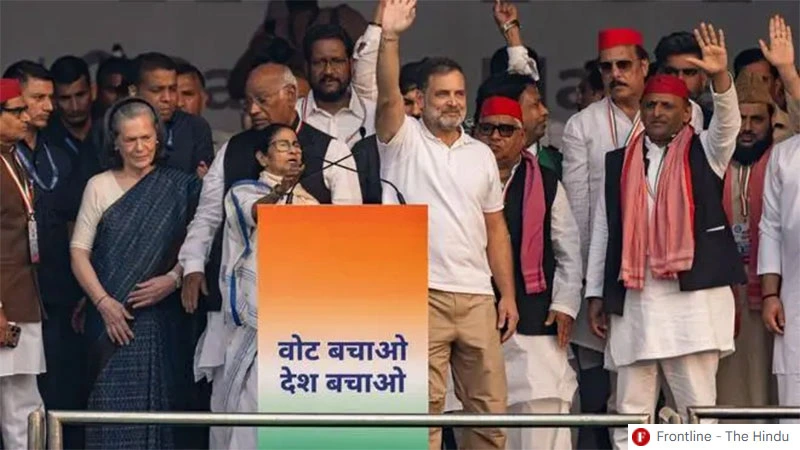
There is a Hemanta Mukherjee song whose sentiment can be loosely described as standing behind one’s own political camp. Today, Mamata Banerjee has joined the Opposition’s platform in Delhi, apparently finding an opportunity in troubled political waters. She is now sharing the stage with Rahul Gandhi and other INDIA bloc leaders.
What makes the development interesting is the political history behind it. Mamata has repeatedly resisted accepting Congress leadership within the INDIA alliance. On several occasions, she tried to position herself as an independent power centre within the Opposition bloc. There were also serious differences over seat-sharing and political strategy.
Now, after the Bengal defeat, she is standing on the same platform as Rahul Gandhi. At the Ramlila Maidan rally on November 1, 2026, she joined other Opposition leaders in demanding Gyanesh Kumar’s resignation and alleging electoral irregularities. She also spoke about the need for Opposition unity. The rally was covered by The Indian Express and other national news outlets.
At the same time, there is an unmistakable attempt to project a new generation of Opposition leadership. Rahul Gandhi, Akhilesh Yadav and Tejashwi Yadav are being presented as young political fighters, while Abhishek Banerjee is also being placed in that company.
I do not know exactly which major political battle Abhishek has fought, when he faced a police baton charge, or when he voluntarily courted arrest for a political cause.
Perhaps somebody can enlighten me.
There is nothing wrong with promoting a young political leader. But political credentials cannot be manufactured simply by sharing a stage with established leaders. A leader’s political standing has to be established through a record of public struggle, organisation and accountability.
For years, Mamata has been accused by her political opponents of undermining Opposition unity, particularly by refusing to accept Congress leadership. Whether one agrees with every such accusation or not, her political history does not provide much assurance that today’s arrangement will necessarily survive tomorrow’s differences. What guarantee is there that she will not return to the same politics of competing leadership and political one-upmanship?
Political Analyst, Rajat Sethi, has pointed out correctly in India Today debate that the oppositions have been united only after massive electoral losses. Knowledge Mart has also echoed the same at INDIA Bloc: The Wail of the Losers Now, a long back.
Let Us Look at the Facts Behind Bengal SIR
Enough of political theatre. Let us examine the figures and the actual process behind the Bengal SIR Voter Deletion controversy.
First, there were approximately 58 lakh names deleted in the ASDD category during the enumeration stage. ASDD refers to electors identified as Absent, Shifted, Dead or Duplicate. Booth Level Officers were involved in the enumeration exercise, and the relevant lists were made available for scrutiny through the booth-level process, including interaction with Booth Level Agents.
There should be no automatic presumption that every deletion in this category was wrong. If a person has died, permanently shifted or has been enrolled more than once, retaining that name on the electoral roll serves no democratic purpose. An electoral roll is not a family heirloom that must preserve every name forever.
Of course, this does not mean that individual mistakes were impossible. A person wrongly classified as absent or shifted has every right to challenge the decision. Transparency and an effective correction mechanism are essential. But the existence of individual errors does not establish that the entire exercise was illegitimate.
The real controversy intensified when the Election Commission introduced the category of Logical Discrepancy. Nearly one and a half crore electors were asked to provide documents to establish their eligibility or resolve discrepancies in their records.
I have written about this earlier, and I was also among those who had to go through the exercise.
There is no denying that the process involved considerable inconvenience. Public money was spent, and ordinary citizens had to make repeated efforts to produce documents and establish information that should ideally have been available in government records. We can certainly question whether the Commission could have handled the exercise more efficiently. I would certainly call some of this unnecessary harassment. But inconvenience and illegality are not necessarily the same thing.
The figures released during the different stages of the exercise should not be mixed up. The number of cases examined, the number of names deleted at an interim stage and the number eventually referred for judicial adjudication represent different stages of the process. Treating them as one final deletion figure only adds to the confusion.
Read: SIR Deletions: The Shocking Truth in India.
Who Actually Ordered the 27.16 Lakh Deletions?
This is the most important question in the entire controversy.
After the Election Commission’s exercise and the continuing litigation, the Supreme Court intervened. On February 20, 2026, the Court directed the Chief Justice of the Calcutta High Court to arrange for judicial officers to adjudicate the eligibility of the remaining 60,06,675 electors who had been placed under adjudication over logical discrepancies.
Approximately 700 judicial officers, including officers from neighbouring Jharkhand and Odisha, were involved in the exercise. They examined the records and documents and decided whether the concerned electors should be retained on the electoral roll.
The outcome was significant. The judicial officers ordered the deletion of exactly 27,16,393 names. Approximately 32.9 lakh electors were found eligible and retained.
These were the figures reported in the initial account of the judicial adjudication outcome by The Indian Express. Later data releases have reported updated totals, so figures from different reporting stages should not be combined as though they were one set of final numbers.
Now, let us understand the distinction. The Election Commission identified the cases and the Supreme Court arranged for judicial adjudication. The final decisions in these cases were taken by judicial officers. The 27 lakh deletions were not 27 lakh individual deletion orders personally issued by Chief Election Commissioner Gyanesh Kumar.
Therefore, attributing every one of these 27 lakh judicial decisions personally to the Election Commission is factually misleading. If someone disagrees with the judicial officers’ decisions, the appropriate course is to examine the individual cases and the available appellate remedies. Political allegations cannot substitute for that exercise.
However, there is another question worth examining. How exactly were the 60 lakh cases selected and transferred to the judicial officers? Some investigative reports have raised questions about whether certain cases already examined by Electoral Registration Officers were subsequently moved into the adjudication category. The Wire’s investigation has raised questions about the process. That deserves a proper explanation from the authorities. The role of the Commission in identifying and referring cases should not be confused with the judicial officers’ authority to decide them.
Still, we had recorded our objections in Murder of Democracy in Bengal 2026 Now.
The 16.10 Lakh Appeals: Were These Voters on the Electoral Roll?
Now comes the figure that has given a fresh lease of political life to the Bengal SIR Voter Deletion controversy.
An Indian Express report revealed that, out of 38.31 lakh appeals filed before the appellate tribunals, 22,21,118 were filed by voters whose names had been deleted and who wanted to be restored to the electoral roll. Another 16,10,311 appeals were filed against the inclusion of voters whose eligibility had been approved by judicial officers.
Let us be absolutely clear about the second category. These 16.10 lakh voters were not people whose names had already been deleted. They were among those who had been examined by judicial officers and found eligible. Their names had been retained in the electoral roll. The appeals were seeking their subsequent removal.
And what happened before the Assembly election? These appeals did not automatically delete the names. The Election Commission subsequently informed the Supreme Court that the voters whose inclusion had been challenged were nevertheless entitled to exercise their franchise in the 2026 Assembly election. The Print reported this clarification.
This is the central point that seems to get lost in the political noise. These 16.10 lakh names were on the electoral roll for the election. Filing an appeal against their inclusion did not, by itself, deprive them of their voting rights. Whether every one of them actually turned up and voted is a different question. But it is factually incorrect to suggest that all these voters were removed or prevented from voting merely because appeals had been filed against them.
There is, however, a serious administrative question. Who filed these appeals, and under whose authority? In a subsequent affidavit before the Supreme Court, the Election Commission clarified that officers from the office of the Chief Electoral Officer, West Bengal, had filed the appeals in their capacity as authorities under the Representation of the People Act. The Commission said these matters had not been brought before it. The clarification followed a communication from the State CEO’s office dated October 22, 2026. Bar and Bench reported the details of the affidavit.
The affidavit does not identify who in the CEO’s office authorised the filing of these appeals, how that decision was taken or the specific grounds for each challenge. Those are legitimate questions. The fact that the officers claimed statutory authority does not make the need for transparency disappear. LiveLaw’s report on the ECI affidavit also provides details of the appeal figures.
So, let us not confuse the two categories. The 27,16,393 names were ordered to be deleted by judicial officers. The 16,10,311 appeals were challenges against voters whose inclusion had been approved. These are two different sets of people and two different procedural developments. Combining them to suggest that all these voters were prevented from voting would be misleading.
What About the Role of Bengal’s Bureaucracy?
There is another aspect of the SIR exercise that deserves attention. The documents and records used during the verification process were handled by government officials, including personnel working under the state administration. Booth Level Officers, Electoral Registration Officers and Assistant Electoral Registration Officers played important roles in the exercise.
Remember the movement called the BLO Adhikar Mancha? The working conditions and grievances of Booth Level Officers had become a subject of public discussion. These employees were under considerable pressure during the SIR exercise. They were expected to complete an enormous amount of work within strict deadlines.
It is also worth asking how freely the bureaucracy in West Bengal can express disagreement with the political establishment. Anyone who has followed Bengal politics closely knows that allegations of punitive or inconvenient postings against officials who fall out of favour have frequently surfaced.
If documents were incorrectly uploaded, if records were mishandled, or if names were transferred into adjudication without proper scrutiny, the responsibility of the officials involved must also be examined. We cannot hold judicial officers responsible for decisions they did not make, nor can we absolve every administrative authority merely because the final adjudication was judicial.
Ultimately, the electoral roll revision must be judged by the quality of its records, transparency of its procedures, accuracy of its decisions and effectiveness of its appeal mechanism. Political loyalty cannot be the standard by which government employees or election officials are judged.
Mamata’s Politics of Not Knowing When to Stop
Those who have followed Mamata Banerjee’s political career closely will probably recognise one recurring problem. She often seems unable to understand when it is time to stop.
Look at Singur. Mamata achieved her political objective and eventually reached Writers’ Buildings. But what happened to Singur and West Bengal in the process? The consequences of that political battle continued long after the initial victory.
Even after the Trinamool Congress suffered a major electoral defeat, she expected party leaders and workers to stand up and welcome Abhishek Banerjee. There is nothing wrong with appreciating a family member or a political colleague. But after such a result, should the first priority not have been to understand why the electorate had delivered such a verdict?
Instead of conducting a serious assessment of the reasons behind the defeat, the party leadership appears to have spent considerable energy protecting its internal hierarchy and political image. It is hardly surprising that leaders who had stood beside Mamata for years might begin to reconsider their political future.
Her repeated disagreements with Opposition partners have also damaged the credibility of her claims about Opposition unity. She has often wanted the benefits of a united Opposition without necessarily accepting the compromises that such unity demands.
Now she is back on a common platform with Rahul Gandhi. Perhaps political circumstances have changed. Perhaps the need of the hour has forced a change of approach. But political alliances require consistency, not merely convenience.
The Numbers That Matter: Separate Facts, Separate Questions
Before drawing conclusions, it is worth putting the principal figures in perspective. The political debate becomes unnecessarily confusing when different categories of voters and different stages of the SIR process are mixed together.
- Approximately 58 lakh ASDD deletions: Names categorised as Absent, Shifted, Dead or Duplicate during the enumeration stage. Individual errors could still be challenged.
- 60,06,675 electors under adjudication: These were the cases referred for judicial examination following the Supreme Court’s intervention.
- 27,16,393 deletions: The initial reported outcome of the judicial adjudication, with judicial officers finding these electors ineligible and ordering their names deleted.
- Approximately 32.9 lakh inclusions: The corresponding initial reported figure for electors found eligible and retained.
- 16,10,311 appeals against inclusion: These appeals sought the removal of voters whose inclusion had been approved. Their names remained on the electoral roll for the 2026 Assembly election, and the ECI confirmed their eligibility to vote.
- 22,21,118 appeals against exclusion: These were filed by voters whose names had been deleted and who sought restoration to the electoral roll.
The distinction between these figures is essential. The 27.16 lakh deletions were the outcome of judicial adjudication. The 16.10 lakh appeals against inclusion did not automatically remove the concerned voters from the electoral roll. The 22.21 lakh appeals, on the other hand, concerned people who had already been excluded and wanted their names restored.
There are legitimate questions about the selection of cases, documentation requirements, administrative handling and the filing of appeals. But those questions must be examined separately. One cannot turn every appeal into a completed deletion or every deletion into an allegation of deliberate electoral manipulation.
For a wider examination of the political and democratic implications, readers can also refer to our earlier articles on the Bengal voter roll controversy and electoral rights and why Mamata Banerjee lost power.
The Political Theatre Continues
Seeing Mamata Banerjee on the Opposition stage at Ramlila Maidan, one could not help noticing the contrast. A politician who once refused to accept Congress leadership within the INDIA bloc is now sharing a platform with Rahul Gandhi and appealing for Opposition unity. We have explained INDIA Bloc Betrayal: How the Alliance Broke.
There is nothing inherently wrong with changing political positions. Politics is not a permanent marriage contract. But when a leader repeatedly changes the terms of political cooperation, questions about credibility are inevitable.
And what about Abhishek Banerjee? The effort to present him as a national youth leader alongside Rahul Gandhi, Akhilesh Yadav and Tejashwi Yadav is understandable as a political strategy. But leadership is not inherited through photographs, stage appearances or family connections. It has to be earned.
Meanwhile, the central questions about the SIR remain straightforward. Who identified the disputed cases? Who referred them for adjudication? Who decided the final eligibility of the 60 lakh voters? And what exactly happened to the 16 lakh voters against whom appeals were filed?
These questions deserve factual answers, not slogans.
The BJP’s electoral victory does not make every action of the Election Commission automatically correct. Similarly, Mamata Banerjee’s electoral defeat does not make every allegation she raises automatically true.
But if the 27 lakh deletions were ordered by judicial officers under the Supreme Court’s directions, the responsibility for those individual decisions cannot simply be transferred to Gyanesh Kumar. If there were administrative irregularities in the selection or transfer of cases, those must be investigated separately. The appeals filed by officers of the State CEO’s office also require transparency about who authorised them and on what grounds.
For the moment, Bengal’s SIR voter deletion controversy has become a political theatre in which every party is trying to occupy the moral high ground. Mamata Banerjee, unable to retain her political foothold in Bengal, has now found a national platform in Delhi.
Whether this is the beginning of a genuine democratic movement or another attempt to revive a fading political narrative remains to be seen.
One thing is certain: electoral rolls must be accurate, voting rights must be protected, and every genuine grievance must receive justice. But democracy also demands that political leaders accept facts, take responsibility for their own decisions and respect the verdict of the electorate.
Otherwise, the show will go on. Only the stage will change.