Teachers' Political Rights: Bengal's New Ban
Nov 03, 2026 - By Ashutosh Roy PoliticsEducationRegional UpdatesWest Bengal Politics
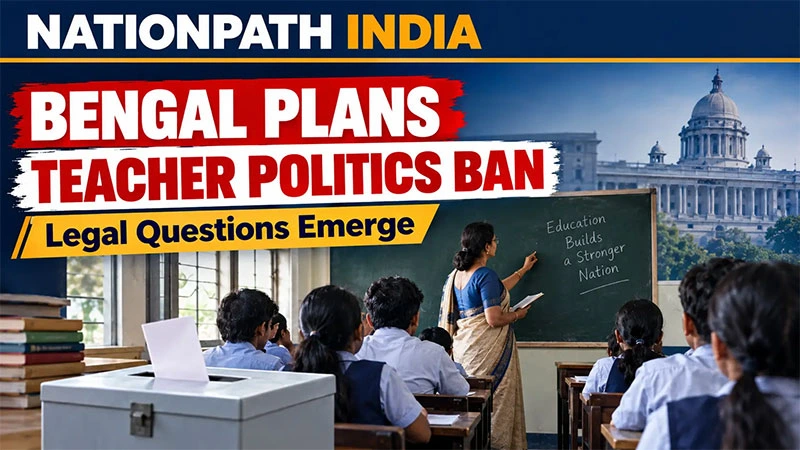
Teachers’ Political Rights Under Threat in Bengal?
The West Bengal government’s decision to restrict the political activities of schoolteachers has opened up a debate that goes far beyond a service rule. It raises fundamental questions about teachers’ political rights, freedom of expression and the future of education in Bengal. The irony is difficult to miss. A government that wants to keep teachers away from politics has, at the same time, appointed political personalities to head college governing bodies.
Is this really a departure from the political culture that Bengal has witnessed under the CPM and the Trinamool Congress, or simply the old wine in a new bottle?
The Cabinet decision announced on October 28, 2026, initially concerned future schoolteacher recruits through the West Bengal School Service Commission (SSC). Chief Minister Suvendu Adhikari said that newly recruited teachers would not be allowed to participate directly in politics or contest elections. Existing teachers, including those already holding elected positions, would remain outside this restriction.
School Education Minister Dipak Barman subsequently indicated that the government intended to prohibit political activities by teaching and non-teaching staff in government-run and government-aided schools, with the necessary rules to be framed. This difference in the public explanations makes the precise scope of the proposed restrictions particularly important. The Indian Express reported the Chief Minister’s clarification, while The Telegraph covered the Education Minister’s subsequent statement.
There is another proposal accompanying this decision. The government is considering linking teachers’ annual salary increments and promotions to the academic performance of their students. Since teachers have been closely associated with Bengal’s political life for decades, both announcements have naturally generated considerable discussion. It is worth mentioning that School Education Minister Dipak Barman himself comes from a school-teaching background.
The restrictions on future recruits, the possible extension to different categories of school staff and the proposed performance-based accountability system deserve separate examination.
But first, let us look at the larger question: what exactly does the new government want to achieve in the field of education?
Where Is the Education Reform Blueprint?
Over the past five decades, the standard of education in Bengal has steadily declined. The last 15 years, in particular, have witnessed a serious deterioration.
When the new BJP government came to power, many of us expected it to undertake genuine education reform in West Bengal. We hoped it would go beyond changing a few administrative arrangements and attempt a complete overhaul of the education system, from primary schools to colleges and universities. Such a transformation requires a comprehensive blueprint, not a collection of isolated decisions.
The government could have brought together successful Bengali educationists, academics and distinguished professionals, including those who have made their mark outside Bengal and abroad, to discuss how the state’s education system could be rebuilt. A serious consultation involving people with experience in education, research, administration and institutional management could have produced a long-term roadmap.
- Have we seen anything substantial in that direction?
- Where is the consultation?
- Where is the long-term vision?
- Where is the roadmap for improving teaching standards, school infrastructure, research and academic administration?
So far, what we have largely seen are administrative interventions and cosmetic changes. Will transferring teachers or restricting their political activities take us even an inch closer to genuine educational improvement? These measures may be presented as attempts to restore discipline, but administrative control is not the same as education reform. Bengal needs a serious plan that addresses the actual problems faced by schools, teachers and students. It needs better infrastructure, adequate teaching staff, quality teacher training, accountability and an academic environment where merit matters more than political connections.
Read: Education System in West Bengal: The Crisis.
Consider the appointment of BJP leaders and political personalities to head college governing bodies. That looks suspiciously like an attempt to sell old wine in a new bottle. The CPM once treated educational institutions as political strongholds. The Trinamool Congress followed much the same path.
Has the new BJP government chosen a fundamentally different approach, or are we witnessing another version of the same political culture? Bengal’s political landscape has changed considerably over the years, but the tendency to treat public institutions as extensions of political power remains an important subject of discussion.
I have examined the broader political transition in my article West Bengal Political Landscape.
There were expectations, and there was an opportunity to do things differently. Let me make one thing clear: I am not questioning the individual qualifications of those appointed to college governing bodies. There are distinguished names among them, including Swapan Dasgupta and Priyanka Tibrewal.
My objection is not about their personal credentials. It is about the principle behind political appointments in educational institutions. As reported by The Telegraph, a large number of college governing body presidents were appointed from among local BJP MLAs, ministers and senior party leaders. Even if some appointees are highly qualified, the larger question remains: should political affiliation become the guiding principle for administering educational institutions?
This is particularly relevant when the same government wants to restrict the political participation of teachers. If political neutrality is the principle, it should apply consistently to the entire educational administration. The government cannot expect teachers to stay away from politics while political leaders occupy influential positions within colleges. This contradiction deserves more attention than the announcement of another service rule.
Teachers and Politics: A Long Bengal Tradition
Let us now examine the issue from the perspective of both principle and practical experience. Teachers and academics have made significant contributions to Bengal’s political and intellectual life. Names such as Gopal Das Nag, Dr. Asim Dasgupta, Dr. Ashok Mitra and Shambhu Ghosh come to mind. These personalities remind us that teaching and academic life have historically been closely connected with public affairs in Bengal.
But here is an important question: did they have to abandon their teaching or academic backgrounds before contributing to politics? Is there something inherently wrong with an educated person participating in democratic life while remaining associated with the teaching profession?
Why look only at Bengal? Consider Dr Manmohan Singh. India’s economic transformation, particularly the liberalisation process that began in 1991, was steered by a person with a distinguished academic background. Before entering the highest levels of government, Singh had taught at Panjab University and the Delhi School of Economics.
His academic career is documented in his official Prime Minister’s profile. His example reminds us that academic experience and public life need not be mutually exclusive. A teacher’s professional responsibilities must certainly be respected, but that does not automatically make democratic participation incompatible with teaching.
Of course, nobody is suggesting that classrooms should become party offices or that students should be subjected to political propaganda. Teachers must maintain professional discipline, treat students fairly and ensure that their personal political preferences do not interfere with academic responsibilities. But that is a different question from whether they should have the freedom to participate in democratic politics outside their professional duties.
Political neutrality in educational institutions and the complete denial of political participation to teachers are not necessarily the same thing. A government can insist that teaching responsibilities come first without automatically treating every form of political participation as professional misconduct.
This distinction is central to the debate over teachers’ political rights. There is a legitimate case for regulating the misuse of official authority, political campaigning during school hours and the involvement of students in partisan activities. But the government must explain precisely what it intends to prohibit and why the restriction is necessary. It must also distinguish between professional conduct inside educational institutions and an individual’s participation in democratic life outside the workplace.
One Rule for the Government, Another for Teachers?
Now comes the most important question. If the government’s intention is genuinely to free educational institutions from political interference, why are BJP leaders and political personalities being placed at the helm of college governing bodies? If the government believes that education must remain free from politics, I would wholeheartedly support that objective. But the principle must apply consistently. You cannot practise one set of rules at the top and impose another on those below. In simple words, practise what you preach.
The BJP government in Bengal should be judged not merely by its electoral promises but also by the way it handles public institutions. The CPM and the TMC both faced criticism for allowing political considerations to influence educational institutions. If the BJP now follows a similar approach, what exactly has changed? Merely replacing one party’s political representatives with another party’s representatives does not amount to institutional reform. I have discussed the broader accountability challenge in BJP in Bengal: The Fairness Test. The test of a new government is not simply whether it replaces the people appointed by its predecessors, but whether it establishes a different institutional culture.
There is a difference between appointing a qualified individual and making political affiliation or political proximity the guiding principle of appointments. I have no objection to a distinguished academic or professional being entrusted with an institutional responsibility. But the government must explain why political leaders should occupy so many governing body positions in the first place. The issue is institutional independence, not an individual’s personal worth. Educational institutions need people who understand academic administration and can protect institutional autonomy, irrespective of their political affiliations.
The University Transfer Bill has also raised concerns about university autonomy and the service conditions of academic and non-academic employees. The legislation allowing inter-university transfers of employees across state-run universities has brought the relationship between the government and higher education institutions into the spotlight. Taken together with the latest decision on teachers’ political activities, it raises a larger question: how much independence will educational institutions retain in their academic and administrative affairs?
Why Should Two Teachers Have Different Political Rights?
There is another problem with the government’s proposed arrangement. The Chief Minister clarified that the restrictions would apply to future recruits through the School Service Commission and would not affect existing teachers, including those already involved in politics or holding elected positions. The government has argued that existing employees cannot be subjected retrospectively to a condition that was not part of their appointment terms. That may explain the administrative reasoning, but it does not remove the practical problem.
Imagine two teachers sitting beside each other in the same school, performing identical duties and drawing salaries under the same service structure. One was appointed before the new rule came into force and may participate in political activities, while the other joined later and is prohibited from doing so. One may be able to attend a party procession or participate in political activities, while the other may face disciplinary consequences for doing the same thing.
- How is this arrangement supposed to work in practice?
- Will schools maintain two categories of teachers, one with political rights and another without them?
- Will political participation become a privilege determined by the date on which someone received an appointment letter?
The question is not whether every teacher should be allowed to neglect professional responsibilities in the name of politics. That would be unreasonable. The question is whether the government can create such a sharp distinction between people performing the same public service. The detailed rules will have to clarify the scope of the restriction, including what constitutes direct political participation and whether membership of political organisations, participation in demonstrations or other forms of civic activity will be treated differently. The government should not leave teachers and prospective candidates guessing about the boundaries of their rights and responsibilities.
There is also a constitutional dimension. Freedom of expression and political participation are important democratic principles, although they are subject to reasonable legal restrictions in particular employment contexts. The legal position of government employees, government-aided school employees and other categories of staff may not be identical. The government must therefore explain the legal foundation of its decision rather than assume that a Cabinet announcement alone settles the matter. The Education Minister has also clarified that teachers may participate in non-political organisations, but the distinction between political and non-political participation will need to be made clear in the formal rules.
Will Performance-Based Promotions Improve Education?
The government’s proposal to link teachers’ annual increments and promotions to students’ academic performance deserves separate attention. At first glance, accountability sounds reasonable. Teachers should certainly be accountable for the quality of education they provide. If students are unable to acquire basic reading, writing and mathematical skills, the reasons must be investigated. But can student performance be treated as a direct measure of an individual teacher’s contribution? A child’s learning depends on several factors, including family background, school infrastructure, attendance, availability of learning materials, classroom size and the quality of the wider education system.
Suppose 15 out of 20 students in a class fail to acquire basic reading skills. Should the teacher automatically be held responsible? What if the school lacks adequate classrooms, teaching materials or sufficient staff? What if students have irregular attendance or face difficulties outside school? A fair accountability mechanism must consider these circumstances.
Otherwise, performance-linked increments may become another administrative tool for shifting the responsibility for systemic failures onto individual teachers. The government should first establish transparent evaluation standards, provide adequate resources and ensure that teachers receive the necessary support.
There is a fundamental difference between holding teachers accountable and making them convenient scapegoats. If the government wants better learning outcomes, it must invest in teacher training, school infrastructure, regular assessment and academic support. Merely threatening to withhold increments will not necessarily improve classroom learning. The proposed system should therefore be debated with teachers, educationists and parents before implementation. As the Times of India has reported, the government is considering a wider teacher-accountability framework, but the assessment criteria and implementation details have not yet been established.
Will the Courts Have the Final Say?
It would not be surprising if the decision eventually faces a legal challenge. Questions about the scope of the restrictions, their application to different categories of teachers and their compatibility with constitutional protections may well reach the courts. The government should anticipate these questions and frame its rules carefully rather than allow uncertainty to continue. A policy affecting the professional and democratic rights of thousands of people deserves proper consultation and a clear legal foundation. It would be unfortunate if a decision announced in the name of educational reform ended up creating another prolonged legal dispute.
However, I would also like to make another point. In a democracy, the role of the judiciary is important, but it should not become a substitute for responsible lawmaking. If every controversial decision has to be settled by the courts, what exactly are our elected representatives and legislators doing? The responsibility of the government is to examine the legal, practical and social implications of its decisions before announcing them. Passing the responsibility to the judiciary whenever a controversy arises is hardly a sign of effective governance.
What This Debate Reveals
- West Bengal’s Cabinet has approved restrictions on direct political participation by future schoolteacher recruits. The precise scope of the rules and their implementation still require clarification.
- The government is also considering linking teachers’ annual salary increments and promotions to students’ learning outcomes.
- Teachers have historically contributed to Bengal’s political and intellectual life. Professional discipline and democratic participation need not automatically be treated as contradictory.
- Political neutrality in schools is a legitimate objective, but political appointments to college governing bodies raise questions about the consistency of that principle.
- The University Transfer Bill and the proposed restrictions on teachers bring university autonomy, institutional independence and academic freedom into the wider debate.
- Different rules for existing teachers and future recruits may create practical and legal complications.
- Genuine education reform requires a comprehensive blueprint covering school infrastructure, teacher training, academic standards, accountability and higher education.
Education Reform or Political Control?
Let me be clear. If the government genuinely wants to make educational institutions free from political interference, I will have no hesitation in supporting that objective. Bengal has suffered enough from the practice of turning schools, colleges and universities into extensions of political parties. But the government must demonstrate that it is serious about this principle. It cannot demand political neutrality from teachers while allowing political considerations to influence appointments to educational institutions. Nor can it claim to be transforming education simply by introducing restrictions on teachers or transferring university employees.
The real challenge is much bigger. Bengal needs better schools, qualified and motivated teachers, accountable administration, academic freedom, improved infrastructure and a clear vision for higher education. It needs a system that encourages merit rather than political loyalty.
The government must decide whether it wants to build institutions that can function independently or merely replace one form of political influence with another. The history of Bengal’s education system offers enough lessons about what happens when political control becomes more important than academic excellence.
The question before the government is therefore quite simple: what should come first? Putting shackles on teachers’ political participation, or undertaking the difficult task of genuinely improving the quality of education? I believe the government should get its priorities right. Bengal does not need another experiment in political control of education. It needs genuine education reform.