Form 6 Controversy: A Voter Rights Crisis
Oct 29, 2026 - By Ashutosh Roy PoliticsElection AnalysisNational NewsNational PoliticsWest Bengal Politics
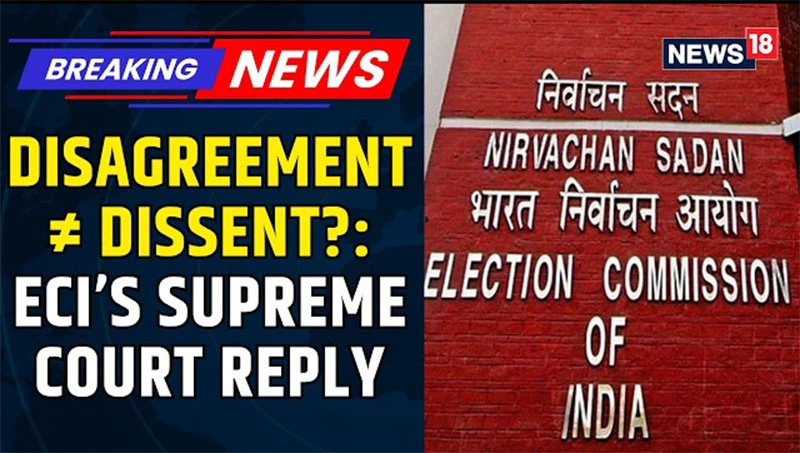
Form 6 Controversy: Voter Right is Constitutional
There is a Bengali song that begins, “আমরা দুটি ভাই, শিবের গাজন গাই” — Amra duti bhai, Shiber gajan gai. Roughly translated, it means, “We are two brothers, singing the same song in praise of Shiva”. It is often used humorously when people who appear to be on the same side are expected to sing in harmony. The Election Commission of India’s recent defence of its functioning brings this line to mind.
According to the Commission’s affidavit before the Supreme Court, all three members took the decisions relating to the Special Intensive Revision (SIR) unanimously. So, apparently, there is no difference of opinion and no discord within the family. Everything is fine.
If so, why did reports emerge that two Election Commissioners had objected to the way the online version of Form 6 was changed? And why has the presentation of the form become a matter for the Supreme Court to examine?
The Form 6 Controversy is not merely a technical disagreement about an online form. It raises a much more important question: when the Election Commission changes the way citizens register as voters, who checks that the process is lawful, transparent and fair? Above all, what happens when an eligible citizen is unable to establish a connection with an old electoral roll and risks being denied the right to vote?
The congress has demands answer in Form 6 and picks holes in EC Reply in Apex Court. Watch India Today Report.
What Is the Form 6 Controversy?
Form 6 is the application used by an eligible citizen to seek inclusion in the electoral roll as a new voter. The Election Commission provides information about voter registration and the relevant procedure through its official voter-registration guidance.
But the controversy arose when a declaration connected with the SIR appeared alongside the online version of Form 6. Reports in July 2026 said that applicants were being asked whether they, their parents or their grandparents appeared in an earlier intensive revision of the electoral rolls, including the rolls associated with 2002. Critics questioned whether this additional requirement had effectively changed the statutory form without the necessary legal process.
An investigation published by The Indian Express reported that Election Commissioners Vivek Joshi and Sukhbir Singh Sandhu had raised objections to the changes. The reporting described concerns about whether the form could be altered without an amendment to the relevant rules.
These are serious allegations. The Commission has denied that the statutory Form 6 itself was amended. Its position is that the additional declaration was a separate document prescribed for the SIR, not part of the statutory form under the Registration of Electors Rules, 1960.
However, the Commission’s own affidavit acknowledged that the way the declaration was displayed on its online platform could be understood as though Form 6 had been amended. It also said that certain steps taken by officials needed correction. From 21 October 2026, the online application process was separated into Form 6 and the SIR declaration.
That correction is welcome. But it does not make the original questions disappear.
- Who authorised the online presentation in the form it took?
- Why did the controversy arise in the first place?
- Why did it take so long to correct something that could affect the registration of new voters?
Why Did the Commission Need an Affidavit?
In its affidavit filed before the Supreme Court, the Election Commission defended the SIR and maintained that the relevant decisions had been taken unanimously. It argued that the additional declaration was separate from Form 6 and that the Commission had acted within its legal authority.
The affidavit is an important statement of the Commission’s position. It is not, however, a judicial verdict establishing that every step taken during the process was lawful. Nor does the Commission’s description of the decisions as unanimous, by itself, answer every question raised by reports of internal objections.
The Commission’s affidavit and the Form 6 dispute must therefore be read with care. The Commission says the statutory form was not amended, while acknowledging that the way the declaration appeared online could give that impression. It says corrective steps have been taken. Critics, meanwhile, want answers about how the disputed arrangement was introduced and why objections reportedly raised within the institution did not prevent it.
Here lies the real problem. A public institution cannot expect citizens to accept “everything was unanimous” as a complete answer when the process itself has raised questions about authorisation, implementation and accountability. If there was no wrongdoing, a clear explanation should help establish that. If there were administrative mistakes, those mistakes should be acknowledged and corrected without hiding behind technical distinctions.
Read the allegations and subsequent rages: CEC Gyanesh Kumar: Students Rage & SC Fired
The Goa Question: Why Did Voters Have to Apply Again?
The Goa episode makes the issue more concrete. In its affidavit, the Election Commission said that 97 voters had been left out of the final electoral roll. Of these, 88 subsequently submitted Form 6 applications, and their applications were accepted. The Commission said six were outside the country and three were Portuguese passport holders or foreigners.
These details matter. It would be inaccurate to suggest that all 97 cases were identical or that every omission had the same explanation. The Commission’s account distinguishes the 88 accepted applications from the six people abroad and the three cases involving Portuguese passports or foreign citizenship.
But another question remains: why did the 88 voters have to apply through Form 6 to get their names back into the electoral roll? If their names had been wrongly omitted, why could the relevant election authorities not identify and correct the problem through the records and procedures already available to them?
The Commission’s position is that no electoral-roll entry is added, deleted or modified except by an order of the Electoral Registration Officer. That is an important legal safeguard. But a safeguard on paper is not enough if a citizen has to navigate another application process to restore an entry that should not have been lost in the first place.
For the affected voter, the distinction between a software problem, an administrative error and a procedural requirement may mean very little. The practical question is simple: was the person eligible to vote, and if so, why was the person’s name missing?
The Goa figures do not prove that every omission was unlawful. They do, however, justify asking whether the system is capable of identifying and correcting errors without transferring the entire burden to ordinary citizens.
Why Must Citizens Search for the 2002 Electoral Roll?
Let us consider the burden placed on an ordinary citizen. A young woman may have married and moved to another district or state. A worker may have left home decades ago to find employment elsewhere. A family may have shifted several times. Parents or grandparents may have died, and old documents may no longer be available. Some people may never have had easy access to digital records.
Are all these citizens expected to trace an electoral roll from 2002, establish a family connection and then prove that they are entitled to register today? What happens when the old record is difficult to find, the spelling of a name differs, or the family has no copy of the relevant document?
The Election Commission has access to electoral-roll records and employs Booth Level Officers (BLOs), Electoral Registration Officers (EROs) and Assistant Electoral Registration Officers (AEROs). It also spends public money on technology and electoral administration.
If the system depends on citizens doing all the historical research themselves, what exactly are these institutions and systems meant to accomplish?
There is nothing wrong with asking an applicant to provide information reasonably needed to establish eligibility. Electoral rolls must be accurate, and identity and citizenship requirements cannot simply be ignored. But the process must be proportionate, practical and consistent with the law. A requirement that is easy for one person may become an impossible obstacle for another.
The Form 6 Controversy therefore goes beyond the design of a form. It concerns the balance between verification and access. A voter-registration process should help officials establish the facts, not turn every applicant into an investigator responsible for reconstructing family records from a quarter of a century ago.
Get a glimpse at: Bengal Electoral Roll Row: Shocking Truth!
Cleaning the Electoral Roll Is Necessary—but So Is Fairness
Let me make one point clear. Deceased voters should not remain on electoral rolls indefinitely. Duplicate entries should be identified and removed through the proper procedure. People who are no longer eligible should not be allowed to remain registered simply because correcting the records is inconvenient.
But the opposite danger is equally serious. An eligible voter must not lose the right to vote because a database fails, a record cannot be mapped or an administrative procedure is poorly designed. The purpose of electoral-roll revision is to make the list more accurate, not to make it harder for genuine voters to remain on it.
There is a difference between removing an ineligible name after proper verification and excluding an eligible citizen because the system cannot establish a historical connection quickly enough. The first protects the integrity of an election. The second risks undermining it.
Reports about political strategist Prashant Kishor’s name appearing in two electoral rolls have also raised questions about the reliability of the process. Kishor reportedly said that he had tried to get one of the entries removed but had not succeeded. Yet it points to an obvious concern: if even a prominent person says that correcting a duplicate entry was difficult, how much harder might the process be for someone without public visibility or influence?
Technology should make such corrections easier. It should help identify duplicate entries, flag inconsistencies and direct cases to the appropriate officials. It should not become an opaque gatekeeper that leaves citizens uncertain about why their names have disappeared or what they must do to restore them.
Remember Kadambini: Proving That You Are Alive
There is a famous touch of irony in Rabindranath Tagore’s story Jibito O Mrito, often translated as The Living and the Dead. Kadambini must struggle to establish that she is alive. Her predicament is tragic, but it also exposes the absurdity of a society that refuses to accept a person’s own existence without the approval of its systems and conventions.
Electoral administration should never put an eligible citizen in a similar position. Nobody should have to run from office to office, submit one form after another and repeatedly establish a basic fact simply because a record has gone missing or a computer system has failed.
Of course, voter registration involves legal checks, and an application cannot be accepted merely because someone insists that their name belongs on the list. But verification must be fair, accessible and supported by clear reasons. Where the administration has the records, it should use them. Where a discrepancy exists, the citizen should be told what is missing and given a realistic opportunity to respond.
The test of a democratic system is not how efficiently it deletes names. It is whether it can distinguish an ineligible entry from an eligible citizen who has been caught in an administrative mistake.
Look at my personal experience in SIR Deletions: The Shocking Truth in India.
What Has the Supreme Court Said?
The Supreme Court is now examining the wider controversy surrounding the Election Commission’s functioning and the SIR. On 27 October 2026, the Court issued notice on a fresh plea by Trinamool Congress MP Dola Sen challenging the alleged changes to Form 6. It also gave petitioners ten days to respond to the Commission’s affidavit.
The wider hearing was deferred to 17 November 2026. During the proceedings, the Court did not grant the requested interim direction to preserve internal files, notings and correspondence. Instead, the bench indicated that it would examine the issues when the matter came up for hearing. The Court has not yet delivered a final ruling on the legality of the disputed online arrangement.
These developments should not be misrepresented as a finding that the Commission has either been cleared or found guilty. The legal questions remain before the Court. The Commission has presented its defence; the petitioners have an opportunity to respond; and the judges will have to assess the arguments and records.
The Supreme Court’s earlier observations on Form 6 are also relevant. As reported by The Indian Express, the Court had made clear that it had not approved the alleged modification and wanted to examine the record to understand what had been changed and by whom.
That is precisely why the distinction between the Commission’s defence and the Court’s eventual findings matters. The ECI says the statutory Form 6 was not amended and that the declaration was a separate document. Critics question how the declaration appeared online and whether the process was properly authorised. It is for the Supreme Court to examine the legal issues on the evidence before it.
Why Can’t the Three Election Commissioners Face the Public Together?
The Election Commission is a constitutional institution, and public confidence in it matters. When serious questions arise about its decisions, a press release or a lengthy affidavit may not be enough to settle public doubts. The institution needs to explain what happened in language ordinary citizens can understand.
Why not hold an open press conference with all three Election Commissioners—Gyanesh Kumar, Sukhbir Singh Sandhu and Vivek Joshi? Let journalists ask questions. Let the Commissioners explain the distinction between the statutory form and the additional declaration, the decision-making process and the corrective measures taken on 21 October.
If there were differences of opinion, the Commission should explain how those differences were handled under the law. If all decisions were unanimous, as its affidavit states, it should be able to explain how the reported objections fit into that account. There is no reason to treat reasonable questions as an attack on the institution itself.
Of course, an internal disagreement does not automatically prove that a decision was unlawful. Institutions can have different views and still reach lawful decisions. But when reports suggest that officials raised concerns about a process affecting voter registration, transparency becomes essential. Citizens should not be expected to choose between unverified media accounts and institutional assurances without receiving a clear explanation.
And here we return to the Bengali song. If the three Commissioners are indeed singing together, let the public hear the song from all three of them. If there were different notes before the final tune was settled, explain those too. Otherwise, the insistence that everything is harmonious may sound less like reassurance and more like an attempt to cover the fish with vegetables—shak diye mach dhaka.
Institutional Credibility Cannot Be Demanded
Public trust is not created by declaring an institution trustworthy. It grows when an institution answers difficult questions, acknowledges errors and demonstrates that its procedures are fair. It weakens when citizens are left to guess why a form changed, why names disappeared or why an application must be filed again.
Debates over the conduct of constitutional bodies are not new. The judiciary, election authorities and other institutions have all faced criticism at different times. Public discussion of the former Supreme Court judge, Justice Sanjay Kishan Kaul’s memoir or controversial remarks by retired judges may raise wider questions about institutional independence and credibility, but those debates should not be used as a substitute for examining the specific evidence in the Form 6 case.
The immediate issue is more straightforward. The Commission says its statutory form was not amended, but it has acknowledged that the online presentation could have created that impression and has changed the process. That is a useful correction. Now the Commission should provide a fuller account of how the problem arose, what safeguards are in place and how voters affected by errors can obtain a remedy without unnecessary hardship.
The Supreme Court will decide the legal issues before it. Citizens, journalists and civil society must continue to scrutinise the process without treating allegations as proven facts or institutional claims as the last word. The right to vote is too important for either blind faith or careless accusation.
Key Takeaways: What the Form 6 Controversy Reveals
- The Form 6 Controversy concerns the online presentation of an additional SIR declaration, the Commission’s claim that the statutory form itself was not amended, and questions about how the arrangement was authorised.
- The Election Commission says all three members approved SIR-related decisions unanimously. Reports of internal objections still deserve a clear explanation, but they should not be treated as a final legal finding.
- On 21 October 2026, the online process was separated into Form 6 and the SIR declaration after the Commission acknowledged that the earlier presentation could be understood as an amendment.
- In Goa, the Commission said 88 of the 97 voters left out of the final roll later applied through Form 6 and had their applications accepted; six were abroad and three were Portuguese passport holders or foreigners.
- Electoral-roll accuracy matters, but removing deceased or duplicate entries must not become an excuse for wrongly excluding eligible voters.
- Citizens should not have to reconstruct decades-old family records when the administration already holds relevant electoral information that can reasonably be checked.
- The Kadambini comparison captures the absurdity of making a person repeatedly prove a basic fact when the system should be capable of checking its own records.
- The Supreme Court has issued notice on Dola Sen’s plea and given petitioners ten days to respond to the ECI affidavit. The legal dispute remains unresolved, with the wider hearing deferred to 17 November 2026.
- A transparent explanation from all three Election Commissioners would help address public concerns more effectively than simply insisting that everything was unanimous.
- Ultimately, the credibility of the Election Commission depends not on slogans or assurances but on lawful procedures, accountable decisions and the protection of every eligible voter’s right to vote.
The Right to Vote Must Not Become a Test of Endurance
The Election Commission has a difficult responsibility. Electoral rolls must be accurate, and the system must prevent fraudulent or duplicate entries. But the same system must protect every eligible citizen from exclusion caused by technical failures, confusing procedures or administrative mistakes.
That is why the Form 6 issue cannot be brushed aside as a minor disagreement over paperwork. A form is not merely a form when its design can affect whether a citizen gets onto the electoral roll. A database is not merely a database when an error can threaten a person’s democratic right.
The Commission has corrected the online process and defended its decisions before the Supreme Court. The next step should be equally clear: explain the process, identify any failures, ensure that affected voters receive fair remedies and make the system easier—not harder—for eligible citizens to use.
Let the three Commissioners sing together if they wish. But before asking the public to join the chorus, they should answer the questions that have made the song necessary in the first place.