Mamata FIR, Abhishek Notice: Big Showdown
Sep 01, 2026 - By Ashutosh Roy Current AffairsGovernancePoliticsRegional UpdatesWest Bengal Politics
What Happens Next After Mamata FIR?
Mamata FIR has opened a new front in Bengal’s political battle. Kolkata Police have registered a suo motu FIR against former Chief Minister Mamata Banerjee over alleged violation of Calcutta High Court directions during the TMCP foundation-day programme. At almost the same time, TMC national general secretary Abhishek Banerjee has received a police notice over the Camac Street office scuffle.
The two cases are separate, but their timing has created an unusual situation for the TMC leadership. With both Mamata and Abhishek facing police action, the bigger question is no longer simply what happens to each case. Could these developments trigger a much bigger political and legal showdown in Bengal?
Why is the Mamata FIR important?
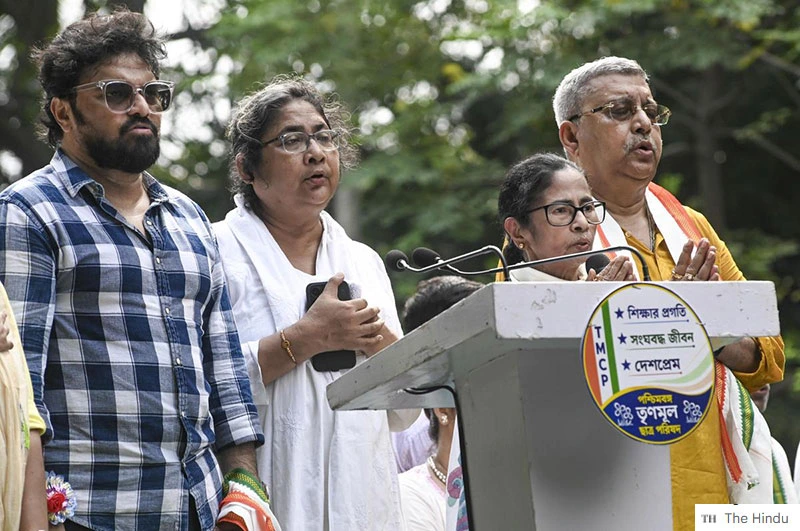
Kolkata Police registered a suo motu FIR against former West Bengal Chief Minister Mamata Banerjee on August 29, 2026. The case relates to allegations that conditions connected with a Calcutta High Court order were violated during the Trinamool Chhatra Parishad foundation-day programme in Kolkata.
According to reports, the court had directed that a particular portion of Cathedral Road should remain open for the movement of vehicles and pedestrians. Police have alleged that barricades were breached during the programme, causing disruption to normal traffic and public movement.
A video shared by ABP Ananda also shows the concerned police officer cautioning Mamata Banerjee from the stage; according to the report accompanying the video, she did not respond to the warning.
The FIR has therefore turned what might otherwise have remained a political controversy into a formal legal matter.
Times of India reported on the FIR against Mamata Banerjee. The report says the case was registered by Kolkata Police on its own initiative and concerns the alleged violation of the High Court’s directions.
The FIR is not, by itself, a finding of guilt. The allegations will have to be investigated and tested through the legal process.
What happened at the TMCP programme?
The controversy emerged around the annual foundation-day programme of the Trinamool Chhatra Parishad, the student wing of the TMC.
The event was politically significant because it came at a time when Mamata Banerjee was attempting to keep the party’s organisation active after the dramatic changes in Bengal politics.
Reports suggest that a large gathering attended the programme and that the movement of people and vehicles around the venue became a major issue. The police action followed allegations that the court’s directions regarding traffic and public movement were not followed.
The political argument is now likely to revolve around a simple question: was this merely a crowd-management failure, or was there a deliberate violation of the court’s directions?
That distinction matters enormously.
If investigators find evidence of a deliberate violation, the matter could take a more serious legal turn. Any separate contempt-of-court proceedings would ultimately depend on the court and the circumstances of the alleged violation. If the evidence does not support the allegations, the political controversy may eventually lose some of its force.
Perhaps Mamata Banerjee has not yet come to terms with the political reality of Bengal. She is no longer the state’s Home Minister, and that department is now under Suvendu Adhikari. The police are now operating under a different administration. The same police machinery that once worked under her government is now examining allegations involving her. For years, opposition leaders and workers accused her administration of using the police aggressively against them. Now the political equation has changed. The same police machinery that once answered to her government is being controlled by a new administration – and Mamata Banerjee herself is now facing its scrutiny.
For someone who spent years giving directions from the seat of power, this is a very different political reality. The police are no longer working under her government. This time, Mamata Banerjee may have to answer the questions instead of asking them.
Why is Abhishek Banerjee facing a notice?
While the Mamata FIR is linked to the TMCP programme, the police action against Abhishek Banerjee is connected to a completely different incident.
Around Abhishek’s Camac Street office, a dispute developed during the removal of a billboard. Police and civic officials were involved in the operation, while private security personnel and supporters were also present.
The situation reportedly turned into a scuffle. Several FIRs were registered, and More than a dozen people have reportedly been arrested in connection with the incident.
Abhishek Banerjee was named in two of those FIRs, according to reports. Kolkata Police has now served him a notice asking him to appear before the investigating officer.
The Economic Times reported that Kolkata Police summoned Abhishek Banerjee in connection with the Camac Street scuffle.
The Times of India reported that three FIRs were registered in connection with the incident and that Abhishek was named in two of them.
The investigation has reached a stage where the police want information, clarification or the person’s cooperation.
Is this a double blow for the TMC leadership?
Politically, it certainly creates a difficult picture.
On one side is Mamata Banerjee, the founder and central political figure of the Trinamool Congress. On the other is Abhishek Banerjee, the party’s national general secretary and one of its most important organisational leaders.
When both faces of the party become involved in separate police proceedings within days of each other, the opposition naturally gets an opportunity to attack the TMC.
For the BJP-led government in Bengal, the message is straightforward: nobody should be above the law.
For the TMC, however, the argument is likely to be very different. Party leaders may describe the developments as part of a broader political campaign against the opposition.
This creates the possibility of a fresh TMC versus BJP confrontation over law enforcement.
Why “Mamata FIR” could become a bigger political issue
The phrase Mamata FIR is likely to generate substantial political attention because Mamata Banerjee spent years as one of the most powerful political figures in Bengal.
Her political identity has often been built around direct confrontation. She has regularly positioned herself as a leader willing to take on the Centre, the BJP and central investigative agencies.
Now the nature of the confrontation has changed.
The issue is no longer only about political speeches, rallies or accusations. A police FIR places the dispute inside a formal legal process.
That can have a very different political impact.
Every subsequent development can become a headline: police questioning, submission of documents, investigation reports, court hearings, possible chargesheets or any judicial intervention.
For the opposition, every step can be presented as evidence that the former ruling establishment is finally being held accountable.
For the TMC, every step can become an opportunity to claim political victimisation.
Could the Mamata FIR lead to arrest?
One question is already dominating the political debate: could the FIR against Mamata Banerjee eventually lead to her arrest?
It would, however, be too early to jump to that conclusion. An FIR is just the starting point of an investigation, and what happens next will depend on the sections applied, the evidence gathered, the nature of the alleged offence, Mamata Banerjee’s cooperation with the investigators and, ultimately, the courts.
Political supporters may move from the first stage straight to the last in their public arguments, but the law does not work that way.
For now, the police are expected to focus on the evidence. CCTV footage, videos from the programme, statements from police personnel and eyewitnesses could all become relevant. Investigators may also question people who were present at the venue before deciding whether the allegations are strong enough to justify further legal action.
The case could eventually reach the courts, where Mamata Banerjee’s legal team will have the opportunity to challenge the proceedings and raise any objections permitted under law.
So, speculation about arrest may generate headlines, but the real story will be the evidence. The registration of an FIR is only the beginning; what the investigation ultimately establishes will decide how far this case goes.
What does Abhishek’s notice mean?
The police notice to Abhishek could become equally important because the Camac Street case involves allegations surrounding an incident at his office.
Reports say that the dispute occurred during the removal of a billboard and that police personnel and civic officials faced resistance from private security guards and others present at the location.
The case has already resulted in arrests.
That means the investigation is not merely theoretical. Police have already taken action against several people connected with the incident.
The next question is whether Abhishek’s questioning produces further developments.
Will investigators seek additional statements? Will more people be questioned? Will the police identify further accused persons? Or will the matter remain limited to those already named?
These are the questions that could determine how serious the Abhishek Banerjee police notice becomes.
Abhishek already has another legal battle
The latest notice comes against the backdrop of other legal cases involving Abhishek Banerjee.
Just days before the latest development, the Calcutta High Court granted him protection from coercive action in three criminal cases while directing that the investigations should continue and that he should cooperate with the process.
The Indian Express reported on the High Court’s protection to Abhishek Banerjee.
The court’s intervention is important because it demonstrates that the legal battle surrounding Abhishek is not simply a political argument. Courts are actively examining the cases and setting conditions for both the investigating agencies and the accused.
That could become a recurring pattern in the months ahead: police investigation followed by court intervention.
What could happen next for Abhishek?
Abhishek’s immediate issue is more straightforward: he has received a police notice and is expected to cooperate with the investigation.
The police could question him about the circumstances surrounding the Camac Street incident, his knowledge of the events and the people involved.
His lawyers may also challenge any step they consider legally unjustified.
The political significance, however, will depend on what happens after questioning.
If no major development follows, the notice may gradually disappear from the political spotlight. If investigators take additional action, the issue could become a much bigger confrontation.
Notices, FIRs and interrogations have followed Abhishek Banerjee for years. Still, despite all the noise, there has been little visible outcome – no major breakthrough and no arrest so far.
That raises a very simple question: how many more showdowns do we need?
If the investigating agencies have credible evidence against Abhishek Banerjee, why has decisive legal action not followed? And if the evidence is not strong enough to proceed, why does the cycle of notices, questioning and fresh cases keep returning?
Is this really about building a case, or is it becoming a prolonged exercise in keeping political pressure on Abhishek? Is the objective investigation, or simply keeping the controversy alive and public emotions charged?
But, Abhishek Banerjee has rarely sounded defensive. In his familiar combative style, he has repeatedly taken on the BJP and the state administration, warning them not to underestimate him.
But Bengal has heard this script too many times. People want evidence, accountability and a clear outcome – not another round of political fireworks followed by silence.
Is this a political vendetta or rule of law?
This is likely to become the central political argument.
The TMC can argue that cases against its top leaders are politically motivated. The BJP and the government can counter that an investigation should not be stopped merely because the accused is a major political leader.
Both arguments will receive strong support from their respective political camps.
But there is a more important test.
Can the investigation remain transparent?
If police follow the same legal standards that would apply to an ordinary citizen, the government will have a stronger argument that this is about the rule of law.
If the investigation appears selective, politically timed or procedurally questionable, the TMC will gain ammunition to claim persecution.
That is why transparency will matter more than political speeches.
What about the public reaction?
For ordinary voters, the most important issue is not which political party wins the argument on television.
People want to know whether the law is being applied equally.
If a political leader violates a court order, there should be a legal mechanism to investigate it. If a government misuses the police to target an opposition leader, there should also be a legal mechanism to challenge that action.
That is the basic strength of democratic institutions.
The credibility of the system will ultimately depend on whether the same standards are applied to everyone.
Could Mamata and Abhishek turn this into a political battle?
Almost certainly, the political temperature will rise.
Mamata Banerjee has historically been strongest when facing a direct political opponent. Her political style relies heavily on taking the fight directly to the opposition.
Abhishek Banerjee has also emerged as an increasingly aggressive political campaigner.
That combination means the legal developments could quickly become part of the wider Bengal political battle.
The TMC may organise demonstrations, press conferences or political programmes around the issue. The BJP may use the cases to argue that the previous administration must now answer questions about law and order and political privilege.
The resulting battle could therefore move well beyond the courtroom.
What does this mean for the future of TMC?
This may be the most important question of all.
The TMC has gone through a major political transformation. The party that once dominated Bengal’s political landscape now faces a much stronger opposition environment.
In such a situation, the leadership’s ability to manage legal pressure, organisational challenges and political attacks will be crucial.
Mamata Banerjee remains the party’s biggest political identity, while Abhishek Banerjee represents its organisational and generational transition.
If both leaders remain under sustained legal pressure, the TMC will have to prove that its organisation can survive when its top leadership is facing trouble on multiple fronts. That may be easier said than done, particularly when factionalism and talk of a possible TMC split are becoming harder to ignore.
The situation among the party’s rebel MPs is already adding to the pressure. The TMC rebel MPs have joined the NCPI, attended breakfast with the Prime Minister and held closed-door meetings with Bengal Chief Minister Suvendu Adhikari in Delhi. These are no longer developments that can be brushed aside as routine political activity.
The Ritabrata faction of TMC MLAs has also been making its presence felt separately. They organised their own rallies around the 21 July Martyrs’ Day and the 28 August TMCP Foundation Day programmes. More importantly, their criticism of the Mamata camp is now becoming increasingly open.
Taken together, these developments point to a serious organisational challenge for Mamata Banerjee. The bigger question is whether the TMC can keep its ranks united, or whether the pressure from within will eventually prove more damaging than the pressure coming from outside.
At the same time, one cannot ignore the larger political objective of the BJP government. Is it simply trying to weaken the TMC, or is the ultimate goal to wipe the party off Bengal’s political map?
That is why the current developments should not be viewed only as isolated police cases.
Could this become a bigger TMC crisis?
It could, but that depends on what happens next.
A political crisis usually develops when several pressures arrive together.
The pressure on the TMC can come from several sides. A widening investigation could create legal problems, while uncertainty among leaders and workers could deepen organisational tensions. The opposition, meanwhile, will have every reason to turn these individual cases into a much larger political narrative.
At present, all three possibilities are worth watching.
But it would be wrong to suggest that the TMC’s troubles began with these cases alone. The party has been dealing with a much deeper crisis for several other reasons. Critics have long pointed to what they describe as the concentration of power around Mamata and Abhishek, the growing distance between the leadership and booth-level workers, and a series of alleged scams and corruption controversies that have emerged during the party’s first 15 years in power. The situation could become even more painful for Mamata if more of her trusted aides continue to distance themselves from her.
Why the next few weeks matter
The coming weeks could be more important than the headlines of today.
The Mamata FIR will be judged by what investigators actually find. The Abhishek notice will be judged by what emerges from the questioning and investigation.
Political parties will naturally try to influence public opinion. Television debates and social media will intensify the confrontation.
But the legal process will ultimately depend on evidence.
This is where citizens should remain careful.
An allegation is not proof. An FIR is not a conviction. A police notice is not a declaration of guilt. At the same time, political status should not provide automatic immunity from investigation.
What are the opposition parties likely to say?
The BJP is likely to portray the Mamata FIR as evidence that the former ruling establishment is no longer above scrutiny.
Government leaders have already defended the police action. West Bengal minister Agnimitra Paul, for example, said that violations of a High Court order could not be tolerated regardless of who was involved. The Times of India reported her reaction to the FIR.
Union minister Sukanta Majumdar has also backed the FIR, arguing that action was justified over Mamata Banerjee’s alleged remarks at a rally. The Newsmill reported Sukanta Majumdar’s reaction.
The TMC, on the other hand, is expected to argue that the cases represent political pressure against the opposition.
That political contest is unlikely to end quickly.
Watch the political debate carefully
The recent developments have already generated extensive political discussion across television and YouTube.
For example, News Tak’s video on an earlier Mamata FIR and the political developments around Abhishek Banerjee provides an example of how these legal issues have been presented in the wider political debate.
Another recent video discussion, NDTV’s report on Mamata Banerjee being under pressure on multiple fronts, shows how the broader TMC leadership question has been framed in political coverage.
Readers should, however, distinguish between news reporting, political commentary and verified court or police records.
What is the real “Big Showdown”?
The phrase Big Showdown is not simply about Mamata Banerjee facing an FIR or Abhishek Banerjee receiving a notice.
The bigger confrontation is between political power and institutional accountability.
For years, Bengal politics has been dominated by battles between political parties. Now the courts, police and administration are becoming increasingly important parts of the political story.
That makes the current situation especially significant.
If the investigation against Mamata proceeds, the former Chief Minister will have to defend herself through the legal process.
If the investigation against Abhishek expands, he too will have to respond through legal channels.
At the same time, the government will have to demonstrate that its actions are based on law rather than political revenge.
Bottom line: What happens next?
The Mamata FIR and Abhishek Banerjee police notice are two separate legal developments, but their political impact could converge.
Mamata Banerjee faces an FIR connected with allegations of violating directions linked to a Calcutta High Court order during the TMCP programme. Abhishek Banerjee has been asked to appear before investigators in connection with the Camac Street office scuffle.
Neither development should be treated as a final judgment.
The real story will be what happens after the FIR and notice.
Will the investigations produce new evidence? Will more people be questioned? Will the courts intervene? Will the TMC launch a stronger political counterattack? Will the BJP turn the cases into a larger campaign about accountability?
Those questions remain open.
One thing, however, is already clear: Mamata FIR is no longer just a political headline. It has become part of a wider legal and political confrontation involving the two most important faces of the Trinamool Congress.
If the investigations expand further, the Mamata-Abhishek political showdown could become one of the most closely watched battles in Bengal politics. For now, however, the real test is simple: will these FIRs and notices lead to evidence and legal outcomes, or will Bengal once again be left watching another round of political fireworks?
10 key Takeaways:
- Mamata FIR has turned a political controversy into a formal legal issue, with the investigation now likely to attract close attention.
- The FIR against Mamata Banerjee and the notice to Abhishek Banerjee arise from separate incidents, but together they create a major political challenge for the TMC leadership.
- Police have alleged that the High Court’s directions were not properly followed during the TMCP foundation-day programme.
- If investigators find evidence of a deliberate violation, the case could take a more serious legal turn, while weak evidence could reduce its impact.
- Mamata Banerjee is no longer in charge of the West Bengal Home Department, which changes the political equation surrounding police action against her.
- Abhishek Banerjee’s police notice is linked to the Camac Street incident and could lead to further questioning or investigation.
- The repeated cycle of FIRs, notices and interrogations involving Abhishek has raised questions about why previous investigations have not produced a clear outcome.
- The TMC may portray the latest cases as political pressure, while the BJP is likely to present them as evidence that nobody is above the law.
- The credibility of the entire process will depend on whether the investigations remain transparent, evidence-based and politically neutral.
- The real big showdown may now be less about political speeches and more about whether the police investigation produces a tangible legal outcome.
[…]Mamata FIR, Abhishek Notice: Big Showdown Mamata FIR sparks a major political showdown as Abhishek faces notice. What does the latest police action mean for the TMC leadership and Bengal politics?[…]
[…]Mamata FIR, Abhishek Notice: Big Showdown Mamata FIR sparks a major political showdown as Abhishek faces notice. What does the latest police action mean for the TMC leadership and Bengal politics?[…]
[…]Mamata FIR, Abhishek Notice: Big Showdown Mamata FIR sparks a major political showdown as Abhishek faces notice. What does the latest police action mean for the TMC leadership and Bengal politics?[…]
[…]Mamata FIR, Abhishek Notice: Big Showdown Mamata FIR sparks a major political showdown as Abhishek faces notice. What does the latest police action mean for the TMC leadership and Bengal politics?[…]
[…]Mamata FIR, Abhishek Notice: Big Showdown Mamata FIR sparks a major political showdown as Abhishek faces notice. What does the latest police action mean for the TMC leadership and Bengal politics?[…]