BJP's Record Win: Is Suvendu Really Happy?
Oct 11, 2026 - By Ashutosh Roy PoliticsCurrent AffairsElection AnalysisRegional UpdatesWest Bengal Politics
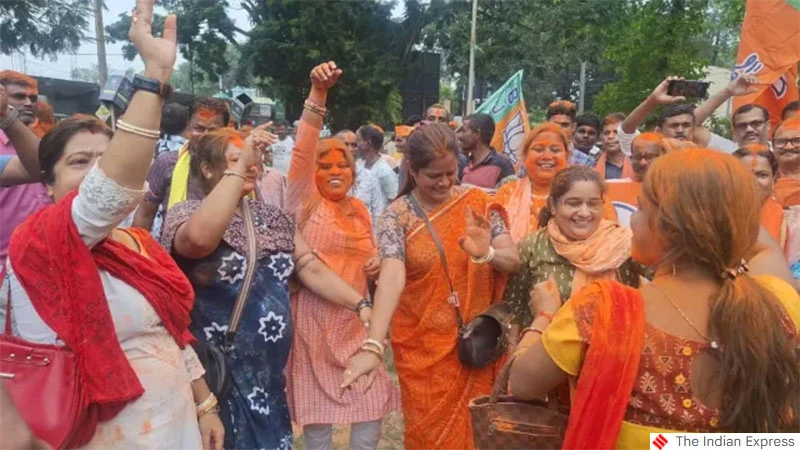
Can BJP’s Record Win Make Suvendu Really Happy?
The BJP’s Record Win in Bengal has given Suvendu Adhikari plenty to celebrate. The results in Nandigram, Falta and Rejinagar have added new records to his political career. Still, once the celebrations are over, a question remains. Is Suvendu as happy as he appears, or does this victory leave him with a few uncomfortable questions to answer?
Take Nandigram, for instance. Suvendu had spoken of defeating Mamata Banerjee by 50,000 votes, but his final winning margin was just 1,956. He won, and nobody can take that victory away from him.
Still, when a leader publicly sets such an ambitious target, people are entitled to ask what went wrong. Did he misread the contest, or was the target of winning by 50,000 votes simply too ambitious? Journalists could have asked him these questions, but the discussion seemed to move on without much curiosity. Does Bengal now expect the media to become “Didi’s media” all over again, or are we heading towards a new version of “Dada’s media“?
Record Wins, But What About the Real Issues?
What a result! Falta delivered the record that the Chief Minister had wanted, while Hasirani Rath surpassed Suvendu’s own winning-margin record from Nandigram in 2016. Rejinagar produced another surprise. Suvendu had reached out to Muslim voters there, and the result gave the BJP another talking point. The party also won a Muslim-majority constituency, challenging the familiar assumption that it cannot win in such areas.
Consider constituencies such as Dhubri, Barpeta and Nagaon in Assam, or Moradabad Rural in Uttar Pradesh, where the BJP could never win in the past. Bengal has now produced a result that Suvendu can proudly add to his political record. The reaction of the winning candidate, Sakharav Sarkar, including his Hindi remarks, gave the impression that even he had not fully anticipated the outcome. But Suvendu wanted the victory, and he got it. Fair enough. The question is what he wants next.
When will Suvendu put the same determination into improving Bengal’s education system? When will better healthcare, more industries and jobs for young people become his priorities? If his wishes carry such political weight, Bengal should hope he wants these things just as strongly as he wanted record-breaking victories. We are still waiting to see that determination on the ground. The problems facing Bengal’s education system will not disappear simply because the BJP has won more seats.
Same Old Political Script, Only the Actors Have Changed
On the evening of October 9, BJP representative Pranoy Roy explained the party’s record vote share by saying that people wanted a change of government and development. Does that sound new? Have we not heard much the same argument before? Perhaps Bengal has been watching the same political programme for years, with only the cast and party flags changing.
For fifteen years, TMC leaders repeatedly told us that people had voted for them because they wanted development. Now the BJP is using much the same language. The seats have changed hands, but the familiar promises remain. If Pranoy Roy were replaced by Kunal Ghosh or Arup Chakraborty, would the script sound very different? The faces may have changed, but the political vocabulary has barely moved.
I am not suggesting that the BJP and TMC are identical in every respect. The question is how quickly a party that spent years criticising those in power can begin to sound like the very establishment it once attacked. Bengal has seen this happen before. Jyoti Basu once raised the question of whether the Left should field candidates on behalf of the Opposition. Mamata Banerjee and Abhishek Banerjee, too, have faced criticism over the arrogance that can accompany prolonged political dominance. The BJP should take note before it falls into the same trap.
My unfortunate Bengali people! One government replaces another, yet you are still left holding the pencil. You cast your votes, the rulers change, and the promises start all over again.
Does a Record Margin Guarantee Anything?
In a democracy, a candidate can win a seat by a single vote. Even a margin of one lakh votes gives the winner only one seat. At the national level, Atal Bihari Vajpayee’s government fell in 1999 after losing a confidence vote by just one vote. Nobody argued that the government needed to lose by a larger margin for the result to count. Parliamentary arithmetic decided the outcome.
Electoral history offers plenty of reminders that winning a constituency once does not guarantee victory at the next election. The BJP won Jamalpur-Khadia in Gujarat in 2012 and Sonai in Assam in 2016, but failed to retain those seats in the following elections. A victory can make history without becoming a permanent political achievement.
So why was Suvendu so determined to break records and secure an extraordinary margin? Political leaders are free to set ambitious targets, and there is nothing wrong with wanting a convincing victory. But voters are equally entitled to ask what such records actually achieve. A bigger margin makes a better headline. It does not automatically build a better school, improve a hospital or open a factory.
What About the Videos and Allegations?
I do not accept every allegation made by the Opposition simply because it is directed at the BJP. Political parties have their own interests, and their claims must be examined rather than swallowed whole. At the same time, I have seen television reports and numerous local videos and reels circulating on social media. Some of them raise questions that deserve proper answers.
Will BJP leaders dismiss every uncomfortable clip as doctored? A video can be edited, misleading or taken out of context. That is precisely why the facts must be checked. But the possibility of manipulation cannot become a convenient excuse to avoid scrutiny altogether. A person recording an incident locally may support one party or another. That does not, by itself, prove that the incident was invented or that the person intended to defame the BJP.
The answer is simple: investigate each specific allegation, establish what happened and make the findings public. If a video is fake, show the evidence. If it records genuine wrongdoing, take action. A party that has won such a large mandate should have enough confidence to answer difficult questions instead of treating every criticism as a political attack.
Where Is the Good Governance?
Prime Minister Narendra Modi congratulated the BJP and credited its victory to good governance. But where is the evidence of that good governance in Bengal, five months after the new government took office? Apart from stern actions such as in the Halisahar and Baruipur incidents, much of the political conversation appears to revolve around defections and the shifting loyalties of elected representatives.
Bengal did not vote simply to watch MLAs change sides. People want better schools and colleges, hospitals that function, jobs for young people and an administration that treats citizens fairly. The state has serious problems in education and industry, and these cannot be brushed aside while political parties count their new recruits. Knowledge Mart has examined these challenges in its analysis of the West Bengal political landscape. A change of government offers an opportunity to address these problems; it is not proof that the problems have already been solved.
If the BJP wants to show that its government is different from the TMC’s, people must see that difference in their daily lives. The real test is not how many Opposition leaders can be persuaded to join the ruling party. It is whether an ordinary citizen can get work done without first seeking help from a party office.
What Happened to the Allegations Against TMC Leaders?
When Suvendu was in the Opposition, he raised serious allegations against several TMC leaders. He displayed Firhad Hakim’s signature in the Assembly, spoke about properties linked to Javed Khan and his son, and levelled allegations against Arup Biswas, including claims relating to land grabbing and the Messi fiasco. These were presented as matters that required scrutiny.
So what has happened since then? Have the authorities followed up on these allegations, and what have their investigations established? If the claims were supported by evidence, the public deserves to know what action was taken. If they could not be substantiated, that should be made clear as well. Allegations are not proof of guilt, but neither should serious questions simply disappear from public discussion.
Or have some of these leaders become acceptable because they are now willing to move closer to the new ruling party? Are yesterday’s targets suddenly being treated as “good Trinamool” leaders, or even as welcome additions to the BJP? That is the uncomfortable question. Political convenience must not determine whether an allegation deserves attention. If the BJP raised these issues in the name of accountability, it should pursue them consistently when they are in power.
Defections: Principles or Political Convenience?
I understand why a party in power wants to increase its numbers, particularly at the Centre, where parliamentary arithmetic can influence its plans. But the BJP has won a huge mandate in Bengal. Would the new government really have been in danger if it had failed to attract a few more legislators? Would it have lost power because it could not bring particular leaders or representatives into its fold?
Under Mamata Banerjee, we watched elected representatives switch sides in the name of “development”. Suvendu took a different path when he left the TMC. Before joining the BJP, he resigned from his positions in the TMC and the state government. I appreciated that decision and wrote about the importance of political principles in Knowledge Mart’s coverage of BJP, TMC and the battle for opposition space in Bengal.
Now comes the question: will Suvendu expect incoming MLAs and MPs to follow the same standard? Will he ask them to resign first and seek a fresh mandate from the voters? Or does this principle apply only when someone leaves a party, not when someone joins the ruling side?
Perhaps these newcomers do not have Suvendu’s public appeal or his ability to win elections. Perhaps their value to the BJP lies less in their personal popularity than in the numbers they can add to the party. Whatever the explanation, the contradiction is difficult to ignore. If political loyalty can be traded in the name of development, people from Rajabazar and Metiabruz may soon be eager to climb aboard Suvendu’s “development chariot” too. Perhaps the next corporation election will provide another opportunity for such political displays.
Is the Centre Having Its Own Problems?
The Centre has its own share of political and legal challenges. The controversy surrounding Chief Election Commissioner Gyanesh Kumar’s legal immunity and Changes in Form 6 have raised questions about accountability and the powers of a constitutional authority. A case challenging the legal protection granted to the CEC and Election Commissioners is before the Supreme Court, which has issued notices to the relevant stakeholders. As reported by The News Minute, the case raises important questions about the scope of that protection.
This does not mean that the Supreme Court has ruled against Gyanesh Kumar or the BJP. It has not. But the questions raised in a pending case cannot simply be wished away. The controversy surrounding the Election Commission, along with wider concerns over voter deletions during the Special Intensive Revision (SIR), has kept electoral accountability firmly in the public debate.
Then there is Elon Musk’s public criticism concerning Starlink’s entry into India and the role of Mukesh Ambani’s business interests. The BBC report on Musk, Starlink and India’s telecom market adds another dimension to the debate about business competition and government decisions. Musk’s remarks have raised questions about the influence of powerful business interests, although they do not, by themselves, prove that any one businessman controls the country.
These controversies do not automatically determine what the Centre will do for Suvendu or Bengal. They do, however, remind us that the BJP’s national leadership has its own political, legal and economic issues to manage. If support from Delhi becomes less dependable, can Bengal’s new leadership stand firmly on its own feet? A government with such a large mandate should be able to do so.
I think everyone has seen how the Delhi Police turned the entire capital into a fortress this Saturday, just to stop CJP. Doesn’t this remind us of the student protests in Bangladesh?
The Real Test Begins After the Victory
Suvendu Adhikari has every right to celebrate a record win. The BJP has achieved something that once seemed difficult in Bengal, and the result has changed the state’s political map. But an election victory is not the end of the story. It is the beginning of a government’s responsibility to the people who voted for it, as well as to those who did not.
Bengal needs better education, stronger healthcare, new industries, more jobs and an administration that does not judge citizens by their political loyalties. It also needs a government willing to answer uncomfortable questions, investigate allegations consistently and understand the difference between an electoral mandate and a licence to do whatever it wants. If the BJP repeats the very habits for which it criticised the TMC, the change will be far smaller than the election result suggests.
Rabindranath Tagore’s famous lines capture a deeper disappointment with Bengal’s political and social condition: “O enchanted Mother, you have kept seven crore Bengalis Bengali, but you have not made them truly human”.
These words should not be treated as a verdict on every Bengali, nor should they become an excuse to insult the people of Bengal. They are a painful challenge to a society that takes pride in its language, culture and political history but must still ask whether it has built a humane public life. What is the value of being Bengali if political loyalty matters more than honesty, power more than accountability, and every new ruler repeats the mistakes of the one before?
Suvendu has secured his record. The BJP has secured its mandate. Now they must prove that Bengal’s next chapter will be about more than electoral records, defections and political victories. The people deserve to see a difference in their lives.
10 Key Takeaways from BJP’s Record Win
- A record victory does not end the questions. Suvendu Adhikari won Nandigram by 1,956 votes, far short of the 50,000-vote margin he had reportedly predicted.
- The BJP’s results in Nandigram, Falta and Rejinagar have strengthened Suvendu’s political record, but electoral success must eventually translate into better governance.
- Pranoy Roy’s explanation that voters wanted development sounded familiar. The article questions how much the BJP’s political language differs from the TMC’s rhetoric over the past fifteen years.
- A huge winning margin offers no guarantee of future victories. The examples of Jamalpur-Khadia in Gujarat and Sonai in Assam show how electoral fortunes can change.
- Videos circulating on social media that allege election-related wrongdoing should be investigated. Calling every uncomfortable clip fake is no substitute for checking the evidence.
- The Prime Minister has credited the BJP’s victory to good governance, but the article asks whether people can see meaningful improvements in Bengal’s education, healthcare and industrial development.
- Defections test a party’s political principles. Suvendu resigned from his positions before joining the BJP. Should incoming legislators be expected to meet the same standard?
- Questions remain about the allegations Suvendu raised against Firhad Hakim, Javed Khan and Arup Biswas. The public deserves clarity about what the investigations have established, without treating allegations as proven guilt.
- The legal questions surrounding Chief Election Commissioner Gyanesh Kumar and the debate over Starlink’s entry into India highlight wider concerns about accountability, competition and the relationship between business and government.
- The real test begins after the election. Bengal needs better schools, functioning hospitals, industries, jobs and fair administration. If the BJP repeats the political habits it once condemned, ordinary people may have little reason to celebrate the change.