TMC Fall: Why It Is Now Guaranteed
Jun 04, 2026 - By Ashutosh Roy Current AffairsElection AnalysisPoliticsRegional UpdatesWest Bengal Politics
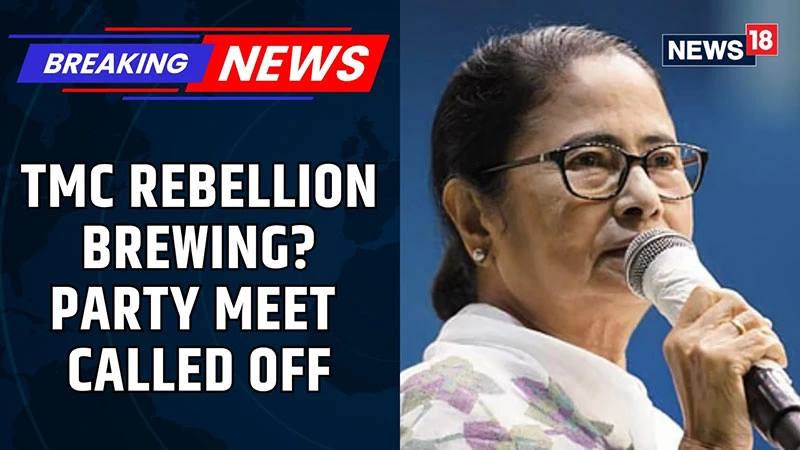
Will the Massive Drop in MLA Attendance Cause a TMC Fall?
The political landscape in West Bengal is shifting at a breakneck pace. Consequently, a sudden TMC Fall looks more inevitable by the day.
Events are unfolding so quickly that keeping track of these rapid developments has become incredibly difficult for political observers.
Public sentiment shifted critically against the leadership also. Soon after, a severe structural collapse became obvious during emergency meetings called by the former Chief Minister Mamata Banerjee.
This dramatic downturn immediately triggered a historic West Bengal political crisis. Consequently, the ongoing rebellion is shaking the ruling party to its absolute core.
Nevertheless, a section of TMC MLAs are all set to back rebel Ritabrata Banerjee as the Leader of Opposition in the Assembly and raise their claims to the speaker. Reports also reveal that they have met privately in a Hotel.
Latest Update on 03/06/2026:
- 10:45: Ritabrata has already reached the assembly house with some others. Moreover they are going to submit the claim for LOP with the signature of 59 rebel MLAs.
- 14:05: Mamata Banerjee has dissolved all the state-level committees finally.
- 17:05: Ritabrata Bandyopadhya has started a press conference in the Assembly House. Interestingly, he is conducting the press meet from the Leader of Opposition’s chair.
Will the Massive Drop in MLA Attendance Cause a Trinamool Congress Crisis?
Internal support for the top leadership has completely evaporated over just a short period. In addition, Lawmakers are rapidly distancing themselves from the party core to protect their own political futures. Look at the shocking attendance drop during the recent high-level party meetings:
| Date / Meeting Day | Number of MLAs Attending | Current Status of the Party |
|---|---|---|
| Day 1 Meeting | 71 MLAs | Growing internal panic and distrust. |
| May 19 Meeting | 65 MLAs | Growing internal panic and distrust. |
| May 31 Meeting | Only 20 MLAs | Severe isolation and total organizational collapse. |
As the data indicates, attendance plummeted from 71 lawmakers down to a mere 20 on May 31.
Consequently, this dramatic shift proves that grassroots representatives are completely abandoning the high command, accelerating the TMC internal rebellion across the state.
Why Are Resignations Rocking West Bengal Politics?
The trouble does not stop with low meeting attendance. Despite, a massive wave of resignations is hitting the ruling party from every single corner of the state.
These compounding crises are fast-tracking the final breakdown of the party machinery and triggering a complete political structural collapse in Bengal.
- A Mountain of Resignations: Local leaders across multiple districts are quitting their administrative posts daily.
- The Sonarpur Violence: Party National General Secretary Abhishek Banerjee faced a violent confrontation while visiting Sonarpur in South 24 Parganas, exposing intense public anger. You can watch the real-time ground situation in this media coverage showing the Mob Attack on Abhishek Banerjee.
- The Hospital Video Controversy: Following the assault, a shocking video surfaced from the hospital. It allegedly shows Mamata Banerjee putting immense pressure on treating doctors, sparking widespread public outrage.
How is the Leadership Handling the Internal Pressure?
Instead of resolving the internal crisis, the leadership is choosing aggressive confrontation. During an emergency late-night press conference at 11:00 PM, Mamata Banerjee lashed out with bitter statements against critics, which many viewed as a sign of panic.
Therefore, the administration’s defensive stance has only fueled deeper skepticism among the public.
Above all, the state apparatus is now facing serious allegations of political conspiracy. The State CID suddenly issued a high-profile summons to Abhishek Banerjee. This legal move targets a highly controversial criminal case.
Specifically, investigators are probing the alleged forged signatures of sitting MLAs. Consequently, this sudden crackdown has pushed the top leadership into a defensive corner.
Ultimately, these desperate legal battles prove a well-known political truth: during a downfall, no one wants to take responsibility or stand by a failing leadership.
What is the Current Status of the TMC Collapse?
To understand why a TMC Collapse is now heavily discussed, we must look at the unprecedented structural collapse over the last few days. The party’s core organization is breaking apart due to mass expulsions, suspensions, and high-profile resignations across every level of governance.
| Action Taken | Names of Leaders Affected | Designation / Impact |
|---|---|---|
| Expelled (বহিস্কৃত) | Ritabrata & Sandipan | Both are sitting MLAs, dealing a direct blow in the Assembly. |
| Suspended (সাসপেন্ডেড) | Riju Dutta, Kartik Ghosh, Kohinoor Majumdar | Prominent faces and state-level spokespersons/leaders. |
| Resigned (পদত্যাগ) | Kakoli Ghosh Dastidar, Santanu Sen, Arup Chakraborty, Sushanta Ghosh | High-ranking leaders, including an MP and senior party organizational heads. |
How Deep is the Grassroots Rebellion in Municipalities and Panchayats?
The rebellion is no longer limited to Kolkata or top-tier leaders only. Instead, it has turned into an unstoppable landslide at the grassroots level, completely crippling local governance.
- Mass Municipal Resignations: Around 175 municipal councillors have officially resigned from their posts, bringing several civic bodies to a complete standstill and signaling a massive grassroots political shift in Bengal.
- Panchayat Collapse: Countless members at the rural Panchayat tier have either submitted formal resignations or publicly distanced themselves from party activities.
- Desertion at Public Rallies: Even during official TMC protest programs held right outside the Legislative Assembly, the attendance of winning MLAs dropped to nearly half. This poor turnout highlights a massive internal boycott.
Why are the Police and CID Opening Old Corruption Files Now?
In a surprising turn of events, the state administration is facing heat from its own law enforcement agencies. Currently, numerous district and panchayat-level leaders are languishing in jail following the recovery of massive amounts of unaccounted cash and deep involvement in corruption scams.
Moreover, the state police and the CID have suddenly turned highly active. Instead of protecting political assets, investigators are genuinely reopening old, dust-covered corruption files.
Chief Minister Suvendu Adhikari recently made key top-tier appointments in the state administration. Specifically, he brought in Manoj Agarwal as Chief Secretary and Subrata Gupta as Advisor.
Hence, these choices triggered a sudden shift toward complete administrative neutrality. Consequently, this new oversight directly cleared the path for the police to reopen old corruption files.
Both bureaucrats have long-standing, established careers as honest and upright officers who refuse to yield to political pressure, making anti-corruption crackdowns in Bengal a reality.
Will the Current Crisis Lead to a Vertical Split or Total Annihilation?
The ultimate fate of the ruling party remains the biggest question in West Bengal politics today.
Will the party suffer a clean, vertical split, or will the entire organization dissolve into political history?
In modern state politics, multiple scenarios are rapidly emerging as real possibilities.
Politics is truly the art of the possible. Over the years, Indian political history has shown us that absolutely any scenario can materialize when a ruling regime faces an existential crisis. The current instability points toward three highly likely paths forward:
Will Trinamool Congress survive?
A look at recent national events shows exactly how collapsing regional regimes lose control. Consequently, political analysts are actively mapping these three outcomes for West Bengal:
| Scenario | Operational Mechanism | Expected Political Outcome |
|---|---|---|
| 1. Direct Outside Support | A major rebel faction breaks away and directly supports the BJP in the Assembly without officially joining them. | A new government stabilizes while completely bypassing the high command. |
| 2. The Eknath Shinde Model | A powerful leader separates with a majority of MLAs and legally claims ownership of the original party symbol. | The founder loses their own party, resulting in a total institutional hijack. The rebels need support of 52 MLAs as per Anti-defection Law |
| 3. Total Organizational Dissolution | Mass exodus of grassroots workers and top leaders occurs simultaneously. | The entire party structure collapses completely, leaving no core machinery behind. |
- The Reality of a Legal Hijack: Think back to the historic Shiv Sena split in Maharashtra. In that case, Chief Minister Eknath Shinde successfully claimed the original party name and symbol based on legislative majority, leaving the founding family isolated.
- The Threat to the Founder: A highly similar situation could happen in West Bengal. Mamata Banerjee might face a reality where the very party she built with her own hands is entirely hijacked by an internal coup.
Senior journalist Shikha Mukherjee recently shared a striking perspective on NDTV. Specifically, she quoted the late veteran leader Subrata Mukherjee, who famously called the Trinamool Congress “a tree without roots“.
This description sounds undeniably harsh. Nevertheless, the statement reveals a stark political reality.
Ultimately, the TMC suffers from a fatal core flaw: a total lack of defining ideology.
What is the Real History Behind the Birth of the Trinamool Congress?
To truly understand the root causes of a potential Trinamool Congress Crisis today, we must look closely at the party’s origin story. The political outfit was born out of internal conflict and rebellion rather than a long-standing ideological struggle.
Historical evidence shows that if Mamata Banerjee had not lost the crucial state party president election to Somen Mitra within the Congress camp, the Trinamool Congress would likely have never been created in 1998.
At that time, her biggest political asset was a highly credible, aggressive opposition to the ruling CPI(M) regime. This fierce anti-Left stance quickly attracted a large group of seasoned leaders to her side.
- The Founding Group: Senior political figures like Ajit Panja, Mukul Roy, Madan Mitra, and Krishnendu Adhikari immediately stood shoulder-to-shoulder with her.
- A Roots in Rebellion: However, it is vital to remember that this organization emerged purely out of dissident factionalism, not on a foundation of distinct political ethics.
- The Core Weakness: While a fierce anti-Left agenda serves well as a temporary political strategy, long-term survival becomes incredibly difficult for any political entity that completely lacks a clear ideological or philosophical foundation, sparking the Trinamool Congress structural collapse we see today.
How Do Faction-Based Parties Compare to Ideological Movements in Bengal?
West Bengal’s political history is filled with examples of powerful leaders who formed breakaway groups only to see them completely disappear over time. Without an ideological anchor, personality-driven platforms struggle to survive generational shifts or internal crises.
For instance, legendary leader Ajoy Mukherjee once shook the state by forming the Bangla Congress, which even led a coalition government.
Yet, the party faded into obscurity. Similarly, senior leader Subrata Mukherjee attempted to establish an independent political platform, but it failed to make a lasting impression on voters.
| Political Party Type | Historical Examples in Bengal | Core Survival Factor | Long-Term Outcome During Crisis |
|---|---|---|---|
| Faction-Based / Leader-Centric | Bangla Congress, Subrata Mukherjee’s Platform, TMC | Rely on immediate public anger and strong individual personalities. | Face structural disintegration or a sudden collapse once leadership weakens. |
| Ideology-Based | BJP, CPI(M) | Built on a core party cadre, rigid philosophy, and organizational values. | Retain a loyal base and survive even after suffering massive electoral defeats. |
Why Do Ideological Parties Survive Total Electoral Defeats?
Regardless of political criticism, established organizations like the BJP or the Left Front operate on a clear ideological foundation. In its early years, the BJP secured only 5% in 2021 of the total vote share.
Nevertheless, the party’s institutional existence never vanished from the state. Pioneer leaders like Tapan Sikdar, Tathagata Roy, and Julu Mukherjee actively stepped in during this lean patch.
They built a fiercely dedicated cadre base. Ultimately, this loyal network kept the entire party framework intact through decades of electoral defeats.
Similarly, despite dropping down to zero seats in 2021 assembly dynamics, the CPI(M) cadre still mobilizes for public movements. Their political presence was highly visible during the “Bangla Bachao Yatra” and the widespread protests surrounding the RG Kar Medical College incident.
The Left Front continues to face incredibly tough electoral times. Nevertheless, contemporary spokespersons like Mohammad Salim and Sujan Chakraborty routinely command massive public attention.
Younger leaders like Shatarup Ghosh, Minakshi Mukherjee, and Ipsita Chatterjee also actively drive the political narrative.
Consequently, their sharp public messaging ensures that the party remains highly visible on the ground. Unlike the current state of the ruling regime, these ideological groups rarely appear completely directionless or structurally broken from within.
How Did Unchecked Corruption Accelerate the Institutional Decline?
A major factor driving the ongoing Trinamool Congress Crisis is the unbridled greed that gripped the organization shortly after it assumed power.
The sheer scale of wealth and opulence displayed by local leaders across the state clearly exposes the depth of institutionalized corruption in West Bengal.
Today, the political situation has degraded completely. Law enforcement agencies are now conducting massive search operations across the state. During these raids, officers are uncovering basic relief materials hidden directly inside the residences of party functionaries.
Crucially, these stolen items include blankets and tarpaulins strictly intended for the poor. Because the high command failed to enforce strict party discipline, this culture of corruption spread like a contagion through every tier of the organization.
- Public Admissions by Veterans: The crisis has grown so severe that even veteran leaders like MP Kakoli Ghosh Dastidar and Sukhendu Sekhar Roy have publicly spoken out about institutional corruption.
- The Question of Leadership Accountability: These open admissions raise a critical question: Is it fundamentally possible that the party supremo was entirely unaware of these systematic irregularities?
- The Breakdown of Discipline: When senior voices openly question their own regime, it proves that the internal disciplinary framework has completely fractured.
What Happens When a Political Party Merges with a Poll Strategy Firm?
The transformation of the party’s operational style further alienated its traditional base. Abhishek Banerjee rose to power suddenly, banking heavily on high-flying helicopter campaigns. Soon after, the leadership institutionalized I-PAC within the party structure. This corporate political strategy firm quickly took control of day-to-day operations.
Consequently, this corporate shift entirely sidelined traditional grassroots workers. This marked a massive shift toward corporate political strategy in Bengal.
Mamata Banerjee has historically been regarded as a grassroots politician who could effortlessly read the pulse of the common people. Yet, for reasons that baffle political observers, she tolerated and relied heavily on the corporate arrogance of these external managers.
Ultimately, when a political party completely merges its identity with a commercial poll strategy firm, organizational disaster becomes inevitable.
The current state of the ruling regime serves as a direct textbook example of this failure.
| Operational Era | Core Decision Makers | Connection to Grassroots | Impact on Party Health |
|---|---|---|---|
| Early Years (1998–2011) | Mass leaders and ground-level workers | Incredibly high; deeply connected to local public sentiment. | Built a powerful, loyal, and resilient political base. |
| The Corporate Shift (Post-2019) | Corporate strategists (I-PAC) and centralized high command | Extremely low; driven by data sheets, algorithms, and PR campaigns. | Alienated veteran leaders and triggered widespread internal rebellion. |
Is the Signature Forgery Case a Sign of a Deeply Entrenched Authoritarian Mindset?
While critics may question the political credibility of expelled leaders like Ritabrata, the core issue he raised cannot be easily brushed aside.
Above all, the ongoing controversy regarding the alleged forged signatures of sitting MLAs points toward a much larger systemic problem, fueling the growing narrative of an authoritarian political crisis in Bengal.
This incident is not merely an administrative oversight; rather, it reflects a deeply entrenched authoritarian mindset. For years, the top leadership operated under the assumption that their power was absolute and that the rank-and-file would blindly accept any directive without question.
Certainly, This habit of autocratic functioning has blinded them to legal and ethical boundaries. Consequently, the matter has escalated into an official criminal investigation, with the State CID actively probing the forgery charges.
Will the Leadership Accept the Reality or Continue to Blame Outside Forces?
The ultimate question hanging over West Bengal is whether the TMC supremo Mamata Banerjee will publicly double down on political conspiracy theories, or if she will privately stand before a mirror to examine the systemic decay of the empire she built with her own hands.
Recent events suggest that the high command is firmly choosing the path of public denial. Instead of addressing the mass desertions, the leadership has actively accused outside forces and state machinery of orchestrating a structural coup.
However, an objective political analysis reveals a sharp contrast between public rhetoric and the stark reality on the ground.
| The Leadership’s Public Narrative | The Actual Institutional Reality | The Strategic Missing Link |
|---|---|---|
| MLAs are being threatened by police and the BJP | Lawmakers are willingly staying away from party emergency meetings. | Fails to address why internal loyalty collapsed so completely after the election. |
| Opposition forces are forcibly looting the public mandate | Grassroots workers and municipal councillors are resigning in massive waves. | Ignores the deep public anger stemming from rampant local corruption. |
| Legal cases and CID summons are political setups | Official state agencies are acting on tangible evidence of document and signature forgery. | Overlooks the dangerous systemic culture of absolute authoritarian functioning. |
Why Public Blame Cannot Halt the Imminent TMC Fall
Relying heavily on defensive statements might temporarily rally a shrinking group of loyalists, but it completely fails to stop a compounding organizational crisis. When a ruling regime chooses to ignore internal warnings, the structural foundation naturally begins to crumble under its own weight.
- The Evaporating Legislative Majority: Blaming local police chiefs or the opposition does not explain why attendance at crucial party meetings plunged from 71 down to just 20 lawmakers.
- The Loss of the Grassroots Pulse: A leader who once prided herself on flawlessly reading the pulse of the common people has allowed corporate political strategists and a centralized high command to entirely separate the party from its core ground reality.
- The Clear Writing on the Wall: By refusing to acknowledge institutional greed, corruption, and high-handed arrogance, the high command is missing its final opportunity for internal reform.
Ultimately, shifting the blame onto external conspiracies will not change the final script. The structural collapse of the regime has progressed past the point of simple political fixes.
Consequently, whether the leadership acknowledges it or not, a historic TMC fall has become the absolute reality in West Bengal’s political landscape today.
Major Political Events in Bengal since Independence
| Period | Crisis Type | Key Issue | Core Impact |
|---|---|---|---|
| 1947–1950s | Partition & Refugee Crisis | Mass migration from East Pakistan | Demographic shift and economic pressure |
| 1960s | Food Movement | Food shortage and price rise | Political instability and decline of Congress |
| 1967–1970s | Naxalite Movement | Armed Maoist insurgency | Breakdown of law and order |
| 1975–1977 | Emergency Period | Suspension of democratic rights | Political repression and public backlash |
| 1977–2011 | Left Front Rule | Single coalition dominance | Stability with cadre-based political control |
| 2006–2008 | Singur & Nandigram Protests | Land acquisition conflicts | Decline of Left government |
| 2011 | Change of Power | End of 34-year Left rule | Rise of new ruling party and political clashes |
| 2013–2016 | Financial Scams | Chit fund and corruption cases | Loss of public trust |
| 2016–2021 | Political Polarisation | Rise of strong opposition | Increased electoral tension and violence |
| 2021 | Post-Election Violence | Clashes after election results | National attention and legal scrutiny |
| 2022–2025 | Governance & Corruption Issues | Recruitment scams and institutional crisis | Administrative credibility under pressure |
| 2026 | Regime Change & Administrative Shift | BJP victory ending 15-year rule; improved election management | Peaceful polling phase with only minor clashes reported strong administrative action including arrests and FIRs however, limited post-poll violence and clashes still occurred |
10 Key Takeaways
- A historic decline is hitting the state’s ruling party. Consequently, a massive structural collapse looks more inevitable by the day.
- Lawmakers are rapidly distancing themselves from the top leadership. For instance, attendance at emergency meetings plummeted from 71 down to just 20 on May 31.
- A massive wave of resignations is crippling local governance. Specifically, around 175 municipal councillors have officially quit their administrative posts.
- Abhishek Banerjee faced a violent public backlash during his Sonarpur visit. Soon after, the incident sparked a major political firestorm across South 24 Parganas.
- The State CID suddenly issued a high-profile summons to Abhishek Banerjee. This legal move directly targets an investigation into the alleged forged signatures of sitting MLAs.
- The party high command relies heavily on corporate political strategists like I-PAC. This operational shift completely alienated the traditional grassroots cadre.
- Rampant institutional corruption has severely damaged the party’s public image. Today, police raids are even uncovering basic relief blankets hidden inside the homes of local functionaries.
- Chief Minister Suvendu Adhikari recently appointed upright, non-partisan bureaucrats to top state positions. These strategic choices immediately cleared the path for the police to reopen old corruption files.
- Ideological movements like the BJP and CPI(M) routinely survive massive electoral defeats. Nevertheless, their dedicated cadre base keeps their core framework intact during tough times.
- The ruling party now faces three highly likely paths forward. Ultimately, these scenarios range from a vertical legislative split to the total institutional hijack of the party symbol.
People Also Ask (PAA)
1. What triggered the current political crisis in West Bengal?
Mass defection and an intense anti-corruption crackdown triggered the crisis. Specifically, the ruling party’s legislative majority began crumbling after a historic electoral defeat. Consequently, a massive wave of grassroots resignations completely paralyzed local municipalities and rural panchayats.
2. Why did the CID issue a summons to Abhishek Banerjee?
The State CID issued a high-profile summons to investigate a serious document fraud case. This legal move targets the alleged forged signatures of sitting MLAs on official documents. Ultimately, this sudden crackdown has pushed the top leadership into a defensive corner.
3. What is the Eknath Shinde Model being discussed in Bengal politics?
This political model refers to an internal coup where a rebel faction hijacks the entire party. For example, a breakaway leader claims the original party name and symbol based on a legislative majority. Finally, many analysts believe a similar vertical split could completely isolate the current high command.
4. How did the appointment of new bureaucrats impact the corruption cases?
Chief Minister Suvendu Adhikari recently appointed upright, non-partisan officers to top state positions. Specifically, he brought in Manoj Agarwal as Chief Secretary and Subrata Gupta as Advisor. Thus, these choices immediately restored administrative neutrality, directly clearing the path for police to reopen old corruption files.
5. Why are veteran TMC leaders publicly speaking out against their own party?
Unchecked institutional corruption has forced senior leaders to openly distance themselves to save their own political futures. For instance, veteran MPs like Kakoli Ghosh Dastidar and Sukhendu Sekhar Roy have publicly admitted to widespread irregularities. Soon after, their statements confirmed that internal party discipline has completely fractured.
[…]TMC Fall: Why It Is Now Guaranteed Discover why the rapid TMC Fall is now guaranteed. An inside look at the growing internal crisis and the major shifts redefining Bengal’s political landscape.[…]
[…]TMC Fall: Why It Is Now Guaranteed Discover why the rapid TMC Fall is now guaranteed. An inside look at the growing internal crisis and the major shifts redefining Bengal’s political landscape.[…]