Taslima Nasrin: Fearless Voice or Fame Game?
Jul 17, 2026 - By Ashutosh Roy Current AffairsGovernancePoliticsRegional UpdatesSocial IssuesWest Bengal Politics
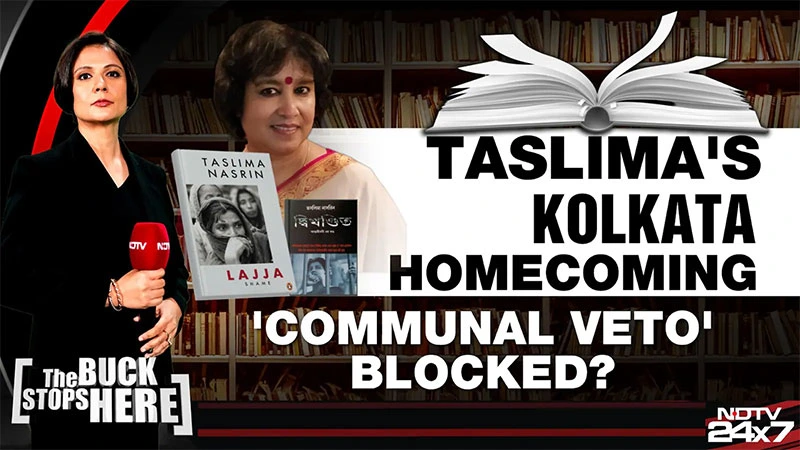
Taslima Nasrin: Truth Seeker or Controversial?
A packed room holds its breath as the exiled writer takes the stage, her presence alone challenging two decades of forced silence.
Taslima Nasrin is finally set to break her long exile and touch down in Kolkata on August 1st.
For twenty painful years, the city of her dreams remained a forbidden paradise. Her sudden return has instantly ignited a massive ideological firestorm across India and Bangladesh.
Is she a fearless voice fighting for true gender equality? Or is this just another tactical move in a lifelong fame game? The internet is buzzing with opinions.
At Knowledge Mart, we look past the media noise to analyze the deep political games behind the exile of Taslima Nasrin. We examine the massive hypocrisy of the intellectual class and why her presence still terrifies the political elite on both sides of the border.
Why Was the Writer Exiled from Kolkata 20 Years Ago?
To understand the present, we must look at the past. The year was 2007. The Left Front regime ruled West Bengal under Chief Minister Buddhadeb Bhattacharya.
Ironically, Bhattacharya was an author himself. He loved literature and prided himself on progressive thoughts.
Still, when religious fundamentalism knocked on his door, his government chose a dark path. Violently hostile mobs hit the streets of Kolkata, demanding the immediate expulsion of the Bangladeshi author.
Instead of defending freedom of speech, the Left government surrendered. They forced the writer out of the state overnight. They claimed her safety was under extreme threat.
But shouldn’t a democratic state protect its writers? Why didn’t the police stop the fundamentalists? This craven capitulation exposed the deep intellectual bankruptcy of the Left.
Many analysts believe the government adopted a subdued minority vote bank politics policy. They chose political survival over core human values. This political surrender remains a permanent black spot on the clean image of the Left Front.
“A government that cannot protect a writer’s pen has no right to call itself progressive”. – Knowledge Mart Political Analysis.
Taslima Nasrin Exit from Kolkata: Timeline & Key Events (2004-2008)
| Date / Period | Event | Impact / Outcome |
|---|---|---|
| 2004 | Taslima Nasrin arrives in Kolkata with a residence permit | Begins living, writing, and engaging with cultural circles |
| 2006 | Controversy over her book Dwikhondito; religious opposition rises | Threats, fatwas, and demands for expulsion intensify |
| 9 Aug 2007 | Attacked during a book event in Hyderabad | National outrage; security concerns escalate |
| Aug-Oct 2007 | Growing protests and threats in Kolkata | Pressure mounts on the state government |
| Mid-Nov 2007 | Effigy burning and protests across Kolkata | Police advise her to leave temporarily |
| 21 Nov 2007 | Large-scale riots erupt in Kolkata | Violence, arson, and Army deployment to control situation |
| 21-22 Nov 2007 | Government secretly evacuates Taslima from Kolkata | Shifted to Jaipur and then Delhi under tight security |
| Late 2007 – Early 2008 | Kept in a secure safe house with restricted movement | Effectively removed from public life in India |
| March 2008 | Taslima Nasrin leaves India | Marks the end of her stay; de facto expulsion completed |
Ironically, the book Dwikhondito, was banned once by the Left Front Government in West Bengal and Bangladesh, but it was translated in English as “Split: A Life” by Penguin Random House, India in 2018.
Who Were the Intellectuals Who Signed the Letter Against Her?
The political betrayal was painful, but the cultural betrayal cut deeper. Shockingly, reports revealed that 25 prominent Bengali intellectuals wrote a joint letter to the Chief Minister. They explicitly demanded the removal of the author from West Bengal.
The biggest surprise on that list was Sunil Gangopadhyay. He was a giant of modern Bengali literature. He famously championed secular and progressive thoughts. Though at the end, he turned his back on a fellow writer in her darkest hour.
This shocking move exposed the deep hypocrisy within Kolkata’s elite cultural circles. The very people who preached freedom of expression actively campaigned to silence a controversial voice to maintain street peace.
The best part is that A collective statement by cultural group SAHMAT, signed by 50+ intellectuals, condemned her removal from Kolkata.
The Myth vs. Reality of Kolkata’s “Progressive” Culture
To understand the irony of Kolkata’s stance, we have to look past the “progressivism” the city wears on its sleeve. The data below shows the stark disconnect between the city’s claims and its actual historical treatment of dissent.
| Feature | The “Progressive” Claim | The Harsh Ground Reality |
|---|---|---|
| Intellectual Freedom | “We are the hub of free thinkers“. | Signatories demanded the exile of a writer. |
| Political Stance | “We are secular and inclusive”. | Appeasement politics dictates who can stay. |
| Safety for Artists | “We protect creative voices”. | Police forced a writer out for “safety”. |
| Human Rights | “We stand for gender equality“. | Fundamentalist street vetoes override rights. |
What Happened to the Promised Return to Bangladesh?
The author’s dream has always been to return to her homeland, Bangladesh. Recently, a glimmer of hope appeared during an interview with senior journalist Sumon Chattopadhyay. Watch the YouTube Video.
She revealed that Tarique Rahman, the prominent leader of the Bangladesh Nationalist Party (BNP), had promised her a safe return. He gave her his word before his political group gained significant ground.
- The Promise: A guarantee of safety and the restoration of her citizenship rights.
- The Reality: Total silence after the political shift.
Once the transition of power happened, those sweet political promises vanished into thin air. No political leader wants to upset religious fundamentalism for the sake of an exiled atheist writer.
It seems Bangladesh remains a closed chapter for her, forcing her to look toward India for a permanent home.
What Do Political Parties Say About Her Present Stay?
Her visit to attend a literary seminar has exposed the deep fractures in modern Indian politics. The political responses are entirely divided along ideological lines:
- The BJP Stance: A party spokesperson stated she is welcome to stay in Kolkata. However, they added a strange catch. They suggested she should live specifically in a Hindu-dominated area for her own safety.
- The Left Stance: Veteran CPM leader Bikashranjan Bhattacharya fiercely criticized her. He openly labeled her as an active agent of the BJP-RSS alliance.
This bitter blame game shows that no political party views her simply as a human being or an artist. To them, she is just a useful tool for polarization. The Left uses their old, rigid ideologies to dismiss her. In between, the Right tries to fit her into their own political narrative.
Does She Support the Uniform Civil Code?
One major reason for the current political tension is her strong stance on the Uniform Civil Code (UCC). The central government may introduce the crucial UCC bill in the next parliamentary session.
The writer has passionately championed a uniform law for decades. She firmly believes a democratic nation cannot have two separate sets of family rules for two different religious groups.
- Her Argument: True secularism means one law protects all women equally, regardless of religion.
- The Left’s Dilemma: The Left parties historically claim to support secularism. Yet, they oppose the current UCC proposal. This contradiction raises a major question: Why does the Left oppose a law that fights for the uniform rights of women? If they truly believe in gender equality, they should be the first to support laws that abolish discriminatory religious personal codes.
Will Bengal Allow Her to Stay If She Criticizes Everyone?
Taslima Nasrin has made her intentions very clear. After twenty long years of hopping around dozens of global cities, living out of a suitcase is no longer an option. She is getting older, and health issues are quickly catching up with her.
Now, she simply wants a peaceful place to settle down, and Kolkata is the only city where she feels a deep linguistic and cultural connection.
However, her upcoming arrival presents a massive challenge for West Bengal’s political landscape:
- The Selective Welcome: Currently, right-wing groups welcome her because her primary target has historically been Islamic fundamentalism.
- The Atheist Wildcard: She remains a strict, uncompromising atheist who yields to no religion.
- The Uncomfortable Question: What happens if Taslima Nasrin starts writing sharp critiques against Hindu fundamentalism tomorrow?
- The Litmus Test for Bengal: Will the current administration protect her right to offend when the target changes?
True secularism cannot be conditional. It means actively protecting a writer’s right to speak, even when their words hurt your own sentiments.
Knowledge Mart Final Thoughts
The return of the writer, Taslima Nasrin, is a massive litmus test for Indian democracy. Over the years, we have seen governments use various methods to handle dissent.
Whether through state-sponsored exile, harassment, or the grim reality of extrajudicial encounters, silencing a fearless voice is a mark of a weak, insecure government.
At Knowledge Mart, we strongly believe that an encounter or extrajudicial force is never the solution in a civilized society. Free speech must be met with counter-speech, not with violence, police brutality, or exile.
Silencing a writer through fear or force is an admission of intellectual defeat. Bengal must move past its historical mistakes. The state needs to reinstate its truly secular, modern culture.
Kolkata must prove to the world that it is still brave enough to house a controversial voice, even if that voice stands entirely alone.
External References
- Read the background timeline and political reactions via the Daily Pioneer News Briefing.
- Review the context of her arrival via The Hindu Homecoming Report.
- Watch the full video report on the Times Now Analysis of Taslima Nasrin’s Return.
10 Key Takeaways
- Shocking Homecoming After 20 Years: The legendary exiled author Taslima Nasrin is officially breaking her forced exile to step foot back into the City of Joy.
- The Left’s Broken Promise: Former Chief Minister Buddhadeb Bhattacharjee, an author himself, abandoned his progressive ideals by surrendering to fundamentalist mobs.
- The Intellectual Betrayal Exposed: Shockingly, 25 prominent Bengali intellectuals, including the celebrated modern writer Sunil Gangopadhyay, signed a joint letter demanding her ouster rather than defending free speech.
- Minority Vote Bank Politics: The Left Front regime’s decision to ban her books and deport her was a clear strategy of political appeasement to secure its core electorate.
- The Hollow Myth of a “Progressive” Kolkata: Despite branding itself as a hub for open-minded, radical, and modern thought, the city historically chose a street veto over structural freedom of speech.
- Hollow Bangladeshi Political Promises: Prominent leader Tarique Rahman explicitly backed out of his commitment to guarantee her safe return to her homeland once political power shifted.
- The Uniform Civil Code (UCC) Stance: As a strict advocate for gender equality, Taslima Nasrin fiercely champions the UCC, exposing the absolute contradiction of Left parties who claim to fight for women’s rights but oppose uniform laws.
- Ghettoization of Free Speech: Current right-wing factions welcome her return, yet their spokespersons reveal underlying bias by suggesting she limit her residence exclusively to Hindu-dominated areas.
- The Fear of a True Atheist: While political groups use her to critique Islamic fundamentalism, the true test will be whether Bengal tolerates her sharp pen if she targets Hindu fundamentalism next.
- Knowledge Mart Verdict against Extrajudicial Encounters: True democracy means using counter-speech to answer dissent; utilizing state exile or lawless police execution is a total admission of systemic weakness.