Indira vs Mamata: A Ruthless Contrast
Jul 03, 2026 - By Ashutosh Roy PoliticsGovernanceNational PoliticsWest Bengal Politics
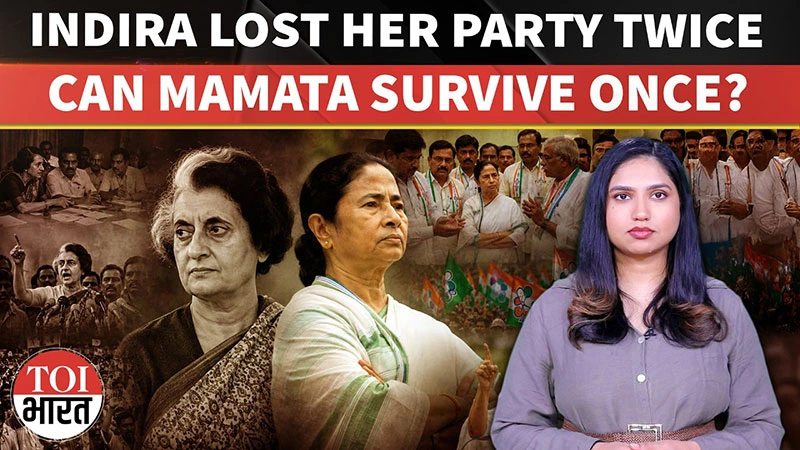
Is the Indira vs Mamata Comparison a Misleading Political Narrative?
A fierce and emotionally charged comparison between Indira vs Mamata has erupted into the spotlight, seizing media attention and igniting a storm of debate in recent times.
The air inside the crowded war room in Kalighat is heavy, thick with an unfamiliar, stunned silence. For over a decade, this has been the epicenter of absolute command in West Bengal Politics.
But following the staggering upheavals of the recent assembly elections, the political ground has shifted violently. The unassailable authority of a powerful regional matriarch is visibly fracturing, sending shockwaves through the ranks of top party loyalists.
As the dust settles, a familiar historical debate has taken a sharp, urgent turn. Political analysts are once again drawing lines between West Bengal leader Mamata Banerjee and the late Prime Minister Indira Gandhi.
At first glance, the comparison is intoxicating. Both iconic women carved their paths to absolute power through sheer, uncompromising grit. Both masterfully crafted an image as the fierce, iron-willed protector of the masses, commanding fierce loyalty while flattening institutional opposition.
Yet, expert political analysts at Knowledge Mart argue that this popular comparison is profoundly flawed. Beneath the superficial alignment lies a truly ruthless contrast.
While both leaders undeniably shared an identical compulsion to single-handedly control their political parties and the state machinery, the striking similarities end abruptly at the threshold of power.
Their foundational political standards, administrative execution, and ultimate ethical legacies stand miles apart.
Indira vs Mamata: Key Snippets
| Parameter | Indira Gandhi | Mamata Banerjee |
|---|---|---|
| Landmark Achievement | Liberation of Bangladesh | Nothing of National/ Inter-national Standard |
| Position Held | Prime Minister of India (1966-77, 1980-84) | CM of West Bengal (2011-2026) |
| Leadership Style | Centralized, authoritative, decisive | Highly centralized, personality-driven |
| Political Scale | National & global influence | Primarily state-level influence |
| Party Control | Strong command over Congress | Absolute control over TMC |
| Governance Approach | Pragmatic, strategic decision-making | Populist, welfare-driven politics |
| Crisis Handling | War leadership (1971), Emergency (1975-77) | Administrative crises, law & order debates |
| Institutional Use | Accused of institutional overreach (Emergency) | Allegations of political interference at state level |
| Corruption Charges | No direct personal corruption charges | Allegations often raised in political discourse |
| Political Legacy | Shaped India’s national trajectory | Strong regional dominance in Bengal |
| Mass Connect | Pan-India appeal | Strong grassroots connect in Bengal |
| Ideological Position | Congress-led nationalism & socialism | Regional populism with secular positioning |
| Global Standing | Internationally recognized leader | Limited global political footprint |
| Succession Planning | Groomed Sanjay Gandhi with notable political exposure | Promotes Abhishek Banerjee without any political background; Only qualification is next of the kin |
Key Difference
It is worth underscoring that Indira Gandhi’s political conviction carried far greater credibility and consistency, whereas Mamata Banerjee is often criticized for a pattern of frequent flip-flops and shifting standards.
Put bluntly, any Indira vs Mamata comparison feels forced and far-fetched, more a product of idle speculation than serious political reasoning.
Why Is the Indira vs Mamata Comparison Faulty?
To truly evaluate the core dynamics of Indira vs Mamata, we must closely examine their foundational political cultures. Indira Gandhi did not just happen upon power by chance.
She carried an elite, inherited political culture of national statecraft and deep-rooted diplomacy.
The Power of National Base vs Regional Roots
Indira Gandhi commanded a robust, highly centralized all-India base that stretched seamlessly from Kashmir to Kanyakumari.
She served directly as the Congress President during the legendary Jawaharlal Nehru regime. This early high-level exposure gave her a profound, systemic understanding of complex institutional diplomacy.
On the flip side, Mamata Banerjee remains entirely a local level leader. Her political roots belong firmly to the soil of West Bengal Politics.
While she managed a historic feat by uprooting a 34-year-old Left Front regime, her executive influence rarely crossed state borders. This sharp regional limitation severely restricts her ability to shape long-term national policy or guide federal coalitions.
So, the comparison of Indira vs Mamata may raise TRP of a Channel, but which is just a results of culmination of thoughts of some so-called political analysts.
How Did Their Political Standards Differ?
A major point of divergence lies in how both alpha leaders managed their respective political career timelines. Indira Gandhi was a master of grand ideological consistency, maintaining her primary national focus even during her darkest hours.
Ideological Stance and Trimming Sails
Mamata Banerjee has frequently shifted her central political alignments over the decades simply to survive. Her career shows a pattern of fluidly changing party support based on current trends:
- Moving her regional forces from the Congress to join the BJP-led NDA coalition.
- Shifting aggressively from the BJP back to join the Congress-led UPA.
- Forming temporary, highly tactical alliances based purely on localized regional necessity.
Because of this constantly shifting nature, Mamata Banerjee could never maintain a convincing stance or build lasting trust at the national level.
Critics often label these frequent maneuvers as purely opportunistic rather than genuinely pragmatic statecraft.
The Hidden Games in Parliament
Furthermore, serious allegations have regularly emerged regarding Mamata’s indirect relationship with central ruling powers.
To expand her footprint, her party fielded candidates in traditional Congress-dominated states like Tripura, Goa, and Nagaland. Political analysts from Knowledge Mart noted that this deliberate move fragmented the opposition vote share, which indirectly helped the BJP score crucial victories.
Moreover, her regional party frequently allowed controversial, crucial bills to pass smoothly in Parliament. How? By systematically instructing her MPs to abstain from voting during critical sessions.
This hidden strategy severely damaged her public credibility as a steadfast, uncompromising opposition voice against the central government.
Did Indira Face Personal Corruption Scandals?
The definitive dividing line between these two powerful figures is the critical question of absolute financial integrity. This is the precise point where the structural comparison collapses completely under analytical scrutiny.
“While Indira Gandhi faced heavy historical criticism for her autocratic methods, heavy centralization, and the infamous 1975 Emergency, her bitterest detractors never once accused her of personal financial corruption or building personal wealth”.
The Multi-Crore Scams in Bengal
In stark contrast, Mamata Banerjee’s current administration faces an unprecedented existential crisis over systemic institutional financial scandals. The public has witnessed a shocking, continuous parade of multi-crore corruption cases unfolding rapidly across West Bengal. These include:
- The widespread, institutionalized School Service Commission (SSC) recruitment scam.
- The massive, state-wide ration distribution scam.
- The infamous Saradha and Rose Valley chit fund scams that wiped out public savings.
Unlike Indira’s centralized, high-level political battles, these ground-level cash-for-jobs scams directly harmed the lives of ordinary citizens.
The shocking public visuals of massive mountains of cash recovered by central agencies from the homes of close party associates have deeply damaged the ethical image of the regime.
So, any Indira vs Mamata equivalence appears not just meaningless, but entirely devoid of logic.
Can Mamata Fight Back Like Indira Did?
According to a detailed analysis published by Anandabazar Patrika, the political road ahead for the Bengal Chief Minister is extraordinarily steep compared to past historical precedents.
The Lesson of 1977
When Indira Gandhi lost everything during the historic 1977 general elections, she temporarily lost her entire party structure, her official name, and her iconic election symbol. Even then, she fought back with immense resilience.
She returned to absolute power within just three years. She successfully accomplished this monumental comeback because she possessed a robust, unshakeable pan-Indian organizational network that remained loyal to her brand.
Why the Road is Harder for Mamata
As detailed in a recent analytical report by the Times of India, Mamata Banerjee faces a far more complex internal crisis. Today, her regional party structure is actively splintering from within. Senior leaders are openly abandoning the ranks, and her closest administrative associates face intense federal investigations.
Without a pan-Indian framework or a lasting legacy of institutional governance, staging a grand Indira-style national comeback remains highly unlikely.
Knowledge Mart Analysis: Key Takeaways
Political Framework Comparison
| Metric | Indira Gandhi | Mamata Banerjee |
|---|---|---|
| Scope of Influence | National Institution (Pan-Indian Presence) | Regional Movement (Restricted to West Bengal) |
| Political Foundation | Inherited culture and Nehruvian statecraft | Grassroots street-level agitations |
The Resurgence Trajectory (1977 vs Current Crisis)
| Phase | Indira Gandhi’s Roadmap | Mamata Banerjee’s Current Hurdle |
|---|---|---|
| The Crisis | Lost the 1977 election, party name, and symbol. | Faces severe internal fracturing and multi-crore corruption scandals. |
| The Anchor | Maintained an unshakeable pan-India organization. | Lacks an organizational base outside West Bengal. |
| The Outcome | Swept back into absolute national power by 1980. | Staging a nationwide comeback remains nearly impossible. |
Final Verdict
The structural comparison under the precise lens of Indira vs Mamata reveals that single-handed control over a party is not a substitute for an enduring institutional legacy.
Indira Gandhi built a centralized national authority anchored tightly by institutional statecraft and a clean personal record regarding financial scams. Mamata Banerjee’s centralized rule, conversely, remains structurally confined to a single regional territory and faces severe unravelling due to deep-seated grassroots corruption.
While both leaders successfully challenged established systems in their prime, their underlying political standard, strategic consistency, and financial credibility create an unbridgeable gulf. Equating the two remains entirely a political myth.
10 Key Snippets:
- The Iron Grip Similarity: Both matriarchs demand absolute, single-handed control over their political party and government machinery.
- National vs. Local Power: Indira Gandhi commanded a sweeping, all-India base, while Mamata Banerjee remains structurally a local level leader.
- Deep Political Roots: Indira operated with an inherited political culture from the Nehru era, compared to Mamata’s street-level agitation roots.
- Shifting Political Loyalties: Mamata fluidly changed party alignments (BJP to Congress and back), preventing a convincing national stance.
- The Personal Integrity Gap: Indira Gandhi never faced personal financial scandals, whereas Mamata’s legacy is heavily plagued by multi-crore scams.
- Systemic Grassroots Scams: Bengal is rocked by monumental corruption, including the explosive School Service Commission (SSC) recruitment scam.
- Hidden Parliamentary Games: Critics expose Mamata’s indirect helper role for central powers by splitting opposition votes and abstaining MPs.
- The Epic 1977 Resilience: When Indira lost her party name and symbol in 1977, her vast national network allowed a stunning 3-year comeback.
- A Fracturing Bengal Regime: Modern analysts highlight a splintering internal structure in Bengal, making an Indira-style resurgence highly unlikely.
- The Myth of Equivalence: Knowledge Mart emphasizes that comparing them is a myth; Indira played on a global chessboard, while Mamata remains bound to regional politics.
[…]Indira vs Mamata: A Ruthless Contrast Looking at Indira vs Mamata? Beyond the ruthless quest for total control lies a massive divide in administrative pragmatism and rampant institutional scams.[…]
[…]Indira vs Mamata: A Ruthless Contrast Looking at Indira vs Mamata? Beyond the ruthless quest for total control lies a massive divide in administrative pragmatism and rampant institutional scams.[…]