Birth of West Bengal: Shocking 1947 Vote
Jul 02, 2026 - By Ashutosh Roy PoliticsCurrent AffairsRegional UpdatesWest Bengal Politics
Who Really Fabricated the Narrative Behind the Birth of West Bengal?
The birth of West Bengal was not a peaceful dawn; it was extracted from the jaws of absolute erasure during a screaming match of political survival on June 20, 1947. On that fateful Friday, the destiny of millions hung by a thread inside the Bengal Legislative Assembly.
Knowledge Mart has delved into the Paschim Banga Dibas and analyzed it from the historical perspective.
Had a single voting bloc blinked, the entire map of eastern India would have been wiped clean, permanently swallowing Kolkata and its surrounding districts into the territory of Pakistan.
Today, right-wing forces like the Bharatiya Janata Party (BJP) actively attempt to rewrite this critical historical milestone.
They paint the birth of West Bengal as the solo rescue mission of a singular Hindu icon: Dr. Syama Prasad Mookerjee. Yet, historical records tell a far more complex story of cross-ideological survival.
It was a massive legislative consensus that brought together bitter political rivals to keep the state within the Union of India.
By looking closely at the actual numbers, the political maneuvering, and the records preserved by the West Bengal Legislative Assembly, we can bust the myths surrounding this foundational day.
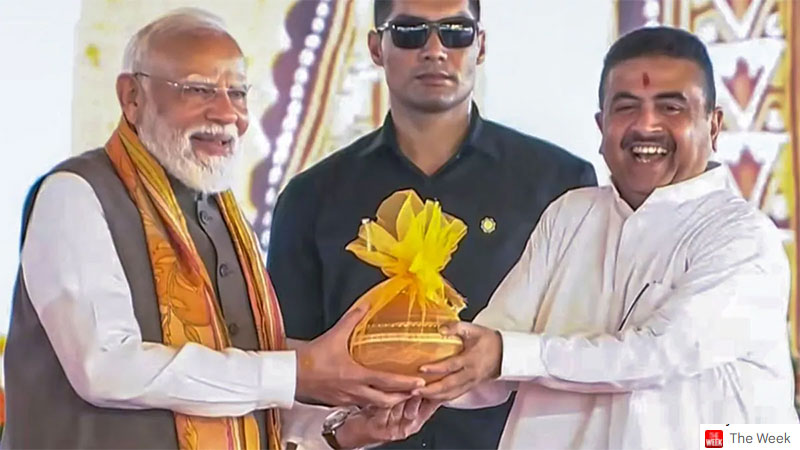
Narendra Modi has attended the Paschim Banga Dibas at Tarakeswar.
Why Is June 20, 1947, Considered the True Birth of West Bengal?
To understand why this day matters, we have to look at the crumbling British Empire in the summer of 1947. Under the Mountbatten Plan, announced on June 3, the British laid out a highly specific mechanism to split the massive provinces of Punjab and Bengal.
The British (Radcliff Line) did not simply draw a line on a map overnight; they forced the local elected representatives to make the choice themselves.
The procedural layout was unique. The British rules dictated that the Bengal Assembly would vote on two futures: a united Bengal or a partitioned Bengal. Crucially, the plan granted a veto power to the minority population.
If either the Muslim-majority districts or the non-Muslim-majority districts voted for a split, the province would automatically divide.
Because the western representatives chose separation to stay out of a religious state, June 20 stands as the legal and constitutional birth of West Bengal. So, BJP can celebrate it as Paschim Banga Dibas, but the credit goes to a host of contemporary law makers.
The Step-by-Step Chronology of the Assembly Votes
The assembly session on that historic Friday did not consist of just a single show of hands. The legislators had to undergo three distinct, high-stakes voting phases on the exact same day. The entire future of the region shifted step by step through this legal chronology:
- Phase 1: The Joint Assembly Session – All members met together to decide which new nation a united Bengal would join. With the Muslim League holding a natural majority, the joint house voted 126 to 90 to join the Pakistan Constituent Assembly.
- Phase 2: The Muslim-Majority Meeting – Representatives from East Bengal met separately. They voted 106 to 35 against partitioning the province, hoping to absorb the entire geography of Bengal into Pakistan.
- Phase 3: The Non-Muslim-Majority Meeting – Representatives from West Bengal met in a separate chamber. They voted 58 to 21 in favor of partition, overriding the previous votes and securing their place in India.
The tables below map out exactly how these votes fell, showcasing the stark contrast between the different sessions:
Phase 1 & 2: The Joint Session and East Bengal Decisions
| Voting Session | Core Proposal Under Review | Votes For | Votes Against |
|---|---|---|---|
| 1. Joint Assembly Session | Join Pakistan’s Constituent Assembly as a whole province | 126 | 90 |
| 2. Muslim-Majority Districts | Partition the Province of Bengal to separate the West | 35 | 106 |
Phase 3: The West Bengal Decision (The Decisive Veto)
| Political Party / Affiliation | Votes Cast FOR Partition (To Join India) |
|---|---|
| Indian National Congress | 54 |
| Communist Party of India (CPI) | 2 (Jyoti Basu & Ratanlal Brahman) |
| Hindu Mahasabha | 1 (Dr. Syama Prasad Mookerjee) |
| Independent / Others | 1 |
| Total Winning Votes | 58 (vs. 21 Against) |
Exposing the BJP’s Monopoly Over the Historical Narrative
The voting data from the non-Muslim-majority session completely deconstructs the modern BJP narrative.
As documented by detailed political analysis in The Indian Express, the BJP frequently promotes the idea that West Bengal exists today solely because of Dr. Syama Prasad Mookerjee.
While Mookerjee was a powerful orator and a fierce advocate for Bengali Hindus outside the assembly, the legislative reality inside the hall tells a different story.
As the table clearly demonstrates, the Hindu Mahasabha held exactly one single seat in that decisive session. The crushing weight of the vote came from 54 members of the Indian National Congress.
Without the unwavering mobilization of the Congress leadership, Mookerjee’s proposal would have been nothing more than a historical footnote. So, Birth of West Bengal would remain as a cherished dream for Bengalis.
By erasing the 54 Congress MLAs from the text, the BJP twists a broad-based, multi-party democratic defense into a personalized, right-wing victory. This selective memory of Paschim Banga Dibas in the name ofDr. Syama Prasad Mookerjee serves modern electoral agendas rather than honest history.
The Communist Strategy: Why Did Jyoti Basu Vote For Partition?
One of the most intensely debated aspects of the birth of West Bengal is the behavior of the political left. Communist legends Jyoti Basu and Ratanlal Brahman, representing the Communist Party of India (CPI) as elected MLAs, cast their votes squarely in favor of partitioning Bengal.
Modern critics often attempt to weaponize this vote, claiming that even the secular left succumbed to communal lines when pressure mounted.
However, reducing their vote to a simple Hindu-Muslim split ignores the sophisticated geopolitical strategy of the CPI at the time. Their decision was driven by the larger national interest through these key priorities:
- Securing a Democratic Future: The communists knew that a united Bengal under the Muslim League’s majority would enter Pakistan. They refused to let millions of working-class citizens be trapped inside a fundamentally religious state.
- Preserving Ties with India: The CPI leaders believed that West Bengal’s social, economic, and trade-union movements belonged alongside the massive, secular mass movements of the main Indian subcontinent.
- Rejecting Isolation: Voting for partition was the only legal pathway to ensure the western districts remained anchored to the Union of India, rather than being entirely cut off and isolated from the rest of the nation.
Instead of labeling these leaders as communal partitionists, it is historically accurate to state that they opted to keep Bengal tied to India’s secular fabric.
They recognized that saving a democratic, pluralistic space in the west was far more valuable than pursuing a doomed, unified territory under a religious framework. This strategic cross-party consensus is frequently noted in historical retrospectives by major publications like The Hindu.
The Human Cost: Why June 20 Is a Day of Reflection, Not Triumph
The BJP’s aggressive push to celebrate June 20 as an uncritical “State Foundation Day” misses the deep emotional texture of Bengali history. For millions of families across the region, the partition was a profound human tragedy.
As detailed extensively in coverage of the legislative debates by The Indian Express, the division of the province triggered one of the largest refugee crises in human history, uprooting millions from their ancestral homelands in East Bengal.
A Distorted Celebration: Turning a day of displacement, trauma, and broken hearts into a triumphant political party festival shows a distinct lack of empathy for the lived experiences of Bengali refugees. The vote on June 20 was a defensive act of survival, not a celebratory victory lap.
We may celebrate the Paschim Banga Dibas, but we must not forget the hazards of heart-rendering partition and the sufferings of many people.
Knowledge Mart Key Notes
The birth of West Bengal succeeded because a diverse group of nationalists, communists, and regional leaders put aside their deep ideological feuds to protect a secular future.
It was carried by the collective votes of dozens of lawmakers who chose the Union of India. Erasing this multi-party consensus to build a modern political monopoly does a massive disservice to the real history of West Bengal.
10 Key Takeaways:
- The Multi-Stage Veto: While the joint assembly initially voted 126 to 90 against division, a procedural clause in the Mountbatten Plan meant the non-Muslim-majority districts held an ultimate veto to force the partition.
- The 58–21 Verdict: The definitive birth of West Bengal occurred when the western district legislators voted 58 to 21 to separate from the east and remain an integral part of the Union of India.
- Congress Carried the Vote: Despite modern political narratives, the partition proposal was overwhelmingly carried by 54 members of the Indian National Congress, while the Hindu Mahasabha held only a single seat.
- The Communist Alignment: CPI icons Jyoti Basu and Ratanlal Brahman voted for partition to secure a secular, progressive future within India rather than allowing the whole province to be absorbed into a religious state.
- End of the United Bengal Plan: This historic vote permanently crushed the alternative blueprint for a sovereign, independent, and undivided Bengal nation championed by Sarat Chandra Bose and Huseyn Shaheed Suhrawardy.
- The East Bengal Counter-Vote: Simultaneously, the Muslim-majority eastern district legislators voted 106 to 35 against partition, aiming to absorb the entire province, including Kolkata, into Pakistan.
- Economic Hub Preserved: By choosing India, the western lawmakers successfully secured Kolkata’s port, the Hooghly industrial belt, and critical coalfields for the newly formed Indian state.
- Radcliffe Line Activated: This legislative outcome served as the legal trigger for Sir Cyril Radcliffe’s Boundary Commission to physically dissect the province’s map along demographic lines.
- Massive Refugee Catalyst: Though a constitutional decision, this vote became the formal catalyst for one of the largest human migrations in history, uprooting millions of families across the new borders.
- A Bitter Modern Flashpoint: The date remains a heavy political battleground, balancing the pride of staying within a secular India against the deep, inherited trauma of the 1947 partition.