NEET Protests: Tolerating Violent Assaults?
Jul 29, 2026 - By Ashutosh Roy Current AffairsGovernance & AdminNational NewsNational PoliticsPoliticsRegional UpdatesWest Bengal Politics
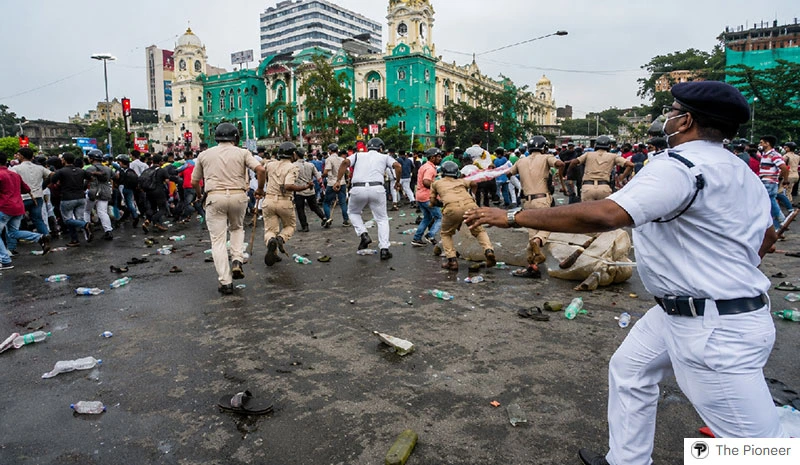
NEET Protests: Chaos, Justice or Lawlessness?
A sudden, sharp shower of jagged red bricks cut through the thick, humid afternoon air of Kolkata, instantly transforming a peaceful gathering into a scene of utter bedlam. Within seconds, rhythmic slogans for academic justice dissolved into piercing screams of panic and confusion.
Heavy camera lenses shattered on the hard pavement, and fresh blood dripped down the foreheads of seasoned photojournalists who were desperately trying to shield their expensive gear from incoming stones. These all happened in the name of NEET Protests in Kolkata.
This gathering was never intended to turn into a violent street riot. Across major Indian cities, thousands of dedicated medical aspirants had come together to voice their raw frustration over leaked question papers, systemic corruption, and shattered career dreams.
But, as the NEET Protests grew in scale and emotion, the atmosphere shifted dramatically. What started as a genuine, urgent plea for educational fairness was gradually hijacked by outside elements looking to exploit student anger.
- Peaceful Aspirants Co-opted: Genuine students asking for exam integrity were suddenly pushed aside by violent agitators and opportunistic political groups.
- Street Demonstrations Turning Chaotic: Peaceful marches quickly spiraled into unpredictable urban brawls, damaging public property and risking student safety.
- The Core Legal Dilemma: As public gatherings turn volatile, every responsible citizen must ask where we draw the firm line between protected democratic dissent and outright lawlessness.
We must acknowledge that we are talking of future doctors, who have to play the pivotal role in our healthcare system. There are allegations of inadequacy and pitfalls of our health care system in various states. We should be sensitive enough again the aspirants can not behave with such atrocities. The original movement of CJP was peaceful.
Look at the YouTube Video of TV9, how brutally the journalists had been attacked.
How Did Peaceful Rallies Turn Into Violent Street Clashes?
When the nationwide NEET Protests first broke out, the movement was driven by an undeniable moral clarity. Hundreds of thousands of young students, alongside anxious parents, demanded a complete overhaul of the national testing framework, transparent investigations, and severe punishments for high-level paper-leak masterminds.
Still, as these rallies gained massive traction, anti-social elements and professional troublemakers recognized an golden opportunity to hijack the narrative for their own distinct ends. The Gen Z Politics has added a new dimension in today’s political landscape.
In the narrow lanes and major intersections of Kolkata, peaceful gatherings rapidly degraded into outright urban chaos. Detailed news coverage published by Anandabazar Patrika confirmed that city police were forced to arrest additional suspects who were explicitly linked to organized unrest during the local NEET paper leak protest.
Investigators uncovered that these individuals were not student candidates at all, but rather outside operatives brought in to engineer violent confrontations with law enforcement agencies.
Instead of holding placards, chanting slogans, or presenting formal memorandums to administrative officials, masked agitators began pulling heavy bricks from nearby construction sites and hurling iron rods at police barricades. Working news reporters, videographers, and innocent bystanders were cornered in narrow alleyways, verbally abused, and brutally assaulted simply for documenting the unfolding violence.
The moment a peaceful protester picks up a heavy brick to hit a fellow citizen or a journalist, the moral authority of the entire movement completely crumbles.
This deliberate shift from peaceful agitation to organized street violence poses a massive existential threat to real students. Their genuine pleas for testing integrity and educational reform are now being systematically buried beneath sensational national news headlines about damaged public property, burning tires, and hospitalized journalists.
The hooligans might forget that the Mamata Banerjee Government has been thrawted now. The new BJP Government has been desperate in implementing rule of law with a strict hand.
Should Governments Offer Amnesty or Apply Anti-Goonda Laws?
As demonstrations continued to spread across state borders, various regional governments adopted drastically different legal philosophies to manage the escalating crisis. This sharp administrative divide has triggered a fierce national debate regarding public safety, equal accountability, and the rule of law.
The comparative breakdown below highlights how different state administrative bodies and political groups are responding to individuals detained during the ongoing NEET Protests:
| State / Authority | Official Legal Stance | Action Taken on Agitators | Rationale & Practical Effect |
|---|---|---|---|
| Bihar Government | Full Political Amnesty | Withdrawing registered FIRs; releasing dozens of detained protesters | Attempting to quickly appease public anger and prevent statewide transport shutdowns. |
| Assam Government | Comprehensive Case Dismissals | Releasing detained agitators following top-level state assurances | Seeking to avoid prolonged confrontation with local student organizations and political rivals. |
| West Bengal Government & Administration | Strict Judicial Prosecution | Applying stringent Anti-Goonda Laws; executing targeted arrests | Maintaining zero tolerance for stone-pelting, assault on media crews, and politically backed vandalism. |
| Cockroach Janata Party (CJP) | Demand for Universal Amnesty | Calling for all pending FIRs against NEET Protests participants to be dropped | Claiming public solidarity with students, though violent infiltrators directly benefit from blanket forgiveness. |
As documented in a separate investigative report by Anandabazar Patrika, state leadership in Bihar and Assam opted to calm rising political heat by promising a broad withdrawal of criminal cases filed against detained demonstrators. Their political logic suggests that forgiving young protesters helps restore administrative normalcy and prevents long-term societal alienation.
Conversely, state administration in West Bengal, backed strongly by political voices like Suvendu Adhikari, took an uncompromising legal posture.
Rather than viewing the street violence through a lenient political lens, Bengal law enforcement began meticulously scrutinizing video footage to identify suspects with known criminal histories or hidden party affiliations. Police subsequently began invoking tough, specialized legal measures, such as Anti-Goonnda Laws, against habitual offenders who engaged in physical violence under the cover of student rallies.
This stark policy contrast brings several troubling legal questions straight to the forefront of our national consciousness:
- Does granting blanket political amnesty to individuals who pelted bricks create a highly dangerous precedent that encourages future riotous behavior during public rallies?
- Is it fair or constitutionally sound for state governments to treat peaceful, petitioning students and violent, weapon-wielding criminals as part of the exact same protected group?
At Knowledge Mart, our stance is clear and unwavering: a democratic government cannot afford to adopt a soft, double-standard approach toward public violence. Offering political pardons to violent rioters merely to buy temporary peace is a short-sighted strategy that invariably invites greater lawlessness down the road.
When Does Freedom of Expression Become Character Assassination?
While physical clashes flared up on city streets, an equally toxic war erupted across social media feeds. The legitimate digital discussion surrounding the NEET Protests was quickly overshadowed by an aggressive wave of online vitriol that strayed far from the core issues of exam fairness.
Instead of focusing on systemic paper leaks, test administration failures, or structural reforms, the online rhetoric rapidly devolved into targeted personal attacks. Social media channels became flooded with troubling content, including:
- Vulgar Memes and Reels: Content designed less for constructive critique and more to mock and humiliate public figures.
- Personal Character Assassination: Explicit posters and slander aimed at undermining individual dignity rather than challenging government policy.
- Distraction From Student Issues: High-profile controversies, such as Bengali artist Srilekha Mitra drawing heavy public backlash for displaying an explicit political poster at a demonstration, shifted the national conversation away from medical aspirants and onto personal feuds. Even Mamata Shankar taken on Srilekha for such posters.
Satire and sharp political humor have always played a vital role in healthy democracies. Challenging Government or Administration through irony or wit is a protected form of expression.
Watch a satire related to Srilekha Mitra in X.
However, a clear line exists between critiquing a flawed policy and launching malicious attacks meant to tear down an individual’s personal standing or target constitutional offices.
Where Is the Legal Boundary Between Satire and Slander?
Veteran journalists and senior political commentators like Sumon Chattopadhyay have repeatedly advocated for a strategy of silence, suggesting that responsible society should simply ignore these crude online provocations rather than granting them additional visibility through public outrage.
But in an age driven by virality and algorithms, is turning a blind eye really a viable defense?
A closer look reveals why ignoring digital harassment consistently fails to protect public discourse:
- Normalizing Mob Mentality: When explicit personal character assassination is allowed to pass without legal friction, online bullies feel emboldened to push their attacks into increasingly dangerous territories.
- Outdated Cyber Frameworks: Existing statutory laws struggle to keep pace with rapid digital trends, leaving a glaring legal gray zone between humorous political commentary and criminal defamation.
- Direct Spillovers Into Real-World Conflict: Online vitriol does not remain confined to phone screens. Unchecked digital aggression fuels real-world animosity, transforming online mobs into angry physical crowds at protest grounds.
Freedom of speech is unquestionably one of our most sacred constitutional rights. Now, the moment free expression is weaponized to inflict intentional psychological harm or defame an individual’s personal life, it ceases to function as legitimate democratic critique.
Watch the video of Sumon Chattopdhyay regrading the NEET Protests.
Is the Cockroach Janata Party Movement Being Sabotaged From Within?
When the Cockroach Janata Party (CJP) initially entered the fray to organize nationwide student rallies surrounding the exam scandal, its leadership laid down a very clear, unambiguous mandate: the agitation must remain entirely non-violent, constructive, and strictly focused on securing testing transparency for young aspirants.
Unfortunately, that founding promise rapidly collapsed when put to the test on the ground. Fringe political operatives, anti-social groups, and professional agitators quickly infiltrated the CJP’s public marches.
Hiding behind dense crowds of genuine students, these external bad actors used the emotional cover of “student solidarity” to charge police lines, destroy public buses, set up road blockades, and physically target working journalists.
By failing to rigorously vet their own crowds or forcefully hand over violent infiltrators to law enforcement, the movement’s organizers inadvertently sabotaged their own cause. Instead of keeping national attention glued to the urgent need for systemic testing reforms, news headlines were dominated by images of street violence, property damage, and mass police arrests.
Timeline of NEET Protests Chaos in Kolkata:
| Date & Time | What Happened | Impact / Turning Point |
|---|---|---|
| July 24, Morning | Mass protest begins in Kolkata from Sealdah. | Peaceful student-led rally takes shape. |
| July 24, Afternoon | Crowd swells; rally marches toward Esplanade (Dorina Crossing). Tension rises; unidentified elements allegedly enter crowd around 5:30PM | Protest reaches peak participation. Shift from controlled protest to volatile situation. |
| Evening (July 24) | Stone pelting, barricade breach, clashes with police begin. Police respond with lathi charge to disperse protesters. | Protest turns violent; law & order breakdown. Full-scale confrontation on Kolkata streets. |
| Late Night | Journalists reportedly attacked; media equipment damaged. | Issue escalates beyond student protest. |
| July 25 – 27 | FIRs filed; 16 arrests made; many identified as outsiders. Political blame game starts; protests over arrests continue. | Investigation begins; crackdown intensifies. Narrative shifts to politics vs student movement. |
| Post July 27 | Supreme Court comments on protest rights vs excessive force. | National debate: Protest vs Violence intensifies. |
Key Snippets of NEET Protests in Kolkata
What began as a student protest for justice quickly spiraled into Chaos, clashes, and political controversy. The Kolkata NEET protests. Now stands as a critical example of how movements can lose direction when violence enters the scene.
What Separates Real Aspirants From Political Infiltrators?
To fully grasp how the legitimate NEET Protests were hijacked, we must carefully examine the stark differences in motivations, tactics, and personal stakes between the two distinct groups occupying the streets:
- Real Student Aspirants:
- Core Motivation: Securing a fair, leak-free re-examination, enforcing transparent grading criteria, and putting corrupt testing syndicates behind bars.
- Operational Methods: Organizing peaceful sit-ins, submitting formal petitions, leading silent candlelight marches, and holding policy-focused placards.
- Personal Risks: Facing academic delays, enduring physical exhaustion, risking police lathi-charges, and losing invaluable public sympathy due to external street violence.
- Anti-Social Infiltrators:
- Core Motivation: Inciting public disorder, creating headlines, provoking law enforcement into overreacting, and scoring cheap political points against rivals.
- Operational Methods: Pelting heavy bricks, smashing public transport, physically assaulting news crews, and circulating defamatory memes online.
- Personal Risks: Minimal real academic stake, they actively hide behind genuine students during clashes and rely on political parties to demand blanket legal amnesty if caught.
Knowledge Mart Final Thoughts
Our comprehensive analysis at Knowledge Mart points toward one inescapable, uncomfortable reality: mainstream political parties, fringe opportunists, and violent anti-social elements are actively destroying a vital student movement from the inside out.
The Cockroach Janata Party (CJP) leadership publicly promised a strictly peaceful, non-violent campaign for student rights. Still, political opportunists and criminal agitators systematically hijacked CJP rallies for their own selfish, short-term interests.
When violent mobs hurl heavy stones at police, physically beat up working photojournalists, and hide behind the noble banner of “solidarity”, they inflict irreparable harm on the dreams of millions of deserving medical aspirants.
At the same time, regional governments cannot afford to play political games with public safety or judicial integrity. While peaceful, law-abiding student participants of the NEET Protests must be fully protected from high-handed police action, any individual caught throwing bricks, smashing property, or assaulting journalists belongs behind bars, not on a politically motivated amnesty list.
We all know that the time has come to evaluate Alternative to NEET exam, which becomes more reasonable and concrete way of judging the students’ merit. After all, we are dealing with the futures of doctors, who will become our saviors in any medical distress.
If our society continues to tolerate street violence and vile personal character assassination under the broad, sacred umbrella of public dissent, we risk sacrificing democratic integrity for total social anarchy.
On-the-Ground Video Context
To gain an unfiltered look at how rapidly these demonstrations escalated into severe physical danger for reporters, bystanders, and law enforcement officers in Kolkata, watch NEET Row Escalates! Protesters Seen Throwing Bottles in Kolkata | India Today. The news footage clearly captures the volatile ground reality and real-world safety risks that unfolded during the height of the agitation.
10 Key Takeaways:
- Legitimate Student Demands Were Hijacked: What started as a peaceful fight for exam fairness turned into organized street violence when violent agitators infiltrated student crowds.
- Media and Photojournalists Facing Brutal Assaults: Working reporters and cameramen covering the Kolkata rallies were targeted with flying bricks and physical attacks, exposing severe safety risks on the ground.
- A Deep Political Divide Over Law Enforcement: States like Bihar and Assam promised blanket amnesties, while West Bengal invoked tough Anti-Goonda Laws to prosecute violent offenders.
- Blanket Amnesty Sets a Dangerous Precedent: Forgiving individuals who pelted stones and destroyed public property simply to buy temporary peace undermines equal accountability and the rule of law.
- Online Satire Has Escalated Into Character Assassination: Social media feeds were flooded with vulgar memes and explicit posters, crossing the clear boundary between fair political critique and personal slander.
- Ignoring Digital Slander Fails to Stop Real-World Mob Violence: Turning a blind eye to targeted cyber harassment emboldens online bullies and directly fuels real-world aggression at protest grounds.
- Internal Discipline Within CJP Rallies Collapsed: Despite promising a strictly non-violent movement, the Cockroach Janata Party (CJP) failed to prevent political opportunists from co-opting their marches.
- A Stark Line Exists Between Aspirants and Infiltrators: Real medical candidates seek transparent testing reforms through peaceful sit-ins, whereas anti-social infiltrators seek urban chaos and political cover.
- Infiltration Destroys Public Sympathy for Students: Every thrown brick and smashed bus shifts national headlines away from NEET exam corruption and onto street lawlessness, hurting innocent aspirants most.
- Knowledge Mart’s Stance on Equal Justice: Peaceful student protesters deserve complete administrative protection, but violent rioters must face strict criminal prosecution without political favoritism.
[…]NEET Protests: Tolerating Violent Assaults? Are violent mobs escaping justice under the guise of NEET protests? Discover why brick-pelting and assault must not be tolerated under free speech.[…]
[…]NEET Protests: Tolerating Violent Assaults? Are violent mobs escaping justice under the guise of NEET protests? Discover why brick-pelting and assault must not be tolerated under free speech.[…]