SIR Controversy: A Battle Without End
Oct 26, 2026 - By Ashutosh Roy Election AnalysisNational PoliticsPoliticsWest Bengal Politics
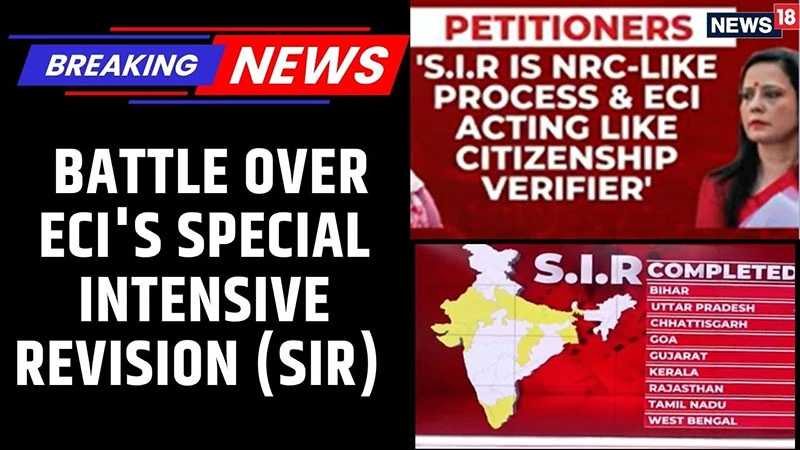
SIR Controversy: The Real Issues India Must Address
The SIR Controversy has spread across India, from political rallies and street protests to courtrooms and the Election Commission itself. It has caused hardship to ordinary citizens and triggered bitter political confrontations. Yet, amid demands for resignations and accusations of vote theft, are we paying enough attention to the real problems?
In my view, four issues lie at the heart of the Special Intensive Revision (SIR) of electoral rolls: the large-scale deletion of voter names, changes to Form 6, concerns about access to electoral software and the burden placed on citizens asked to prove their eligibility. Political battles and protests may attract public attention, but they cannot solve these underlying problems. Unless the system itself is examined and improved, changing the people in charge will achieve little.
The Four Core Issues Behind SIR
1. Mass Exclusion of Voters
Reports have indicated that around 13.3 crore names were removed from draft electoral rolls across the states and Union Territories covered by the exercise. The figures and their implications vary by state, and deletion from a draft roll does not necessarily mean permanent exclusion. Even so, the scale demands serious scrutiny. The Election Commission must explain how it distinguishes genuine deletions from mistakes that could deprive eligible citizens of their voting rights.
Nobody should defend an inaccurate voter list simply because it existed before the revision. Deceased persons, duplicate entries, people who have permanently shifted elsewhere and those who are legally ineligible to vote must be dealt with according to the law. But removing an ineligible entry is one thing; depriving an eligible citizen of the right to vote is quite another. No eligible voter should be wrongly excluded, and every affected person must have a fair opportunity to challenge a deletion.
The Indian Express reported on a special drive to help voters whose names were missing from draft rolls. Such a corrective exercise is important, but it also raises a basic question: if the process is sufficiently reliable, why has this additional effort become necessary on such a scale?
2. Form 6: Legality Is Not the Only Question
Form 6 is used by people applying to register as new voters. The controversy concerns the addition of a declaration connected with the previous SIR to the online form. We must examine not only whether such a change is legally valid but also why it was introduced and how it affects ordinary people. Does it improve registration, or does it create additional hurdles for eligible citizens?
A specific investigation by The Indian Express into the Form 6 changes reported that Election Commissioners Sukhbir Singh Sandhu and Vivek Joshi had objected to the new declaration. According to the report, they argued that the statutory form could not be changed in this way without the appropriate amendment to the rules. The Commission’s own response and the relevant legal framework must also be considered, but the objections make a clear explanation necessary.
The right to register as a voter should depend on the legal eligibility of the individual, not on whether a parent or grandparent appeared on an earlier electoral roll. The ECI must explain the legal basis for any additional requirement and demonstrate that it does not create an unnecessary barrier for first-time voters. Administrative convenience cannot take precedence over the right to vote.
The Supreme Court also rebukes claim on Form 6 Approval. Such a stance fueled the SIR Controversy.
3. Access to Electoral Software
The third issue concerns access to the Election Commission’s digital systems, including ECINet and the electoral-roll database, and the ability of Electoral Registration Officers (EROs) and Booth Level Officers (BLOs) to perform their duties. EROs have statutory responsibilities relating to electoral registration, while BLOs help verify voter information on the ground. If officials cannot access essential information or face technical obstacles, the entire exercise can suffer.
The Indian Express investigation into disagreements within the ECI raised concerns about the centralisation of electoral-roll data and the role of the Commission’s IT division. The ECI disputed aspects of the reporting, saying its digital platforms operate under security protocols and that officers function within their statutory powers. These responses must be considered alongside the objections reported by the newspaper.
The questions nevertheless deserve scrutiny. Who controls access to the electoral database? Can officials perform their statutory duties without avoidable restrictions? What safeguards protect the records against errors, unauthorised changes and misuse?
These are not trivial technical matters. A digital system should make electoral administration more efficient, not obstruct the officials responsible for maintaining accurate voter lists. The Commission should explain what happened, whether the reported access problems affected the work of officials and what steps have been taken to address any weaknesses.
4. The Burden on Ordinary Citizens
The fourth issue is the hardship faced by people asked to prove their eligibility. For a well-connected person, arranging documents and attending a hearing may be manageable. For a poor labourer, an elderly pensioner, a migrant worker or someone living far from an administrative office, the same process can mean lost wages, long journeys and repeated visits. Some may not even understand why their names have been questioned.
The Election Commission has a duty to verify eligibility, but that duty must be balanced against the citizen’s right to fair treatment. Verification should be proportionate, accessible and supported by clear information. People who cannot travel easily must receive appropriate assistance, and citizens should not suffer because of administrative mistakes they did not cause.
The right to vote must not become a privilege reserved for those who can navigate complicated paperwork.
Political Drama Has Overshadowed the Real Problem
The opposition’s allegations of vote chori, demands for Gyanesh Kumar’s resignation, CJP protests, marches and court battles have all become part of the wider SIR dispute. Questions about restrictions on protests at Jantar Mantar and the detention of activists have added another dimension to the conflict.
These matters deserve attention in their own right. The right to peaceful protest and the conduct of the police must be examined on their merits. I have discussed the wider issue in my Knowledge Mart article, Why Jantar Mantar Protest Rules Changed.
But we should not allow the political spectacle to overshadow the original problem. Whether a protest was properly restricted or an arrest was justified does not establish whether electoral rolls are accurate. Even if every protest were allowed and every political leader were heard, the central problem would remain unless the system protected eligible voters from wrongful exclusion.
Political drama attracts attention; repairing an administrative system is harder. Our focus must return to the accuracy of voter lists, the fairness of verification and the accountability of the institution responsible for conducting elections.
The SIR Controversy Began Before the Exercise
Questions about the need for a Special Intensive Revision were raised even before the exercise began. Legal experts, retired civil servants and political observers questioned why such an extensive exercise was necessary after decades of electoral revisions. Former Rajya Sabha MP Jawahar Sircar also questioned the justification, asking what the term “Special” meant in the context of repeated revisions since 1952.
The question deserves consideration, although previous revisions do not automatically make another one unnecessary. Electoral rolls can become inaccurate as people die, move to other places or appear more than once. The Election Commission must be able to correct these problems. The real test is whether the chosen method is lawful, proportionate and fair.
The experience in Bihar intensified the debate, as the large number of names removed from draft rolls raised concerns about the possible exclusion of eligible voters. Constitutional experts, activists and political representatives challenged aspects of the process. Yogendra Yadav also raised objections and pursued legal remedies. In West Bengal, lawyers became involved in the legal battle, and Mamata Banerjee, then the Chief Minister, appeared in the Supreme Court during proceedings connected with the revision.
The legal challenges do not, by themselves, establish that the entire exercise is unlawful. The Supreme Court has considered the ECI’s authority to conduct SIR, while questions about implementation, individual exclusions and the protection of eligible voters remain important. The government and political parties may spend substantial resources on legal arguments, but the practical question is still this: how can India conduct a comprehensive revision without creating an unacceptable risk of excluding eligible citizens?
The Trinamool Congress was eventually voted out of power in West Bengal, but that electoral result does not settle the legal or administrative questions surrounding SIR. Similarly, Rahul Gandhi’s presentations on alleged vote theft have brought the issue into public debate, but exposing suspected irregularities after an election is not the same as preventing them. We need to establish the facts, correct mistakes and introduce safeguards before the next election.
The Election Commission’s Internal Disagreements
The controversy took a new turn when The Indian Express reported on objections raised by two Election Commissioners. According to the newspaper’s investigation, Sukhbir Singh Sandhu and Vivek Joshi raised concerns about decisions relating to electoral revision, including changes to Form 6, control of electoral-roll data and work allocation within the Commission.
The ECI responded that differing views and observations are a normal part of institutional decision-making and maintained that its decisions had been unanimous. The Commission also defended its digital systems and the safeguards governing access to electoral data. These responses matter.
The issue became more serious when the two commissioners wrote separately to Cabinet Secretary T. V. Somanathan on 29 July 2026, concerning a work-allocation order and the conduct of a senior Election Commission official. An RTI response later revealed that the Cabinet Secretariat had received the letters and forwarded them to the Chief Election Commissioner’s office and the Department of Personnel and Training. The Hindustan Times report on the RTI disclosures described how the communications were handled.
These developments raise questions about internal procedures, oversight and the way disagreements are resolved within a constitutional institution. The Commission’s response should be assessed alongside the reported correspondence and the documentary evidence. The public deserves a credible account of the decisions taken, the procedures followed and the reasons behind them.
A constitutional institution must follow the law, explain its decisions and inspire public confidence. When senior members disagree over decisions that may affect voter registration, transparency is not an optional extra. It is part of maintaining trust.
Will Gyanesh Kumar’s Resignation Solve Anything?
The internal disagreements strengthened opposition demands for Gyanesh Kumar’s resignation. It is understandable that opposition parties would demand accountability if they believe the institution responsible for conducting elections has failed to act impartially. If evidence establishes misconduct, it must be dealt with through the appropriate legal and institutional process. Read CJP Demands CEC Resignation on SIR: Big Risk.
But will the resignation of one person solve the underlying problems? The Election Commission existed before Gyanesh Kumar and will continue to exist after his tenure. If the difficulties lie in the design of SIR, the handling of voter data, software access or inadequate safeguards against wrongful deletion, changing the person at the top will not automatically correct them.
The Commission’s history offers a useful perspective. The Election Commission was briefly expanded into a multi-member body in 1989, reverted to a single-member arrangement, and became a multi-member body again in 1993, during T. N. Seshan’s tenure as Chief Election Commissioner. The institution’s structure has evolved over time, but its central responsibility has remained the conduct of free and fair elections.
The real question is not simply whether decisions are unanimous or whether the Chief Election Commissioner has been criticised by colleagues. Unanimity does not prove that a decision is sound, just as disagreement does not prove wrongdoing. What matters is whether decisions are lawful, proper procedures are followed and the evidence supports the action taken.
Replacing the Chief Election Commissioner without repairing the system may offer political satisfaction, but it will not necessarily produce a more accurate voter list.
West Bengal: No Eligible Voter Should Be Excluded
West Bengal has become a major centre of the SIR debate, with large-scale deletions from draft electoral rolls causing anxiety among citizens.
My position is clear: no eligible voter should be excluded, and no ineligible person should be allowed to vote. Both principles are essential to a fair election. Defending one while ignoring the other would be a mistake. We have narrated the problems previously at Bengal Electoral Roll Row: Shocking Truth!.
There have long been concerns about deceased persons remaining on electoral rolls, duplicate entries and people who have moved away but whose names remain in their former constituencies. There have also been allegations that ineligible immigrants have obtained a place on voter lists. Such claims must be investigated rather than accepted as facts. Allegations about immigration or duplicate registration should never become a reason to target a person or community without evidence.
Cases in which the same person appears on more than one electoral roll raise a basic question: how do such errors survive repeated revisions? The ECI must explain how duplicate entries are detected, how identities are verified and how citizens can challenge incorrect deletions. The same standards should apply across states, regardless of which party governs them.
An accurate electoral roll is not a favour to the ruling party or the opposition. It is a basic requirement of democracy.
Why Can We Not Build a Reliable Digital Voter System?
The SIR controversy also exposes a wider failure of administrative planning. Why should citizens have to move from one government office to another to correct records that could often be checked against reliable databases? When a person reaches voting age, why can registration not become simpler? When a registered voter dies, why should updating the electoral roll depend entirely on a lengthy process of manual reporting and verification?
I am not suggesting that names should be added or deleted automatically without checks. Birth and death records can contain errors, and legal eligibility cannot always be established by matching two databases. But technology can make the process far more efficient. Indian software professionals have achieved remarkable success across the world, and digital systems are widely used in banking, taxation and welfare services. Why should voter registration remain so difficult?
Consider how much time citizens can spend visiting ration offices, polling booths, welfare centres, Duare Sarkar camps, pension offices and banks to establish or correct their details. The same information may have to be submitted repeatedly, even when it already exists in government records. A properly designed system could flag possible duplicate entries, receive verified information about deaths, identify discrepancies and notify citizens when their registration requires attention.
Such a system would need strong privacy protections, human verification and a clear right of appeal. A software match must never become conclusive proof that someone is ineligible to vote. The purpose of technology is to reduce administrative burdens without weakening legal safeguards.
The reported difficulties with electoral software make this issue even more urgent. If officials cannot access essential information or technical restrictions interfere with their statutory duties, the system needs a thorough examination. The ECI’s voter services portal already offers digital facilities for registration and other voter-related services. These services should become more integrated, reliable and accessible.
A country with India’s technological capabilities should not force citizens to spend days proving the same facts to different offices when secure databases could help verify them responsibly. Technology cannot replace due process, but it can help make due process less burdensome.
What Should the Opposition and the ECI Do?
The opposition has every right to question the Election Commission through peaceful protests, parliamentary debate and legal challenges. But it must move beyond slogans and the demand for one person’s removal.
It should press for an independent review of the SIR process, including the reasons for deletions, the handling of applications for inclusion, the functioning of ECINet and the responsibilities of officials at different levels. It must also demand an accessible appeal process for people whose names have been wrongly removed.
The ECI, meanwhile, must provide clear explanations of the legal basis for SIR, the changes to registration procedures and the safeguards against wrongful exclusion. It should publish meaningful state-wise data on deletions, applications reviewed, voters restored and cases rejected, subject to privacy and legal requirements. Technical and administrative decisions must follow proper procedures, and serious concerns must receive evidence-based answers.
Neither side should assume that every deletion proves deliberate manipulation or that every decision by the Commission is necessarily correct. Where misconduct is supported by evidence, there must be accountability. Where mistakes have occurred, they must be corrected. Where procedures are unnecessarily complicated, they must be simplified.
The goal should be a system that remains fair and reliable regardless of which party governs the country or who heads the Election Commission.
Final Thoughts: Political Spectacles or Real Reform?
The SIR Controversy has raised serious questions about voter exclusion, Form 6, electoral software and the transparency of the Election Commission.
But the central issue is simple: India needs an electoral system that includes every eligible voter, removes ineligible entries through a lawful process and allows citizens to correct mistakes without unnecessary hardship.
If Gyanesh Kumar resigns, another person will take his place. The appointment of a successor will follow the applicable constitutional and legal framework. But if the procedures remain unnecessarily complicated, technical problems go unresolved and citizens continue to struggle to prove their eligibility, the same difficulties may return under a different leader.
That is why the opposition must demand more than a resignation, and the Election Commission must offer more than assurances. India needs transparent decision-making, reliable technology, effective appeals and reforms that protect both the integrity of electoral rolls and the rights of citizens.
Ultimately, we must choose between political spectacles that dominate the headlines for a few days and genuine reform that strengthens democracy. The objective should be an accurate, transparent and trustworthy voter list that every eligible Indian can rely on. That is the reform worth fighting for.
What the SIR Controversy Must Teach Us
- Protect every eligible voter: Administrative mistakes must never deprive a citizen of the legal right to vote.
- Remove ineligible entries through lawful verification, not arbitrary deletion.
- Make Form 6 accessible: Registration requirements must not create unnecessary barriers for first-time voters.
- Ensure EROs and BLOs can perform their duties without avoidable technical obstacles.
- Reduce the burden on citizens: Voter verification must be simple, transparent and accessible.
- Investigate disagreements within the ECI and demand evidence-based answers.
- Separate allegations from facts: Claims of vote theft and manipulation must be properly investigated.
- Remember that resignation alone is not reform; systemic weaknesses require systemic solutions.
- Use secure digital databases to reduce paperwork while protecting privacy and the right to appeal.
- Choose reform over political drama: The ultimate goal is a fair, accurate and trustworthy electoral roll.