BJP's Big Parivartan Yatra for 2026 Victory
Mar 05, 2026 - By Ashutosh Roy Current AffairsElection AnalysisPoliticsRegional UpdatesWest Bengal Politics
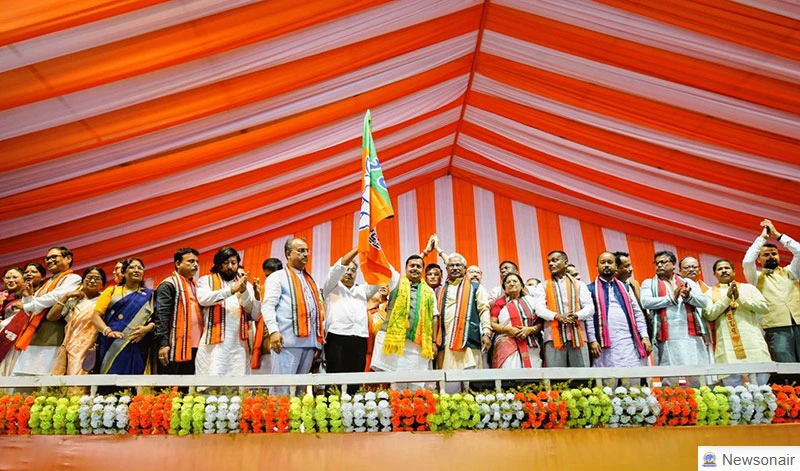
BJP Launches Big Parivartan Yatra for 2026 Bengal Election
The BJP’s 2026 Bengal Big Parivartan Yatra began on 1 March 2026. The party launched the campaign simultaneously from nine locations across West Bengal.
Moreover, the organizers started the yatra after receiving permission from the High Court. As a result, the events saw massive public gatherings. BJP leaders and party workers appeared highly motivated and confident.
A Reminder of 2011: Will History Repeat Itself?
Back in 2011, the people of Bengal voted for change under the slogan of “Parivartan”. The outcome is well known to everyone.
Now, after 15 years, the BJP is once again pushing the narrative of change. However, voters are asking a crucial question — will this campaign bring real transformation in 2026?
Top National Leaders Join the Campaign
Several heavyweight national leaders joined the BJP’s Grand Parivartan Yatra, including:
- Amit Shah
- Rajnath Singh
- Shivraj Singh Chouhan
- Devendra Fadnavis
- Smriti Irani
- JP Nadda
- Dharmendra Pradhan
- Nitin Nabin
In fact, political observers describe this strategy as “carpet bombing”. In other words, the BJP plans to deploy its full national strength before the 2026 West Bengal Assembly election.
Will the Outsider Debate Gain Momentum?
However, one important question remains. None of the major names leading the campaign are Bengali leaders.
Therefore, this gives the ruling party fresh ammunition to strengthen its “outsider” narrative against the BJP. Critics argue that the absence of a strong Bengali face at the national level exposes a leadership gap within the party in West Bengal.
BJP vs Mamata Banerjee: The Real Battle
At the same time, the BJP must remember one key fact: its main opponent is Mamata Banerjee.
She rose from being a long-time opposition leader to becoming the Chief Minister of West Bengal. Even today, Mamata Banerjee remains one of the most influential and recognizable political faces in Bengal.
Obvious Question Before 2026
As the 2026 Bengal election approaches, the big question is clear:
- Will a centrally driven campaign overpower regional leadership?
- Or will Bengal once again choose a familiar face over a national wave?
The answer now lies with the voters of West Bengal.
BJP’s 10 Key Advantages in the 2026 West Bengal Election
Now, let us examine the possible advantages the BJP may have in the 2026 West Bengal Assembly election. Several political and social factors could influence voter sentiment in the coming months.
1) 15 Years of Anti-Incumbency
First, the ruling government has been in power for nearly 15 years. Over time, anti-incumbency naturally builds up. As a result, many voters may look for an alternative.
2) Public Anger Over Corruption and Governance Issues
Moreover, repeated allegations of corruption and administrative failures have created frustration among common people. Consequently, this dissatisfaction could translate into votes against the ruling party.
3) Job Scam Fallout and Public Protests
In the teacher recruitment scam, nearly 26,000 people reportedly lost their jobs. This issue deeply affected thousands of families.
Furthermore, the spontaneous public mobilization during the “Abhaya movement” brought public anger into the open. Therefore, employment and fairness in recruitment remain sensitive election issues.
4) Law and Order Concerns in Samserganj and Minority Appeasement
The violence in Samserganj, where a Hindu father and son were killed during communal tensions, raised serious law and order questions. Reports of families crossing the Ganga overnight and taking shelter in camps in Malda created fear among sections of the Hindu community.
As a result, law and order and minority Appeasement could become a major campaign theme in 2026.
5) Debate Over Women’s Safety
In addition, certain statements made by Chief Minister Mamata Banerjee on women’s safety sparked criticism. Many social groups did not respond positively. Therefore, women’s security may emerge as another critical electoral issue.
6) Waqf Issue and Temple Politics
The Waqf issue, along with continuous temple construction politics, has reportedly created dissatisfaction among sections of the Muslim community. Consequently, identity politics may influence voter behavior on both sides.
7) Shift from Soft to Hard Hindutva
Political observers note that Mamata Banerjee has attempted a “soft Hindutva” approach in recent years. However, some Hindu voters may prefer the BJP’s more assertive ideological position. Therefore, a consolidation of Hindu votes could benefit the BJP.
8) SIR Process and Voter List Revision
The Special Intensive Revision (SIR) process reportedly removed many deceased or permanently shifted voters from the electoral roll. If implemented strictly, this may reduce the scope of fake or proxy voting. As a result, a cleaner voter list could change booth-level dynamics.
9) Changed Campaign Strategy of Narendra Modi and Amit Shah
Importantly, the campaign style of Narendra Modi and Amit Shah appears to have changed.
Now, Modi often announces development projects first at public rallies and then criticizes the ruling party. This development-first messaging may resonate more positively with voters.
10) Focus on Practical Issues Like the 7th Pay Commission
In Brief, the BJP has started highlighting concrete governance promises. For example, Amit Shah stated that the party would announce the 7th Pay Commission within 45 days if voted to power.
Such direct and time-bound commitments may appeal to government employees and middle-class voters.
Will These Factors Shape 2026?
Knowledge Mart, being a close watch dog of West Bengal Politics, feels in summary, anti-incumbency, corruption allegations, law and order debates, ideological polarization, and a revamped campaign strategy may provide the BJP with multiple advantages in 2026.
However, elections in West Bengal often depend on booth management, regional leadership, and emotional connect with voters. Therefore, while these factors may strengthen the BJP’s position, the final outcome will depend on how effectively the party converts issues into votes.
BJP’s 10 Key Disadvantages in the 2026 West Bengal Election
Now, let us examine the challenges that could work against the BJP in the 2026 West Bengal Assembly election. While the party may have certain advantages, several political and social realities could limit its growth.
1) Polarizing Statements and Minority Consolidation
Statements by Suvendu Adhikari that critics describe as anti-Muslim may create fear among Muslim voters. Though, minority communities are partially divided now.
As a result, Muslim voters could consolidate more strongly behind Mamata Banerjee. Therefore, polarization might strengthen the ruling party instead of weakening it.
2) Lack of a Reliable, Indigenous Face
Another concern is the absence of a widely accepted Bengali face in the BJP’s top state leadership.
Moreover, many senior leaders in the state unit previously belonged to the Trinamool Congress. Consequently, voters may question the emergence of fresh, long-term leadership within the BJP.
3) Popular Welfare Schemes Like Lakshmir Bhandar
The Lakshmir Bhandar scheme and various other state allowances have a large beneficiary base. These direct cash transfer schemes provide financial support to women and economically weaker sections.
Therefore, beneficiaries may hesitate to shift their support if they fear losing these benefits.
4) Demographic Arithmetic and Seat Conversion
In 2024, the BJP reportedly secured over 50% of the Hindu vote. However, West Bengal’s demographic composition makes it difficult to convert that support into a majority in all 294 Assembly seats.
Thus, even strong consolidation in one community may not automatically ensure an electoral majority.
5) Public Suffering During the SIR Process
The Special Intensive Revision (SIR) process reportedly caused inconvenience for many voters. In addition, some Hindu names were allegedly removed from the list.
Notably, members of the Matua community are still facing issues under the “adjudication” category. As a result, dissatisfaction over voter list corrections could hurt the BJP if not addressed properly.
6) Emotional Street Mobilization by the Trinamool Congress
From the beginning of the SIR process, the Trinamool Congress organized protests and applied pressure at the booth level.
In contrast, the BJP did not match that level of emotional street mobilization. Consequently, the ruling party managed to shape public perception more effectively on this issue.
7) Weak Presence in Street Movements
Observers note that the BJP has remained largely absent from sustained street movements.
Meanwhile, Suvendu Adhikari, who once worked closely with Mamata Banerjee, understands how mass movements operate in Bengal politics. Therefore, the BJP’s limited agitation politics could weaken its grassroots connect.
8) Weak Grassroots Organization
A major structural problem is the BJP’s relatively weak grassroots network compared to the Trinamool Congress. In West Bengal, booth-level management plays a decisive role.
Without strong local organization, translating votes into seats becomes difficult.
9) Alleged Intimidation and Defections
There are allegations that some BJP booth-level workers have been pressured or financially influenced to switch sides.
If true, such defections could damage the party’s local structure and morale.
10) Internal Conflicts in State Leadership
Finally, reports suggest serious internal disagreements within the BJP’s top state leadership.
Internal divisions can weaken campaign coordination and confuse voters. Therefore, unity within leadership will be crucial ahead of 2026.
A Balanced Political Battlefield
Above All, while the BJP may benefit from anti-incumbency and governance issues, Knowledge Mart analyzes, it also faces structural, demographic, and organizational challenges.
Ultimately, the 2026 West Bengal election will depend on booth management, voter turnout, minority consolidation, and leadership credibility. Both sides have strengths and weaknesses. The final verdict will rest with the people of Bengal.
Crowd Does Not Always Mean Votes: A Ground Reality in Bengal Politics
One important reality must be remembered, a massive crowd at rallies does not automatically convert into votes.
History has repeatedly shown that public meetings and processions may create visual impact, but they do not guarantee success at the ballot box. Therefore, political parties must look beyond crowd size and focus on voter conversion.
Can the 2026 big Parivartan Yatra Create a Lasting Impact?
There is no doubt that the BJP’s massive 2026 Bengal Parivartan Yatra can generate emotion and political momentum. Large gatherings often build excitement and media attention.
However, creating emotion is only the first step. The real challenge lies in converting that emotion into votes on polling day.
Organizational Strength: The Real Test for BJP
At this point, the responsibility shifts to the Bengal BJP leadership. They must ensure booth-level coordination, voter outreach, and election-day management.
In fact, the party’s organizational weakness became visible during the Special Intensive Revision (SIR) process. Compared to the grassroots network of Mamata Banerjee’s party, the BJP appeared less effective at the booth level.
Therefore, without strong organization, even a powerful campaign may fail to deliver electoral results.
Can only Hindu Consolidation make BJP Winner?
The BJP must also understand a demographic reality, uniting Hindu voters alone may not be sufficient to capture power in West Bengal.
Moreover, an overly aggressive Hindutva approach could push Muslim voters toward complete consolidation against the BJP. As a result, sharper polarization might strengthen the opposition instead of weakening it.
The Verdict: Emotion vs Execution
Finally, we must admit, rallies create emotion, slogans create narrative, and national leaders create momentum.
However, elections are ultimately won through booth management, social coalition-building, and disciplined organization.
If the BJP wants to transform the energy of the 2026 Parivartan Yatra into electoral victory, it must strengthen its grassroots machinery and expand its voter base beyond emotional appeal.
Because in Bengal politics, execution matters more than excitement.
Are Central Forces Alone Enough in Bengal Elections?
Similarly, deploying central forces during elections is not enough. Authorities must ensure that they use these forces properly and effectively.
Security personnel should not remain symbolic or inactive. Instead of spending time at tourist spots like Victoria Memorial or Hazarduari Palace, they must focus on protecting polling booths across West Bengal.
Ensuring Free and Fair Access to Polling Booths
Most importantly, central forces must ensure that voters can safely reach polling stations without fear or obstruction.
They should:
- Protect voters on their way to polling booths
- Prevent intimidation or forced voting
- Maintain law and order in sensitive areas
Only then can people cast their votes freely and confidently.
Preventive Action Against Criminal Elements
Law enforcement agencies should take preventive steps against individuals with criminal backgrounds who may attempt to influence voting.
Authorities must:
- Conduct preventive arrests where legally justified
- Seize illegal arms before polling day
- Closely monitor sensitive booths
These steps can reduce violence and fear during elections.
Protection for Booth Agents and Monitoring Systems
Booth agents from all political parties must receive proper security. Without protection, they cannot perform their duties effectively.
At the same time, the Election Commission must ensure that CCTV cameras function properly at every booth. Real-time monitoring can help prevent malpractice and increase transparency.
The Role of the Election Commission of India
Ultimately, the responsibility lies with the Election Commission of India to guarantee a free and fair election.
The Commission must:
- Ensure neutral deployment of central forces
- Monitor security arrangements closely
- Take immediate action on complaints
Demand: Let the People’s Vote Decide
The demand remains, elections must reflect the true will of the people.
Votes should not be influenced by fear, coercion, or fraudulent practices. Instead, every ballot must represent a free and independent choice.
Because in a democracy, the election must belong to the voters but not to pressure or manipulation.
The Powerful X-Factor
The 2026 Bengal Election has a powerful X-factor. Right now, nearly 60 lakh voters are waiting for their fate. Authorities have marked them as “Under Adjudication.” Judicial officers are now verifying their documents and credentials.
However, a big question remains. What if officials do not complete the scrutiny of all these names? Will the Election Commission of India still announce the 2026 Bengal Election?
If the Commission goes ahead and declares the election, what will happen to those voters whose status remains undecided? On the other hand, if the ECI delays the announcement until it finishes the entire process, the state could face a constitutional challenge.
The timeline is tight. The new government must take oath before 7 May 2026. Therefore, any delay may create serious legal and political complications.
At the same time, if we follow the pattern of the Modi Government, it usually avoids imposing Article 356. We all know that Manipur was an exception. However, if a constitutional crisis forces the Centre or the Election Commission to invoke Article 356, the entire political scenario in West Bengal may change dramatically.
In that case:
- Mamata Banerjee may use her strong victim narrative to mobilize public sympathy.
- West Bengal may witness an election without what critics call a “subservient” administration and police machinery.
As a result, political calculations could collapse. Analysts may find their forecasts completely shaken. In short, the 2026 Bengal Election may turn far more unpredictable than expected.
Knowledge Mart, because of its political interest knows from Various Reports that the Chief Election Commissioner, Gyanseh Kumar with full bench is to visit West Bengal on March 09 and 10 to review the situation.
Elections: Arithmetic Or Chemistry?
However, voting does not always follow pure arithmetic. Numbers matter, but emotions often matter more. In West Bengal politics, political chemistry frequently outweighs simple vote calculations.
For example, a scheme like Yuva Sathi may not strongly influence voters. Yet, beneficiaries of Lakshmir Bhandar still form a significant support base for Mamata Banerjee.
Therefore, welfare beneficiaries may continue to back her despite criticism in other areas.
Mamata Banerjee’s Emotional Connect with Voters
Over the years, Mamata Banerjee has proven her ability to mobilize voters through emotional appeal. She often frames elections as a personal and cultural battle for Bengal.
As a result, her political messaging frequently creates a direct connection with women, rural voters, and economically weaker sections.
This means the 2026 election may turn into a clear contest: Mamata Banerjee’s personal charisma vs allegations of corruption and governance failures.
Mamata Banerjee has already announced to sit for a Dharna in Kolkata from 06 March, 2026. This is just an add-on to fuel the emotion of grassroot people.
Will There Be a Political Wave in 2026?
It is possible that a political wave may emerge before the 2026 West Bengal Assembly election. Public dissatisfaction, opposition unity, or strong campaigning could create momentum.
However, turning a wave into a decisive electoral storm is never guaranteed.
In Bengal politics, perception can shift quickly. Emotions, local alliances, turnout patterns, and booth management often decide the final result.
Final Thought: Wait for 2026
In conclusion, Knowledge Mart feels that the real picture will become clear only when Bengal votes in 2026 will take places in reality.
Until then, the contest remains open between charisma and criticism, welfare politics and governance debate, emotion and arithmetic.
Because in Bengal, elections are not just about numbers, rather, they are about narrative, emotion, and timing.
Key Takeaways: Big Parivartan Yatra 2026
- Big Parivartan Yatra launched from 9 locations across West Bengal on 1 March 2026.
- Massive rallies created strong political momentum before the 2026 election.
- Top national leaders joined, signaling BJP’s full-force campaign strategy.
- Anti-incumbency after 15 years may benefit the BJP.
- Corruption allegations and job scam fallout remain major voter concerns.
- Crowd size may not automatically convert into votes where booth management is crucial.
- Organizational weakness at the grassroots level remains a key BJP challenge.
- The core battle: Mamata Banerjee’s personal charisma vs governance and corruption debate.
- Emotional wave possible but conversion into votes will decide the 2026 result.
People Also Ask (PAA)
1) What is the Big Parivartan Yatra launched by the BJP for the 2026 Bengal Election?
The Big Parivartan Yatra is a statewide political campaign launched by the BJP on 1 March 2026 from nine locations across West Bengal. The party aims to build momentum for the 2026 Assembly election by mobilizing public support around issues like governance, corruption, law and order, and development.
2) Why is the 2026 Parivartan Yatra being compared to the 2011 “Parivartan” wave?
In 2011, the slogan “Parivartan” led to a historic regime change in West Bengal. Now, after nearly 15 years of rule by Mamata Banerjee, the BJP is attempting to recreate a similar change narrative. Voters are debating whether history can repeat itself in 2026.
3) Which national leaders are participating in the BJP’s Bengal campaign?
Several top BJP leaders have joined the campaign, including Amit Shah, Rajnath Singh, Shivraj Singh Chouhan, Devendra Fadnavis, Smriti Irani, JP Nadda, and Dharmendra Pradhan. Political observers describe this as a full-strength national push ahead of 2026.
4) What are the key advantages for the BJP in the 2026 West Bengal Election?
- Major advantages may include:
- 15 years of anti-incumbency
- Corruption and recruitment scam allegations
- Law and order debates
- Hindu vote consolidation
- A revised voter list under SIR
- Development-focused messaging by Narendra Modi
These factors could reshape voter sentiment if effectively converted into booth-level gains.
5) What challenges does the BJP face in West Bengal ahead of 2026?
Key challenges include:
- Minority consolidation against polarization
- Lack of a strong Bengali face
- Popular welfare schemes like Lakshmir Bhandar
- Weak grassroots organization compared to the ruling party
- Internal leadership conflicts
These structural realities could limit the BJP’s ability to convert momentum into seats.
6) How important is booth-level organization in Bengal elections?
Extremely important. West Bengal elections are often decided by booth management, voter turnout, and local mobilization. Large rallies do not guarantee votes unless supported by disciplined grassroots coordination.
7) What is the controversy surrounding the SIR voter list revision?
The Special Intensive Revision (SIR) process reportedly removed deceased and shifted voters but also placed nearly 60 lakh names under “adjudication”. Questions remain about whether all cases will be resolved before the election announcement and how this could impact voter participation.
8) Can central forces alone ensure free and fair elections in West Bengal?
Central forces play a crucial security role, but effective deployment, booth monitoring, preventive action against violence, and strict oversight by the Election Commission of India are essential to ensure voters can cast ballots without fear.
9) Will Hindu consolidation alone be enough for the BJP to win in 2026?
Not necessarily. While consolidation may help, Bengal’s demographic composition means broader social coalitions are essential. Over-polarization could trigger minority consolidation in favor of the ruling party.
10) What is the biggest X-factor in the 2026 Bengal Election?
The fate of nearly 60 lakh voters marked “Under Adjudication” remains a major uncertainty. Any delay or dispute regarding their voting status could create legal, political, and constitutional complications before the May 2026 deadline.
11) Is the 2026 election a battle of emotion vs execution?
Yes. While rallies and national leaders generate emotion and momentum, elections in Bengal are ultimately decided by organization, narrative control, turnout, and booth management.
12) Can the Big Parivartan Yatra actually change the political landscape of Bengal?
It has the potential to reshape perception and build momentum. However, whether it translates into electoral victory will depend on grassroots execution, leadership credibility, and voter chemistry closer to polling day.