Explosive CJI Protests: Huge Govt Blunder?
Jul 31, 2026 - By Ashutosh Roy PoliticsCurrent AffairsGovernance & AdminNational NewsNational PoliticsRegional UpdatesSocial IssuesWest Bengal Politics
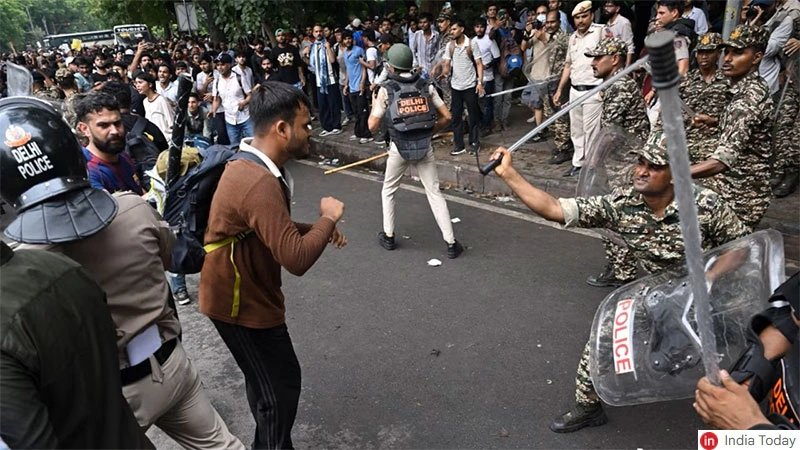
Did Explosive CJI Protests Show the System Pitfalls?
Explosive CJI Protests have caught the ruling establishment completely off guard, turning what officials brushed off as a minor campus grumble into a full-blown political storm.
How does a government backed by massive intelligence networks, social media command centers, and unlimited resources sleepwalk right into an explosive public uprising? When administrative hubris collides with deep sociological blind spots, the state rarely sees the shock coming until the streets are already packed.
Welcome to Knowledge Mart, where today we unpack this massive political miscalculation. How did the ruling party fail to gauge the raw energy, sheer volume, and rapid organic spread of this youth movement? NEET paper leak protests have gone beyond the control now as the Government has not shown any Plan B to handle this issue at the initial stage.
Let’s examine the security breakdowns, digital echo chambers, and psychological missteps that transformed a localized protest into a nationwide headache.
We must say in the beginning that the usage of pallet guns in peaceful and unarmed youths in the Explosive CJI Protests is unethical, inhuman and immoral. The former central Home minister P. Chidambaram has criticized this retaliation of the police forces in the interview with Rajdeep Sardesai.
One can watch the conversation in India Today at YouTube.
Did the Government Suffer a Massive Intelligence Breakdown?
When an establishment holds power at both the state level in Delhi and at the Centre, information is supposed to flow seamlessly. Still, despite controlling all administrative levers, the government completely misread the room.
How did a solid political machine known for micro-managing every local election ward miss a massive crowd assembling right under its nose?
The Double-Power Blind Spot
Holding authority at both state and central levels usually provides a dual security net. In this instance, it generated double the complacency. When subordinates constantly reassure top officials that everything is under control, no one bothers to verify ground reality.
| Administrative Level | Systemic Weakness Observed |
|---|---|
| Central Administration | Filtered reporting that privileged official narratives over raw intelligence |
| Delhi Local Apparatus | Ignored neighborhood mobilization and grassroots anger signals |
| Street Reality | Explosive CJI Protests peaked before security forces prepared a response |
Security managers treated a spontaneous youth agitation like a standard political rally driven by paid attendees. That fundamental misjudgment allowed anger to compound exponentially before anyone raised a red flag.
For more insights on how administrative blindness feeds public anger, read The Telegraph India piece on the psychology of uprisings.
How Did Powerful Intelligence Agencies Misjudge the Situation?
India operates some of the most extensive domestic surveillance and security networks in the world. The Intelligence Bureau (IB) and internal security wings continuously track socio-economic trends and potential unrest. Why did they miss the scale and momentum of these demonstrations of Explosive CJI Protests?
| Intelligence Dimension | Standard Protocol | Actual Outcome During Protests |
|---|---|---|
| Ground Intelligence | Detect early crowd buildup at key hubs | Failed to estimate turnout at major gathering points |
| Digital Monitoring | Track rapid peer-to-peer mobilization | Overlooked organic messaging trends across student groups |
| Strategic Warning | Send actionable alerts to the Ministry | Delivered sanitized reports that downplayed public rage |
| On-Ground Readiness | Preemptive crowd containment | Dispatched police reactively after bottlenecks formed |
A Pattern of Systemic Lapses
This oversight does not exist in a vacuum. Similar intelligence lacunae were observed during security breaches in Pahalgam and unexpected urban explosions in Delhi.
When intelligence apparatuses focus primarily on conventional political opponents, they often fail to spot non-traditional, decentralized citizen movements.
This raises an urgent question: Is it time to revamp the core operational pillars of our intelligence agencies? When agencies feed leadership agreeable statistics instead of uncomfortable truths, decision-makers end up thoroughly blind-sided.
We have witnessed such a misleading reports from I-PAC, the electoral agent of Trinamool Congress in West Bengal Assembly Election 2026.
The communication gap between the central Government and the agencies have become vivid in NEET paper leak protests. We can just tell that the fatal outcome is Dharmendra Pradhan resignation.
Why Couldn’t the Social Media Army Spot the Growing Storm?
The ruling establishment commands one of the most formidable digital machinery setups anywhere. They field armies of volunteers, algorithmic monitoring dashboards, and dedicated trend-analysis desks. How did their digital radars miss a massive viral surge?
Inside the Digital Echo Chamber
- Preference for Confirmation: Social media teams were so focused on promoting party lines that they ignored opposing viral trends. Isn’t it a major failure of the BJP Social Media Cell?
- Mislabeling Organic Anger: Strategists dismissed early online frustration as mere opposition bot activity rather than genuine student rage.
- Monitoring the Wrong Platforms: While party teams dominated public timelines, youth organizers mobilized quietly on encrypted channels and niche platforms.
- Over-Confidence in Numbers: The assumption that no organic hashtag could compete with official outreach bred operational laziness.
When a communications system is tuned exclusively to broadcast rather than listen, it fails to pick up the early warning signals of a gathering storm.
We have also seen that this explosive CJP Protests had not got much of political narratives by any mainstream media. We have witnessed how media trials are conducted in several events. Perhaps the former Prime Minister, Dr. Manmohan Singh, was the most pathetic victim of such media trials.
Did Unconventional Metaphors Trick the Administration?
Routine political rallies follow a tired blueprint: hired buses, staged speeches, photo ops, and quick dispersals. The Explosive CJI Protests broke every rule in that playbook.
Demonstrators adopted unconventional cultural references, including terms like “Cockroaches“, to describe how ordinary citizens navigate systemic corruption. Bureaucratic analysts, unused to such symbolic framing, simply dismissed the terminology as internet noise.
| Protest Format | Core Characteristics | Government Response |
|---|---|---|
| Standard Political Rally | Named leaders, central funding, predictable routes | Easily monitored, negotiated, or contained |
| Fluid Youth Movement | Decentralized leadership, viral slogans, symbolic jargon | Total administrative confusion and misread signals |
Instead of probing why student participation was expanding rapidly under these strange banners, officials shrugged it off. Had party leaders paid closer attention early on, they might have initiated dialogue before the agitation reached a boiling point and Dharmendra Pradhan resignation under compulsion could be avoided. After all, one resignation hardly changes the loopholes of a ruined system/
Did Arrogance Cause Officials to Undermine Public Anger?
Does prolonged political dominance breed a level of institutional hubris that makes governments dismiss public anger?
When a ruling party holds a solid parliamentary majority, a dangerous operational mindset often takes root: “Nothing can touch us“.
| Phase of Miscalculation | Administrative Fallback |
|---|---|
| Early Stage | Brushing off warnings as routine political noise |
| Mid Stage | Relying on police barricades instead of opening political channels |
| Escalation Stage | Watching localized grievances turn into widespread public solidarity |
This disposition transforms legitimate public complaints into simple “law and order problems“. Rather than inviting campus delegates or legal experts for discussions, administrators defaulted to hardline statements. That posture turned fence-sitters into active rally participants overnight.
Kapil Sibbal, the sitting MP, former law minister and the veteran lawyer has been highly critical on the Home Minister Amit Shah and holds him culpable in the pallet bullets of Delhi Police Lathi Charge during Explosive CJP Protests in an interview with Karan Thapar. Watch the Video of The Wire.
How Did Anti-Social Elements Join Without Police Knowledge?
Whenever a peaceful rally grows beyond a certain scale, opportunists and provocateurs attempt to infiltrate the crowd. Why couldn’t Delhi Police spot rogue elements before violence flared up?
Key Operational Failures by Law Enforcement
- Special Branch Blindness: Plainclothes officers failed to identify outside agitators blending into student contingents.
- Weak Perimeter Protocols: Access routes to central protest sites were left poorly monitored for key stretches of time.
- Missing De-escalation Training: Ground units lacked training in handling leaderless, high-energy youth crowds without resorting to heavy force.
- Excessive Reliance on Force: Heavy-handed barricading and water cannon deployments escalated friction instead of neutralizing it.
When security forces fail to separate peaceful agitators from bad-faith actors, the entire policing framework breaks down rapidly. The Explosive CJI Protests have also pinpointed the lacuna of our intelligence system.
To follow updates on security protocols during large public gatherings, consult reporting on The Week. Perhaps apparently calm peaceful NEET paper leak protests could become so violent so quickly.
Was Detaining Sonam Wangchuk the Trigger That Blew the Lid Off?
If one tactical error turned a manageable dispute into an uncontrollable firestorm, it was the abrupt state action against Sonam Wangchuk.
Removing Sonam Wangchuk by force and taking him to a medical facility proved to be a major administrative blunder.
Why That Step Backfired Spectacularly
- Public Respect: Wangchuk is widely regarded as a peaceful innovator, educational reformer, and quiet advocate for local rights.
- Symbol of Overreach: Visuals of a non-violent figure being forcibly detained sent shockwaves through student communities.
- Cross-Campus Mobilization: The incident galvanized law students, youth groups, and civil society members who had previously remained on the sidelines.
- Erosion of Official Narrative: It shattered claims that the demonstrations were orchestrated purely by fringe political elements.
Instead of diffusing the situation, this heavy-handed move handed the movement a compelling moral rallying point.
Why Did Top Leadership Appear So Late to Manage the Crisis?
Prime Minister Narendra Modi remains an exceptionally effective communicator whose direct appeals carry immense political weight. History demonstrates that timely words from top leadership can calm volatile national moments. Why, then, did the Prime Minister intervene so late in this crisis? Perhaps, Dharmendra Pradhan resignation could be avoided.
| Crisis Timeline | State Action Taken | Public Reaction |
|---|---|---|
| Days 1 – 3 | Silence from senior ministry figures | Frustration builds across universities |
| Days 4 – 6 | Detention measures and heavy barricading | Mass indignation and campus walkouts |
| Days 7 – 9 | Bureaucratic press releases issued | Protests expand across multiple states |
| Final Phase | Belated intervention from top leadership | Substantial narrative damage already done |
An early, empathetic statement from the highest office could have reassured grieving groups, opened formal talks, and prevented an extended public standoff. Waiting until the situation reached critical mass left the administration looking reactive and flat-footed.
How the Psychology of Uprising Baffled Bureaucrats
As social scientists have observed across various historical movements, state bureaucracies rarely comprehend the mechanics of popular uprisings. Administrative systems run on official files, rigid rules, and threat charts.
They struggle to quantify human emotion, moral indignation, and shared frustration. This has been brutally vivid in Explosive CJI Protests.
At Knowledge Mart, we observe how social discontent typically moves from quiet grievance to active resistance:
- The Dismissal Phase: Initial complaints are written off as minor public complaints.
- The Trigger Event: High-handed administrative actions spark broader outrage.
- The Networked Expansion: Digital channels amplify grievances, linking previously unconnected groups.
- The Institutional Scramble: Authorities default to heavy policing, which only reinforces public resistance.
When decision-makers view every public demonstration as an orchestrated plot rather than a signal for structural reform, they fall straight into this classic governance trap.
Watch How Delhi Police Lathi charge Backfired & Made CJP Protests Even More Powerful.
Knowledge Mart Final Thoughts
The fallout from these Explosive CJI Protests stands as a vivid case study in institutional blind spots and policy miscalculations.
The core responsibility for this failure sits squarely with the Government, the Intelligence Bureau (IB), and key state security organs. Holding power in both the Centre and the capital should have provided clear foresight. Instead, the leadership suffered an astounding anticipation failure.
Key Takeaways on the Administrative Breakdown:
- Intelligence Flaws: Agencies failed to deliver candid ground assessments, offering sanitized updates over hard truths.
- Politicized Handling: Leaders leaned on police deterrence instead of engaging in timely political diplomacy.
- Misreading Youth Dynamics: Officials treated a decentralized, tech-literate movement like a traditional political rally, missing viral signals entirely.
- Delayed Intervention: Waiting too long to address public concerns turned a localized protest into a national political crisis.
Unless the governing setup fixes its intelligence feedback loops, reads social media trends objectively, and swaps political hubris for responsive governance, future agitations will catch it off guard once again. Healthy democracies require active listening, not administrative deafness.
10 Key Takeaways from the Explosive CJI Protests Analysis
- Dual-Power Complacency: Despite controlling both the central government and Delhi’s local administration, the establishment suffered from internal blind spots and false security, mistaking organic youth anger for routine political noise.
- Systemic Intelligence Failure: Major intelligence pillars (like the IB and local Special Branches) failed to gauge the raw volume, intensity, and decentralized buildup of the crowd due to Explosive CJI Protests before it escalated into major street clashes.
- Digital Machinery Blind Spot: The ruling party’s extensive digital network failed to spot the viral surge because algorithms and teams were tuned to broadcast propaganda rather than monitor organic youth anger across encrypted and non-traditional platforms.
- Misjudging Unconventional Metaphors: Bureaucrats ignored the movement’s symbolic, non-traditional framing (such as using terms like “Cockroaches” to depict corruption survivors), foolishly brushing it off as internet drama instead of investigating its rapid expansion.
- Catalytic Administrative Blunder: The forceful hospital transport and detention of peaceful activist Sonam Wangchuk served as the ultimate spark, unifying students, legal scholars, and civil society against the government.
- Institutional Hubris: Enjoying a strong parliamentary majority led officials to treat legitimate public grievances as mere “law and order nuisances”, opting for police force over proactive political diplomacy.
- Failure of Local Perimeter Policing: Delhi Police struggled to differentiate between peaceful student demonstrators and anti-social infiltrators, relying heavily on tear gas, barricades, and Delhi Police lathi charge rather than strategic de-escalation.
- Delayed Intervention by Top Leadership: Prime Minister Narendra Modi’s late public response left the administration looking reactive and flat-footed, missing the window for early, empathetic crisis resolution.
- Inability to Understand Mobilization Psychology: State machinery failed because bureaucrats operate on rigid files, rules, and threat matrices, leaving them incapable of anticipating human moral outrage, passion, and collective student frustration.
- Knowledge Mart Final Verdict: The agitation through Explosive CJP Protests exposed a textbook anticipation failure across state agencies, proving that over-relying on intimidation and sanitized intelligence reports creates massive governance blind spots.
Frequently Asked Questions (FAQ)
Q1: What led to the massive youth and student protests at Jantar Mantar?
A: The primary trigger was the systemic failure and corruption allegations surrounding national examinations, specifically the 2026 NEET-UG paper leak and irregularities in CBSE On-Screen Marking. Disillusioned by repeated paper leaks over recent years, student groups and youth political movements mobilized at Jantar Mantar in New Delhi to demand institutional accountability, examination system overhauls, and the resignation of key union ministers.
Q2: Who is the “Cockroach Janta Party” (CJP) and what role did they play?
A: The Cockroach Janta Party (CJP) is a youth-driven political movement that originated as a satirical social media handle. It evolved into a major organizer of the protests by capturing widespread youth frustration over exam malpractices, mobilizing thousands of students across the country for sit-ins and the historic “Sansad Chalo” march toward Parliament. That very Rally turned into a Explosive CJP Protests.
Q3: Why did activist Sonam Wangchuk join the protests and go on a hunger strike?
A: Environmentalist and education activist Sonam Wangchuk joined the protest in solidarity with the students demanding educational reforms, an end to paper leaks, and financial compensation for the families of aspirants affected by exam turmoil. He undertook a prolonged hunger strike, drawing massive national attention to the issue before ending his fast following assurances from the government.
Q4: How did the central government and Delhi Police respond to the escalation?
A: Initial responses included heavy security deployment, barricading, and localized mobile internet shutdowns in Central Delhi. As crowds swelled during the “Sansad Chalo” march, clashes broke out, resulting in police baton charges, tear gas deployment, dismantling of protest tents, and mass detentions. Following widespread public outcry, high-level ministerial meetings were convened, leading to government assurances on examination reforms and no legal retaliation against peaceful student protesters.
Q5: What action has the Supreme Court of India taken regarding the protests and police action?
A: The Supreme Court barred law enforcement from taking coercive action against student protesters and ordered the immediate release of all detained minors. A bench led by Chief Justice Surya Kant directed authorities to preserve all electronic evidence (CCTV, drone, body-cam footage) and indicated plans to set up an independent committee to investigate allegations of excessive police force.
Q6: What are the main political and administrative outcomes of the unrest?
A: The protest resulted in major concessions, including:
- Government Commitments: Assurances of strict legal frameworks to prevent future paper leaks and compensation for impacted families.
- Judicial Directives: Strict limits placed on police action during peaceful demonstrations and a review of protest-policing protocols.
- Institutional Shift: A structural overhaul of national testing agencies and examination delivery systems to rebuild public trust.
[…]Explosive CJI Protests: Huge Govt Blunder? Did the government completely misread the explosive CJI protests? A deep look at how this surge exposed a major miscalculation and its wider political impact.[…]
[…]Explosive CJI Protests: Huge Govt Blunder? Did the government completely misread the explosive CJI protests? A deep look at how this surge exposed a major miscalculation and its wider political impact.[…]
[…]Explosive CJI Protests: Huge Govt Blunder? Did the government completely misread the explosive CJI protests? A deep look at how this surge exposed a major miscalculation and its wider political impact.[…]
[…]Explosive CJI Protests: Huge Govt Blunder? Did the government completely misread the explosive CJI protests? A deep look at how this surge exposed a major miscalculation and its wider political impact.[…]