BJP in Bengal: Can It Play Fair? BIG Test
Oct 08, 2026 - By Ashutosh Roy Current AffairsNational PoliticsPoliticsRegional UpdatesWest Bengal Politics
BJP in Bengal: Can It Play Fair? BIG Test
The BJP in Bengal has achieved something that, until a few years ago, looked almost impossible. From being a party that struggled to build a serious organisation in the state, it has now formed the government with 208 of the 294 Assembly seats. Voters have every right to change governments, punish one party and give another a chance. The victory itself is not the issue. The real test begins after the victory: can the BJP use its enormous mandate without using every available political and administrative lever to eliminate whatever remains of the opposition?
That question has become particularly relevant after the Nandigram bypoll, the Rejinagar bypoll and the extraordinary developments in the Malda Zilla Parishad. When a party has 208 MLAs, one would expect it to have enough confidence to allow its opponents some political breathing space. Instead, we are watching rapid expansion into local bodies through defections, political realignment and the breaking up of rival organisations. Individual actions may be legally permissible, but legality and political ethics are not always the same thing.
Apu’s Curiosity and Bengal BJP’s Political Hunger
There is an interesting contrast in Bengali literature that comes to mind while watching this political transformation. Apu, in Bibhutibhushan Bandyopadhyay’s Pather Panchali, moves through the world with wide and curious eyes. His hunger is a beautiful one: he wants to see the railway line, distant places and the world beyond his surroundings. The political hunger currently visible in sections of the Bengal BJP appears rather different. It sometimes resembles the ruthless appetite of the imperial powers described by Rabindranath Tagore in Africa, where the objective is not simply to enter another territory but to possess and dominate it.
Shamik Bhattacharya, the Bengal BJP president, certainly knows Bibhutibhushan and Rabindranath much better than I do. He is also known as an articulate speaker with a strong connection to Bengal’s cultural traditions. That is precisely why I find the present approach difficult to understand. When the BJP already controls 208 Assembly seats, why is it so determined to capture every remaining piece of political territory? There are reportedly another 60 or more opposition MLAs looking towards the ruling party. If political persuasion is enough to bring them over, why does the BJP need anything more?
From By-Elections to Malda: Where Does the Expansion Stop?
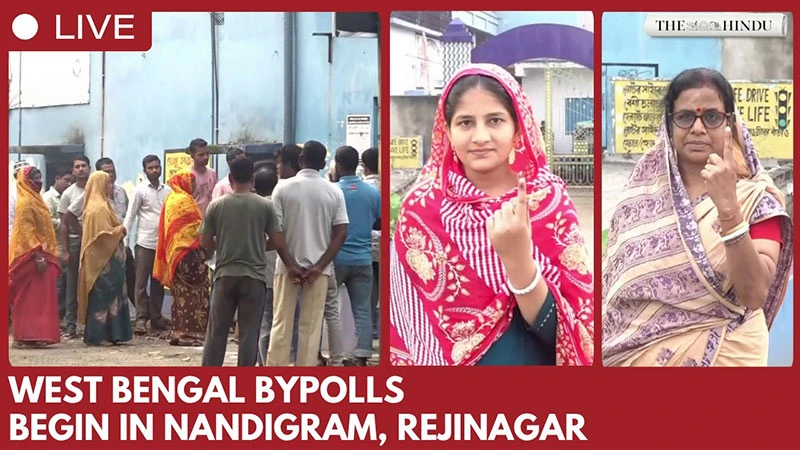
The first major test after the Assembly election came with the Nandigram and Rejinagar by-elections. These were important because they were the first Assembly contests after the BJP formed the government. Before polling, there had already been allegations of arrests, pressure on opposition workers and candidate withdrawals. The Indian Express described the two seats as the first electoral test for the new BJP government.
The polling produced another controversy. Opposition parties alleged booth capturing, intimidation and the removal of polling agents, while Congress demanded repolling. The BJP and Chief Minister Suvendu Adhikari rejected the allegations and maintained that polling was peaceful. Indian Express reported the competing claims, while ThePrint reported Congress’s demand for total repolling. These are allegations, not judicial findings, and that distinction matters. But when several opposition parties raise concerns about an election, the ruling party cannot simply expect voters to forget them.
There is a political irony here that the BJP leadership should not ignore. For ten years, when the party sat in opposition, its leaders repeatedly alleged that Trinamool used the police and administration to create an uneven electoral field. Today, many of those same accusations are being made against a BJP government by Trinamool, Congress and the Left. Shamik Babu, during your decade in opposition, didn’t you make precisely these allegations? If the answer was yes then, why should the same argument suddenly become meaningless simply because the BJP is now sitting on the other side of the table?
On the evening of October 6, I was listening to BJP representative Sayantan Basu on ABP Ananda. His argument was that, apart from a few isolated incidents, polling had remained peaceful and bloodless. The statement immediately sounded familiar. It was very similar to the language Trinamool representatives used after elections during their years in power: there may have been a few incidents, but nothing serious happened. The ABP Ananda coverage of the bypolls is worth watching alongside the competing statements.
That is why the BJP in Bengal has a bigger responsibility than merely winning elections. A party cannot demand one standard of democracy in opposition and another in government. If the BJP genuinely believed that Bengal needed a cleaner electoral culture, it now has the opportunity to demonstrate it. The administration must behave in such a way that even political opponents have fewer reasons to question its neutrality.
Malda Zilla Parishad: The Four-Member BJP That Took Control
The Malda Zilla Parishad episode makes the issue even sharper. The 43-member rural body had only four elected BJP members, yet the BJP took control with the support of a large section of Trinamool members. BJP’s Dipali Bala became sabhadhipati, while former Trinamool sabhadhipati Lipika Barman Ghosh became her deputy. The Times of India reported the unusual political arithmetic, while The Telegraph highlighted how four BJP members were enough to secure the top post.
Politically, this was clever. But it raises an uncomfortable question about political defections in Bengal. Before the election, a group of Trinamool members alleged that a police team from Ratua had gone to Pakur, where they were staying, and harassed them. Another group of Trinamool members was reportedly staying in a Malda hotel along with the four BJP members. These are allegations, but the timing makes them difficult to ignore. The Telegraph reported the allegations.
The Malda story is also not isolated. The BJP had earlier taken control of Nadia Zilla Parishad with only six elected BJP members in a 52-member body, again with support from Trinamool dissidents. It subsequently took control of the English Bazar municipality despite having only three councillors in the 29-member civic body. The Times of India reported the English Bazar takeover.
This is where the phrase “opposition-free Bengal” becomes relevant again. The BJP spent years accusing Trinamool of trying to create precisely such a political landscape. It now has the opportunity to prove that it learned from those mistakes rather than simply inheriting them.
Shamik Bhattacharya Cannot Blame Mamata Anymore
I would also remind Shamik Bhattacharya of another uncomfortable part of the BJP’s Bengal story. One of the major accusations BJP leaders once made against Suvendu Adhikari was that he was involved in engineering defections for Trinamool. Murshidabad, Malda and Dinajpur were often described as areas where Suvendu had enormous organisational influence. BJP leaders could then blame Mamata Banerjee and argue that Suvendu was operating within the political culture created by Trinamool.
But Suvendu is no longer operating under Mamata Banerjee. So, that shield has gone away. He is now the Chief Minister and the principal face of the BJP government in Bengal. If the same style of political management is now being used under a BJP government, it can no longer be conveniently explained as the culture of the previous regime. The responsibility lies with the BJP leadership itself.
This becomes even more significant because the BJP promised Bengal voters that it would not become “Trinamoolised“. The phrase “post-noon December 4th BJP” has been used to distinguish the older BJP organisation from politicians who joined after the party became electorally powerful. But once these people enter the BJP, they become part of the BJP. The party cannot welcome them when they are useful and then disown their political methods when those methods become embarrassing.
The Bengal BJP is under your leadership, Shamik Babu. Suvendu Adhikari is the Chief Minister. The BJP controls the government and administration. So if the political culture begins resembling the culture you spent a decade criticising, you cannot simply point towards the old Trinamool regime and say, “They started it”.
Is The BJP’s Bengal Organisation as Deep as Its Electoral Victory?
There is another point the BJP should consider before celebrating every defection as an organisational victory. The BJP organisation in Bengal has not developed organically in the same way that the party did over decades in Gujarat, Madhya Pradesh, Chhattisgarh, Uttar Pradesh and several other states. Bengal has a long history of Congress, Left and Trinamool organisation reaching deep into villages, municipalities, trade unions, clubs and student bodies. The BJP’s rise has been impressive, but electoral dominance should not be confused with decades of grassroots consolidation.
A party can acquire power faster than it acquires political legitimacy. Bringing elected representatives into the ruling camp can increase numbers on paper, but it does not necessarily create committed workers or genuine public support. A politician who changes sides because the government is powerful can change sides again if the political wind changes. That is why political defections are a poor substitute for organic growth.
Knowledge Mart has already examined the changing BJP opposition in Bengal, where the struggle is not simply about TMC or CPI(M), but who will occupy the political space against the BJP. The party in government should not be afraid of that competition. A healthy opposition forces a ruling party to remain accountable.
The same argument applies to the possibility of a CPI(M) comeback. The Left’s decline helped create the political space through which the BJP expanded. If the BJP now helps eliminate every remaining opposition structure, it may create another unpredictable political vacuum. Bengal has seen that cycle before.
Is BJP in Bengal Watching the Delhi Problem?
The BJP’s Bengal government cannot completely separate itself from what happens in Delhi. Its political strength is connected to the Union government, while the state’s financial position remains substantially dependent on central assistance. That makes the condition of the national BJP important for Bengal as well. A party that looks invincible today should remember that national politics can change quickly.
Delhi is already facing a different kind of political challenge. Opposition parties are trying to unite around the Election Commission and Chief Election Commissioner Gyanesh Kumar, while student organisations and newer political groups are taking their protests to the streets. The Cockroach Janta Party (CJP) and student organisations are scheduled to protest at Jantar Mantar on October 10. Economic Times reported the planned mobilisation.
Managing experienced opposition politicians is one thing. Dealing with students, young activists, social-media campaigns and groups outside the traditional political system is something else. Reuters has also reported on the emergence of the youth-led protests. Knowledge Mart has separately examined the wider controversy around Gyanesh Kumar and the electoral-roll controversy. The BJP should understand that public anger does not always remain within the boundaries of conventional party politics.
The Development Question Cannot Be Avoided
There is another question the BJP cannot escape, and this one goes beyond Bengal. The party has been in power at the Centre for twelve years. It has repeatedly presented development, infrastructure, electrification and a stronger India as major achievements. But the government’s record has to be judged against the conditions that still exist on the ground.
Seasoned columnist Tavleen Singh has already raised a different kind of political question, noting how Gandhi’s Shivling attracted more attention than Prime Minister Narendra Modi’s speech. That may sound like a question of political messaging, but it points to a larger problem: governments cannot live indefinitely on political spectacle when voters are still dealing with basic failures in public services.
Shankkar Aiyar, has highlighted parliamentary data showing that 73,481 schools have no electricity and 1,00,843 schools have only one teacher. These are not abstract statistics. They represent children studying in schools where basic infrastructure or adequate teaching staff remains unavailable.
After twelve years of BJP rule at the Centre, isn’t that a question the government has to answer? The issue is not whether the government has built roads, expanded digital infrastructure or pursued major national projects. The issue is whether those achievements can coexist comfortably with such basic deficiencies in government schools. A government can celebrate electrification, but it still has to explain why tens of thousands of schools remain without electricity.
This matters for Bengal too. The BJP cannot ask Bengal voters to judge it only by how many opposition leaders cross the floor, how many Zilla Parishads change hands or how many seats it has won. Eventually, people will ask much simpler questions: Are schools functioning properly? Are hospitals accessible? Are jobs available? Is investment reaching ordinary people? Is law and order improving? And is the government spending enough attention on problems that do not produce dramatic television headlines?
Political power can be expanded through elections and defections. Public trust is harder to acquire and much easier to lose. That is why the BJP’s Bengal government will eventually have to demonstrate its record in governance rather than merely its strength in political arithmetic.
The BJP’s Old Opposition Argument Is Now Its Own Test
There is an irony here that Bengal politics has seen many times. Mamata Banerjee’s government spent years being accused of using the administration to weaken the opposition. The BJP built much of its Bengal campaign around that criticism. It now has the opportunity to prove that it was not merely asking for power for itself but genuinely believed Bengal needed a different political culture.
That means allowing Congress to exist, allowing the Left to exist and allowing a weakened Trinamool to reorganise. It also means allowing independent political voices to criticise the government without immediately treating every criticism as a conspiracy. Above all, the police and administration must be seen as institutions of the state rather than instruments of the ruling party.
This is why the Malda Zilla Parishad takeover, the Nandigram bypoll and the Rejinagar bypoll matter beyond their immediate results. Together they provide an early indication of what kind of ruling party the BJP wants to become in Bengal. The party has already shown that it can win power. Now it has to show that it can handle power.
BJP in Bengal Has Won Power. Now It Must Earn Trust.
The BJP has already won the biggest prize. It does not need to prove that it can defeat Trinamool; with 208 Assembly seats, that argument is over. It does not need to prove that Trinamool has lost its old dominance either. The challenge now is whether the BJP can govern without treating every remaining opposition organisation as an enemy that must be dismantled.
Shamik Bhattacharya, of all people, should understand this. During the BJP’s years in opposition, the party complained about the use of police, administration and political pressure against its workers. It complained about defections and intimidation. It complained about an opposition-free Bengal. Those arguments helped the BJP win the confidence of voters who wanted change. The party now has to demonstrate that those were principles, not merely weapons used against a political opponent.
The BJP in Bengal therefore faces its first BIG test after winning power. Playing fair does not mean allowing the opposition to win. It means allowing political competition to survive without using the machinery of government to manufacture its disappearance. If the BJP is genuinely as strong as its election result suggests, it should have enough confidence to let Congress, the Left, Trinamool and newer political groups fight their own battles.
Apu wanted to see the world beyond his village. The BJP should perhaps adopt a little of that curiosity and look beyond the immediate excitement of political expansion. Power is useful, but it can also be intoxicating. If the party becomes obsessed with controlling every Zilla Parishad, municipality and opposition leader, it may eventually discover that it has captured a great deal of political territory without answering the more important question of why people trusted it with power in the first place.
The BJP has won Bengal. The bigger challenge now is whether it can govern Bengal without becoming the very political force it spent years promising voters it would replace.
The BIG Questions Bengal Should Ask
- The BJP in Bengal has won a massive mandate with 208 of 294 Assembly seats, but its real test begins with how it uses that power.
- From the Nandigram and Rejinagar bypolls to the Malda Zilla Parishad, the BJP’s methods of political expansion deserve closer scrutiny.
- The Malda episode is particularly striking because only four elected BJP members were enough to secure control of the 43-member Zilla Parishad with support from Trinamool dissidents.
- Shamik Bhattacharya once criticised Trinamool for using administrative and political pressure. Now the BJP is in power, and the same standards must apply to its government.
- Suvendu Adhikari can no longer be viewed simply through the political culture of Mamata Banerjee’s government. As Chief Minister, his administration carries the BJP’s responsibility.
- The BJP’s promise not to become “Trinamoolised” will be tested by how it treats defections, opposition leaders and rival political organisations across Bengal.
- Electoral dominance should not be confused with deep organisational roots. The Bengal BJP still has to build lasting grassroots strength rather than depending heavily on political crossovers.
- A healthy democracy needs Congress, the Left, Trinamool and newer political groups to remain capable of competing. Eliminating political competition is not the same as winning an election.
- Beyond political victories, voters will ultimately judge the BJP on schools, hospitals, jobs, investment, prices, law and order and the quality of everyday governance.
- The BIG test for the BJP is therefore not whether it can defeat its opponents, but whether it can govern Bengal without becoming the political force it once promised to replace.