17 NCPI MPs To Join BJP? Basunia's Bombshell
Sep 16, 2026 - By Ashutosh Roy Current AffairsNational NewsNational PoliticsPoliticsRegional UpdatesWest Bengal Politics
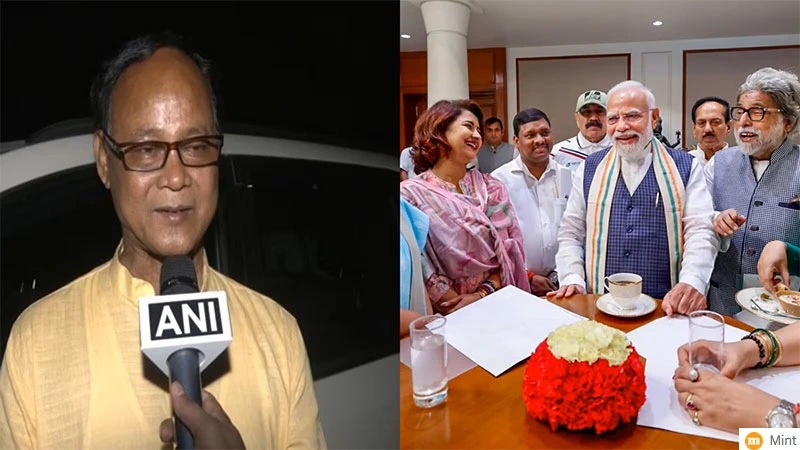
17 NCPI MPs to Join BJP: Unethical Defection Maneuvers and Democratic Decay
Finally, the cat is out of the bag. Jagadish Chandra Barma Basunia, the rebel MP from Cooch Behar, made an explosive statement related to 17 NCPI MPs to join BJP either before or right after Durga Puja. I do not know how many politicians are left today who can speak the truth so candidly in front of the camera. At first, I wondered if I heard it correctly. But then it was shown so many times across numerous news channels that I realized everything was indeed accurate—though one wonders what state Basunia will find himself in after this candid admission.
Listen to the Jagadish Basunia BJP claim in ABP Ananda.
Then again, Jagadish Basunia is not the kind of politician who acts completely naive. He was previously with the All India Forward Bloc. Later, after Mamata Banerjee came to power, he joined the Trinamool Congress (TMC) to align with her development agenda. The truth is, he had once faced such intense local protests at his home in Sitai, Cooch Behar, that he had to flee his residence with his wife in the middle of the night under police escort on August 11, 2026. On September 13, he faced similar angry demonstrations again, so it is not difficult to understand his mental strain.
Perhaps out of sheer desperation to prove his political relevance, he remarked: “Oh, they don’t know—we are having breakfast with the Prime Minister and lunch with the Chief Minister”. In short, he tried to project how high his status is in the corridors of power. He even let slip that four meetings had taken place at Union Minister Bhupender Yadav’s residence. Having blurted out so much, he must have endured significant embarrassment from the BJP’s Delhi leadership, the NCPI camp, and dissident Trinamool MPs alike.
What we are witnessing in Indian politics today is no longer an exchange of ideological principles. It has devolved into a raw political battlefield which is unethical, immoral, and completely detached from democratic values. Elected leaders switch allegiances without giving a single thought to the voters who put them in office.
The recent political churn surrounding the planned entry of 17 NCPI MPs into the BJP exposes how party lines, constitutional ethics, and institutional integrity are systematically dismantled for short-term arithmetic and personal gains.
We have also raised our concerns regarding the TMC Rebel MPs NCPI Trap earlier.
Political Aftershocks: The Wider Fallout of Basunia’s Statement
Jagadish Basunia’s premature disclosure has triggered political ripples that extend far beyond a single joining date.
- Fresh Ammunition for the Opposition: Rahul Gandhi, already pressing Amit Shah over the recent pellet-firing incidents during the CJP protests, now gains fresh leverage to attack the ruling party’s internal strategies.
- Unified Regional Pushback: Opposition leaders Mamata Banerjee and Arvind Kejriwal are poised to seize upon this admission to launch a coordinated offensive against the BJP’s ruthless expansion tactics.
- Discontent Within Bengal BJP: The revelation severely embarrasses the state leadership, amplifying frustration among ground-level workers who strongly oppose the top-down “Trinamoolisation” of their local party units.
Whether Basunia spoke out of sheer candor or under the intense strain of local hostility at home, the broader strategic damage from his unscripted admission cannot be easily undone.
The Backstory of the Defection: How 20 Rebel MPs Landed in the NCPI
To understand the weight of the Jagadish Basunia BJP claim, one must trace the timeline back to the aftermath of the 2026 West Bengal Assembly elections. Following the electoral shift in the state, a faction of 20 Lok Sabha MPs originally elected on Trinamool Congress tickets broke away from the parent party. However, entering the saffron party straight away was legally and politically risky due to statutory constraints.
Instead of resigning their parliamentary seats and seeking a fresh mandate from the electorate, the breakaway group engineered an intermediate move. They aligned themselves with a lesser-known registered entity—the Nationalist Citizens Party of India (NCPI). This move allowed them to claim a collective political merger under parliamentary norms while pledging external support to the National Democratic Alliance (NDA).
Defection Process Flowchart
- Step 1: Parent Group — 20 Rebel TMC Lok Sabha MPs
- Step 2: Intermediate Merger — NCPI (Registered Political Party)
- Option A (17 MPs): Direct transition to formal BJP membership.
- Option B (3 MPs): Retaining external NDA support status without formal party membership.
- Step 3: Final Outcome
- Formal BJP Entry (17 MPs)
- External NDA Support (3 MPs)
As detailed in reporting on The Hindu’s political coverage, the breakaway group sought separate seating arrangements and legal recognition as an independent block within the House. Yet, parliamentary records continue to register them under their original party affiliation while disqualification petitions wind their way through constitutional bodies.
Anti-Defection Law and the Mathematical Numbers Game
This is where the anti-defection law and the numbers game come into play. There are 20 dissident MPs in the Trinamool Congress breakaway group, three of whom belong to the minority community: Abu Taher Khan (Murshidabad), Khalilur Rahaman (Jangipur), and Yusuf Pathan (Baharampur). For these three, joining the BJP directly is almost impossible due to local constituency dynamics and political pressures in their regions.
That is why this obscure party, the NCPI, was tracked down to enable a collective merger in the first place. Now, among them, 17 NCPI parliamentarians plan to formally join the BJP, keeping the mathematical equation intact.
In terms of anti-defection mechanics, the rebel faction comprises a total size of 20 MPs, where a minimum of 14 MPs (two-thirds of the group under the Tenth Schedule of the Indian Constitution) is legally required to execute a valid merger without triggering disqualification. Since 17 MPs intend to formally join the ruling party, their numbers comfortably exceed the legal threshold of 14, while the remaining 3 MPs representing minority constituencies will retain their status as external NDA supporters. By sheer numbers, they manage to bypass the anti-defection law while leaving Trinamool, and similarly, when transitioning from the NCPI to the BJP, the numerical requirement remains satisfied.
However, orchestrating the entire setup in this manner is beyond the capacity of just a few individuals. From the Jagadish Basunia statement on September 14, everyone learned that top central strategists including Union Home Minister Amit Shah, Bhupender Yadav, and the Leader of Opposition in Bengal Suvendu Adhikari are allegedly behind this move. Though, in my view, this is what everyone had already assumed; perhaps Basunia’s claim simply put an official seal on it—nothing more.
Explore the explicit analysis by veteran journalist Sumon Chattopadhyay on the 17 NCPI MPs defecting to the BJP.
Why the BJP Needs Parliamentary Numbers Before 2029
Meanwhile, look at the BJP’s position. They are freshly reveling in their strategic gains in Bengal politics. But to build a bulletproof winning strategy for the 2029 general elections, the ruling party requires major constitutional changes to clear legislative hurdles:
- Delimitation Bill Implementation: Realignment of parliamentary constituency boundaries across states.
- Women’s Reservation Act Rollout: Statutory seat allocation requiring constitutional amendments and census mapping.
- Special Constitutional Measures: Legislative backing that demands a two-thirds special majority in both Houses of Parliament.
Therefore, by hook or by crook, the party leadership needs the numbers. In the Rajya Sabha, they managed to arrange something by splitting AAP factions and pulling three Trinamool members. However, securing a stable margin in the Lok Sabha is still a long way off.
Thus, even if not 20, absorbing 17 NCPI MPs into the BJP works out well for their parliamentary arithmetic. The remaining three Muslim MPs have taken the best stance—they will enjoy the indirect political benefits of aligning with the NDA without getting their hands dirty by taking formal party membership. A splendid position indeed. We eagerly await what kind of reception they receive when they visit their respective home constituencies.
Samik Bhattacharya’s Reaction and Internal BJP Friction
The reaction within the state unit of the ruling party was far from unanimous. Samik Bhattacharya, the Bengal BJP state president, responded in his usual poetic style, remarking to news reporters: “That must be the BJP of Mars“.
Is it possible that such a massive political development is about to take place and the state unit president is kept entirely in the dark? Or is it a calculated tactical retreat to prevent backlash from grassroots party workers who fought bitter local battles against these very defectors?
As captured in live video broadcasts on YouTube news channels covering Bengal politics, ground-level workers expressed deep frustration over admitting leaders who previously opposed them. Bhattacharya publicly reminded reporters about past electoral violence in Bengal, emphasizing that the party would not admit leaders unconditionally just because they expressed a desire to join. Nevertheless, under the current circumstances, his statement certainly threw a wrench into their smooth direct joining process.
The Public Denial and Internal Chaos Among Rebel MPs
Adding another layer of absurdity to this political drama, fellow rebel MPs immediately tried to distance themselves from Basunia’s public declaration. The moment the news broke across media outlets, several members of the NCPI faction issued conflicting statements:
- Satabdi Roy (Birbhum MP): Clarified that Basunia spoke strictly in his personal capacity and that no collective decision had been finalized by the group.
- Abu Taher Khan (Murshidabad MP): Strongly rejected Basunia’s authority to speak on his behalf, stating outright, “We will not go to the BJP. We will not go to the NDA. This is clear”.
- Arup Chakraborty, Mitali Bag, and Kalipada Soren: Claimed total ignorance of any scheduled joining ceremony prior to Durga Puja.
This public friction reveals that NCPI MPs joining the BJP is not a smooth, unified transaction, but a messy, fragmented bargain where individual leaders are attempting to negotiate their own political survival.
The Morality of Defection: Why This Battlefield Is Unethical and Immoral
Now coming to the larger, vital question: switching parties without resigning from the seat. Is this becoming the accepted norm in Indian democracy today? Morally speaking, do elected representatives have no accountability whatsoever toward the voters who spent hours in line to elect them under a specific party symbol and platform?
Political analyst Biswanath Chakraborty has harshly criticized the reported defection move by the 17 NCPI MPs to join the BJP. He has gone so far as to say that voters are taking the trouble to cast their ballots, only for a group of elected representatives to trade those votes in the political market. If you think deeply, it is nothing different.
IDEAL DEMOCRATIC PROCESS vs CURRENT DEFECTION REALITY
| IDEAL PROCESS | CURRENT REALITY |
|---|---|
| 1. Candidate wins under Party Manifesto | 1. Candidate wins under Party Manifesto |
| 2. Candidate disagrees with Party | 2. Candidate breaks away with faction |
| 3. Candidate resigns parliamentary seat | 3. Candidate joins shell party (NCPI) |
| 4. Candidate faces fresh By-Election | 4. Candidate switches to Ruling Party |
| 5. Voters decide candidate’s legitimacy | 5. Voters bypassed completely |
When an MP is elected, the mandate belongs jointly to the candidate and the party ideology they represent. When leaders manipulate statutory loopholes—using obscure proxy outfits like the NCPI to jump from one side of the aisle to the other without returning to the electorate—it degrades the social contract between citizens and their government.
Electoral Deception: Voters who voted against a party find their elected representative sitting with that exact party a few months later. Subversion of Legislative Intent: The anti-defection law was drafted to end political horse-trading, not to provide a legal step-by-step manual on how to execute wholesale defections using proxy entities. Institutional Erosion: Parliamentary proceedings suffer when members spend months in legal ambiguity while speaker notices and court petitions gather dust.
Comprehensive analyses of defection dynamics can be reviewed via LiveMint’s breaking politics archive.
Legal Scrutiny: Speaker Notices and Supreme Court Petitions
The Jagadish Basunia statement regarding the 17 NCPI MPs joining the BJP is still tightly caught in legal scrutiny. Following petitions filed by the parent party leadership, Lok Sabha Speaker Om Birla issued formal notices to the 20 rebel parliamentarians, requiring them to show cause why they should not face disqualification under the Tenth Schedule.
The rebel camp sought extensions to file their legal replies, pushing procedural deadlines further into the calendar. Simultaneously, disqualification proceedings have been dragged to the Supreme Court of India, where petitioners argue that forming a proxy faction to support an opposing coalition constitutes a voluntary giving up of original party membership.
Because the Lok Sabha Speaker’s office has not officially validated their independent group status, the core question of whether these 20 leaders legally joined the NCPI remains completely unresolved—let alone their subsequent step of joining the BJP.
The Urgent Need to Reform the Anti-Defection Law
The honorable lawmakers of the Lok Sabha and constitutional experts must urgently consider whether the anti-defection law—originally enacted during Rajiv Gandhi’s tenure via the 52nd Constitutional Amendment in 1985—requires sweeping revision or total overhaul.
Key Flaws in the Current Framework
- The Merger Loophole: The 2/3rd merger clause intended to protect genuine ideological splits is routinely weaponized to facilitate mass defections without triggering by-elections.
- Indefinite Timelines: The absence of a mandatory statutory deadline for the Speaker to decide disqualification petitions allows defection disputes to drag out over years, often outlasting the legislative term.
- Proxy Parties: Rogue factions exploit unrecognized or dormant political parties as intermediate holding accounts to evade immediate disqualification.
Such unethical party-switching is fundamentally dangerous for democracy. Today, while the ruling party benefits from these statutory loopholes to expand its numerical strength, political power is inherently cyclical. Tomorrow, when current decision-makers find themselves in the opposition benches, these very same loopholes will inevitably boomerang back to hit them. Democracy cannot survive when laws designed to uphold political ethics are treated merely as technical hurdles to be bypassed by clever accounting.
10 Key Takeaways: NCPI-BJP Defection Controversy
- Explosive Revelation: Rebel MP Jagadish Chandra Barma Basunia publicly claimed that 17 NCPI MPs are set to formally join the BJP around Durga Puja.
- Intermediate Proxy Party: 20 dissident MPs originally elected on TMC tickets used the obscure NCPI as a temporary legal bridge to avoid immediate anti-defection disqualification.
- The Math Behind Defection: By moving 17 out of 20 MPs, the rebel faction comfortably clears the mandatory two-thirds legal threshold (14 MPs) required under the Tenth Schedule.
- Strategic Minority Exclusion: Three minority-community MPs chose to remain external NDA supporters without taking formal BJP membership to navigate local constituency pressures.
- High-Level Central Coordination: Basunia’s admission pointed to direct involvement from top BJP strategists, including Union Ministers and Bengal leadership, in planning the move.
- BJP’s Legislative Push: The ruling party needs additional parliamentary seats to build a two-thirds majority for key bills like constituency delimitation and women’s reservations ahead of 2029.
- Internal BJP Pushback: State unit president Samik Bhattacharya sarcastically dismissed the claim, reflecting friction between ground-level workers and incoming defectors.
- Factional Denial: Key rebel MPs, including Satabdi Roy and Abu Taher Khan, publicly distanced themselves from Basunia’s claims, revealing internal division within the group.
- Pending Legal Battles: The Lok Sabha Speaker has issued show-cause notices, and disqualification petitions remain active in the Supreme Court regarding their initial breakaway status.
- Systemic Law Flaws: The episode highlights major loopholes in the Anti-Defection Law, where proxy outfits and indefinite legal delays allow politicians to bypass the electorate’s mandate.