Kolkata Hotel Fire Again: Govt Must Act Now!
Aug 21, 2026 - By Ashutosh Roy Current AffairsGovernancePoliticsRegional UpdatesWest Bengal Politics
5 Questions:
- Why does Kolkata Hotel Fire keep happening continuously? Didn’t the administration learn anything from the Rituraj Hotel fire in Burrabazar in 2025?
- Didn’t the administration realise the urgent need for proper fire audits even after the Bideshini Hotel fire in Rampurhat?
- How can the administration show lack luster attitude about something as serious as fire audit and safety audit?
- How did the Corporation and Fire Brigade issue the certificates in the first place? Do they actually carry out regular compliance audits?
- If capable bureaucrats like Subrata Gupta and Manoj Agarwal are at the helm, how can the government and administration remain so indifferent to such urgent safety requirements?
Kolkata Hotel Fire: 9 Dead, Who Is Responsible?
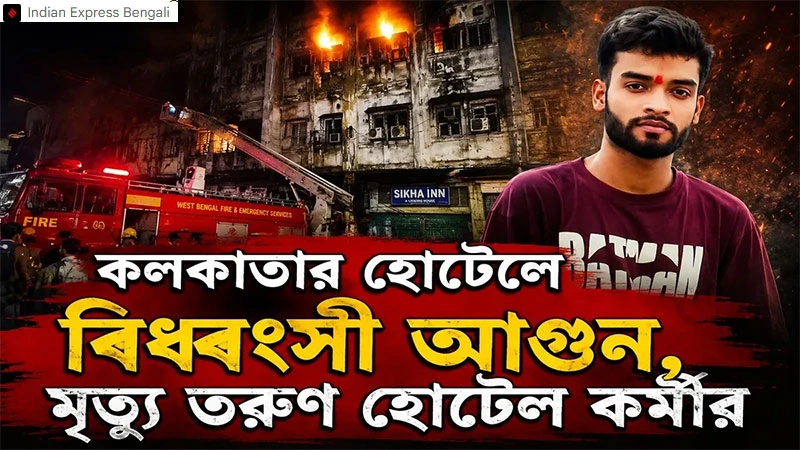
Thick black smoke everywhere. Flames shot into the air while terrified guests screamed for help from cramped window ledges. Below, fire trucks raced to the scene. Right after the Rampurhat tragedy involving a foreign tourist, another deadly Kolkata hotel fire erupted at Shikha Inn on Mirza Ghalib Street. Nine lives gone in an instant!
Sure, the local fire brigade arrived quickly after the fire accident started as they were just in a 50-meter distance. Soon came the ministers, the flashing lights, and the inevitable high-level inquiry team.
A Special Investigation Team (SIT) got slapped together, just like always. Rapid government paperwork might speed up returning bodies to grieving families, but it won’t raise the dead.
Right now, it is breaking news on TV. Tomorrow? Forgotten. Today’s newspapers feature massive photo spreads on page one, but by tomorrow, those stories shrink into tiny page-five blurbs. Pundits will write heavy-handed op-eds.
Then we wait. We just sit around waiting for the next disaster to strike – whether it is another hotel fire in Kolkata, an illegal firecracker shop blowing up, or a residential tower going up in flames. Same old story.
How long until the news coverage of this Hotel Shikha fire fades away? Hard to say. Setting up an SIT inquiry or a special probe is standard operating procedure (SOP). We have watched this exact rerun since the 2011 AMRI Hospital fire. But what ever happens to those official reports? Who actually goes to prison? Nobody knows.
Remember that Kolkata hotel fire in Mechhua/ Burrabazar a year back? The Kolkata Municipal Corporation formed a special team to audit local commercial properties. They flagged roughly 60 buildings for blatantly breaking basic fire safety rules. And then? Silence.
Way back in March 2010, Stephen House burned down. Did anyone ever face real punishment? You tell me.
Political power shifts, new governments take office, and old ones pack up. Still the nightmare of a Hotel Shikha fire never gets resolved. Opposition figures shout for blood. The ruling party makes grand promises. Take the Taratala building collapse, Suvendu Adhikari held up Firhad Hakim’s signature right inside the Assembly floor. But the moment political allegiances shifted, the entire investigation went quiet.
The Endless Blame Game in West Bengal Politics
Tragedy strikes, and West Bengal politicians immediately start playing games. The political mudslinging around this Kolkata hotel fire is outright embarrassing. Cabinet members point fingers at former mayor Firhad Hakim. Hakim fires back, calling it dirty politics. None of this surprises anyone here, it is just standard West Bengal political drama.
Think back to the 2011 AMRI Hospital fire. Mamata Banerjee openly blamed the Left Front, claiming they sold off the land dirt cheap. For years, her administration dodged accountability by pointing backward. Now, with political shifts across the state, current leaders just repeat the same play.
Round and round the blame game goes, while ordinary citizens pay the ultimate price.
Most Deadly Kolkata Fires Since 2010
| Year | Major fire incident | Location | Deaths |
|---|---|---|---|
| 2010 | Stephen Court Fire | Park Street | 43 |
| 2011 | AMRI Hospital Fire | Dhakuria | 89–93 |
| 2013 | Surya Sen Street Market Fire | Central Kolkata | 19 |
| 2016 | Topsia Illegal Fuel Unit Fire | Topsia | 3 |
| 2017 | Golden Park hotel fire in Kolkata | Ho Chi Minh Sarani | 2 |
| 2020 | Ganesh Chandra Avenue Fire | Central Kolkata | 2 |
| 2021 | Eastern Railway Headquarters Fire | Strand Road | 9 |
| 2025 | Rituraj hotel fire in Kolkata | Mechhua/Burrabazar | 14 |
| 2026 | Shikha Inn Fire | Mirza Ghalib Street, Central Kolkata | 9 |
Why Are Urgent Fire Audits Needed?
A new administration is running things now. Fair enough – they need time to govern. But has anyone called an urgent meeting specifically on fire safety issues? What are this government’s actual priorities?
Speaking on ABP Ananda, BJP leader Bimal Shankar Nanda pointed out high-rises in his own area packed along narrow alleys where fire engines cannot even fit. TV crews keep broadcasting images of commercial structures wrapped in chaotic webs of live electrical wires, veritable death traps.
This latest Kolkata hotel fire at Shikha Inn exposed a wild reality: nearly 10 separate hotels operating out of a single building with one tiny exit. In earlier disasters at Taratala and Rampurhat, emergency fire escapes were found locked shut. Who is inspecting this? Politicians swap seats, but the bureaucracy stays stagnant.
Watch the video of tragic Hotel Shikha fire.
We do not need another useless post-mortem report. We need immediate, aggressive safety audits targeting every obvious Kolkata hotel fire hazard across the city. Unsafe commercial spaces must be shut down on the spot until audited, plain and simple. When the state cleared street vendors, opposition politicians complained, but commuters at Dum Dum and Park Circus applauded the effort. Business matters, sure – but human life matters more.
Kolkata’s Hotel Fire Traps: Institutional Corruption and the High Cost of Administrative Blindness
The deadly blaze at Shikha Inn on Mirza Ghalib Street – which suffocated at least nine people in dense toxic smoke – was no random act of God. It was administrative negligence. Over the past decade, Mamata Banerjee’s administration permitted Kolkata to transform into a grid of high-density firetraps.
Illegal extra floors, windowless lodging rooms, and missing fire escapes became everyday realities. Don’t get shocked! You just pay the money for illegal construction and turn it to a legitimate one.
Trade licenses and official NOCs got rubber-stamped without physical site checks, turning safety permits into a pay-to-play system where cash replaced actual compliance.
Listen to the horrific description from an eye-witness.
Commercial operators keep running guest houses inside overcrowded, aging hubs like Burrabazar, Mechhua, and Park Street with zero working sprinklers, functional alarms, or emergency stairwells. Municipal inspectors turned a complete blind eye for years. By treating building codes as mere suggestions, local authorities effectively gambled with public safety.
This is not just about one hotel owner or one inspector. The problem goes much deeper. Entire commercial corridors across Central Kolkata have morphed into death traps right under the nose of civic bodies.
Year after year, building plans are quietly modified post-construction. Residential properties are converted into multi-tenant commercial hubs overnight without structural stability assessments or electrical load reviews. Air conditioning units, high-voltage equipment, and illegal commercial kitchens run continuously on outdated wiring designed for simple residential usage.
When local authorities accept bribes in lieu of real physical inspections, they are actively signing off on future tragedies.
What makes the situation catastrophic is the total absence of real-time monitoring mechanisms. Municipal corporations routinely grant business licenses based on self-declarations or superficial documentation. Fire safety clearances, which ought to require rigorous annual on-site testing of pressure pumps, smoke detectors, and hydrants, are treated as administrative formalities. This culture of Delay-dally tactics of institutions has created an urban landscape where hundreds of unregistered guest houses operate in narrow, congested lanes where standard fire tenders cannot even maneuver.
If you face ISO Audit, you will watch the auditor is asking even for the placement of the fire extinguisher. At times, they will even ask one of the employees to demonstrate, how it works.
Do you know where the real difference lies? Those who conduct ISO audits know that if a mistake is detected, they will have to explain themselves and be held accountable. But when there is a nexus at every level, as in the Mamata Banerjee government, everyone knows there is no obligation to give an explanation. So, instead of taking the trouble of visiting the site, it is better for the officer to sit in an air-conditioned office and enjoy the comfort.
A Failure of Governance and Misplaced Administrative Priorities
While the previous TMC administration built this legacy of neglect, Chief Minister Suvendu Adhikari’s current government deserves criticism for its sluggish response. Instead of dispatching municipal inspection teams to shut down uncertified guest houses on day one, the leadership wasted time on political debates, administrative posturing, and setting up slow-moving probe committees.
Read the tragic comparison in The Telegraph.
We have seen this many times before. People die, an inquiry is announced, and then public attention slowly moves on. The state needs proactive leadership right now. The government must stop talking and start sealing non-compliant properties, overhauling outdated urban building codes, and enforcing mandatory safety audits across Bengal before the next building burns.
While Suvendu Adhikari has shown a level of promptness that was completely absent under the previous regime, expectations are now even higher: people want him to break the long-standing procedural trap and deliver a lasting solution.
If the administration truly intends to break this cycle, it must establish a non-partisan, independent safety task force armed with statutory powers to shut down unsafe facilities immediately. Rebuilding public trust requires accountability at the top – holding regional municipal officers, fire inspectors, and licensing authorities legally liable for safety lapses in their jurisdictions. Until the government starts fixing the problems at their roots instead of reacting to each disaster, people in Kolkata will keep paying with their lives.
Is the Government Showing Signs of Disarray?
Systemic Failure of Building Audits and Environmental Clearances
The reality on the ground is that building codes in Kolkata are treated as flexible guidelines rather than strict legal mandates. Across central commercial zones like Mirza Ghalib Street, Park Street, and Burrabazar, high-density structures house dozens of independent commercial establishments without basic fire barriers or centralized alarm systems. Environmental and structural safety certificates are routinely issued without verifying whether electrical loads can handle the massive power demands of multiple heavy air conditioners, commercial appliances, and continuous lighting setups. Kolkata Hotel Fire can never stop without immediate Government Steps.
When nobody enforces the rules, making money becomes more important than keeping people safe. When building owners modify internal floor plans – adding extra partitions, removing secondary exits, and blocking stairwells – they convert standard properties into dangerous death traps. Nobody notices these changes until something goes badly wrong. By then, smoke may already be filling the building and people may have nowhere to escape.
The answer is simple: every commercial building in these crowded areas should be inspected properly, and the findings should be made public. The periodical safety audit has to be made compulsory. Publicly accessible databases listing certified safe buildings would empower visitors to make informed choices while forcing non-compliant owners to fix their infrastructure.
Civic authorities must implement strict penalties, including immediate closure and legal action, for any property owner operating without valid, independently verified fire safety and environmental permits, without which Kolkata Hotel Fire will continue.
Reforming West Bengal’s Urban Governance and Public Safety Rules
West Bengal cannot fix this problem with another round of hotel inspections. The way municipal bodies monitor buildings has to change. Beyond individual hotel checks, city-wide urban planning policies must adapt to high-density commercial growth. Narrow access roads, tangled overhead power cables, and overcrowded commercial complexes present massive challenges for emergency response units during a fire. Addressing these hazards requires coordinated action between electric utility providers, municipal authorities, and emergency services.
The government needs to act before the next fire, not after it. Safety inspections cannot remain something officials remember only when people die. Rather than engaging in political blame-shifting after every disaster, state leadership must invest in modern firefighting technology, clear narrow lanes for emergency access, and enforce strict, non-negotiable safety standards across every district. West Bengal needs to enforce the rules properly, make the system more transparent and stop giving unsafe buildings a second chance to avoid tragedies like the Kolkata hotel fire.
10 Key Takeaways
- A devastating Kolkata Hotel fire at Hotel Shikha on Mirza Ghalib Street resulted in nine tragic deaths, highlighting the critical human cost of urban fire safety failures.
- Multiple commercial operations and guest houses were functioning inside a single structure with only one narrow exit point and locked emergency staircases.
- The standard administrative response – quick arrival of fire services followed by the setup of a Special Investigation Team (SIT) – fails to prevent recurring incidents.
- Despite past committees identifying dozens of non-compliant buildings after previous urban fires, lack of enforcement leaves safety violations unresolved. Isn’t it a deliberate systematic audit failure?
- Dense urban zones continue to see unchecked building modifications and commercial operations without proper fire safety infrastructure or emergency access right in front of Fire Brigade and near Corporation.
- Instead of post-disaster post-mortems, hazardous commercial establishments and firetraps must be shut down and audited before accidents occur. Preemptive Audits can save such heart-rendering life losses.
- Immediate political blame-shifting between rival parties distracts from taking long-term, concrete measures to ensure public safety.
- Recurring incidents – from Stephen House and AMRI Hospital to recent Kolkata Hotel Fire – demonstrate a long-standing failure across successive administrations irrespective of Governments.
- Civic safety enforcement and immediate, city-wide inspections must take precedence over opposition split, political rhetoric and bureaucratic delays.
- While economic activities and local businesses are essential, strict compliance with safety regulations is non-negotiable to protect human life.