Abhishek's Amtala Office: Bulldozer Attack
Jul 20, 2026 - By Ashutosh Roy Current AffairsGovernancePoliticsRegional UpdatesWest Bengal Politics
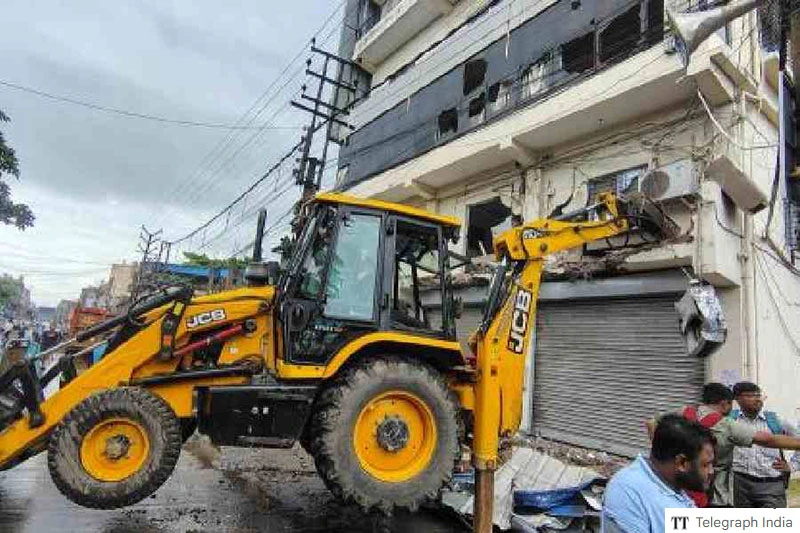
Abhishek’s Amtala Office Razed: Is it Bulldozer Raj?
Abhishek’s Amtala Office shook on Saturday morning as heavy diesel engines roared to life on the Amtala-Baruipur road. For years, this five-storey building stood as a fortress of political power in South 24 Parganas.
It was the nerve center where the Trinamool Congress (TMC) structured its local dominance. But within hours, three massive earthmovers tore through its concrete facade, shattering more than just brick and mortar.
The sound of breaking glass and crushing concrete echoed far beyond the Amtala crossing. This unexpected action signals a dramatic shift in the political landscape of West Bengal.
It brings a controversial administrative tactic straight to the doorstep of one of the state’s most powerful political figures.
Watch the video of Abhishek’s Amtala Office Demolition.
There are allegations that Abhishek’s Amtala Office had been built up by demolishing a Bakery.
Is This Demolition a Case of Political Vendetta?
Many people are asking a critical question today. Is the action against Abhishek’s Amtala Office a targeted attack driven by political rivalries?
| Metric / Event | Details of the Amtala Demolition |
|---|---|
| Location of Incident | Amtala-Baruipur road, Diamond Harbour constituency |
| Structure Properties | Five-storey commercial building linked to Leaps and Bounds |
| Administrative Grounds | Complete lack of an approved municipal building plan |
| First Notice Date | June 20, 2026 |
| Second Notice Date | June 30, 2026 |
| Final Statutory Summons | July 7, 2026 |
| Disputed Hearing Date | July 15, 2026 |
| Execution Date | July 18, 2026 (Ground and First floors razed) |
The timing of this demolition raises serious eyebrows among independent analysts. Consider the following sequence of events that unfolded rapidly:
- Sudden Bureaucratic Speed: For nearly a decade, the five-storey structure operated without facing any real administrative hurdles or inspections.
- Rapid Notices: Multiple government departments suddenly issued rapid notices back-to-back within a three-week window.
- Massive Security Deployment: Heavy central forces and Bengal police cordoned off the entire locality early in the morning to prevent public mobilization.
- Preemptive Measures: Fire brigades stood by, power lines were disconnected, and the doors were broken open before the machinery arrived.
- Seizure of Materials: Officials quickly entered the premises and seized laptops, documents, and digital devices under digital locks.
Abhishek Banerjee publicly claimed that his team attended a hearing just days prior. They requested a copy of the original complaint filed by local resident Sushanta Mondal. Instead of receiving the documents, they woke up to see the ground and first floors flattened.
To many observers, this frantic pace smells heavily of a calculated political strike. It feels designed to dent the public image of a top leader.
Has the Bulldozer Culture of Uttar Pradesh Permanently Arrived in Bengal?
For the last few years, we watched televised images of heavy machinery leveling properties in Uttar Pradesh. The famous Bulldozer culture pioneered by the Yogi Adityanath government became a national talking point.
Many analysts at Knowledge Mart believe this aggressive model has officially made its entry into West Bengal.
| Feature / Metric | Yogi’s UP Model | Traditional Indian Law |
|---|---|---|
| Operational Speed | Immediate executive action (within days) | Slow, due process (months to years) |
| Optical Impact | High public spectacle, media cameras | Low-profile administrative execution |
| Primary Target | High-profile political figures & mafias | Standard, routine building violators |
| Legal Precedent | Executive discretion and immediate drive | Judicial orders and multi-stage appeals |
| Collateral Damage | High structural risk to nearby properties | Contained, highly regulated manual labor |
This sudden shift feels highly unethical to a large section of civil society. The use of heavy earthmovers before a final judicial verdict bypasses standard constitutional checks and balances.
However, there is another side to this coin that Knowledge Mart highlights. We must look at the hard truth about urban planning in our state:
- Illegalities Pose Direct Threats: Unauthorised constructions are completely illegal and compromise public safety.
- Risk to Human Lives: They pose an immense, undeniable risk to innocent human lives across congested urban pockets.
- History of Catastrophes: We cannot forget the tragic building collapses we have witnessed in Taratala and various other corners of Kolkata.
- Engineering Compromises: When influential people build massive structures without approved plans, they compromise basic structural engineering standards. It places entire neighborhoods in extreme danger.
Bulldozer Culture Bengal 2026: Key Demolition Actions
| Location | Structure / Property | Action Taken | Reason Cited | Status | SEO Keywords |
|---|---|---|---|---|---|
| Amtala, South 24 Parganas | Abhishek Banerjee’s Party Office (Leaps & Bounds) | Partial demolition using bulldozers | Illegal construction, no approved building plan | Executed | Bulldozer Culture Bengal 2026, Amtala demolition, Abhishek office bulldozer |
| Diamond Harbour Constituency | Multi-storey political office building | Front portion dismantled | Violation of municipal building rules | Executed | West Bengal bulldozer politics, political demolition Bengal |
| Kolkata (Tiljala Area) | Residential & apartment clusters | Demolition notices issued | Unauthorized construction | Ongoing | Kolkata illegal buildings demolition, Bengal urban crackdown |
| Beleghata, Kolkata | Commercial units & restaurants | Marked for bulldozer action | Illegal structural expansion | Under process | Bulldozer drive Kolkata 2026, illegal property removal Bengal |
| Topsia-Tiljala Belt | Large apartment zones | Identified as demolition zone | High percentage of unauthorized buildings | Planned | Bulldozer culture Bengal, unauthorized housing crackdown |
| Across Kolkata (Multiple Boroughs) | Approx 3000 buildings (estimated) | Surveyed for demolition | Long-term rule violations | Proposed | Bengal demolition drive 2026, mass bulldozer action WB |
Why Did the Previous Administration Stay Silent for So Long?
If Abhishek’s Amtala Office was built illegally around 2017 on the ashes of a burnt bakery, a vital question arises. Why did the previous administration look the other way for nine long years?
Why did Mamata Banerjee’s governance and local administration fail to take a single step during the actual construction process?
The answers point toward a deep, institutional problem in Bengal. There is a notorious, long-standing nexus between aggressive local promoters, civic administration officials, and influential local councillors or chairmen.
| Nexus Component | Mode of Operation in Bengal Politics |
|---|---|
| Local Promoters | Provide immediate funds and muscle power to local party offices. |
| Civic Officials | Deliberately skip field inspections and withhold violation reports. |
| Local Councillors | Act as political shields to prevent police or municipal crackdowns. |
| Financial Deals | Under-the-table cash distributions to grease the administrative wheels. |
Consider the structural breakdown of this institutional blindness:
- Greasing the Wheels: A project of this scale cannot rise beside a major highway without local administrative compliance and financial arrangements.
- Political Protection: Local municipal inspectors remained completely quiet because the property carried the name of the state’s most powerful political family.
- Paralysis of Law: Even when the central leadership under Narendra Modi openly criticized the lack of structural transparency regarding properties linked to Abhishek’s Amtala Office, the local state machinery remained completely frozen.
Mamata Banerjee’s absolute silence during those years speaks volumes. It shows how deeply political pressure can paralyze local civic bodies, rendering them completely toothless against ruling party elites.
Illegal Constructions During TMC Regime in West Bengal (2011-2026)
| Area / Location | Type of Illegal Construction | Key Findings / Data | Authority / Report | SEO Keywords |
|---|---|---|---|---|
| Tiljala-Topsia (Kolkata) | Unauthorized apartment blocks | Approx 70% structures built without approval in last 20 years; Approx 1000 buildings marked | KMC Red Zone List (2026) | Illegal construction Kolkata, TMC regime buildings, Topsia illegal flats |
| Across Kolkata (6 Boroughs) | Residential & commercial buildings | Approx 3000 buildings identified as “red-zone” with major violations | Kolkata Municipal Corporation | Bulldozer Culture Bengal 2026, illegal buildings WB, KMC crackdown |
| East Kolkata Wetlands (EKW) | Warehouses, godowns, commercial sheds | Illegal land conversion of protected wetlands for construction | SIT Investigation (2026) | Wetlands encroachment Bengal, illegal land conversion WB |
| Garden Reach & Metiabruz | Dense unapproved housing clusters | Frequent violations; collapse incidents raised safety concerns | Civic audits & post-collapse reviews | Building collapse Bengal, unsafe illegal housing Kolkata |
| Burrabazar-Chitpore Belt | Commercial + mixed-use illegal structures | Clusters of buildings violating planning norms | KMC Red Zone Identification | Illegal commercial property Kolkata, Bengal construction scam |
| Ekbalpore-Kidderpore | Unapproved residential buildings | Identified as high-risk unauthorized construction zone | KMC Internal Reports | Unauthorized housing WB, illegal flats Kolkata |
| Tiljala (Specific Case) | Illegal filling of water bodies for buildings | Water tank converted into land for unauthorized construction | NGT Case Filing | Illegal land filling Bengal, environmental violation WB |
| Narkeldanga (Kolkata) | Unauthorized building floors | Court ordered demolition of dangerous illegal structure | Calcutta High Court Case | court demolition order Kolkata, illegal building case WB |
Will the New Construction Audit Address Existing Illegal Buildings?
The political winds have changed. The new administration under Chief Minister Suvendu Adhikari has promised sweeping changes.
The state government recently ordered a comprehensive technical audit of all running real estate constructions across West Bengal. These active projects must clear strict structural inspections before they can resume work from the 1st of August.
| Audit Phase | Focus Area | Statutory Timeline |
|---|---|---|
| Phase 1 | Running Real Estate Constructions | Deadline: July 31, 2026 |
| Phase 2 | Suspended/Disputed Projects | Resumption Allowed: August 1, 2026 |
| Phase 3 | Retroactive Structural Audits | Schedule: Post-September 2026 |
This is undoubtedly an excellent administrative move to stop fresh corruption. But what happens to the thousands of illegal buildings that have already been completely built up? What is the plan for structures that are currently occupied by citizens?
The current government must adopt a deeply humane consideration here:
- Middle-Class Exploitation: Millions of common citizens are already living inside these legally flawed buildings.
- Life Savings at Stake: These ordinary families are not political heavyweights or wealthy promoters; they are middle-class citizens who invested their hard-earned life savings into buying these flats.
- Unfair Retaliation: Knocking down residential buildings without providing alternative housing shifts the punishment from the corrupt builder to the innocent buyer.
Can We Protect Innocent Buyers Without Compromising Public Safety?
We find ourselves stuck in a massive ethical dilemma. On one hand, the state cannot leave human lives at lurch inside unstable, unapproved structures. On the other hand, the administration must not take reckless steps that cause innocent people to lose their hard-earned money and roofs overnight.
- Economic Distress: Many of these affected families are already facing immense financial pain due to broader macroeconomic shifts.
- Job Losses: A significant number of victims have lost their secure jobs in recent years due to industrial stagnation in Bengal.
- The Core Injustice: Forcing them onto the streets via sudden bulldozer drives would be an absolute humanitarian disaster.
With the highest due respect for our Judiciary, we must openly state a frustrating reality. The common people cannot whole-heartedly accept these sudden demolitions when the real perpetrators face zero punishment.
The corrupt promoters, dishonest municipal engineers, and complicit political leaders who signed off on these projects are walking free.
Unfortunately, the end-buyers are left holding the debris.
Is it Time to Unmask the Subservient Bureaucrats and Complicit Police?
One must acknowledge a striking, albeit dark, administrative achievement of the past decade. The previous leadership ran a highly disciplined political system where the entire state bureaucracy and police force became completely subservient to the ruling party.
Senior IAS and IPS officers routinely ignored open illegalities to please their political masters.
| Administrative Figure / Body | Role in the System | Public Expectation |
|---|---|---|
| Subservient Bureaucracy | Ignored building codes to satisfy political bosses. | Complete exposure and legal trial. |
| Complicit Police Force | Provided protection to illegal promoter syndicates. | Internal department probes and suspensions. |
| IAS Subrata Gupta | Upright Advisor to current CM Suvendu Adhikari. | Enforcement of clean, unbiased governance. |
| Rebel/Politicized Factions | Ritabrata Trinamool and NCPI Trinamool. | High public skepticism regarding impartiality. |
It is now time for the current administration to completely dig out those specific names. The officers who intentionally looked away while illegal structures sprouted across the state must face strict disciplinary action:
- Identify Complicit Engineers: Track every municipal engineer who signed off on utility connections for unapproved buildings.
- Expose Political-Bureaucratic Pacts: Bring to light the written and unwritten orders that protected elite party offices from demolition.
- Ensure Independent Inquiries: Avoid using state machinery to simply settle scores, and instead build a institutional framework for urban transparency.
The presence of Subrata Gupta, a widely respected, honest, and upright IAS officer, as the current Advisor raises public expectations significantly. People genuinely believe that clean governance is possible under his technical and administrative guidance.
However, the rapid political emergence of factions like the Ritabrata Trinamool and the NCPI Trinamool forces the common man to view things with a heavy pinch of salt. Bengal has a long history of political shifts simply replacing one set of favored syndicates with another.
The citizens of West Bengal do not want a selective, partisan crackdown. They want an administration that remains completely unbiased, professional, and fair.
Knowledge Mart Final Thoughts: The Failure of Mamata’s Governance Model
The dramatic demolition of Abhishek’s Amtala Office stands as a stark monument to the ultimate breakdown of institutional governance under Mamata Banerjee.
For over a decade, her administration traded long-term structural safety for short-term political loyalty.
The fact that a prominent MP office could sit in complete legal limbo for nearly a decade proves that the system was designed to protect the powerful while exploiting the weak.
- Institutional Blindness: By allowing local clubs, aggressive syndicates, and powerful party leaders to dictate urban development, her government actively turned a blind eye to blatant violations of the law.
- Paralysis of Local Bodies: The administrative machinery effectively became an extension of Kalighat, rendering local civic bodies completely toothless against ruling party elites.
- The Spectacle vs. Substance Dilemma: While the sudden arrival of the Bulldozer culture in Bengal offers a flashy, high-decibel political spectacle for the media, it cannot substitute for deep systemic reform.
If the new government truly wants to clean up West Bengal, it must move away from selective political vendettas.
The administration must focus on punishing the corrupt officials who allowed this lawlessness to thrive, while actively shielding the innocent citizens who paid the ultimate price.
External Resource Links for Continued Reading:
- Read the comprehensive local reporting on the ground situation via the Times of India Local Coverage.
- Track the national political reactions and security details on the India Today Main News Feed.
- Read the detailed technical breakdown of the unauthorized properties list on the News The Truth Investigative Report.
- Listen to the direct statements and warning reactions of the leadership on the India Today Video Coverage.
This videos show the on-site execution of the demolition, capturing the deployment of earthmovers and heavy security forces at the venue.
10 Key Takeaways on Abhishek’s Amtala Office Demolition
- Abhishek’s Amtala Office Leveled: Three massive bulldozers tore through the five-storey TMC stronghold, Abhishek’s Amtalata Office, sparking intense political shockwaves across West Bengal.
- Calculated Political Vendetta? The rapid fire of administrative notices within three weeks suggests a targeted strike to dent the TMC leadership’s public image.
- Yogi’s Bulldozer Culture Hits Bengal: The aggressive, high-decibel demolition model pioneered in Uttar Pradesh has officially made its dramatic entry into Bengal politics.
- The Deadly Cost of Illegal Structures: While controversial, unauthorized constructions bypass structural codes, risking innocent lives as seen in past Taratala collapses.
- Mamata Banerjee’s Silence Exposed: Questions mount over why the previous government completely ignored this massive illegal highway construction for nine long years.
- The Corrupt Promoter-Civic Nexus: A deep, unholy alliance between local promoters, municipal inspectors, and councillors kept the property shielded from law enforcement.
- New Mandatory Real Estate Audit: The current Adhikari administration has frozen unverified constructions, ordering strict technical audits before work can resume on August 1st.
- Middle-Class Homeowners in Limbo: Thousands of families face a brutal humanitarian crisis, risking their life savings and roofs over unapproved flats they bought in good faith.
- Demands to Target Complicit Bureaucrats: Citizens call for the severe punishment of subservient IAS, IPS, and civic engineers who deliberately looked away during the construction boom.
- Knowledge Mart Verdict: Flashy bulldozer actions cannot replace deep structural reforms; the state must punish corrupt elite architects instead of targeting vulnerable end-buyers.
Frequently Asked Questions (FAQ)
- Why was Abhishek’s Amtala Office targeted for demolition?
- According to the South 24 Parganas district administration, the five-storey commercial building in Amtala, renowned as Abhishek’s Amtala Office, was built illegally on a major highway stretch without any sanctioned municipal building plans. Local authorities claim the property, linked to Leaps and Bounds Pvt Ltd, directly violated urban real estate regulations.
- How has the TMC responded to this sudden bulldozer drive?
- Trinamool Congress leader Abhishek Banerjee has fiercely labeled the action a pre-planned political vendetta. He claims his legal team actively attended administrative hearings on July 15 and that the demolition was pushed through maliciously before they were provided copies of the original public complaints.
- Is the controversial UP “Bulldozer Culture” now a reality in West Bengal?
- Many independent analysts at Knowledge Mart argue that the sudden use of high-decibel earthmovers under heavy security closely mimics the aggressive “Yogi Model” of immediate executive action. However, critics point out that this fast-tracked approach threatens judicial due process and sets a highly unpredictable legal precedent in the state.
- What role did the previous Mamata Banerjee government play in this illegal nexus?
- The fact that this massive multi-storey office functioned since 2017 without facing any civic interference highlights a massive failure of governance under Mamata Banerjee. The long-standing nexus between local promoter syndicates, corrupt municipal inspectors, and influential ruling-party councillors successfully shielded the illegal property, Abhishek’s Amtala Office, from law enforcement for nearly a decade.
- What happens to innocent homebuyers who already purchased unapproved flats?
- The current Suvendu Adhikari administration has implemented a strict real estate audit for all running projects starting August 1st. However, the state has yet to announce a clear, humane framework for existing illegal buildings where middle-class families have already spent their life savings, risking an economic and humanitarian disaster if sudden drives continue without punishing the original corrupt builders.
[…]Abhishek’s Amtala Office: Bulldozer Attack Abhishek’s Amtala Office faces a brutal bulldozer attack! See how the party office was demolished and why Abhishek refuses to bend under political pressure.[…]
[…]Abhishek’s Amtala Office: Bulldozer Attack Abhishek’s Amtala Office faces a brutal bulldozer attack! See how the party office was demolished and why Abhishek refuses to bend under political pressure.[…]
[…]Abhishek’s Amtala Office: Bulldozer Attack Abhishek’s Amtala Office faces a brutal bulldozer attack! See how the party office was demolished and why Abhishek refuses to bend under political pressure.[…]
[…]Abhishek’s Amtala Office: Bulldozer Attack Abhishek’s Amtala Office faces a brutal bulldozer attack! See how the party office was demolished and why Abhishek refuses to bend under political pressure.[…]