Pranab Wanted to Be PM? Sonia's Big Shock
Nov 12, 2026 - By Ashutosh Roy PoliticsNational PoliticsWest Bengal Politics
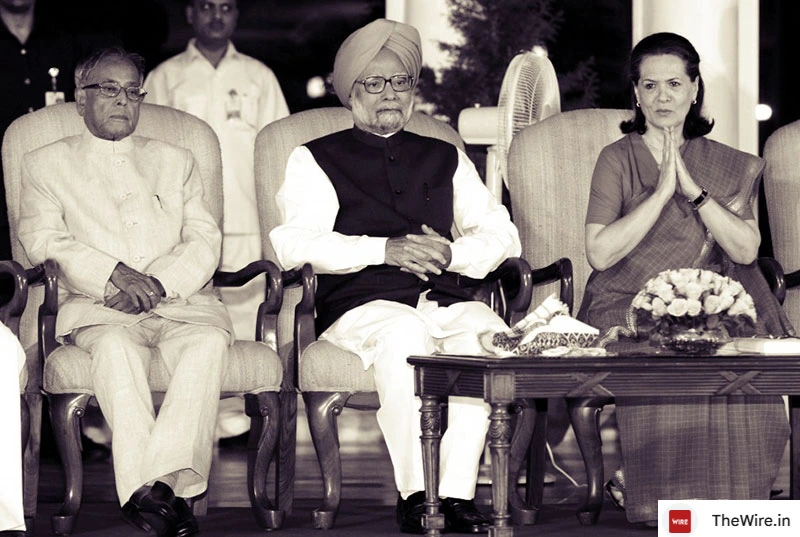
Pranab Wanted to Be PM? Sonia’s Memoir Sparks Controversy
The publication of Sonia Gandhi’s memoir, Belonging: A Journey of Love, has once again stirred up Indian politics. Although much of the book deals with personal experiences, family relationships and her journey into Indian politics, a brief reference to former President Pranab Mukherjee has created an unexpected controversy.
Sonia writes about her relationship with Rajiv Gandhi, her hesitation before entering politics, her position against communalism and her understanding of India’s identity and sense of belonging.
She also touches upon several important political developments, although personal experiences receive greater attention. But one particular recollection about Pranab has attracted considerably more attention than many other political revelations in the book.
According to Sonia, Pranab Mukherjee spoke to her in 2010 about the possibility of a change at the top. At that time, he had developed serious differences with the then Finance Minister, P. Chidambaram.
Sonia interpreted Pranab’s suggestion as an indirect expression of his long-standing ambition to become Prime Minister. She says the remark shocked her and that she gently changed the subject rather than responding directly. In her account, Pranab may have been disappointed, but he never made her feel that he held her response against him.
This is Sonia’s recollection and interpretation of a private conversation. We do not have Pranab’s version of that particular exchange. Nevertheless, the episode raises a much more interesting question: what exactly was so shocking about Pranab Mukherjee aspiring to become Prime Minister?
Pranab Mukherjee Was No Ordinary Congress Leader
Before discussing Sonia’s reaction, we must remember who Pranab Mukherjee was in Indian politics. He was one of the most experienced and influential Congress leaders of his generation. Having served in Indira Gandhi’s government during the 1970s, he went on to hold almost every important ministerial portfolio, including Defence, External Affairs and Finance. His understanding of parliamentary affairs, political negotiations, administration and the functioning of the Congress organisation was exceptional.
He was not simply another senior minister waiting for an opportunity. He was a politician who understood the Congress from within, knew the Opposition and had considerable experience in managing regional parties and complicated political situations.
There was a reason why successive Congress governments depended so heavily on him. During the UPA years, Pranab chaired numerous Groups of Ministers dealing with important policy and administrative matters. His influence extended far beyond the formal responsibilities of his individual portfolios.
In political circles, he was often regarded as the super minister of the UPA government. When a political crisis emerged, when a difficult parliamentary negotiation had to be handled or when coalition partners threatened to withdraw support, Pranab was frequently among the first people the government turned to.
His political experience was an asset that could hardly be replaced. His official presidential biography records his long ministerial career and contribution to public life.
Apart from a brief period of expulsion from the Congress, during which he went on to form his own political outfit, and his later acceptance of an invitation from the RSS, Pranab Mukherjee was rarely surrounded by major political controversies. But nobody can seriously dispute that he was a towering figure in India’s political history. His contribution to the Congress party and to coalition governance was extraordinary.
I hope even his harshest critics within the Congress would acknowledge that the party benefited enormously from his political wisdom, organisational experience and ability to handle difficult situations. Whatever differences he may have had with the party leadership, his contribution to the Congress was far greater than any controversy associated with his career.
How Pranab Managed the UPA Coalition
To understand Pranab’s importance, we must revisit the political circumstances in which the UPA government came to power in 2004. The Congress did not have a majority of its own and depended on several regional and ideological partners. The Left parties, with more than 60 MPs, supported the government from outside. Their political philosophy was fundamentally different from that of the Congress.
Here was a government pursuing economic reforms and working within a market-oriented economic framework, while depending on parties whose ideology was rooted in opposition to capitalism and economic inequality. Maintaining such an arrangement was never going to be easy.
Manmohan Singh was an outstanding economist. His contribution to India’s economic transformation through the introduction of economic liberalisation in 1991 is undeniable. But running a coalition government is a different challenge altogether.
The political calculations involving the Congress, the Left and regional parties required patience, negotiation and a detailed understanding of parliamentary arithmetic. Pranab was particularly comfortable in that territory. His political experience and ability to communicate with leaders across ideological boundaries made him an indispensable figure in the government.
Remember the Indo-US Civil Nuclear Agreement. The Left parties strongly opposed the agreement and repeatedly warned the government against proceeding with it. Pranab played a central role in the negotiations between the UPA and the Left. He had to hold lengthy discussions with CPI(M) General Secretary Prakash Karat and other Left leaders to keep the negotiations alive. Those discussions continued for months, but eventually the Left withdrew support in July 2008 after the government decided to proceed with the agreement. Pranab was also involved in the political negotiations that followed, and the UPA government subsequently secured the confidence vote in Parliament on 22 July 2008.
These were not routine political exercises. They required a leader who could understand the ideological objections of the Left without losing sight of the government’s political and economic priorities. After the withdrawal of Left support, the government also had to secure fresh parliamentary backing. Pranab’s role in managing the political negotiations was crucial. For a detailed background, readers can refer to this Indian Express explainer on the nuclear deal and the UPA-Left confrontation.
There were other difficult moments as well. The controversy surrounding the 2G spectrum allocation and the demand for A. Raja’s resignation exposed the complications of coalition management. The BJP demanded Raja’s resignation, and Manmohan Singh eventually accepted it. This reportedly displeased DMK leader M. Karunanidhi, whose party was an important UPA partner. Raja was subsequently acquitted by a special CBI court in 2017. The episode illustrated how a decision taken under political pressure could create difficulties for the government and its allies.
Pranab was reportedly reluctant to support Raja’s resignation simply to satisfy the BJP’s demand. But Manmohan Singh eventually took a different decision, certainly with the support of Sonia Gandhi. The resulting political discomfort with the DMK was another reminder of the delicate balance the UPA had to maintain. These were precisely the kinds of situations in which Pranab’s experience and political understanding mattered.
Manmohan Singh had the economic vision and intellectual ability to lead the government, but was the complicated arithmetic of coalition politics equally familiar to him? Pranab was in a much more advantageous position in this respect. It is difficult to imagine the UPA functioning as smoothly as it did without his contribution. One can reasonably argue that he was among the most important political managers of the entire ten-year UPA period.
For readers interested in the larger relationship between coalition governments and India’s federal structure, my earlier article The Truth About Federal Structure in India examines how coalition arrangements can influence the balance of political power and government decision-making.
Was Pranab’s Prime Ministerial Ambition Unreasonable?
Neerja Chowdhury, speaking on Barkha Dutt’s programme The Bottom Line, raised an important question. After serving the Congress for so many years and handling some of the most important ministries in the country, what was wrong if Pranab Mukherjee aspired to become Prime Minister? It is difficult to find anything unreasonable about that argument.
Pranab had spent decades building his political career. He had worked under Indira Gandhi, served successive Congress governments and played a decisive role in keeping the party and its coalition partners together. He was not asking for a position without experience or political credentials. He had already demonstrated his administrative and political abilities in some of the most challenging circumstances.
His daughter, Sharmistha Mukherjee, reacted strongly to Sonia’s recollection. She questioned why her father’s ambition should have shocked anyone. In her response, she pointed out that his ambition was supported by decades of experience in politics and governance, hard work and intellectual ability. She also recalled asking her father directly whether he wanted to become Prime Minister. His answer, according to her, was that any politician worth his salt would have such an ambition. Sharmistha further emphasised that her father had earned his position through his own efforts rather than dynastic privilege.
Her response raises an uncomfortable but legitimate question about the political culture of the Congress. Was it really unusual for someone outside the Nehru-Gandhi family to aspire to the highest executive office in the country? Pranab was among the senior-most leaders of the party, had extensive administrative experience and had spent years managing political crises. If such a person wanted to become Prime Minister, there was nothing inherently objectionable about that ambition. Sharmistha’s response to Sonia’s memoir makes this point quite clearly.
Pranab Mukherjee was announced as a recipient of the Bharat Ratna on January 25, 2019, and formally received the country’s highest civilian award from President Ram Nath Kovind at Rashtrapati Bhavan on August 8, 2019. However, the occasion was not free from political controversy.
Sonia Gandhi and Rahul Gandhi were notably absent from the award ceremony, raising questions about the Congress leadership’s attitude towards the honour being conferred on one of its most distinguished former leaders. Their absence became a subject of public discussion.
Watch the report on Sonia and Rahul Gandhi’s absence from the ceremony.
Did Sonia Gandhi Fear Pranab’s Political Influence?
There is another interpretation of this episode that deserves attention. Sankhadip Das, the Editor-in-Chief of The Wall has expressed a pointed suspicion that Sonia Gandhi may have felt threatened by Pranab Mukherjee’s vast political experience, exceptional understanding of political affairs and extraordinary ability to manage crises. In his view, these qualities may have made Sonia uncomfortable and prevented her from fully trusting Pranab.
This is a political interpretation rather than an established fact, but it raises an important question about the Congress leadership. Did Pranab’s independent political stature and influence make him a difficult person for the Nehru-Gandhi family to accommodate?
After all, Pranab was not a leader whose political relevance depended entirely on the family’s approval. He had built his own standing through decades of political work and had become indispensable to the party and the government. His knowledge of the Congress organisation, his understanding of parliamentary politics and his ability to negotiate with leaders across ideological boundaries gave him a position that few other Congress leaders could claim.
It is understandable that a leader with such influence might have had his own views on how the party and government should function. Whether this actually affected Sonia’s trust in him is another matter, and the available recollections do not establish it conclusively.
It is also a matter of historical record that the Congress leadership chose Manmohan Singh over Pranab Mukherjee for the Prime Minister’s post in 2004. Sonia Gandhi decided against becoming Prime Minister herself and selected Manmohan Singh to lead the government. There were several political considerations behind that decision. Manmohan Singh’s reputation as the architect of economic liberalisation was politically useful, particularly when the Congress had to depend on the Left for outside support. His image as an economist and an administrator also helped the government present a particular political identity.
However, the larger question remains: did the Congress leadership prefer a Prime Minister whose political authority and organisational base were different from those of a powerful party veteran? It would be unfair to claim that Sonia deliberately kept Pranab away from the Prime Minister’s chair simply because she feared him. But the repeated preference for leaders outside the Congress’s traditional political hierarchy does invite questions about the party’s internal power structure.
There is also a wider contradiction in the Congress’s political culture. The party has often depended on experienced leaders to manage difficult situations, but the ultimate question of leadership has remained closely connected to the Nehru-Gandhi family.
Pranab’s career provides an interesting example of this tension. He was indispensable to the party, yet the highest executive office remained beyond his reach. The memoir has brought that old question back into public discussion.
Was the 2012 Presidential Nomination a Political Compromise?
In 2012, the Congress-led UPA nominated Pranab Mukherjee for the Presidential election. He was elected as the 13th President of India and served from 2012 to 2017. But was this simply recognition of his long political career, or was it also a way of settling an unresolved question within the Congress? By then, Pranab had already served in almost every important ministry and had been one of the principal pillars of the UPA government.
The Presidency was undoubtedly a prestigious constitutional position, but it also meant his departure from active party politics and the day-to-day functioning of the government.
There were several political calculations behind his nomination. Pranab himself reportedly believed that Mamata Banerjee’s opposition to his candidature had indirectly helped clear the way for his election. Mamata initially opposed his nomination and explored alternative candidates before eventually deciding not to contest the election against him. Whatever the calculations, the Congress eventually supported a leader whose contribution to the party and the government was difficult to ignore. His election was also a recognition of his stature in Indian politics.
Interestingly, Sonia herself acknowledges that the Congress nominated Pranab for the highest constitutional office in 2012. She also writes that she continued visiting him after he became President, often simply to converse with the experienced and knowledgeable politician. That acknowledgement makes the 2010 recollection even more intriguing. If their relationship remained cordial and Pranab continued to command her respect, why highlight his alleged ambition in a way that was bound to invite political controversy?
Pranab and Manmohan: A Relationship of Mutual Respect
One should not forget that Pranab Mukherjee and Manmohan Singh shared a relationship based on mutual respect. Their political differences, whenever they arose, did not turn into a public confrontation. Manmohan Singh respected Pranab’s experience and political wisdom, while Pranab acknowledged the Prime Minister’s intellectual ability, integrity and contribution to India’s economy. Their relationship was not simply that of a Prime Minister and a senior Cabinet colleague; it was also a partnership between two leaders with very different strengths.
Watch how Pranab acknowledges Manmohan as the right leader in NDTV.
Pranab’s own recollections of the UPA years and his political relationship with Manmohan Singh offer an important perspective on this period. In his book The Coalition Years: 1996–2012, he discussed the political circumstances surrounding the formation and functioning of coalition governments. His account is particularly relevant because it provides the perspective of someone who was directly involved in the negotiations and decisions that shaped the UPA years. It is worth reading alongside Sonia’s memoir rather than relying on a single recollection of a private conversation.
It is also evident that Pranab Mukherjee also held Sonia Gandhi & Manmohan Singh Responsible For UPA’s Loss in 2014 in his memoir.
One can also recall the episode following Pranab’s accident in 2007, when Manmohan Singh arranged special air transport to bring him to Delhi for treatment and personally received him at the airport. The gesture reflected the warmth and respect between the two leaders. Whatever political differences may have existed within the Cabinet, their relationship was not simply a story of rivalry over the Prime Minister’s chair.
Why Sonia Gandhi Could Have Avoided This Remark
There is no denying that Sonia Gandhi’s memoir is an important addition to the political history of modern India. Her personal journey, her relationship with Rajiv Gandhi and her account of the Congress’s transformation deserve attention. Her explanation of the division of responsibilities during the UPA years, with Manmohan Singh leading the government and herself leading the party, is also an important part of that history.
But the reference to Pranab Mukherjee has opened an unnecessary controversy, particularly because he is no longer alive to explain what he actually meant during that conversation.
Sonia was perfectly entitled to record her recollections. Equally, readers are entitled to question her interpretation. The words about a change at the top may have meant what she understood them to mean, but that does not establish Pranab’s actual intention beyond doubt. His daughter has offered a different perspective, and the public can judge the episode in the context of his long political career.
What cannot be ignored is that Pranab was not an ordinary political aspirant. He was a veteran Congress leader who had spent decades serving the party and the country. If he wanted to become Prime Minister, there was nothing inherently unusual or objectionable about that ambition.
Perhaps the more important question is not whether Pranab wanted to become Prime Minister. It is why such an ambition appeared so surprising to Sonia Gandhi. Political ambition is hardly a crime. In a democratic party, the desire to lead should not automatically be treated as a challenge to the authority of a particular family. Pranab Mukherjee had earned his place through experience, negotiation, hard work and an extraordinary understanding of parliamentary democracy. His contribution to the Congress and to coalition governance cannot be erased by a personal recollection in a memoir.
My conclusion is simple. Sonia Gandhi could probably have avoided this particular remark, especially when Pranab is no longer alive to clarify the truth behind that conversation. It may have been a personal recollection for her, but its political implications were entirely predictable.
Some disagreements are best left to history, particularly when one of the people involved is no longer here to respond. Pranab Mukherjee was a political institution in his own right. His legacy deserves to be judged by his decades of public service, not merely by an interpretation of one private conversation.
Key Takeaways: Pranab’s PM Ambition and Sonia’s Reaction
- Sonia Gandhi’s memoir: Belonging: A Journey of Love has revived an old question about Pranab Mukherjee’s possible Prime Ministerial ambition.
- The 2010 conversation: Sonia interpreted Pranab’s suggestion of a change at the top as a hint that he wanted to become Prime Minister. This remains her recollection of the conversation.
- Pranab’s political experience: His long ministerial career and crisis-management abilities made him one of the most influential figures in the UPA government.
- Coalition management: He played a major role in handling the UPA’s complicated relationship with the Left and other political partners.
- Sharmistha’s response: She questioned why her father’s ambition should have shocked Sonia, given his decades of political service and experience.
- The T-Wall observation: Its Editor-in-Chief raised the possibility that Sonia was uncomfortable with Pranab’s independent political stature and crisis-management abilities. This remains an interpretation, not an established fact.
- The bigger question: The controversy has once again drawn attention to the influence of the Nehru-Gandhi family in determining the Congress leadership.
- Pranab’s legacy: His contribution to Indian politics and coalition governance deserves to be assessed in the context of his entire political career.
What do you think? Was Sonia Gandhi genuinely surprised by Pranab Mukherjee’s ambition, or does this episode reveal something deeper about the Congress party’s internal power structure? Pranab is no longer here to answer. But the question remains relevant to India’s political history.