Mamata’s Revolutionary Habit Exposed Now
Feb 22, 2026 - By Ashutosh Roy PoliticsWest Bengal Politics
Key Highlights
- Revolutionary Identity: Mamata’s Revolutionary Habit, the core of her political personality is rooted in a long tradition of protest politics in Bengal.
- Opposition to Governance Shift: Although she rose as a powerful Opposition leader, her revolutionary style continues even after becoming Chief Minister.
- Pattern of Resistance and U-Turns: She often strongly opposes central laws and policies at first. However, judicial or constitutional pressure later forces compliance.
- Judicial Intervention: In multiple cases, Supreme Court intervention compelled the West Bengal government to align with central laws.
- 1984 Political Breakthrough: Mamata gained national prominence by defeating Somnath Chatterjee in Jadavpur during the post-Indira Gandhi sympathy wave.
- Shift After Defeat: After losing Jadavpur in 1989, she moved to South Kolkata and focused on aggressive Opposition politics.
- Street Politics & Mass Mobilization: Her career featured high-visibility protests like 21 July movement, Singur agitation, and direct presence at sites of unrest.
- Mass Appeal Factors: Strong anti-Left stance and a simple personal lifestyle boosted her popularity.
- Blurred Constitutional Boundaries: The article argues that opposing the Centre and challenging constitutional institutions are not the same, yet this distinction is often overlooked.
- Cultural Context: Bengal’s long history of confrontational politics shapes her political approach.
- 2026 Election as a Turning Point: The upcoming election is described as a major test—not only for Mamata Banerjee but also for the people of West Bengal.
- Core Question Raised: Can a leader maintain revolutionary politics while holding constitutional executive power?
Is Mamata’s Revolutionary Habit in Her DNA?
Mamata’s Revolutionary Habit is a historical reality. In fact, if we look at the history of Bengal’s freedom movement and the Naxalite movement, we can say that Mamata’s rebellious character follows a long tradition. Like many Bengalis, she carries a spirit of revolution. In simple words, revolution runs in her DNA.
However, although Bengali intellect and excellence today face questions in India and across the world, the revolutionary spirit of Bengalis still survives. Nearly seventy, Mamata’s Protest Style has taken that her identity to such a level that it still attracts attention.
Unfortunately, Mamata’s Revolutionary Habit has rarely been used for positive change. Instead, it has often turned destructive. Perhaps this reflects a self-defeating cultural tendency within sections of Bengali politics.
Moreover, such irresponsible and negative politics may suit a leader in the Opposition. However, once a leader becomes a responsible ruler, that same approach does not fit the role. Yet, it seems no one has seriously tried to explain this simple truth to her.
As a result, she continues to remain in her own distinctive style, unchanged and unwavering.
CM or Permanent Rebel?
Instead, let us examine how Mamata’s habit of confrontational politics has continued even while she remains in power. Time and again, we see a pattern: strong initial resistance, followed by legal or constitutional compulsion.
Protest First, U-Turn Later?
| Issue | Initial Position: | Later Action |
|---|---|---|
Aadhaar Linking with Welfare Schemes (2017) |
|
|
Real Estate Regulatory Authority (RERA) Act (2016–2017) |
|
|
Waqf (Amendment) Act, 2025 |
|
|
Deployment of Central Agencies (CBI/ED) |
|
|
Special Intensive Revision (SIR) of Voter List (2025–26) |
|
|
Labour Codes (2025–2026) |
|
|
In conclusion, we can say that Mamata’s Revolutionary Habit still continues. In each case, the pattern remains consistent. First comes strong political resistance. Then comes judicial scrutiny or constitutional pressure. Finally, compliance follows.
Therefore, Mamata Banerjee’s revolutionary political instinct continues even in governance. However, the realities of India’s constitutional framework often compel eventual alignment with central laws.
Mamata’s Revolutionary Habit even as a Chief Minister
Even as a ruler, Mamata’s Revolutionary Habit has remained largely unchanged. However, since she herself governs the state, the question arises—against whom does she direct this revolutionary energy?
As a result, she often positions herself against almost every major law or policy introduced by the Centre. Later, she may take a U-turn. Nevertheless, the initial resistance remains strong and dramatic.
In reality, Mamata Banerjee grew up in a political culture shaped by movements against alleged “central deprivation” and what many described as step-motherly treatment by the Union government.
Moreover, many people in Bengal witnessed intense agitations against the Centre for decades. A large part of Left politics in the state revolved around opposing the Centre.
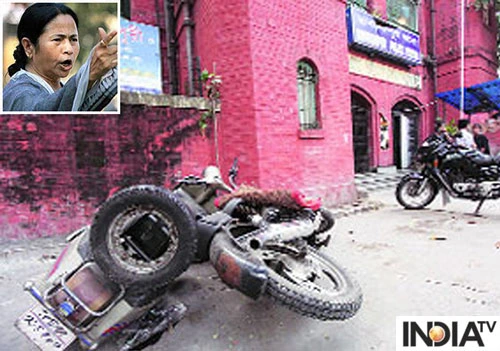
West Bengal chief minister Mamata Banerjee visited a Kolkata police station and forced the release of two of her party workers. Perhaps this is a record in the West Bengal politics, which has never happened in the past.
However, even the Left never reached the intensity of Mamata’s Protest Style. They certainly opposed central laws they disliked. Yet, at the same time, they eventually accepted them within the constitutional framework.
Therefore, they managed two things simultaneously. First, they mobilized public sentiment through protest politics. Second, they avoided directly challenging India’s federal structure. In other words, they understood how far opposition could go and where it should stop.
By contrast, Mamata Banerjee often appears to blur that line. She tends to push resistance to a level where the boundary between political opposition and constitutional confrontation becomes unclear.
History of Mamata’s Revolutionary Habit
Now, let us look back at the past.
1984 Shocking Victory
For most of her political career, Mamata Banerjee spent her time as an Opposition leader. In 1984, with the backing of Subrata Mukherjee, she received a Lok Sabha ticket from Jadavpur. That election brought her instant national attention.
She defeated the highly respected and experienced parliamentarian Somnath Chatterjee by around 15,000 votes. At that time, two major factors worked in her favor. First, there was the massive sympathy wave after the assassination of Indira Gandhi. Second, sections of the media played an aggressive and sensational role.
As a result, Mamata’s revolutionary political image began to take shape.
Jadavpur Defeat & Shift
However, the 1984 Jadavpur victory proved to be an exception. In the 1989 general election, she lost the same seat by over one lakh votes to CPI(M)’s new face, Malini Bhattacharya. After that defeat, she shifted to the safer Congress stronghold of South Kolkata and never returned to Jadavpur.
Mamata Means Headlines
From then on, Mamata became synonymous with Opposition politics.
- But Mamata meant drama.
- Mamata meant headlines.
- Mamata meant aggressive street movements.
- Also Mamata meant politics of dead bodies.
Politics of Protest
Whether it was the 21 July protests or the Singur land movement, she remained at the center of every major agitation. During the Singur movement against the Tata Nano project, she directly challenged the then CPI(M) government led by Jyoti Basu’s political legacy and later Buddhadeb Bhattacharjee’s administration.
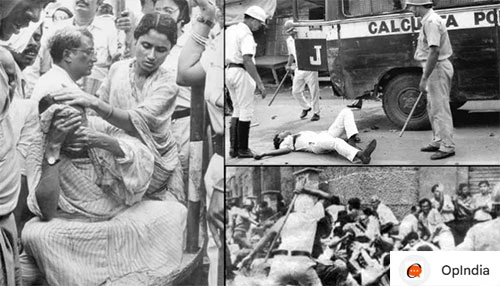
She built a political culture where she personally rushed to sites of unrest, even late at night or early in the morning. For example, during protests over slum eviction linked to the Tollygunge canal metro extension, she led intense agitations before eventually stepping back.
Moreover, her dramatic protest at Shyambazar five-point crossing, where she symbolically staged a noose protest against her own party leadership, remains etched in public memory.
Over time, a new style of politics emerged under her leadership, often described as “politics around the dead body.”
Whenever there was violence, unrest, or a controversial death, Mamata would be physically present. Undoubtedly, she worked tirelessly and maintained high visibility.
At the same time, her uncompromising anti-CPI(M) stance made her extremely popular. Furthermore, her simple lifestyle strengthened her mass appeal.
Therefore, Mamata’s Revolutionary Habit devised a different political persona that carved out a distinct place in public imagination.
Opposition vs Governance: A Critical Difference
However, the role of an Opposition leader and that of a ruling Chief Minister cannot be the same.
Opposing the Central government is one thing. Challenging constitutional institutions like the Election Commission is another. Yet, Mamata’s Revolutionary Habit often blurs that distinction.
Sometimes, it appears that her protest-driven style overshadows the fact that she holds a constitutional office, the Chief Minister, the administrative head of the state.
Moreover, Bengal’s long-standing attraction toward confrontational and negative political culture may also play a role in shaping this approach.
In conclusion, Mamata Banerjee’s revolutionary character helped her rise to power. However, the same instinct continues even in governance, where the rules of engagement are very different.
Where Is The Red Line?
Today, many critics raise eyebrows at Mamata’s present lifestyle or the use of helicopters. However, they often fail to understand her once simple and modest past.
In her early political days, Mamata Banerjee was known for her plain cotton sarees, simple living, and grassroots activism. Therefore, the contrast between her past image and present stature creates sharp political debate.
In many ways, it reflects the old saying, power changes people. In other words, the system often reshapes those who rise within it.
Election 2026: Final Test for Bengal?
However, beyond personal style or political symbolism, the bigger issue now lies ahead. The 2026 election is not just a challenge for Mamata Banerjee. Rather, it is equally a challenge for the people of Bengal.
This election will test leadership, governance, and political maturity. At the same time, it will force voters to decide what kind of political culture they want for the future. Whether they largely demand permanent confrontation or stable administration.
Therefore, 2026 is more than just another electoral contest. It is a defining political moment for West Bengal.
People Also Ask (PAA)
What is Mamata Banerjee’s “revolutionary habit”?
This usually refers to her habit of walking long distances (often 10–12 km a day) and her preference for a simple lifestyle—wearing cotton sarees and rubber slippers—despite her position of power. Some articles also use “habit” metaphorically to describe her history of “street fighting” and protesting as a revolutionary political tool.
How has Mamata Banerjee’s lifestyle influenced her politics?
Her “revolutionary” austerity serves as a political statement. By rejecting the luxury typical of high-ranking Indian politicians, she maintains a “mass leader” image that resonates with the rural and working-class voters of West Bengal.
Does Mamata Banerjee have any creative habits?
Beyond politics, she is a prolific painter and poet. She often creates artwork spontaneously, and the proceeds from the sale of her paintings have historically been donated to the party or for social causes.
Why is Mamata Banerjee called “Didi”?
“Didi” means elder sister in Bengali. The title reflects her “revolutionary” mother/sister figure persona in Bengal, positioning her as a protector of the household and the state’s interests.