Voter Rights: SC's Bold New Order 2026
Apr 18, 2026 - By Ashutosh Roy Current AffairsElection AnalysisPoliticsRegional UpdatesWest Bengal Politics
Aren’t Voter Rights Most Important in Democracy?
Voter Rights are the bedrock of any genuine democracy. Without a secure and inclusive path to the ballot box, the government loses its mandate from the people.
In West Bengal, the SIR 2026 has put these rights at the center of a historic legal battle. Though it might defeat the core purpose of Special Intensive Revision of Voter Lists. The landmark judgement of April 16 has taken us to the final countdown.
The recent intervention of the Supreme Court is a good initiative that aims to rescue millions from disenfranchisement. However, it also highlights a tough reality: for many, the Right to Vote has become a race against a clock that is ticking toward two final deadlines.
What Is the New Supreme Court Order?
The Court, led by CJI Surya Kant and Justice Joymalya Bagchi, recently invoked Article 142, the special oceanic power to ensure complete justice. This was just to bypass the usual rigid rules of the Election Commission.
Normally, once an election starts, the Election Commission freezes the voter list. No new names can be added, even if a judge says you are eligible.
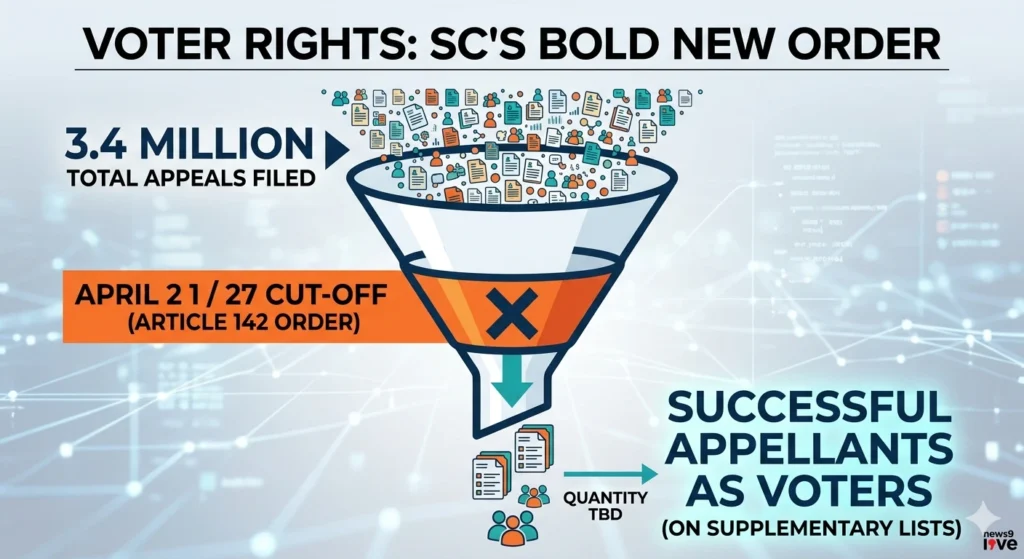
The Court broke this rule to protect Voter Rights. It ordered that if a citizen wins their appeal in an Appellate Tribunal; the Election Commission must add them to a supplementary list immediately. To make this work, the Court set two hard cut-offs:
- April 21: The final deadline for the first phase of voting, where the poll will be on April 23.
- April 27: The final deadline for the second phase of voting, where the poll will be on April 29.
The Impact: For the first time, the voter list remains alive until just 48 hours before the polls. If a tribunal clears your name by these dates, your Voter Rights are restored.
This is also worth mentioning that this is the 2nd instance where the Supreme Court had invoked Article 142 during the Bengal voter list controversy in Bengal Elections 2026.
Such a decision also may raise logistical complications mainly in hilly areas of West Bengal.
The 3.4 Million Appeal Crisis
The reason for this Bold Order is the massive scale of voter deletions during the SIR. Moreover, the goal was to clean the rolls of fake or duplicate entries. Unfortunately, the process was so wide reaching that millions were left out.
Should we blame the process only? What about the tug of war between the State Government and Election Commission that has made the situation even worse.
Key Statistics of the SIR 2026
- 9.08 Million: Names originally deleted from the West Bengal electorate.
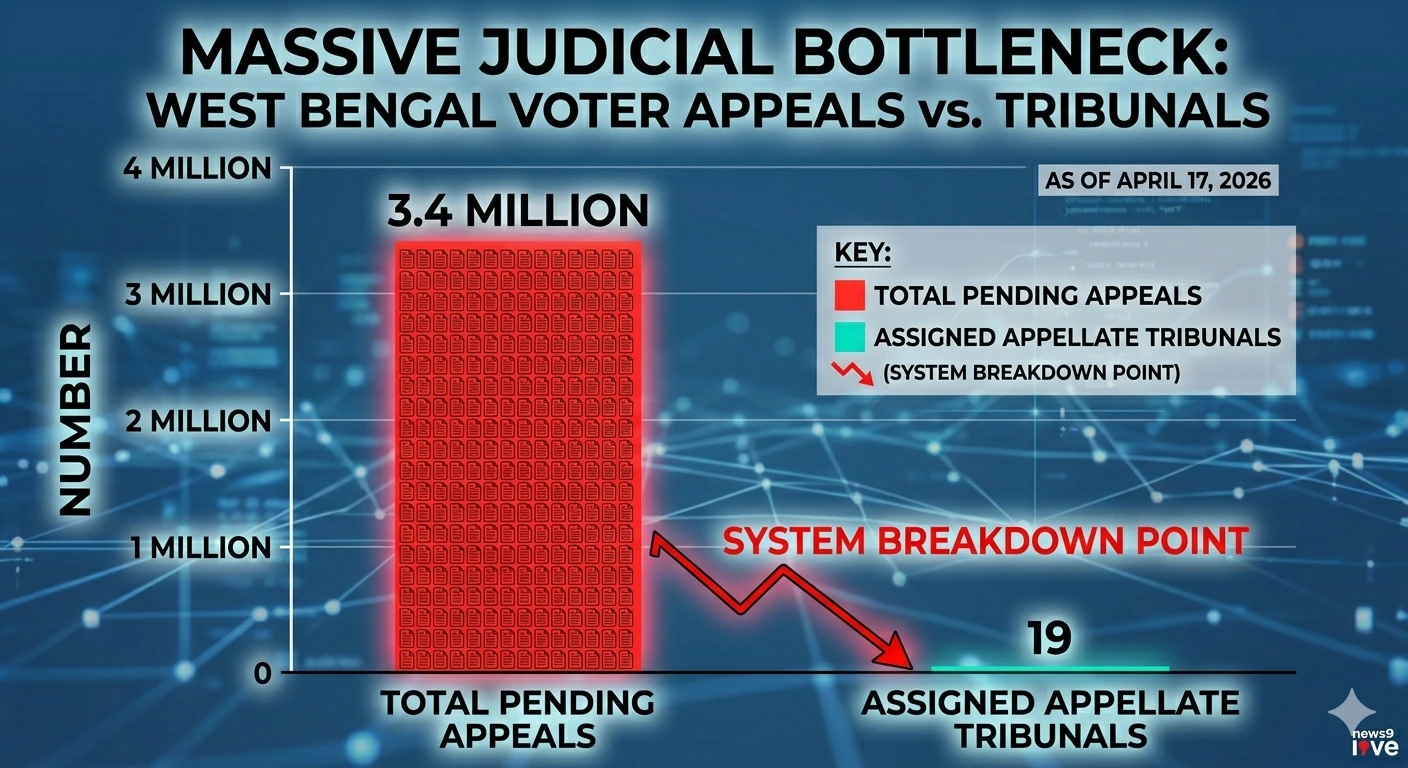
- 3.4 Million: Appeals currently filed by citizens fighting to get their names back.
- 19 Tribunals: The small number of judicial bodies tasked with hearing these millions of cases.
| Category | Data / Date | Note |
|---|---|---|
| Total Names Originally Deleted | 9.08 Million | Result of Special Intensive Revision (SIR) |
| Total Appeals Filed | 3.4 Million | Citizens fighting for their Voter Rights |
| Number of Assigned Tribunals | 19 | Judicial bodies tasked with processing 3.4M cases |
| Phase 1 Deadline (Cut-off) | April 21, 2026 | Final date for supplementary list (Phase 1) |
| Phase 2 Deadline (Cut-off) | April 27, 2026 | Final date for supplementary list (Phase 2) |
Why Not Wait for All Appeals to Finish?
It is a logical question: if Voter Rights are the key, why not pause the election until all 3.4 million appeals are heard? The Supreme Court explained that waiting for everyone would create an anomalous situation for three reasons:
- The Veto Problem: If the law required every address all appeals, a small group of people could block an election of the entire state simply by filing millions of frivolous appeals.
- Constitutional Deadlines: The Assembly term has a fixed end. Waiting 60 or 90 days for tribunals to finish would likely lead to a Constitutional Crisis, forcing the state into Article 356 or President’s rule.
- The Objector Issue: Not all appeals are from people wanting to vote. Many are from objectors trying to remove others. Allowing everyone to vote while their status is pending would let thousands of potentially fraudulent names stay on the list.
The Sandwich Effect on the Citizen
While the order is a good initiative, it creates a survival of the fastest situation. As Justice Bagchi noted, voters are sandwiched between the State and the Election Commission.
- The Benefit: Thousands of wrongly deleted voters now have a last-minute chance to speak up.
- The Risk: Administrative speed now dictates the pace of justice. Two citizens might have the exact same evidence, but if one’s file is at the top of the pile on April 21 and the other’s is at the bottom, only one gets to vote.
Keynotes on Constitutional Vacuum & Sandwich Effect of citizens
With due respect to the Indian judiciary, we ask a humble question: what is the real problem if a constitutional vacuum occurs? After all, the Constitution already provides a solution through Article 356.
Moreover, how much does it really matter to a common citizen whether elections take place under the supervision of Nabanna or Raj Bhavan? In most cases, ordinary voters care less about the authority in charge and more about the fairness of the process.
Therefore, aren’t voter rights far more important for democracy? Protecting every eligible voter’s right should remain the top priority in any democratic system.
Democracy faces a strange irony in the 2026 Bengal Elections. Both major rivals, TMC and BJP, decline to soar on the no vote issue until the appellate authority finishes the verification process.
A Mathematical Gamble for Democracy
The SC has effectively turned the election into a Middle Path compromise. They are prioritizing Election Finality (keeping the schedule) while trying to maximize Voter Rights (allowing late entries).The Bottom Line
Can Oppositions Outshine Mamata Banerjee’s Political Narrative?
Political analyst Biswanath Chakraborty recently analyzed the impact of the latest Supreme Court verdict. While Mustari Banu filed the original lawsuit and Bikash Bhattacharya led the legal battle, Mamata Banerjee is now claiming credit for the victory. She asserts that her dramatic appearance in court ensured the inclusion of the names.
Key Facts:
Legal vs. Political Victories: Mustari Banu and Bikash Bhattacharya of CPM did the heavy lifting in court.
The Power of Political Optics: Mamata Banerjee successfully shifted the political narrative to highlight her personal involvement.
Opposition Struggles: Both the CPM and Congress have failed to match the political branding and political optics generated by the Trinamool Congress.
In short, Mamata Banerjee has mastered the art of political messaging. Consequently, the opposition remains in her shadow despite their legal efforts.
Final Thoughts of Knowledge Mart
The Supreme Court has done something unprecedented to save our Voter Rights. They have forced a massive bureaucracy to stay flexible until the very last minute.
However, the concern remains the core of the issue: if we cannot guarantee every eligible citizen a vote because the clock ran out, is the key to democracy truly in the hands of the people?
For a deeper look at the legal mechanics, one can watch this News9 Live report . The video explains how the Court linked voting rights strictly to these final judicial outcomes.
Do you think the Election Commission should be forced to provide an After-Vote remedy for those whose appeals are cleared after the April 21/27 deadlines?
Finally, all citizens want a free and fair Bengal Elections 2026.
10 Key Takeaways:
- Voter Rights as the Priority: The Supreme Court (SC) reaffirmed that the Right to Vote is the heartbeat of democracy, prioritizing citizen inclusion over rigid administrative schedules.
- Use of Article 142: The Court invoked its extraordinary plenary powers under Article 142 to do complete justice, breaking standard election rules to protect disenfranchised citizens.
- Breaking the Statutory Freeze: Typically, ECI freezes voter lists as per the poll schedule in the announcement. This order thaws the list, allowing names to be added up until 48 hours before polling
- Two Critical Deadlines: The Golden Windows for inclusion are strictly set for April 21 (Phase 1) and April 27 (Phase 2).
- A Good Initiative with Limits: While the initiative is positive, it is a middle path. The Court refused to stop the entire election, choosing to balance Voter Rights with constitutional timelines.
- The 3.4 Million Barrier: There is a massive backlog of 3.4 million appeals. The success of these Voter Rights now depends entirely on the speed of the Appellate Tribunals.
- The Judicial Bottleneck: With only 19 tribunals to handle millions of cases, the math suggests a systemic breakdown where speed may compromise the depth of justice.
- Mere Pendency is Not Enough: The SC clarified that simply having a pending appeal does not grant the right to vote. A citizen must receive a final favorable order from the tribunal to be included.
- Prevention of Electoral Chaos: The Court move moves forward to avoid an anomalous situation where fraudulent entries or unresolved objections could compromise the integrity of the total vote.
- The Sandwich Crisis: Voters remain sandwiched between the aggressive revision of the state and the deadlines of the Election Commission, proving that a right dependent on administrative speed is a fragile one.
People Also Ask (PAA)
What is the Supreme Court’s order on West Bengal Voter Rights?
The Supreme Court invoked its extraordinary powers under Article 142 to protect Voter Rights. It ordered the Election Commission to include any citizen cleared by an Appellate Tribunal in a supplementary list. Consequently, these citizens can vote even if their names were previously missing or deleted.
Can I vote if my appeal is still pending in the tribunal?
No, you cannot vote simply because your appeal is pending. The Court explicitly ruled that mere pendency does not grant you the right to cast a ballot. Therefore, you must receive a conclusive, final order from the tribunal in your favor to exercise your Voter Rights.
What are the final deadlines to be included in the voter list?
The Court set two strict cut-off dates based on the election phases.
- For the first phase on April 23, the tribunal must clear your name by April 21.
- For the second phase on April 29, the deadline is April 27.
Authorities will publish the supplementary lists immediately after these dates.
Why did the Supreme Court refuse to delay the entire election?
The Court balanced individual Voter Rights with the need for constitutional stability. It argued that waiting for all 3.4 million appeals would cause a Constitutional Vacuum and potentially lead to President’s Rule. Additionally, the Court wanted to prevent electoral chaos caused by unresolved objections.
How many people were affected by the voter list deletions?
Reports indicate that over 9 million names were originally deleted during the Special Intensive Revision (SIR). Following this, approximately 3.4 million citizens filed appeals to restore their Voter Rights. This massive volume created a significant bottleneck for the 19 assigned Appellate Tribunals
[…]Voter Rights: SC’s Bold New Order 2026 Explore how the SC is protecting Voter Rights with a bold new order. Learn why the April 21 & 27 deadlines are the final key to the West Bengal elections.[…]
[…]Voter Rights: SC’s Bold New Order 2026 Explore how the SC is protecting Voter Rights with a bold new order. Learn why the April 21 & 27 deadlines are the final key to the West Bengal elections.[…]
[…]Voter Rights: SC’s Bold New Order 2026 Explore how the SC is protecting Voter Rights with a bold new order. Learn why the April 21 & 27 deadlines are the final key to the West Bengal elections.[…]