Ruined Mamata's Congress Alliance Sham
Jun 11, 2026 - By Ashutosh Roy Current AffairsNational NewsNational PoliticsPolitical IdeologiesPoliticsRegional UpdatesWest Bengal Politics
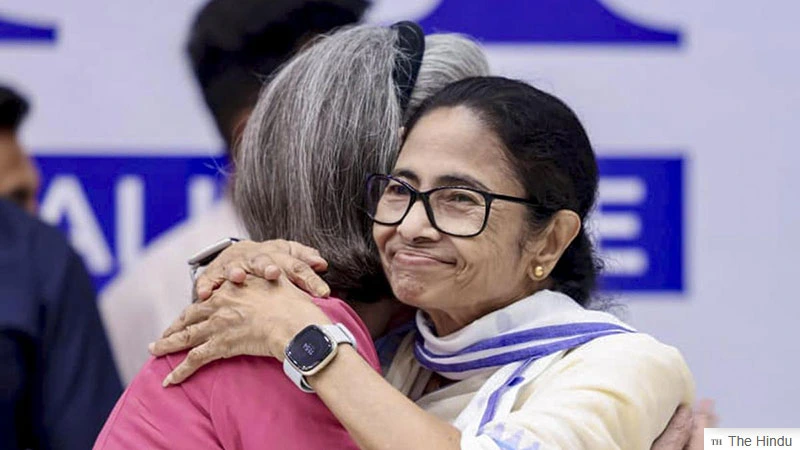
Why Is Mamata Banerjee Desperate for an Alliance?
Is Mamata’s Congress Alliance a Final Bid for Political Survival?
The aggressive push for Mamata’s Congress Alliance clearly proves that her back is against the wall. The fast-evolving West Bengal political landscape has left her completely isolated. Therefore, she is working night and day in New Delhi just to protect her fading relevance.
Many experienced analysts are shocked by this sudden desperation. However, history has a brutal way of catching up with politicians who switch allegiances. The structural reality of this crisis goes back to the very foundation of her party machine.
- The Origins: The Trinamool Congress (TMC) was originally born by fracturing the core vote bank of the national party.
- The Betrayal: Over the years, Mamata systematically delivered a deep political betrayal to Congress in Bengal to expand her own regional empire.
- The Present Reality: Today, the tables have completely turned on the ground.
The leader who once targeted Rahul Gandhi with constant, under-the-belt blows is now knocking on his door. Because she has lost her footing in the West Bengal Assembly, she has no choice but to seek shelter from the exact party she tried to destroy. Her survival depends entirely on this desperate political alignment.
The Breaking Point: A Mass Exodus Within TMC
The core structure of the party is collapsing from within. High-profile TMC leaders defecting to other camps show that her internal grip has shattered completely. The party is hemorrhaging its most recognizable faces daily.
| Leaving Leader | Former Role in TMC Camp | Current Status in Bengal Politics |
|---|---|---|
| Firhad Hakim | Kolkata Mayor & Longtime Close Aide | Resigned from post / Distanced from leadership |
| Sayani Ghosh | Youth Leader & Key Public Face | Abandoned the core Mamata faction |
| Sushmita Dev | Senior Rajya Sabha MP | Resigned and exited the inner circle |
| Mala Roy | Senior Lok Sabha MP | Shifted away from the collapsing core |
| Javed Khan | Veteran MLA & Core Minister Face | Left the centralized party command |
| JPrakash Chik Baraik | Former Minister in the Cabinet of Mamata Banerjee | Resigned from post |
Is the Faction Rebellion Empty Politics?
Mamata Banerjee and her nephew Abhishek Banerjee may loudly label these defectors as traitors. However, angry name-calling will not solve a massive existential crisis in Trinamool Congress. The numbers in the state assembly speak louder than public rhetoric.
Politics is ultimately the art of the possible. Labeling departing leaders as greedy opportunists might soothe internal anger, but it fails to stop the bleeding. The regular ground-level network of the party is vanishing into thin air.
The reality on the ground is grim. The crisis is so severe that Mamata and her nephew camped in Delhi for three straight days. Such a lengthy stay in the national capital is unprecedented for her over the last 15 years. It reveals an absolute panic regarding their regional power base.
Is the INDIA Bloc Ready to Trust Mamata Banerjee? | West Bengal Alliance Dynamics
The Deep History of Betrayal in Opposition Politics
Mamata Banerjee is no longer just begging for a Mamata’s Congress Alliance. She is now desperately talking about strengthening the national INDIA bloc alliance. However, her sudden change of heart faces deep skepticism among senior leaders in New Delhi.
Almost every major alliance partner has a common complaint: they view her as highly unreliable and prone to changing sides for personal gain.
Throughout her career, she has consistently abandoned opposition unity to indirectly benefit the ruling central government. Her past actions have left a paper trail that opposition strategists are currently reviewing with extreme caution.
- The Dhankhar Episode: Her decision to abstain from voting helped select Jagdeep Dhankhar as Vice President of India, shocking the opposition camp.
- Parliament Walkouts: Whenever the central ruling party faced legislative crises, her MPs managed to walk out or remain absent, ensuring crucial bills passed easily.
- Loss of Ground: Undeniably, Mamata maintained a powerful, independent image in New Delhi for years by single-handedly defeating aggressive opposition forces within West Bengal. Today, however, she stands completely isolated in her own homeland.
Isn’t it the Belated Regrets of the Aunt-Nephew Duo?
The voters of West Bengal did not just reject the party machinery. Now, a massive wave of TMC MPs and MLAs rebelling from within has stripped away her authority.
The administrative machinery has ground to a halt under the weight of this mutiny.
Perhaps Mamata is privately reflecting on her choices. Following her direct election defeat to Suvendu Adhikari in her home turf of Bhabanipur, a peaceful resignation would have preserved her democratic dignity.
Instead, she chose aggressive political denial and high drama.
Similarly, her nephew Abhishek Banerjee might regret his high-handed management style. For years, he forced grassroots regional leaders and senior ministers to wait outside his office for hours.
A little basic respect could have prevented this historic mutiny. Unfortunately, this realization comes far too late to salvage their political dynasty.
National Perspective: Abhishek Manu Singhvi Slams “Immoral” Defection Politics
As state-level alliances fracture, the conversation surrounding political floor-crossing has gained massive national traction.
Highlighting this systemic crisis, senior Congress MP and eminent jurist Abhishek Manu Singhvi shared his explicit views on the normalization of defection politics during an exclusive interview with Rajdeep Sardesai on India Today.
- Erosion of Ideology and Morality: Singhvi strongly criticized defecting lawmakers, stating that elected members are switching parties with absolute disregard for their core ideologies and political moralities. He pointed out that these switches are driven entirely by a toxic mix of personal greed, structural pressure, and fear of central enforcement agencies.
- Systemic Attack on Democracy: Holding the ruling dispensation accountable, the veteran jurist directly blamed the BJP for initiating and systematically engineering these unethical movements across multiple states. According to Singhvi, this manufactured engineering of legislative majorities operates completely against the fundamental spirit of Indian democracy.
Consequently, Singhvi’s national critique perfectly mirrors the chaos visible in regional parties.
The fact that top legal minds are now calling for a complete overhaul of the anti-defection law underscores that the internal revolts seen across state capitals are part of a much larger, deeply troubling national trend.
The Irony of Begging for Survival at Sonia and Rahul Gandhi’s Doorstep
Whether Mamata’s Congress Alliance succeeds is a secondary question. The real narrative is the psychological humiliation. How does it feel for a proud regional leader to beg for survival before Sonia Gandhi and Rahul Gandhi?
History remembers her harsh public statements and deliberate sabotage of opposition campaigns across the country. She left no stone unturned to diminish the national party’s standing.
- The TRP Booster: Mamata previously claimed that Rahul Gandhi acted as the biggest television rating point (TRP) booster for the ruling government.
- National Sabotage: Both Mamata and Abhishek actively ran aggressive campaigns in states like Tripura, Meghalaya, and Goa to fracture the anti-establishment vote share.
- Identity Crisis: Their campaigns directly damaged the Congress national campaign and guaranteed easy victories for their opponents, as reported by national outlets.
Today, the Trinamool Congress presence has been completely wiped out in those outer states.
More importantly, if the party is completely hollowed out in its birthplace of Bengal, the title “All India Trinamool Congress” becomes a literal joke.
Public trust has dissolved completely.
Is Mamata’s Congress Alliance Just a Strategic Rumor?
Can the Closed-Door Secrets of the New Delhi Meetings Become Public?
When the top leadership of two major political entities meets in absolute privacy, the details remain highly speculative. Only a microscopic inner circle and a few selected, highly trusted media professionals ever get access to the truth.
The entire narrative regarding a shared platform might just be a calculated media leak designed to buy time from investigating agencies.
However, the media ecosystem in Bengal has completely fractured. Following the massive collapse of the party, top pro-establishment media faces have been forced to step down in quick succession.
- Media Exits: The dramatic exits of prominent editors like Anindya Jana from Anandabazar Patrika show the shifting ground reality.
- The Media Shift: Similarly, the removal of loyalist voices from platforms like Sangbad Pratidin proves that the old guard has lost its narrative control.
- Source Shift: Today, it is highly doubtful if a single loyal journalist remains in her corner. Observers must rely entirely on sources close to the Congress national leadership for accurate updates.
Why Does Abhishek Banerjee Find New Delhi Safer Than Kolkata?
There is a deeper, highly practical reason behind their unprecedented stay in the national capital. A major shift in the state machinery has triggered panic.
The West Bengal CID investigation, now acting under the new administrative reality post-elections, is aggressively issuing summons and conducting rapid raids against Abhishek Banerjee.
For the nephew, New Delhi offers a strategic psychological shelter. In the capital city, he is protected from the direct public anger and physical humiliation, like facing hostile crowds or flying insults, that awaits him on the streets of Kolkata. The fear of public backlash is real.
Furthermore, as long as Mamata Banerjee is physically present alongside him in Delhi, it becomes legally and operationally complicated for the state CID team to simply fly in from Kolkata and execute a sudden arrest.
They are desperately waiting for an interim protection or legal stay order from the Calcutta High Court before they can safely return home.
However, the High Court has finally ordered that Abhishek has to attend CID on 11 June 2026 by 6PM, and a complete cooperation can save him from arrest for 2 weeks.
The Inner Circle Fractures: Kalyan Banerjee Drops Abhishek
The internal rebellion within the West Bengal political landscape has reached a critical boiling point. In a shocking development, Serampore MP Kalyan Banerjee, one of Mamata Banerjee’s oldest and most prominent loyalists—officially announced his complete withdrawal from all court cases representing Abhishek Banerjee.
- The Legal Walkout: The veteran leader has officially dropped all defense strategies and briefs tied to the nephew, leaving him legally exposed amid ongoing West Bengal CID investigation raids.
- Exposing Internal Arrogance: Instead of exiting quietly, the senior TMC leader openly blamed his resignation on the unyielding arrogance and consistent misbehavior of Abhishek Banerjee.
- Unshaken Loyalty to Mamata: Notably, the Serampore MP strictly targeted the nephew’s high-handed leadership style, deliberately pointing no blame or criticism toward Mamata Banerjee herself.
Consequently, this legal desertion proves that the anger driving the historic Trinamool Congress mutiny is directed squarely at the younger leadership.
By walking away, one of the family’s strongest legal shields has made it clear that even the most dedicated loyalists refuse to tolerate the nephew’s behavior.
The Illusion of New Delhi Political Meetings: TMC’s Strategic Push
Staying camped out in Delhi without any public activity would openly broadcast their absolute political defeat. To avoid looking completely stranded, they are using meetings with Congress to project an illusion of relevance.
They are knocking on the doors of Congress because it is the only stable national institution left standing that can offer them a political platform.
| Allied Political Entity | Current Power Dynamics & Support Status | Security Level Against State Police Action |
|---|---|---|
| Congress Top Leadership | Holds the core national opposition anchor; acts as a symbolic shield for regional refugees. | Moderate Protection: Offers a major media platform but cannot block state legal warrants. |
| Hemant Soren (JMM) | Maintains a sympathetic regional stance within the neighboring Jharkhand borders. | Failed Buffer: Bengal Police recently crossed state lines into Jharkhand to arrest a key MLA. |
Their search for regional allies has hit severe practical roadblocks. While they look toward leaders like Hemant Soren in Jharkhand for a mutual safety net, the reality of police power has broken all boundaries.
The aggressive state police machinery recently marched straight into Jharkhand, tracked down a defected MLA, and brought him back in custody. Boundaries can no longer guarantee protection.
The Jalsaghar Mentality: Prioritizing Personal Survival Over the Party
Even though their political empire has collapsed and the crown is officially gone, the aristocratic arrogance remains untouched.
Their behavior perfectly mirrors the proud, delusional protagonist in Satyajit Ray’s classic masterpiece Jalsaghar , clinging blindly to old elite grandeur while the castle crumbles into the dust around them.
Ultimately, this desperate pursuit of Mamata’s Congress Alliance reveals a selfish truth. For both Mamata and Abhishek, personal survival and avoiding immediate legal imprisonment have become infinitely more important than saving the remnants of the Trinamool Congress party machinery.
They are fully prepared to sacrifice the party’s future if it buys them temporary safety from the law. Their priority is clear: self-preservation over institutional loyalty.
Will the Congress Leadership Accept Mamata’s Terms?
The Democratic Shift Within Rahul Gandhi’s High Command
Unlike the era of the Indira Congress, where major state decisions were aggressively imposed from above, Rahul Gandhi follows a strict protocol.
He summons state-level units to New Delhi and consults local leaders before finalizing any major regional pacts. This internal democracy makes things incredibly difficult for outsiders.
Given the current mood of the West Bengal Pradesh Congress leadership, accepting Mamata Banerjee seems almost impossible. Deep political wounds remain fresh in the minds of the state unit:
- The Jhalda Capture: Local party workers still remember the violent capture of the Jhalda Municipality by the regional ruling camp.
- The Poaching History: They still hurt from the controversial defection of Bayron Biswas, who won on a Congress ticket only to be poached by Mamata’s camp shortly after.
- The Grassroots Anger: District leaders refuse to share a stage with the leadership that organized their political marginalization for over a decade.
The Structural Roadblocks in the Congress Working Committee
In addition, veteran leader Adhir Ranjan Chowdhury holds a powerful position within the Congress Working Committee (CWC). He remains a completely uncompromising, fierce anti-Mamata voice in national politics.
Any proposal regarding a formal pact must pass through this critical committee structure, ensuring his veto remains effective.
Therefore, the ongoing media rumors suggesting that Mamata could be appointed as a National Vice President or Abhishek as a General Secretary of Congress face massive internal resistance.
Nationally, the primary goal remains building a joint front against the BJP. However, analysts must evaluate the actual value of Mamata’s Congress Alliance. What percentage of the vote share can a severely diminished leader bring to the table?
Today, the public has completely abandoned her and her invincible image has gone to dust. Her direct defeat to Suvendu Adhikari in her home turf proves that she holds no real bargaining power left.
She is entering negotiations with an empty hand, trying to trade on past glory rather than current strength.
Was Mamata Ever Courteous Towards Congress?
| Year / Date | Event | What Mamata Did | Impact on Congress |
|---|---|---|---|
| 1998 | Formation of Trinamool Congress | Broke away from Congress and formed AITC | Split anti-Left vote base in West Bengal; long-term weakening of Congress |
| 1999-2004 | Alliance Shifts | Aligned with BJP-led NDA at various points | Congress lost a crucial regional ally; Mamata emerged independently |
| 2009-2011 | Congress-TMC Alliance | Partnered with Congress to defeat Left Front | Congress helped TMC rise but later became politically marginalised |
| 2011 | End of Left Rule in Bengal | Became Chief Minister after historic victory | Congress reduced to junior partner, then lost relevance in the state |
| 2014-2019 | TMC Expansion | Strengthened control over Bengal politics | Congress vote share and organisational strength collapsed |
| December 2021 | “No UPA” Remark | Declared that UPA no longer exists | Direct challenge to Congress leadership at national level |
| 2023 | INDIA Bloc Friction | Disagreements over leadership and coordination | Weakened opposition unity; Congress leadership questioned |
| 2024 Lok Sabha Elections | Seat-sharing Breakdown | Refused alliance with Congress in West Bengal | Opposition vote split; Congress prospects hurt |
| 2025-Early 2026 | Solo Political Strategy | Continued independent stance in Bengal | Congress remained marginal in state politics |
| May-June 2026 | TMC Internal Crisis | Faced rebellion, defections, and internal split | Congress faced dilemma, whether to support or compete |
| June 2026 | Renewed Proximity to Congress | Met Sonia Gandhi and Rahul Gandhi | Congress seen as fallback option; dependency narrative emerged |
| June 2026 (Ongoing) | Merger Speculation | Rumours of closer ties or merger floated | Risk of credibility loss for Congress if it absorbs weakened TMC |
Will the Congress High Command forget all the previous historic events before exploring Mamata’s Congress Alliance?
Will a Merger with Trinamool Congress Benefit Anyone?
While a loose local seat-sharing arrangement is a distant possibility, a complete political merger is practically impossible. What exactly does the central command gain by merging with a collapsing regional entity?
The math simply does not add up for the national leadership.
| TMC Faction Group | Elected Assembly Strength | Elected Parliament Strength |
|---|---|---|
| Ritabrata Banerjee Rebel Bloc | Grown rapidly from 58 to 64 MLAs in the House. | 20 out of 29 Lok Sabha MPs aligned in New Delhi. |
| Mamata Banerjee Core Group | Reduced to a minor, shrinking pocket of loyalists. | Facing ongoing, rapid daily desertions. |
In a healthy democracy, numbers dictate absolute power. The rebel faction led by Ritabrata Banerjee has already expanded its numbers significantly.
Meanwhile, prominent public faces are rapidly shifting away from the core team. A merger yields nothing because the grassroot numbers have already shifted to the rebel camp, leaving the old leadership powerless.
Moreover, Why would Congress willingly associate itself with Mamata’s growing unpopularity to ignite the Mamata-in-Congress fantasy Rather, Mamata Banerjee has always proved herself to be a troublesome ally or cadre to the leadership?
Sonia Gandhi’s Nostalgia vs. Rahul Gandhi’s New Vision
The final remaining possibility is admitting Mamata and Abhishek into the party purely as individual members. However, this immediately brings up the massive issue of historical credibility. How can Sonia Gandhi or Rahul trust a leader who publicly attacked them for years?
Mamata routinely questioned why central agencies like the CBI and ED never targeted the top national leaders, subtly implying a secret understanding with the ruling government.
This rhetoric damaged the credibility of the opposition front for months.
Historically, Mamata’s early political rise occurred during the era of Rajiv Gandhi, whose personal affection and support toward her were well known. Under his guidance, she gained leadership of the Youth Congress and secured a safe parliamentary seat in South Kolkata.
Because of these deep historical roots, Sonia Gandhi may still hold a soft spot for her. Today, however, the real organizational power rests entirely with the new generation.
The leader who repeatedly refused to accept Rahul’s leadership is now forced to submit to his authority. Whether the high command chooses to accept this ultimate surrender remains the biggest question in national politics.
FAQ: Inside the 2026 Trinamool Congress Crisis
Why did Mamata’s Congress Alliance become necessary in 2026?
The alliance became a survival necessity after the disastrous May 2026 West Bengal Assembly elections. The massive defeat shattered her image of regional dominance and sparked an immediate internal mutiny among elected representatives.
How big is the rebellion inside the TMC camp?
The rebellion is historic and structural. Expelled leader Ritabrata Banerjee won the support of 58 out of 80 TMC MLAs to break away and become the official Leader of the Opposition. Furthermore, a massive group of 20 out of 29 TMC Lok Sabha MPs rebelled in Delhi to form a separate legislative front, completely crippling the party’s strength in Parliament.
What does this mean for the future of the party?
Because her grassroots power base in West Bengal has collapsed, entering into Mamata’s Congress Alliance is her absolute final shield against total political erasure. Without it, the remnants of her organization face complete absorption or dismantling by state authorities.
The Final Chapter of an Absolute Political Empire
From a Street Fighter to a Collapsing Autocrat
Ultimately, we are witnessing the final, tragic chapter of a unique political journey. The fast-moving events in New Delhi and West Bengal indicate that the story of an ordinary, grassroots street fighter who gradually transformed into an autocrat is reaching its definitive conclusion.
This major shift in the West Bengal political landscape shows how rapidly absolute power can dissolve when the public turns away.
For decades, her entire political identity was built on defiance, grit, and an unyielding connection with the common masses.
However, over the years, that grassroots connection was systematically replaced by centralized control, high-handed police administration, and severe internal arrogance.
Today, that very structure has shattered from within, leaving her completely stranded in national politics.
The Structural Collapse of the Authoritarian Core
The desperate pursuit of Mamata’s Congress Alliance is not a sign of statesmanship; it is the ultimate symptom of an administrative breakdown.
When a regional leader relies entirely on a centralized power structure, the system cannot sustain a major electoral shock.
| Phase of Power | Core Operational Strategy | The Final Real-World Outcome |
|---|---|---|
| The Rise (1998-2011) | Aggressive street struggles, mass mobilization, anti-establishment wave. | Successfully ended 34 years of Left Front rule in West Bengal. |
| The Peak (2011-2025) | Absolute centralization of power, systematic destruction of opposition parties. | Created a deep internal vacuum and widespread public resentment. |
| The Collapse (2026) | Unprecedented mass party desertions, active state agency raids, running to New Delhi. | Forced to beg for shelter at the doorstep of Rahul Gandhi. |
This systematic decline proves that in a democracy, no individual can remain permanently above the system. The very state machinery and police administration that were once allegedly used to crush political opponents have now turned their focus toward the inner circle.
The rapid West Bengal CID investigation and ongoing raids against her nephew have triggered absolute panic in the camp, forcing them to spend days isolated in the national capital.
The Historic Irony of Absolute Political Isolation
The ultimate tragedy of this decline is the complete loss of political dignity.
A leader who once proudly claimed that she would rule Bengal independently and expand her footprint across India has been reduced to a secondary applicant before the Congress national leadership.
Her long-term strategy of weakening the anti-establishment vote share to help opponents outside Bengal has backfired completely, erasing her presence in states like Goa and Tripura.
As the remaining days of this historic crisis unfold, the political circle is complete. The party that was built on the betrayal and fragmentation of Congress is now desperately trying to dissolve into it just to guarantee personal immunity from legal arrest.
Whether the high command accepts this surrender or leaves them to face the law, one truth is undeniable: the era of absolute regional dominance in Bengal has officially come to an end.
10 Key Takeaways: Inside the Trinamool Congress Crisis
- Bid for Political Survival:: The push for Mamata’s Congress Alliance is a desperate final attempt by Mamata Banerjee to protect her fading relevance after total isolation in the West Bengal political landscape.
- Historical Irony of Betrayal: The current surrender completely reverses history, as the Trinamool Congress (TMC) originally built its entire regional empire by systematically destroying the Congress vote bank in Bengal.
- Mass Factional Exodus: The core party structure is collapsing from within due to a historic wave of high-profile TMC leaders defecting, including key faces like Firhad Hakim, Sayani Ghosh, and Mala Roy.
- Loss of Assembly Control: Grassroots legislative power has shifted to a powerful rebel bloc led by Ritabrata Banerjee, which now commands an independent faction of 64 MLAs in the state assembly.
- Parliamentary Collapse: The crisis has entirely crippled the party’s footprint in New Delhi, with an unprecedented 20 out of 29 TMC Lok Sabha MPs breaking away from the central command.
- Deep Trust Deficit: National opposition partners remain highly skeptical of her role in the INDIA bloc alliance, remembering how she repeatedly abstained from critical parliamentary votes to benefit the ruling government.
- Evading State Agencies: The lengthy stay in New Delhi is a tactical move to use Mamata as a physical shield against aggressive West Bengal CID investigation summons and raids targeting Abhishek Banerjee.
- Local Congress Veto: The fierce anti-Mamata stance of local leaders like Adhir Ranjan Chowdhury creates a massive roadblock, as the state unit refuses to forgive past betrayals like the Jhalda municipality capture.
- National Ambitions Erased: Aggressive expansion campaigns in Goa, Tripura, and Meghalaya backfired completely, wiping out the party’s outer footprint and turning the “All India” title into a literal joke.
- Self-Preservation Over Party: The desperate negotiations reveal that securing personal immunity from legal arrest from Rahul Gandhi’s High Command has become far more important to the duo than saving the actual TMC machinery.
[…]Ruined Mamata’s Congress Alliance Sham Mamata’s Congress Alliance exposes her ultimate desperation. After destroying the party for decades, a ruined Mamata Banerjee now begs them for survival.[…]