Education System in West Bengal: The Crisis
Oct 25, 2026 - By Ashutosh Roy EducationPoliticsWest Bengal Politics
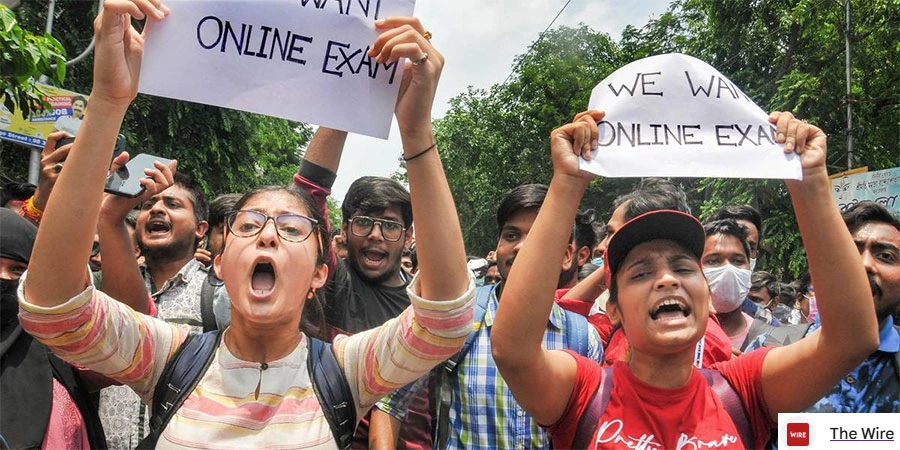
What is the crisis in the education system in West Bengal?
Education system in West Bengal is buckling under heavy political interference, massive hiring scandals like the WBSSC scam, and widespread administrative stagnation across state universities. With cash-for-jobs schemes freezing teacher appointments, over 7,000 primary schools have shut down while vacancies pile up. Frustrated by delayed academic calendars and stalled hiring, students are leaving the state in record numbers to study and build careers elsewhere.
Revamp the Education System in West Bengal Today
What goes through your mind when you turn on the TV and see qualified teachers—people with seven or eight years of experience—standing in protest rallies and getting hit with police lathis? How does it feel to watch qualified, unemployed youth loitering in the streets with nowhere to go? Or to read about a state university operating without a dedicated campus, without full-time faculty, or even without a permanent registrar or controller? Doesn’t it carry a deeply negative impression about the Education System in West Bengal?
For over two centuries, Bengal stood at the center of modern learning in South Asia. Figures like Raja Ram Mohan Roy, Ishwar Chandra Vidyasagar, Ashutosh Mukherjee, Rabindranath Tagore established the foundations of public instruction, while pioneering centers like Calcutta University and Santiniketan set academic standards for the entire country. That reputation was built on rigorous scholarship, institutional autonomy, and respect for genuine merit.
Today, however, that foundation has eroded. Decades of steady political meddling, deep-seated corruption, and administrative neglect have dismantled what was long a source of immense pride. We have watched the transformation from Anilayan to Mamatayan in the Education System in West Bengal.
Walk through neighborhoods in Kolkata, Siliguri, or Kharagpur, and you will hear parents sharing the same quiet anxieties. Families who once trusted local government schools and state degree colleges are now scraping together savings to send their children to other states. The basic promise—that hard work and good marks bring a fair chance at building a life in West Bengal—no longer holds. A system that once helped ordinary families move up in the world has instead collapsed into court battles, political patronage, and widespread decay.
Cash for Classrooms: The Recruitment Scandals
The clearest sign of this institutional breakdown is the West Bengal School Service Commission (WBSSC) recruitment scam. Teaching jobs—once viewed as respected middle-class professions—were turned into political commodities bought and sold for cash.
The details uncovered were staggering: widespread tampering of OMR answer sheets, Enforcement Directorate raids uncovering mountains of seized cash on live TV, and influential political figures sent to jail.
Even the administration has seized huge cash and lavish room inside the college premises. Imagine, how had the past administration been blind under Mamata Banerjee regime.
When the courts stepped in to strike down thousands of fraudulent appointments, the impact hit classrooms and families immediately. Qualified candidates who had cleared selection tests fairly ended up staging years-long protests on Kolkata’s streets near the Gandhi Statue and Exide crossing, enduring scorching summers and heavy monsoons while faith in state-run schooling broke down completely.
The disruption didn’t end with secondary schools; corruption in primary teacher appointments brought over 30,000 posts under Supreme Court scrutiny, creating the grim reality of former ministers remaining in custody while cash-counting machines tallied bribe money on evening news broadcasts. Can there anything more gloomy picture of Education System in West Bengal?
Policy Paralysis: Universities or Schools?
While official announcements and political speeches highlight new university declarations and administrative expansion, the ground reality is starkly different: more than 7,000 primary schools across West Bengal have closed in recent years due to vanishing student enrollment or crumbling facilities.
In between, corrupt teacher transfer practices created deep imbalances—leaving some schools packed with students but almost no teachers, while staff in suburban schools sit in near-empty classrooms with few pupils left to teach.
In rural blocks across Purulia, Bankura, and the Sundarbans, single teachers struggle to instruct four or five different grades together in a single room. Elsewhere, educated candidates who spent years preparing for competitive recruitment exams watch their eligible age limits expire while waiting for courts to untangle frozen hiring lists.
The real cost of this breakdown extends far beyond court dockets—it rests inside thousands of households where educated young adults are stranded in forced career stagnation. However, the new BJP Government has committed to bring about some revolutionary changes in the education system of West Bengal.
Empty Campuses and Administrative Deadlock
Beyond primary and secondary schools, Bengal’s higher education ecosystem suffers from administrative paralysis. Major universities became the primary arena for a bitter political deadlock between the State Executive at Nabanna and Raj Bhavan. This power struggle over Vice-Chancellor (VC) appointments left more than two dozen state-aided universities operating without permanent, legally appointed leadership for years. Does it reveal that the education system in West Bengal remains healthy at all?
Beyond administrative stalemates, basic infrastructure remains missing. Several newly announced universities exist mostly on paper, lacking dedicated campus buildings, full-time professors, registrars, or controllers of examination.
Previous attempts by the state administration to bypass central guidelines and the Chancellor’s authority led to unilateral appointments that were struck down by the High Court and subsequently declared invalid by the Supreme Court. Though the former Chief Minister had talked of multiple alternative plans in Netaji Indoor stadium, the fact of life remains that they are still waiting with uncertainty.
Although the government passed the Teacher Transfer Bill 2026 for university professors, directing that energy toward constructing proper infrastructure and recruiting permanent staff would have done far more to address institutional decay.
Across district colleges, entire academic departments operate with only one full-time professor—or none at all—leaving higher education heavily reliant on part-time State Aided College Teachers (SACT) who carry full teaching workloads without the job security, standard pay scales, or research backing granted to permanent faculty.
How it affects the entire Education System in West Bengal?
This neglect has left hundreds of thousands of undergraduate seats vacant across the state year after year. Admission delays in 2025 forced students to look elsewhere, with many choosing private institutions or moving to other states. In a notable shift, applicants now frequently choose private engineering colleges over premier state institutions like Jadavpur University.
The government was even forced to reopen college admission portals as late as September 2026—an unusually late timeline under the semester evaluation framework that compresses classroom instruction and disrupts academic schedules.
To make it even worse, campus democracy remains suspended, with student union elections on hold for over seven years, replacing elected student leadership with local political control. When asked on a television program, the new education minister stated that student elections would resume once attendance returns to campuses.
When higher education institutions rely permanently on temporary leadership, the damage spreads across every level of academic life. Library budgets are frozen, doctoral research proposals linger without statutory committee reviews, and international research grants bypass state institutions in favor of universities with stable management. The institutional autonomy that once enabled places like Jadavpur University and Calcutta University to drive groundbreaking research has been eroded by daily administrative uncertainty.
Incidents such as outside groups associated with the ABVP vandalizing a university logo highlight the weakness of the local administrative response. When local MLA Shorbori Mukherjee defends these actions while calling for police action against former SFI leaders, it demonstrates political maneuvering rather than effective governance. The ABVP has also forced a Law College Vice Principal to resign.
The Student Exit and Long-Term Consequences
The combined weight of hiring scams and university paralysis has severely disrupted the state’s talent stream. What was historically celebrated as an environment that nurtured scholars, scientists, and writers has been replaced by administrative stagnation and political influence.
This widespread departure of young people stems directly from persistent recruitment fraud and thousands of unfilled faculty posts across state universities. As degree programs face court delays and administrative uncertainty, employers and outside institutions increasingly view state-issued degrees with skepticism. Consequently, ambitious students are moving to educational hubs in southern and western India in search of predictable academic schedules and job opportunities.
Some students have even moved to neighboring states like Uttar Pradesh for specialized courses like agricultural studies. This steady outflow deprives West Bengal of the skilled workforce required to support local industry and development.
This ongoing migration carries distinct long-term risks:
- Mass Student Exodus: Fearing invalid degrees, delayed examination cycles, and poor job prospects, high-performing school-leavers are migrating in record numbers to education hubs in Southern and Western India—like Bengaluru, Pune, Hyderabad, and Delhi NCR—or going abroad for basic undergraduate programs.
- Loss of Meritocracy: The shift away from open, merit-based selection forces young academics to choose between political alignment or seeking opportunities outside West Bengal, leaving local classrooms short of dedicated educators.
- Economic and Social Consequences: As educated young adults leave, the state faces a shrinking skilled workforce. Private companies hesitate to establish corporate offices or research centers in a market where higher education degrees face legal scrutiny and public schooling is disrupted by court cases.
The financial impact of this migration extends beyond individual households. When thousands of students leave Bengal every year, they take spending power, family savings, and future tax revenues with them. Outside education centers benefit from Bengal’s talent pool, while West Bengal’s rental housing, local markets, and service sector lose out on the economic activity generated by a strong student population.
A Concrete Roadmap to Reclaim Bengal’s Educational Integrity
Fixing the education system in West Bengal cannot happen through piecemeal announcements, temporary transfer bills, or short-term promises during election campaigns. It requires a thorough overhaul aimed at restoring institutional autonomy, transparency, and public confidence. If the state intends to rebuild its academic foundation, four key steps should be taken:
1. Depoliticize Appointments and Restore Statutory Autonomy: Vice-Chancellors, registrars, and college principals must be selected strictly through independent search committees composed of respected academics and experts, following established UGC norms without executive intervention. University syndicates and governing bodies must be freed from local political influence so they can make decisions based purely on academic merit.
2. Complete Digital Transparency in Teacher Recruitment: To rebuild faith in the West Bengal School Service Commission and Primary Education Board, all future recruitment drives must adopt end-to-end digital auditing. OMR sheets should be digitized and uploaded to public portals immediately after examinations, and interview marks must be published alongside candidate rank lists in real time to prevent back-door tampering.
3. Regularize College Faculty and Invest in Infrastructure: Higher education cannot survive on the backs of underpaid part-time teachers alone. The state must convert vacant sanctioned positions into permanent full-time faculty posts, streamline the College Service Commission (WBCSC) hiring timeline, and ensure every state university has a functional campus with proper laboratory facilities, libraries, and administrative staff before announcing new paper institutions.
4. Revive Campus Democracy and Student Representation: Holding regular, peaceful student union elections is essential for restoring a healthy academic atmosphere. Democratic student representation gives voice to real campus issues—like hostel conditions, library hours, and fee structures—while breaking the hold of un-elected political muscle on college grounds.
The current situation presents a serious challenge for the region. Rebuilding West Bengal’s education system requires immediate, practical reforms to protect classroom quality and ensure young people have reliable opportunities within the state.
Knowledge Mart Final Thoughts
Rebuilding the Education System in West Bengal is no longer a matter of policy debate or administrative routine—it is an urgent social necessity. A state that once set the standard for academic excellence across South Asia cannot afford to leave its younger generations stranded in an environment shaped by hiring delays, administrative stalemates, and endless court battles. Every vacant faculty post, every closed primary school, and every delayed academic session chips away at the trust families place in state institutions.
The solution does not lie in superficial fixes, political posturing, or late-stage admissions drives. Real recovery demands a total commitment to meritocracy, strict digital transparency in teacher recruitment, and the complete depoliticization of higher education leadership. Institutional autonomy must be restored to state universities, permanent teaching posts must be filled through fair evaluations, and campus democracy must be revived to give students a meaningful voice.
West Bengal’s greatest historic strength has always been its intellectual potential. If state authorities and policy leaders take decisive action today to fix these core vulnerabilities, the Education System in West Bengal can regain its integrity, stem the departure of young talent, and offer future generations the quality learning environment they deserve.
Key Takeaways on the Crisis Bengal’s Education System
- Systemic corruption in the West Bengal School Service Commission (WBSSC) led to the unprecedented cancellation of nearly 25,000 teaching and non-teaching appointments after courts confirmed large-scale fraud and OMR sheet tampering.
- The primary school sector faced severe judicial scrutiny when over 30,000 recruitment cases were dragged to court, exposing widespread manipulation in entry-level state hiring practices.
- Massive cash seizures by investigative agencies resulting in the imprisonment of high-ranking political figures completely shattered public trust in state-run education governance and Education System in West Bengal.
- Persistent institutional neglect forced the shutdown of more than 7,000 primary schools, leaving vast rural stretches without functional public elementary facilities.
- Extreme teacher allocation imbalances plague rural and suburban districts, leaving many schools understaffed despite high student counts while others operate with teachers in empty classrooms.
- Higher education remains paralyzed by an unresolved constitutional power struggle between Raj Bhavan and the State Secretariat, freezing permanent Vice-Chancellor appointments across state-aided universities.
- Several newly created state universities operate on paper only without statutory leadership, lacking basic infrastructure such as permanent campuses, full-time faculty, or controllers of examination.
- Vacant undergraduate seats numbered in the hundreds of thousands, forcing universities to repeatedly reopen admission portals late into the academic calendar year.
- Campus democracy has been effectively silenced through the prolonged suspension of student union elections, replacing student representation with administrative and local political control.
- Mass student migration to other Indian states continues to drain West Bengal’s talent pool as young scholars flee to avoid compromised degree credibility and endless recruitment litigation.