Mamata's Alliance Politics: Friction Exposed
Sep 19, 2026 - By Ashutosh Roy PoliticsElection AnalysisNational NewsNational PoliticsRegional UpdatesWest Bengal Politics
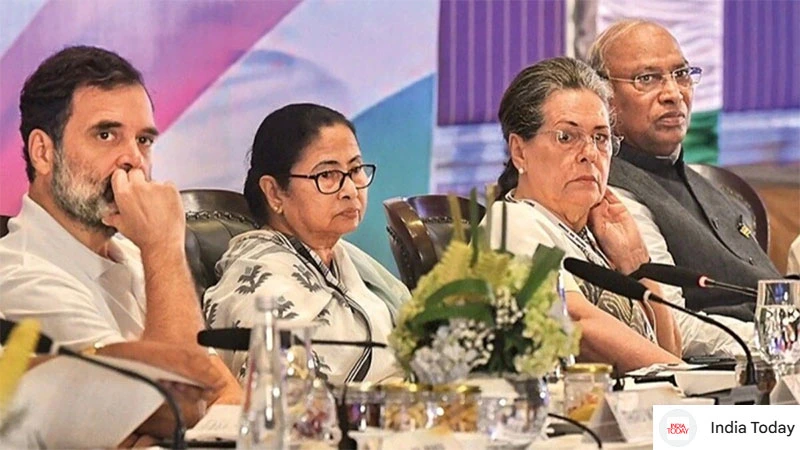
Mamata’s Alliance Politics: Can You Trust It?
There is an old saying in Bengal that a woman’s mind is difficult to understand. But let us leave that old saying aside. The real question here is much more political: can anyone predict where Mamata’s alliance politics will turn next.
With Mamata Banerjee, the political record tells us far more than the speeches do. Since the Trinamool Congress was formed in 1998, the party has worked with different political formations at different points. It has been with the BJP-led NDA Alliance, later joined hands with Congress, and became part of the wider INDIA Alliance. At other times, it has fought those very parties in Bengal.
Mamata’s Alliance Politics refers to the Trinamool Congress’s changing relationships with political parties such as the BJP and Congress, including its participation in the NDA and the wider INDIA Alliance at different stages.
The latest controversy over the Nandigram and Rejinagar by-elections has brought that history back into focus. A senior Congress leader claimed that the TMC had approached the Congress leadership with an offer connected to Nandigram. The TMC denied making any such offer.
But the Nandigram dispute is only the latest episode. The bigger puzzle is this: how can TMC and Congress sit together in a national opposition arrangement and still fight each other bitterly in Bengal?
Is Mamata’s Alliance Politics trustworthy with Congress?
Mamata has moved between the BJP and Congress at different stages of TMC’s journey. Even after joining the INDIA bloc, TMC chose to fight Congress separately in Bengal in 2024. That is a political fact voters cannot simply ignore.
After the 2026 election disaster, Mamata has repeatedly tried to project herself at INDIA bloc meetings and elsewhere as someone who was not defeated by the people but was somehow made to lose. Is anyone really buying that argument today?
Mamata also met Sonia Gandhi after the election defeat. But the political equation has changed considerably. Rahul Gandhi and the Bengal Congress leadership have often taken a much harder line against TMC.
Rahul, in particular, appears to attach much greater importance to the views of the state Congress leadership. On the other hand, after the way Mamata has repeatedly attacked Rahul Gandhi, it is difficult to imagine Rahul continuing to support her unconditionally.
There is another practical problem. Mamata has repeatedly weakened the Congress in Bengal by bringing Congress leaders and workers into her own Trinamool Congress. Latest episodes are found in Jhalda Municiplaity and Bayron Biswas. For a Congress worker in Bengal, that history naturally raises a difficult question: why should TMC be trusted as a long-term partner?
Nandigram and Rejinagar: A Fresh Alliance Test
The present controversy centres on two very different Assembly constituencies. The Nandigram and Rejinagar by-elections are scheduled for October 6, 2026. Nandigram carries an unusually strong political history for Mamata Banerjee, while Rejinagar sits in a part of Murshidabad where Congress, TMC, the Left and other political forces have their own competing calculations. Recent reporting has highlighted the importance of both seats ahead of the bypolls.
The Nandigram claim first surfaced through Bengal political reporting and was subsequently reported by The Indian Express. According to the Congress version, the TMC had sounded out the party about allowing Congress to contest Nandigram. There was also discussion of a possible understanding involving Rejinagar. The TMC rejected the claim.
That distinction should remain clear. A reported political proposal is not the same as a confirmed agreement. At the same time, a denial does not automatically settle what happened behind closed doors.
What is beyond dispute is that the two parties have repeatedly found themselves in this uncomfortable position: partners in a larger national opposition framework, but rivals when Bengal’s electoral arithmetic comes into play.
But Mamata’s Alliance Politics cannot be understood from one reported conversation alone. Its longer history is far more revealing.
Why Nandigram Matters
Nandigram is not just another Assembly constituency for Mamata Banerjee. The anti-land-acquisition movement there became one of the major political turning points that weakened the Left Front and helped create the atmosphere for the TMC’s eventual victory in Bengal.
The constituency later acquired another layer of political importance. In the 2021 Assembly election, Mamata Banerjee contested Nandigram against her former party colleague Suvendu Adhikari and lost. In the 2026 Assembly election, Suvendu again won Nandigram but later vacated the seat after also winning Bhabanipur, leading to the present by-election.
So any decision over who contests Nandigram carries a political message beyond the by-election itself.
For Congress, the question is equally complicated. The Bengal unit has its own organisational history and has spent years competing against the TMC. Accepting a seat arrangement from TMC would therefore have involved more than simple seat arithmetic. It would also have raised questions about the Congress’s independent political space in the state.
This is where national and state politics often pull parties in different directions. Two parties may sit together in Delhi and still fight for the same voters in Kolkata, Murshidabad or Nandigram.
From the NDA Alliance to Congress
Mamata Banerjee’s alliance history began soon after she founded the Trinamool Congress on January 1, 1998.
The new regional party soon entered into an alliance with the BJP. In the 1999 Lok Sabha election, TMC fought alongside the BJP, and Mamata Banerjee became Railway Minister in the Vajpayee government. The relationship did not remain permanent. She left the NDA in 2001 and moved towards an electoral understanding with Congress in Bengal.
The BJP-TMC relationship returned before breaking down again. In 2004, TMC once more fought the Lok Sabha election in alliance with the BJP. The Indian Express has noted that TMC’s strongest performances in that period came in alliance with the BJP in 1999 and later with Congress in 2009.
By 2009, the political picture had changed considerably. TMC and Congress fought the Lok Sabha election together in Bengal, defeating the Left in a number of important constituencies. Mamata again became Railway Minister, this time in the Manmohan Singh government.
Each of those changes had its own political context. Elections, seat-sharing, numbers and the larger national equation all played their part.
But the sequence is still worth remembering. The same TMC that once shared power with the BJP later became a Congress ally, and the Congress ally of 2009 eventually became a major rival of Congress in Bengal.
The INDIA Alliance Has the Same Problem
The formation of the INDIA Alliance brought the old question into a new setting.
Mamata Banerjee joined the wider opposition effort against the BJP, but that did not translate into an automatic TMC-Congress arrangement in Bengal. In January 2024, Mamata said that TMC would contest the Lok Sabha election alone in the state. The disagreement over seat-sharing eventually resulted in the two parties fighting separately.
The final 2024 election picture made the contradiction particularly clear. TMC contested all 42 Lok Sabha seats in West Bengal even though it remained part of the INDIA bloc nationally.
There was a straightforward reason for the tension. Congress wanted to preserve its political space in Bengal, while TMC did not want to give up seats in areas where it believed it could compete. Neither side was willing to treat the national alliance as a reason to surrender its state-level interests.
That is a familiar feature of Indian coalition politics. A party can cooperate with another party at the national level and still regard it as a competitor in a particular state.
An alliance, therefore, does not necessarily mean permanent friendship. Sometimes it means only that two parties have found enough common ground for one particular political arrangement.
Updates on 17 September, 2026
Mamata Banerjee has closed the doors for Congress inside and outside the parliament. Kalyan Banerjee, the veteran lawyer and senior TMC MP has become explosive in TV9.
Why Does Mamata’s Alliance Politics Keep Changing?
The record provides enough material for political observers to debate this question, but it does not prove the private motives behind every alliance decision.
Mamata Banerjee’s relationship with Congress itself shows how quickly political equations can change. TMC and Congress worked together in 2009 and 2011, later fell out, and subsequently explored cooperation again as the BJP grew stronger. The Front Line Magazine has described the relationship as one marked by repeated shifts — from alliance to separation and later attempts at opposition unity.
There is nothing inherently unusual about parties changing alliances. Indian politics is full of such examples.
The more interesting question is what happens to the political language around those changes. A party may describe another formation as an important national partner while attacking it in a state election. A leader may speak about opposition unity while refusing to compromise over particular constituencies. The contradiction is not necessarily illegal or even unusual. But voters are entitled to notice it.
The Nandigram-Rejinagar episode fits into that larger pattern, although the specific proposal remains disputed.
What Does 1989 Tell Us?
There is an important historical example that shows why alliance politics cannot always be judged simply through ideology.
In 1989, V.P. Singh’s National Front government depended on outside support from both the Left and the BJP. Jyoti Basu and L.K. Advani were standing on sharply different ideological ground, yet their parties supported the same government from outside. The Indian Express records that CPI(M)’s Harkishan Singh Surjeet and Jyoti Basu, CPI’s Indrajit Gupta, and BJP leaders L.K. Advani and Atal Bihari Vajpayee met V.P. Singh regularly for discussions.
Bengal once watched an extraordinary political meeting at Brigade Parade Ground, where V.P. Singh brought Jyoti Basu and Atal Bihari Vajpayee together despite their sharply opposite political ideologies. That is how coalition politics sometimes works — political differences remain, but circumstances can bring unlikely leaders to the same table.
There was another remarkable episode during the same period. Basu later recalled that V.P. Singh asked him to intervene with Advani over the Ram Rath Yatra. Basu met Advani, and another meeting involving V.P. Singh, Basu and Vajpayee followed.
The lesson is simple: an alliance can be a political arrangement without becoming an ideological partnership.
That distinction matters when looking at Mamata Banerjee’s changing relationships with the BJP, Congress and the wider INDIA Alliance. Parties can disagree fundamentally and still cooperate when parliamentary numbers or a particular political objective makes cooperation possible.
What About Rejinagar and Minority Votes?
Rejinagar adds another layer to the present discussion because of its political and demographic character. Murshidabad has long been an important centre of minority politics in Bengal, and Rejinagar has its own history of competition between TMC, Congress, the Left and other forces.
It is tempting to reduce such elections to a calculation about “minority votes“. That would be too simplistic. Voters do not behave as one uniform bloc, and demographic composition alone cannot explain the result of an election. But Mamata didn’t agree to leave Rejinagar to Congress because of minority votes.
Congress has nevertheless been trying to rebuild its political space in Murshidabad. Rejinagar is also closely associated with Humayun Kabir, who has won the Assembly seat from the constituency.
That makes any possible seat adjustment more than a matter of ideology. Local candidates, organisational strength, vote division and constituency-level arithmetic all enter the calculation.
This is the practical side of Bengal coalition politics. The question is not always who is ideologically closest. Sometimes it is simply who can contest where without damaging the larger political objective.
The BJP Changed the Equation
The rise of the BJP in Bengal has made these calculations more complicated.
When Mamata Banerjee was fighting the Left Front in the early years of TMC’s rise, the BJP was not the principal challenger in Bengal. The political map changed gradually after 2011, and the BJP became a major force in the 2019 and 2021 elections.
That changed the national equation for TMC. If the principal political contest at the Centre is between the BJP and a wider opposition, cooperation with Congress becomes useful at one level. But in Bengal, Congress remains a competitor for political space.
The same applies, in a different way, to the Left.
TMC can speak about broader opposition unity against the BJP while the Left continues to fight TMC in Bengal. Congress can be a national partner while remaining a state-level rival. None of these relationships fits neatly into a permanent friend-versus-enemy formula.
That is how INDIA Alliance politics in Bengal is much more complicated than a simple anti-BJP coalition.
Where Does Trust Come In?
This is where the word “trust” becomes relevant.
Political parties do not sign lifelong friendship agreements. Their alliances can change with elections, numbers, leadership changes and political circumstances. The history of Indian coalition governments is full of such examples.
The 1989 arrangement involving V.P. Singh, the Left and the BJP is perhaps one of the clearest reminders. Jyoti Basu and L.K. Advani could sit on opposite ideological sides and still support the same government from outside. Their differences did not disappear; the political arrangement simply served a particular purpose at that particular moment.
The difficulty arises when parties present temporary arrangements as something more permanent than they actually are.
This is the core reason for which the TMC-Congress relationship deserves scrutiny. The two parties have cooperated before. They have also fought each other. They have discussed opposition unity and then failed to agree on seat-sharing. In 2024, TMC contested all 42 Bengal Lok Sabha seats on its own despite being part of the INDIA bloc nationally.
Now, ahead of the Nandigram and Rejinagar by-elections, another possible understanding has been reported and denied.
The record matters more here than the rhetoric.
Can Anyone Trust Mamata’s Alliance Politics?
The documented history does not prove that every alliance decision taken by Mamata Banerjee was motivated by personal interest. Nor does it prove that every change of partner was opportunistic. Political circumstances genuinely change, and regional parties have their own interests to protect.
What the record does show is that Mamata’s Alliance Politics has been highly flexible.
TMC has worked with the BJP-led NDA. It has worked with Congress. It has been part of the wider INDIA Alliance. It has also fought those same parties when Bengal’s political calculations were different.
Critics read this history as evidence of a party that adjusts its alliances according to immediate political requirements. TMC supporters see the same record differently: a regional party, they argue, has to protect its space as the national political equation keeps changing.
Both are interpretations of the same record.
The harder facts are easier to establish. TMC has changed partners. Congress and TMC have cooperated and competed at different times. The BJP and TMC have also moved from alliance to confrontation. The national opposition framework has not automatically translated into a Bengal-level seat-sharing arrangement.
And the latest Nandigram episode remains disputed, with a Congress leader claiming that an offer was made and the TMC denying it.
Mamata Brand: Is the Political Magic Fading?
Mamata Banerjee often announces from public platforms, or through Facebook and other social media, that she will soon travel across the districts. Still the promised tour has still not happened. That naturally raises a question: is Mamata Banerjee beginning to have doubts about the political brand she built herself?
The question may sound provocative, but the political record makes it worth asking.
For years, the Mamata brand was perhaps the biggest strength of the Trinamool Congress. She could walk into an election with her own image carrying a large part of the campaign. The party symbol, the leadership and the candidate were often presented as different parts of the same political package.
But fifteen years in power have also brought a long list of allegations against the Trinamool Congress, ranging from corruption and extortion to administrative failures and political violence. These are allegations made by opponents and critics, and their political impact is a matter for voters to judge. But there is little doubt that they have become part of the public debate around the TMC government.
The Narada controversy in 2016 provides an important example. After the videos became public, Mamata Banerjee said that if she had known about the allegations earlier, she would have reconsidered giving tickets to some of the leaders involved.
Yet several of those leaders went on to win elections and remain important figures in Bengal politics. The Narada controversy therefore did not simply disappear with the 2016 election. It remained part of the political arguments surrounding the Trinamool Congress for years afterwards.
That history matters because the Mamata brand has always been built around a very personal form of political leadership. Look at the posters and hoardings. Mamata’s photograph is usually there. Look at government programmes. Her face is difficult to miss. Party leaders, ministers and candidates routinely invoke her leadership when speaking to supporters.
Mamata herself has repeatedly used the line that she is effectively the candidate in all 294 Assembly constituencies. In the 2016 campaign, for example, she publicly described herself as the candidate across all 294 seats.
The message was clear: the election was not merely about individual TMC candidates. It was also a referendum on Mamata Banerjee herself.
There is a political reason why such personal branding became so important.
In the 2004 Lok Sabha election, the Trinamool Congress won only one seat in West Bengal. The official election data records that TMC contested 29 seats and won just one, despite polling more than 21 per cent of the vote in the state.
That result showed the gap between a leader’s personal political appeal and the organisational strength of the party. Mamata’s image could attract attention across Bengal, but the party still needed a strong network of candidates and workers to convert that appeal into seats.
Over the years, the balance changed. The TMC became a powerful electoral machine, and Mamata’s personal identity became deeply tied to the party’s identity. The Mamata brand and the Trinamool brand increasingly became difficult to separate.
That is why her current political visibility matters.
If a leader who has traditionally travelled across Bengal, addressed district-level gatherings and personally led campaigns begins relying more heavily on photographs, government programmes, centralised messaging and public announcements, political observers are bound to ask what has changed.
But there is another side to the argument. A reduction in physical campaigning, or a delay in a proposed district tour, does not by itself prove that Mamata Banerjee has lost confidence in her political standing. There may be organisational, political or strategic reasons behind any change in campaign style.
So the real issue is not whether one tour has happened or not.
The bigger question is whether the Mamata brand can still carry the Trinamool Congress in the way it once did — especially when the party is facing a changed political landscape and growing questions about its past record.
That is the test Mamata Banerjee now faces. And unlike an election slogan, the answer cannot come from a poster. It has to come from the political response of Bengal’s voters.
Knowledge Mart Final Thoughts
Mamata Banerjee’s political journey does not fit into one permanent alliance camp. TMC began with an alliance with the BJP, later worked with Congress, and eventually became part of the broader opposition effort against the BJP. At the same time, it has fought both Congress and the BJP in Bengal when political circumstances demanded it.
That history does not prove that every alliance was dishonest. It does show something more concrete: TMC has treated alliances as political arrangements that can change when circumstances change.
The 1989 V.P. Singh episode reminds us that this is not unique to Mamata Banerjee. Jyoti Basu and L.K. Advani could support the same government despite their deep ideological differences. The important difference is that the arrangement was understood as a political necessity, not as the disappearance of their ideological opposition. They had different ideological goals, but both were willing to support the National Front government from outside.
The current TMC-Congress debate should be viewed in the same practical light. If the reported Nandigram proposal was made, it was an attempt at constituency-level adjustment. If it was not made, as TMC says, then the episode remains a political claim rather than an established agreement.
Either way, the larger history remains.
NDA Alliance, Congress, INDIA Alliance — TMC has travelled through all these political arrangements. The names and partners have changed with time. The record is now there for voters to examine.
10 Key Takeaways
- The TMC has changed political partners several times since its formation in 1998, giving its alliance history a distinctly flexible character.
- Mamata Banerjee’s early political journey included a partnership with the BJP-led NDA Alliance, under which she served as Railway Minister.
- Congress later became an important electoral partner for TMC, including the 2009 Lok Sabha election and the 2011 Bengal Assembly election.
- Being part of the wider INDIA Alliance did not prevent TMC and Congress from fighting separately in West Bengal during the 2024 Lok Sabha election.
- Nandigram has special political significance because of the 2021 Mamata Banerjee-Suvendu Adhikari contest and the constituency’s role in Bengal’s political history.
- The reported Nandigram proposal remains disputed. A Congress leader claimed that TMC approached the party, while the TMC denied making such an offer.
- The 1989 V.P. Singh government showed that the Left and BJP could support the same government from outside despite their sharp ideological differences.
- Rejinagar has its own political arithmetic, with Congress, TMC, the Left and other forces competing for space in a sensitive Murshidabad constituency.
- Alliance politics is shaped not only by ideology but also by seat-sharing, local candidates, organisational strength and electoral arithmetic.
- The history of TMC’s alliances does not prove one fixed motive. It does, however, provide enough evidence for voters to examine how and why its coalition equations have changed over time.