BJP's Trinamool Turn: Shocking Truth
Aug 06, 2026 - By Ashutosh Roy PoliticsCurrent AffairsElection AnalysisNational NewsNational PoliticsPolitical IdeologiesRegional UpdatesWest Bengal Politics
What Is the Real Story Behind BJP’s Trinamool Turn?
Left parties in Bengal have talked about the “Bijemul” theory for a long time. Back then, normal voters did not care much about it. But if you read the recent news and watch the TV or Social Media, the BJP’s Trinamool Turn is clear to see, proving that BJP’s Trinamoolisation has already happened.
Earlier, these political deals happened behind closed doors. Now, everything is out in the open. Top leaders like the Prime Minister and Home Minister sit down for direct meetings with the Rebel TMC MPs. Even the state Chief Minister has been meeting them in Delhi. The images have become viral in social media. So, why hide the truth anymore?
Let me keep one question straight: Can the people believe that the MPs elected from the Bengal are willing to discuss about the development plan for their constituencies with the Bengal Chief Minister in Delhi? Is there any dearth of places in West Bengal? The Chief Minister Suvendu Adhikari is available mostly in Nabanna and he works even till the late evening.
The senior lawyer and long-time TMC MP, Kalyan Banerjee didn’t lose the opportunity to criticize Modi.
We don’t know whether Bijemul or BJP-TMC Setting system has got sanctity, but it has been revealed in ABP Ananda (05/08/2026) that Abhishek Banerjee has tried to get his Visa cleared through Suvendu Adhikari.
Key Timeline of Events:
- Rebel TMC MPs held a secret meeting at Dharmendra Pradhan’s home with Suvendu Adhikari present.
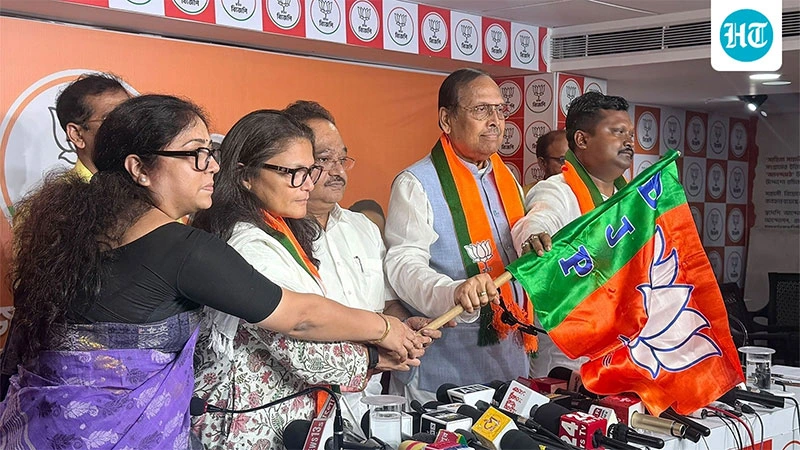
- Samik Bhattacharya – who once claimed “no BJP’s Trinamool Shift will happen”, personally welcomed three resigned TMC Rajya Sabha members into the BJP.
- The BJP helped these former TMC leaders win back their Rajya Sabha seats almost immediately.
When former TMC leaders get top rewards instantly, the circle becomes complete. Political analysts at Knowledge Mart ask a simple question: Do politicians really think voters are that blind?
The clear reality is that the BJP Copies Trinamool Model to win votes, making this political shift undeniable.
Key Figures Driving the Shift
| Factor | Ritabrata Group | NCPI Bloc |
|---|---|---|
| Level | Assembly level (MLAs) | Parliamentary level (MPs) |
| Leader | Ritabrata Banerjee | Kakoli Ghosh Dastidar (acting face) |
| Strength | Roughly 58 to 60 MLAs | Around 19 MPs in total |
| Structure | Driven by an internal TMC split | Formed through a separate party route |
| BJP Link | Indirect alignment with delayed announcements | Direct coordination with faster public ties |
| Strategy | Pushes the “Asli TMC” narrative | Works through official NDA channel support |
Rebel Factions Signal a Deeper Risk for Bengal Politics
Winning 208 majority seats in Bengal was a massive milestone for the BJP. However, its immediate actions sparked widespread debate. Instead of charting a new path, the party encouraged a splinter group of rebel TMC MLAs. This shift highlights how BJP Copies Trinamool Model rather than offering a true alternative.
This new faction is led by Ritabrata Banerjee, a former CPI(M) Rajya Sabha MP who was expelled over personal misconduct allegations before joining TMC. Analysts at Knowledge Mart point out that this political realignment clearly showcases the BJP’s Trinamoolisation in action.
We know political leaders are smart as they are the lawmakers, but it’s unwise to underestimate the commoners’ merit.
Key Figures Joining the Rebel Group:
- Ritabrata Banerjee: Former CPI(M) and TMC leader now steering the rebel group within the assembly.
- Firhad Hakim: Named directly in assembly debates regarding unauthorized constructions.
- Aroop Biswas: Joined the faction despite long-standing controversies surrounding his name and particularly in Messi-mess in Kolkata.
- Several leaders facing active corruption probes now sleep peacefully because of joining Ritabrata Trinamool or NCPI, while state and central agencies narrow their focus to selected targets like Sabyasachi or Sujit Bose.
Why Are Muslim MPs Facing a Unique Dilemma?
Three Muslim MPs from Murshidabad who moved from TMC to NCPI have taken a baffling stand. They refuse to attend NDA meetings, but agree for the meeting with Suvendu Adhikari. They fear losing their home ground credibility once they step out of parliamentary safety.
In the end, citizens are left wondering why major political parties continue recycling leaders with heavy corruption charges. This ongoing strategy confirms the BJP’s Trinamool Shift, leaving voters questioning if real political change will ever arrive.
Are the rebel Muslim MPs – Yusuf Pathan, Abu Taher Khan and Khalilur Rahaman – worried for the Egg therapy, what is going on continuously in West Bengal after the election?
Nobody knows that the people can call them as traitors and hurl anything on them. If a public representative needs stringent security for his movement, it’s nothing but a shame for democracy. Please note that we do not support violence or any form of taking the law into one’s own hands.
Ideology Takes a Backseat in the Race for Power
Political leaders try to justify every political move by calling it “national interest” or the “larger benefit”. But where is the line when it comes to compromising with corruption? Nobody seems to answer that question.
This problem goes far beyond West Bengal. Across India, the BJP once raised serious corruption charges against numerous political figures.
Today, many of those same leaders have joined the BJP or sit comfortably as cabinet ministers or in central and even Chief Minister in state governments. Analysts at Knowledge Mart question how a party can still call itself a “party with a difference” when it relies on cash, power, and political bargains to stay ahead.
We all know that the number plays a pivotal role in democracy, but the numbers without ethics or morality makes hardly any party to be different.
Watch the India Today report on one such meeting.
Top National Leaders Who Switched to BJP
| Leader | From Party | Key Position After Joining | Level |
|---|---|---|---|
| Himanta Biswa Sarma | Congress | Appointed Chief Minister of Assam | State level |
| Jyotiraditya Scindia | Congress | Named Union Cabinet Minister | National level |
| Narayan Rane | Congress / Shiv Sena | Appointed Union Cabinet Minister | National level |
| N. Biren Singh | Congress | Appointed Chief Minister of Manipur | State level |
| Pema Khandu | Congress | Appointed Chief Minister of Arunachal Pradesh | State level |
| Jitin Prasada | Congress | Given Cabinet Minister role in UP Government | State level |
Key Historical Comparisons:
- On April 17, 1999, Atal Bihari Vajpayee lost his government by just a single vote. He chose to step down rather than trade principles or engage in horse-trading.
- Narendra Modi (Today): Modern strategy relies heavily on welcoming opposition rivals, making the BJP’s Trinamool Shift look like standard practice.
- RSS and Mohan Bhagwat: The RSS preaches strict moral values, though top leaders like Mohan Bhagwat remain silent as this political opportunism unfolds. Nevertheless, he has shown his concerns on NEET Protests and Education System.
Why Is Principles-First Politics Dying in India?
When short-term power replaces long-term ideology, moral politics dies. Watching the party adopt old opposition tactics shows how the BJP Copies Trinamool Model to maintain dominance. This complete ideological change proves that the BJP’s Trinamoolisation has compromised the core values the party once stood for.
History shows how leaders once stepped down on moral grounds.
- On November 7, 1956, Lal Bahadur Shastri resigned as India’s Railway Minister taking the moral responsibility after the Ariyalur train accident
- On January 9, 1993, Madhavrao Scindia resigned as Union Civil Aviation Minister. He took responsibility after a leased Russian Tupolev-154 aircraft crashed at Delhi airport.
- In 1996, Lal Krishna Advani also set an example. He resigned as a Member of Parliament. His name had appeared in the hawala diaries of the Jain brothers. He chose to step aside to uphold moral standards in public life.
Indian politics carries that golden legacy and political elitism.
Grassroot Frustration Mounts Over Extortion and Party-Switching
Veteran leaders like Tathagata Roy have strongly criticized the NCPI drama and the top leadership’s closeness to corrupt former TMC politicians. However, because numbers drive modern democracy, even senior internal voices feel powerless to protest effectively. Watch Tathagata Roy’s sharp criticism.
On the ground, local dynamics are changing rapidly. Reports are emerging of BJP MLAs and local leaders facing serious extortion allegations, with threats of violence if money is not paid. Political observers at Knowledge Mart point out that these actions leave citizens asking: Where is the difference anymore?
How Promises Contrast with Reality:
- During campaigning, Prime Minister Narendra Modi and Amit Shah promised an end to “syndicates” and political extortion, promising a fear-free atmosphere.
- Local extortions continue to surface, proving how deeply the BJP Copies Trinamool Model at the grass-roots level.
- While the party president repeatedly warns workers to stop extortion and insists “we won’t allow BJP’s Trinamoolisation“, these warnings fail to reach ground-level cadres.
Is the Local Administration Truly Unbiased?
BJP leaders claim they take quick action against corrupt members, something they argue TMC never did. But citizens wonder if law enforcement is truly working without political bias, or if the BJP’s Trinamool Shift has completely taken over local governance.
We hope that the long hands of the law reach the perpetrators irrespective of political affiliations.
Why Is Mamata Banerjee’s Latest Claim Being Called the Joke of the Century?
The former Chief Minister Mamata Banerjee recently claimed that the police are threatening TMC MPs and MLAs to force them into the BJP. Political observers call this statement ironic. Has she forgotten how her own administration used court cases and police pressure to weaken opposition parties for years?
From veteran leaders like Manas Bhunia to regional figures like Bimal Gurung, history shows how political loyalty was repeatedly reshaped in Bengal. Today, she faces the exact same unethical political tactics she once pioneered.
Analysts at Knowledge Mart note that this cycle simply proves how power dynamics play out when principles are set aside.
What Bengal Voters Wanted vs. What They Got:
- People voted against corruption, syndicate rule, and local extortion, expecting a fresh start for the state.
- The ongoing BJP’s Trinamool Turn has served voters old wine in a brand-new bottle.
- Elected leaders regularly switch sides for personal gain, leaving ordinary voters feeling completely cheated.
Will Voters Punish Leaders for the BJP’s Trinamool Shift?
In the end, everyday citizens do not care about political labels or whether the BJP’s Trinamoolisation is complete. They care about real governance and accountability. They care about progress. The citizens want industrialization and congenial infrastructure.
As political parties continue recycling the same figures, the public notices every betrayal, and they will deliver their final answer at the ballot box.
Bottomline for Knowledge Mart Viewers:
What we are seeing today in Bengal is simple political payback: Mamata Banerjee is being paid back in the exact same coin. For years, her administration used pressure and party-switching tactics to hollow out the opposition.
Today, those same methods are being turned against her own party. In fact, the rocket speed of TMC split has placed her on the receiving end.
However, the BJP should not misread the situation.
The voters of Bengal did not support them because of deep ideological roots; they voted for them primarily as a tool to throw Mamata Banerjee out. In Bengal, the BJP remains relatively inexperienced with a weak booth-level organizational structure.
The political party-hoppers switching loyalties overnight are directly betraying the electorates who voted for real change. Ordinary citizens may seem like silent observers right now, but history proves their strength.
Bengal voters have toppled formidable powers like the CPI(M), the TMC at its peak, and even Indira Gandhi at the national level. If the BJP fails to maintain its “party with a difference” status and continues down this path, the people will not hesitate to throw them out as well.
BJP may feel a solace that West Bengal offer adequate buffer zone to the ruling dispensation, but when they thwart some party, they fail to make a comeback in Bengal Politics. West Bengal has witnessed long term regime of National Congress, CPI(M) Led Left front and Trinamool Congress. Hopefully BJP will take the right lesson from history.
10 Key Takeaways: BJP’s Trinamool Turn
- What began as a political theory by Left parties is now clear reality as the BJP’s Trinamool Turn unfolds openly in Bengal.
- High-level meetings between central leaders and state leadership show that political bargains are no longer hidden behind closed doors.
- Former TMC Rajya Sabha members resigned, joined the BJP, and quickly won their seats back, proving the BJP’s Trinamool Shift.
- The formation of rebel factions containing leaders facing corruption probes shows how the BJP Copies Trinamool Model.
- By accepting party-hoppers, the party strays from its historical principles and drives the overall BJP’s Trinamoolisation.
- Reports of extortion by local members directly contradict campaign promises of a syndicate-free Bengal.
- Mamata Banerjee’s complaints about state pressure mirror the exact same tactics she used against her opposition for years.
- Citizens who voted for clean governance feel betrayed after getting old politics packaged in a new bottle.
- Analysts at Knowledge Mart highlight that people voted for the BJP to remove TMC, not out of ideological loyalty.
- Bengal voters have defeated powerful regimes before, and they will not hesitate to reject any party that breaks its promises.
[…]BJP’s Trinamool Turn: Shocking Truth BJP’s Trinamool Turn exposes a radical shift in Bengal’s political landscape. Discover the shocking truth behind these tactical power moves.[…]
[…]BJP’s Trinamool Turn: Shocking Truth BJP’s Trinamool Turn exposes a radical shift in Bengal’s political landscape. Discover the shocking truth behind these tactical power moves.[…]
[…]BJP’s Trinamool Turn: Shocking Truth BJP’s Trinamool Turn exposes a radical shift in Bengal’s political landscape. Discover the shocking truth behind these tactical power moves.[…]
[…]BJP’s Trinamool Turn: Shocking Truth BJP’s Trinamool Turn exposes a radical shift in Bengal’s political landscape. Discover the shocking truth behind these tactical power moves.[…]
[…]BJP’s Trinamool Turn: Shocking Truth BJP’s Trinamool Turn exposes a radical shift in Bengal’s political landscape. Discover the shocking truth behind these tactical power moves.[…]