Is Mamata Under Fire Now after SC Blow?
Apr 04, 2026 - By Ashutosh Roy Current AffairsElection AnalysisGovernancePoliticsRegional UpdatesWest Bengal Politics
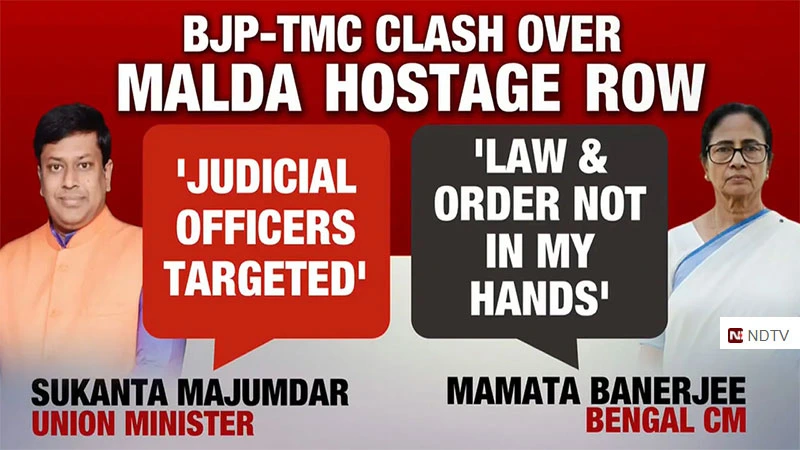
Why is Mamata Under Fire now?
Mamata under fire (তোপের মুখে মমতা) across West Bengal as the 2026 elections approach. The Chief Minister is facing a massive political crisis after a series of legal defeats. Additionally, the recent situation in Malda has caused serious damage before Bengal Elections 2026 (পশ্চিমবঙ্গ বিধানসভা নির্বাচন ২০২৬).
Below, we break down why the ruling Trinamool Congress (TMC) is currently in a state of high tension.
Why Did the Supreme Court Reject Mamata Banerjee’s Plea?
The issue of voter list revision in West Bengal has created intense political debate. Recently, Mamata Banerjee in person approached the Supreme Court of India regarding the Special Intensive Revision (SIR) (বিশেষ নিবিড় সংশোধন) of voter lists. However, the court rejected her request, which has now become a major talking point.
Key Developments Explained
- First of all, West Bengal has seen more legal cases related to Special Intensive Revision (SIR) (বিশেষ নিবিড় সংশোধন) compared to any other state. As a result, tensions, protests, and incidents of unrest have increased significantly.
- Moreover, Mamata Banerjee personally appeared in court. She requested to conduct the 2026 Bengal Elections (বিধানসভা নির্বাচন ২০২৬)using the old voter list instead of the revised one.
- However, the Chief Justice of India did not accept her plea. Instead, the court clearly instructed the Election Commission of India to continue the voter list (ভোটার তালিকা) “clean-up” process.
- Consequently, this decision has weakened a key political strategy aimed at protecting her voter base.
In addition, critics claim that the canon fodders misused illegal voter names previously for fraudulent voting practices, especially later in the day. - Furthermore, the administration under Election Commission has not widely used preventive arrests so far. Still, if many names are removed from the voter list, such practices may become difficult.
- At the same time, the Election Commission has introduced stricter measures. For example, it plans live video telecast for monitoring of polling booths.
- Also, central security forces may be deployed inside polling booths, which could further increase transparency.
Therefore, these steps have raised concerns for the ruling party about tighter election control.
Keynotes on SC’s rejection of Mamata’s plea regarding SIR (বিশেষ নিবিড় সংশোধন)
In summary, the Supreme Court’s decision marks a significant shift in the election process in West Bengal (পশ্চিমবঙ্গ নির্বাচন ২০২৬).
It strengthens the role of the Election Commission and promotes transparency.
As a result, upcoming elections may see stricter monitoring and reduced chances of irregularities, making the political landscape more competitive and closely watched.
Did the Malda Incident Create Negative Political Impact?
The recent events in Malda have sparked serious political controversies. Statements made by Mamata Banerjee during public rallies are now being linked to rising tensions. As a result, many believe these developments may have caused unintended negative consequences in the upcoming Bengal Polls (পশ্চিমবঙ্গ বিধানসভা নির্বাচন ২০২৬).
Key Developments Explained
- First of all, Mamata Banerjee urged women at rallies, from Sagardighi to Vaishnavnagar, to come forward strongly in protests. Because of this, critics argue that such remarks may have influenced aggressive actions on the ground.
- As a result, the situation in Malda is being seen as a possible outcome of these statements. At the same time, concerns about law and order in West Bengal have already been rising.
- In addition, the recent Malda situation has caused serious concern. Reports suggest that ruling party supporters tried to influence judicial officials responsible for verifying voter lists.
- However, instead of helping politically, this move appears to have backfired and created bigger problems.
- Consequently, the Supreme Court of India has taken a strict view of the incident. The court also indicated that law and order in Malda has significantly deteriorated.
- Therefore, after the Malda incident, Mamata Banerjee has stated that she was not informed about the situation.
- She suggested that key officials appointed under the Election Commission of India, such as the Chief Secretary, Home Secretary, DGP, District Magistrates, and SPs, may be responsible.
- However, critics question this claim. They argue that only top-level positions have changed, while the existing administrative system remains largely the same.
- As a result, it seems unlikely to some political observers that local officials or police were completely unaware or failed to inform leadership.
- Finally, Mamata Banerjee has blamed opposition parties like the Indian National Congress, Bharatiya Janata Party, and All India Majlis-e-Ittehadul Muslimeen for attempting to defame West Bengal.
Has the Law and Order Situation deteriorated?
- The state has also witnessed incidents from Samsherganj to Dalkhola highlight ongoing instability in different regions and lack of law and order. Malda is just the tip of the iceberg.
- Furthermore, there is growing concern within the state government that the court may order stricter legal action against the administration.
- Meanwhile, although the Government of India under the regime of Narendra Modi generally avoids using Articles 355 or 356, a court observation about law and order breakdown could force action.
Keynotes on Malda Chaos and its negative political narrative
Overall, the Malda episode appears to have had a significant political and administrative impact. It has raised serious questions about law and order, accountability, and election transparency.
Still there is a caution message. Widespread protests are erupting over the removal of names from the voter list. Any small spark could turn this anger into a wildfire, especially if people cannot access the appellate tribunal to appeal.
Going forward, both the state government and central authorities may face increased scrutiny, making the situation more sensitive and closely monitored before Bengal Elections 2026 (পশ্চিমবঙ্গ বিধানসভা নির্বাচন ২০২৬).
Between the judicial “rap” over the Malda incident and the administrative loss of the voter list (ভোটার তালিকা) battle, the TMC leadership is facing its most “nerve-wracking” election cycle since 2011.
Are Massive Voter List Deletions Creating Political Tension?
The ongoing voter list (ভোটার তালিকা) revision in West Bengal has become highly controversial. A large number of names have reportedly been removed, which has triggered political reactions and public concern. As the situation develops, it is creating pressure on all sides.
Key Developments Explained
- First of all, the scale of voter list (ভোটার তালিকা) revision is unexpectedly high in context of Bengal, though more names have been excluded in various other states. Reports suggest that lakhs of names and possibly up to 8 million (80 lakh) could be removed.
- Moreover, Mamata Banerjee has claimed that “genuine voters” are being unfairly targeted. However, the Supreme Court of India has remained firm in supporting the revision process.
- In addition, Mamata Banerjee has alleged that Muslim and women voters are being selectively removed from the list.
- At the same time, political observers point out that these two groups, minority voters and women, form a key support base for the Trinamool Congress.
- Furthermore, a section of minority voters is reportedly unhappy over issues related to Waqf and other concerns. As a result, some shift in political sentiment may be happening.
- Similarly, concerns about women’s safety (নারী সুরক্ষা) have been increasing. Reports of rising crimes have led to visible dissatisfaction among some women voters.
- For example, incidents like the widely discussed Abhaya case have highlighted public anger and concern over safety issues.
- However, welfare schemes such as Lakshmir Bhandar still continue to support and satisfy a section of women voters.
- Consequently, this mixed sentiment creates uncertainty in the political landscape.
- Therefore, with reduced control over voter data and changing public mood, internal pressure within the ruling party is increasing.
Keynotes on Mass Exclusion in the Voter list (ভোটার তালিকা) before 2026 Bengal Election (পশ্চিমবঙ্গ নির্বাচন ২০২৬)
In conclusion, the large-scale removal of voter names has added a new layer of complexity to West Bengal politics. While the authorities emphasize transparency, political concerns and voter sentiments continue to evolve. As a result, the upcoming elections may become more unpredictable and closely contested.
Can there be A Shift in Vote Banks?
Most importantly, the political ground is shifting. For the first time, three major factors are working against the Trinamool Congress simultaneously:
- Hindu Consolidation: A large section of Hindu voters is moving toward the BJP.
- The Muslim Vote Split (মুসলিম ভোট বিভাজন): Groups like MIM and ISF are gaining visibility. They are likely to split the Muslim vote, which has always been Mamata’s strongest support.
- Agitation Struggles: Although she is calling on women to lead new protests, the public response is uncertain.
- Ravi’s Appointment as a Governor: R.N. Ravi has been appointed as the Governor off late. If the Article 356 (রাষ্ট্রপতি শাসন) is invoked, the Governor plays the pivotal role in state Administration on behalf of the President of India.
Bottom Line:
In summary, the combination of judicial pressure and a divided voter base has left the TMC leadership tensed. Mamata under fire (তোপের মুখে মমতা) is no longer just a headline; it is the current reality of Bengal politics. As the 2026 Bengal Elections (পশ্চিমবঙ্গ বিধানসভা নির্বাচন ২০২৬) draw near, the Chief Minister must find a new way to regain her footing.
10 Key Takeaways:
- The Supreme Court of India rejected Mamata Banerjee’s plea to stop voter list revision.
- The Election Commission of India will continue the Special Intensive Revision (SIR) process.
- West Bengal records the highest number of disputes, protests, and legal cases related to voter list revision.
- The court’s decision weakens a major political strategy linked to protecting voter support.
- Strict election measures like live monitoring and central forces aim to increase transparency.
- The Malda incident raised serious concerns about law and order in the state.
- The court has taken a strict view of administrative failures and may push for stronger action.
- Large-scale voter deletions (possibly up to 80 lakh) have intensified political tension.
- Allegations of targeting women and minority voters have added to the controversy.
- Growing public dissatisfaction and reduced control over voter data are increasing pressure on the ruling Trinamool Congress.
People Also Ask (FAQs)
1. Why did the Supreme Court of India reject Mamata Banerjee’s plea?
The court rejected the request because it supported continuing the voter list revision process to ensure transparency and accuracy in elections.
2. What is the Special Intensive Revision (SIR) (বিশেষ নিবিড় সংশোধন) of voter lists?
SIR (বিশেষ নিবিড় সংশোধন) is a process conducted by the Election Commission of India to update and clean voter lists by removing duplicate or ineligible names.
3. Why is voter list revision controversial in West Bengal?
It is controversial due to large-scale name deletions, political allegations, protests, and concerns about fairness in the process.
4. What happened in Malda?
Malda saw tensions and law-and-order concerns, including alleged attempts to influence officials involved in voter verification.
5. How many voters may be removed from the list?
Reports suggest that the number could reach up to 80 lakh (8 million), making it a major revision exercise.
6. What allegations has Mamata Banerjee made?
Mamata Banerjee has alleged that genuine voters, especially women and minority communities, are being selectively targeted.
7. What steps are being taken to ensure fair elections?
Measures include live video monitoring, stricter supervision, and deployment of central forces at polling booths.
8. Could the central government take action over law and order?
If the court finds a breakdown in law and order, the Government of India may consider constitutional measures like Articles 355 or 356.
9. How is this affecting the ruling party?
The situation is increasing political pressure on the Trinamool Congress due to uncertainty over voter support and administrative scrutiny.
10. What could be the impact on upcoming elections?
The elections may become more competitive, transparent, and unpredictable due to tighter controls and changing voter dynamics.
[…]Is Mamata Under Fire Now after SC Blow? Mamata Under Fire as SC rejects the plea to stop voter revisions! With Malda backlash and BJP-ISF rising, is the CM losing ground? Explore the 2026 poll crisis.[…]