Immigration in West Bengal: A new Analysis
Oct 09, 2025 - By Ashutosh Roy Governance & AdminPoliticsWest Bengal Politics
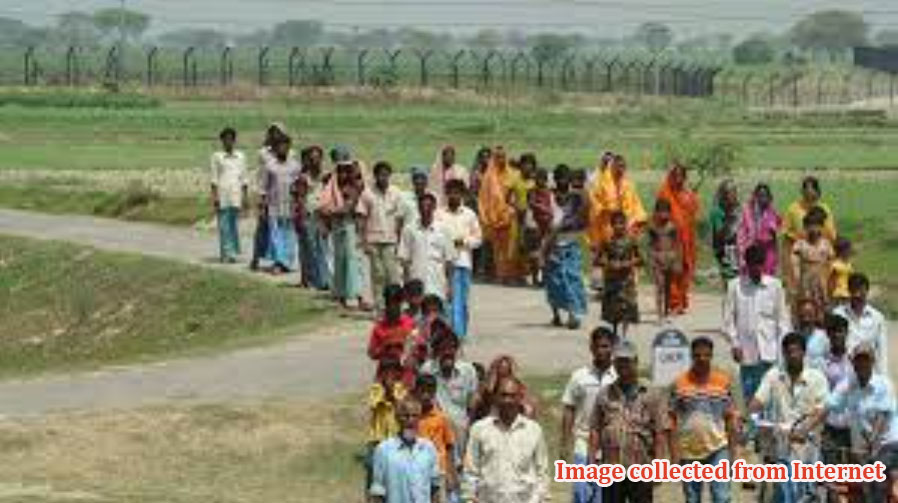
The Lasting Impact of the Radcliffe Line on Immigration in West Bengal
The hastily drawn Radcliffe Line in 1947 by British lawyer Sir Cyril Radcliffe continues to have profound and lingering consequences, particularly for the two adjacent regions of Bengal: modern-day Bangladesh and West Bengal (India). Consequently, this arbitrary partition has been a continuous source of rivalry, communal friction, and mass migration, leading to ongoing anguish in the region. So, Let’s try to analyze the dynamics of immigration in West Bengal and its alleged link to the political power of the ruling party.
Nevertheless, India shares a 4,096-kilometre border with Bangladesh across five states: West Bengal, Assam, Meghalaya, Tripura, and Mizoram. Thus, the length of the border between Bangladesh and West Bengal is 2,216.7 kilometers
Border Security, Immigration in West Bengal and Political Allegations
Moreover, a significant portion of the border between West Bengal and Bangladesh reportedly remains unmanned or lacks effective barbed wire fencing. Hence, This porous and often poorly managed border has become the heaven for the perpetrators.
This lack of complete security is partly for natural constraints, such as the Sundarbans or riverine areas, where fencing is next to impossible. However, Reports also say that some people deliberately damage fences.
In Addition, they make the barriers ineffective. The reason behind is to facilitate illegal activities like smuggling and cattle trafficking, which may also enable illegal immigration and even terrorist infiltration.
However, the West Bengal government, headed by Mamata Banerjee has a “pro-minority mentality.” The Muslim minorities in the state often receive preferential treatment, with local police allegedly hesitant to act against them.
- Reports allege that some immigrants and sections of the Bengali Muslim population in rural areas engage in disruptive behaviour. They also claim that local authorities and political leaders appease these groups.
- Allegations claim that these individuals participate in booth capturing. The Reports also accused them for creating fear among voters to influence election outcomes in favour of the ruling party.
- Such an incident highlights the political contradiction. Mamata Banerjee once protested against illegal immigration by throwing papers in Parliament in 2005. The left front used leverage the Musilm vote as a contemporary ruler. Critics accuse the same Mamata Banerjee is now of indulging in migration for electoral gain.
The Ecosystem of Illegal Immigration in West Bengal
The unholy nexus between the Border Security Force (BSF), local police, and political leaders that facilitates illegal immigration in West Bengal. Many Newspapers and Television channels have reported regarding such nexus several times.
- The mere entry does not limit the system only. Reports also reveal that there are agencies that create fraudulent Indian identity documents in exchange for money. If one can find out the right person, the Aadhaar Cards, Voter Cards, Ration Cards, and even Passports become ready promptly.
- The news reports evidenced the existence of dual citizenship, individuals holding both Indian and Bangladeshi passports. The TV channel showed One person, who was holding voter cards of both the countries.
Demographic Changes
Observers argue that migrant inflows are driving major demographic changes in West Bengal. They say the scale of change is unprecedented.
- According to the 2011 Census, Murshidabad was the only district in West Bengal where Muslims were the majority population.
- The unofficial sources report that constant immigration has altered the demographics of other districts like Dinajpur, Malda. Reports suggest that certain parts of Kolkata have experienced significant immigration. Accurate confirmation would require an updated and comprehensive census.
The Drivers of Immigration
Notably, immigrants are not exclusively Muslim. A significant number of Hindus have also migrated from Bangladesh since independence, often citing harassment by the minority community there. Reports also claim that the major chunk of Immigration in West Bengal are minority Muslims.
Let us try to identify the core reasons of driving migration:
- Poverty
- Livelihood standards
- Political turmoil
- Law and order
- Unemployment
Ultimately, these factors force people to cross the border in search of a better and more peaceful life. Such large migration creates a major challenge for West Bengal in its ability to accommodate such a large number of people.
[…] critics have pointed out that illegal immigrants from Bangladesh and Myanmar have allegedly secured voter IDs through bribery. Cases of dead […]
[…] Muslim appeasing method. There are allegations that the left front Government allowed the illegal immigrants just for their interest of Muslim vote bank. The left front Government and the CPM party cadres […]
[…] exodus of illegal immigrants in the border area has erupted political slugfest. The fright of Special Intensive Revision (SIR) […]