Good vs Bad TMC: BJP's Deep Divide & Rule
Jun 27, 2026 - By Ashutosh Roy Current AffairsElection AnalysisNational PoliticsPoliticsRegional UpdatesWest Bengal Politics
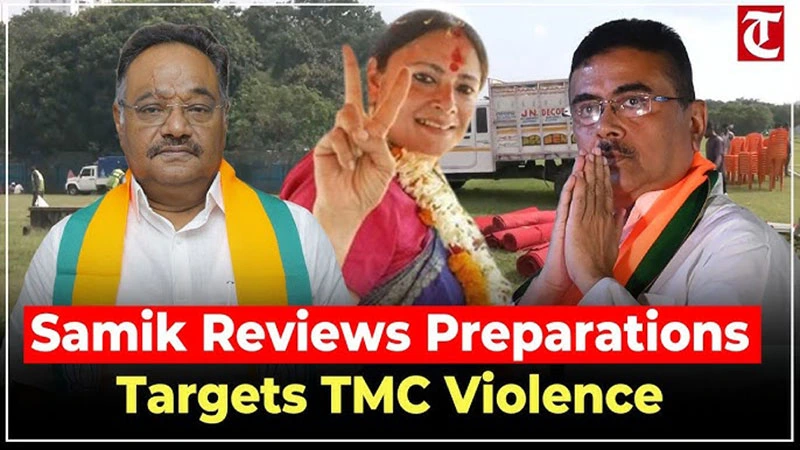
Is BJP Playing a Divide & Rule Policy by Good vs Bad TMC?
Is there an objective benchmark for a “Good TMC vs Bad TMC“, or is it just a classic case of political convenience?
When senior leaders like Shamik Bhattacharya drop calculated hints that the party doors might open for “good” elements later, it triggers a massive debate.
What is the real political strategy at play here? How can a political rival suddenly become clean overnight?
The analytical team at Knowledge Mart has been tracking these fast-paced developments closely. The reality on the ground shows that these labels are simply parts of a deeper game.
In reality, it is nothing but a calculated blueprint designed to fragment opposition forces.
Let’s look at the history of TMC first
The Origin of TMC: A Legacy of Betrayal?
West Bengal politics faces a major debate over political defection. Critics call out the Trinamool Congress (TMC) for complaining about turncoat leaders. The reality is that the TMC was born from political betrayal.
Mamata Banerjee left the Congress party to form the TMC in 1998. She did this despite rising to prominence as an MP and Youth Congress President under Rajiv Gandhi.
The initial Mamata camp consisted entirely of Congress rebels.
TMC’s History of Poaching Opposition Leaders
The TMC has a long history of breaking rival parties to expand its base in West Bengal. Recent political events highlight this trend clearly:
- Bayron Biswas: The sole Congress MLA who defected to TMC.
- Jhalda Municipality: Sudden political shifts that altered local governance.
Severe Corruption Allegations Highlight Internal Silence
Massive financial scams have rocked West Bengal. Despite deep systemic issues, top TMC leaders remained completely silent.
Party members heavily relied on the central leadership. Most leaders invoked the names of Mamata Banerjee and Abhishek Banerjee before making any public statement.
Multiple raids have exposed deep-seated corruption across various levels of the party. Law enforcement agencies recovered massive amounts of:
- Unaccounted cash
- Illegal gold reserves
- Embezzled public relief materials
The BJP’s Dilemma: Can There Be a “Good TMC”?
These structural flaws raise a critical question for the Bharatiya Janata Party (BJP). How can the opposition define a yardstick for a “Good vs Bad TMC“?
When corruption and defection define a political system, choosing between factions becomes impossible.
Why Is the BJP Dividing the Trinamool Congress?
The ruling party at the Center has a well-documented history of using every tool available to expand its footprint. Analysts often point out their ruthless expansion tactics across various states.
They frequently absorb regional leaders to strengthen their own numbers. This is not a new phenomenon in Indian politics.
Right now, the situation in Delhi is highly critical. The BJP does not possess an absolute, single-party majority in the central parliament. They depend heavily on alliance partners to sustain their government.
Because of this, the central leadership is constantly searching for stable numbers.
The Mathematics of Coalition Politics
Politics, at its core, remains a strict game of numbers. Securing the backing of rebel TMC MPs could provide a vital cushion for the central stable layout.
Therefore, creating a division within regional parties serves a major national purpose.
| State Context | Political Action | Target Outcome |
| National Level | Lacking standalone majority in Delhi | Courting rebel TMC MPs to cross the majority mark |
| West Bengal State | Armed with 208 MLAs post-2026 | Squeezing out Mamata Banerjee’s remaining base |
What Is the Reality Behind the Washing Machine Rhetoric?
The opposition has long targeted the ruling party with a specific label. They call it the Washing Machine rhetoric. This term implies a highly biased system of governance.
The Core Allegation: Opposition figures facing intense scrutiny from central investigative agencies suddenly find relief the moment they switch sides. Once they join the ruling camp or support them, the active pressure vanishes completely.
The list of leaders who have followed this path is long. Voters often point to several high-profile examples across India:
| Leader | Original Party | Current Alignment | Status of Investigation |
| Himanta Biswa Sarma | Congress | BJP (Assam CM) | Stalled / Closed |
| Ajit Pawar | NCP | NDA (Maharashtra) | Stalled / Sidelined |
| Eknath Shinde | Shiv Sena | NDA (Maharashtra) | Relieved of agency pressure |
However, these leaders must look closely at historical tactics. The party brilliantly utilizes regional faces for a brief period to capture power.
Once their own structural strength expands, the original regional allies are often sidelined.
Look at recent developments in Maharashtra and Bihar. Devendra Fadnavis has reclaimed the Chief Minister’s seat in Maharashtra, replacing Eknath Shinde.
In Bihar, after winning the elections using Nitish Kumar’s face, the veteran leader was effectively relocated to a role in Delhi. The pattern is clear and highly repetitive.
Why Fuel a Split in West Bengal Now?
The political landscape of West Bengal has shifted dramatically. Following the intense 2026 West Bengal Assembly Elections, the BJP achieved a formidable strength of 208 MLAs inside the state assembly.
Despite holding this massive numbers advantage, they continue to actively fuel a visible TMC split 2026. Currently, more than 60 rebel MLAs have flocked together.
They are operating under the leadership of Ritabrata Banerjee, who has officially claimed a dominant rebel bloc within the assembly according to recent reports by The Hindu on Trinamool Rebels.
Assembly Seat Dynamics Post-2026 Election
This raises an important question for independent observers. When numbers are already heavily in your favor, why support these controversial defectors?
| Political Entity | Seat Count / Strength | Current Political Role |
| BJP Legislature Party | 208 MLAs | Ruling Government |
| Rebel TMC Faction (Ritabrata Bloc) | 60+ MLAs | Claiming ‘Real TMC’ Status / LoP |
| Mamata Banerjee Loyalists | 14 MLAs | Truncated Opposition |
Is This a Strategy for an Opposition-Free Bengal?
Many political analysts believe the goal goes far beyond mere state numbers. The intention seems to be a total erasure of the Trinamool Congress from the political map.
They want to squeeze the entire space available for any opposition. However, an opposition-free Bengal is highly dangerous for the health of a functional democracy.
Why are Commoners Questioning the System’s Bias?
The politically conscious citizens of West Bengal are raising sharp questions. They see a double standard in how justice is being delivered.
If major corruption inquiries or multi-crore asset investigations against certain individuals stop the moment they show a rebellious stance toward the state leadership, public trust collapses.
Why should actions against illegal properties stall based on political alignments?
- The Gender Justice Contradiction: The central leadership frequently campaigns on a platform of zero-tolerance toward crimes against women.
- The Public Question: If that stance is genuine, why aren’t old, controversial cases like the Ritabrata scandal being fully reopened and reviewed?
The party must remember an important historical fact. They managed to disrupt the long-standing status quo in Bengal by riding a massive, emotional “No Mamata” storm among voters.
Staining their public image for minor factional gains could severely damage their long-term credibility.
Will the New Leadership Deliver or Become TMC 2.0?
The people of Bengal understand exactly why rebel factions are shifting alignment. They are watching every move with deep skepticism.
Following the historic transition covered globally by outlets like Firstpost on the Bengal CM Oath, Chief Minister Suvendu Adhikari raised public expectations to an absolute peak.
He promised a radical departure from old administrative flaws. The public initially admired several of his swift, early initiatives:
- Inviting opposition leaders directly to formal government meetings.
- Granting complete operational freedom to the local police force.
- Launching intense, unhindered raids that unearthed massive amounts of fraud money and hoarded relief items.
Now, the burden of proof rests squarely on the administration’s shoulders. They must ensure tight, uncompromised implementation of the law without looking at political party colors.
If investigations against preferred rebel leaders are quietly buried, the public will lose faith.
Without objective justice, the citizens of West Bengal will quickly realize that this new setup is nothing but a rebranded TMC Government 2.0.
True change requires an absolute commitment to fair governance, not just a deep policy of divide and rule.
Knowledge Mart Insights
Knowledge Mart emphasizes that winning on an anti-incumbency wave is only the first step. For the BJP to sustain power for the next five years, it is absolutely essential for them to turn the voter mindset from a reactive “No Mamata” storm into a proactive “Yes BJP” mandate. Safeguarding democracy in Bengal requires robust opposition space, clean institutional ethics, and an end to selective validation under the guise of an arbitrary “Good vs Bad” filter.
10 Key Takeaways:
- Political Convenience Over Objectivity: The classification of a “Good vs Bad TMC” is driven by political strategy rather than objective standards, altering a rival’s status based on political alignment.
- Targeting Coalition Stability: At the national level, the BJP aims to fragment regional opposition like the TMC to secure backup numbers from rebel MPs, offsetting the lack of a standalone single-party majority in Delhi.
- Deepening the Bengal Split: Despite holding a dominant post-2026 assembly majority of 208 MLAs, the BJP actively supports a breakaway faction of over 60 rebel MLAs led by Ritabrata Banerjee.
- The “Washing Machine” Pattern: The strategy follows a well-documented national pattern where opposition leaders across various states experience immediate relief from central investigative agencies upon aligning with the ruling camp.
- Risk of an Opposition-Free Space: The relentless push to fragment the Trinamool Congress aims to systematically erase the party, presenting a severe risk to the democratic health of West Bengal by eliminating strong opposition.
- Sidelining of Regional Allies: Historical precedents in states like Maharashtra and Bihar show that the central leadership frequently uses regional faces to climb to power, only to sideline them once internal structural strength is secured.
- Public Skepticism Over Selective Justice: Politically conscious voters in Bengal are questioning the system’s bias, particularly why multi-crore asset investigations or historical controversies stall based solely on a leader’s political stance.
- Early Administrative Shifts: Under Chief Minister Suvendu Adhikari, the new administration initially boosted expectations by granting police operational freedom and executing high-profile fraud raids.
- The Danger of “TMC 2.0”: If the new leadership selectively buries investigations against preferred rebel defectors, the public will likely dismiss the administration as a rebranded, compromised system.
- Transitioning the Voter Mandate: For long-term stability, the ruling party must transition the public mindset from a reactive anti-incumbency wave (“No Mamata”) into a proactive, trust-driven mandate (“Yes BJP”) rooted in fair governance.
[…]Good vs Bad TMC: BJP’s Deep Divide & Rule Good vs Bad TMC: Is it a real standard or just a tactical game? Exposing the BJP’s deep divide and rule policy behind Samik Bhattacharya’s viral comment.[…]
[…]Good vs Bad TMC: BJP’s Deep Divide & Rule Good vs Bad TMC: Is it a real standard or just a tactical game? Exposing the BJP’s deep divide and rule policy behind Samik Bhattacharya’s viral comment.[…]
[…]Good vs Bad TMC: BJP’s Deep Divide & Rule Good vs Bad TMC: Is it a real standard or just a tactical game? Exposing the BJP’s deep divide and rule policy behind Samik Bhattacharya’s viral comment.[…]