Bengal Voter Roll: Art 356 Looming Now?
Mar 07, 2026 - By Ashutosh Roy Current AffairsElection AnalysisPoliticsRegional UpdatesWest Bengal Politics
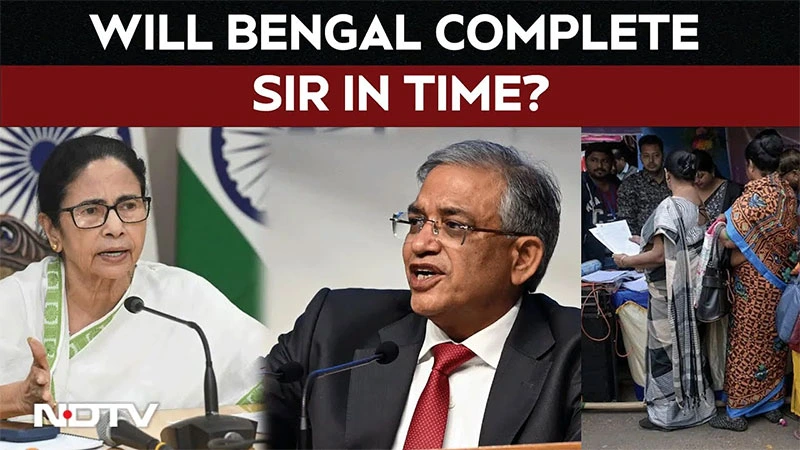
Is the Delay in Bengal Voter Roll Revision leading to Article 356?
West Bengal’s voter roll revision has entered a complex and uncertain phase. More than 60.06 lakh voters still remain in Bengal Voter Roll, “Under Adjudication”, according to the Election Commission of India.
Though the Final Voter List was published on 28 February, but the supplementary lists will be published gradually.
However, reports suggest that only 4.5 lakh cases have been settled as of 05 March 2026. Thus, the gap between the pending cases and the processed ones has raised a serious question:
Is the Bengal voter roll revision stuck in an infinite loop?
At present, around 505 judicial officers are working on the scrutiny process. In addition, 100 more judicial officers from Odisha and Jharkhand each are scheduled to join on 07 March. They should start work from 09 March after a 2-day training.
Yet the logistical and administrative challenges make the process slower than expected. As a result, speculation about a possible constitutional crisis and Article 356 has started gaining traction.
What is Happening in the Bengal Voter Roll Revision?
The Bengal voter roll revision process under the judicial Officers began on 26 February 2026 as per Supreme Court Order. Initially, only 280 officers started the scrutiny work.
Later, more officers joined the process. Still, the number of pending cases remains extremely high.
Key facts of the revision process include:
- Total voters under adjudication: 60.06 lakh
- Cases settled till 05 March: Around 4.5 lakh
- Judicial officers currently working: 505
- Additional officers joining: 200
- Work start date: 26 February 2026
Clearly, the progress is slow compared to the enormous volume of pending cases.
Why Is the Process Moving Slowly?
The delay is not just only about manpower. Instead, several administrative factors are slowing down the process.
Administrative Arrangements
First, the Election Commission must arrange for the judicial officers, who are coming from Odisha and Jharkhand:
- Accommodation
- Food
- Security
- Transport
- Workstations
Judicial officers hold high institutional status. Therefore, authorities must maintain proper hospitality and security arrangements.
Technical and Training Requirements
Second, every officer must receive basic training on the voter roll software system.
The Election Commission also need to:
- Create individual user IDs
- Provide access to the digital database
- Train officers to verify documents
These steps consume time.
Language and Coordination Issues
Another challenge is language.
Many officers arriving from Odisha and Jharkhand may not be comfortable with Bengali documents. Therefore, coordination with local staff becomes essential.
Consequently, the process cannot run like a fast-food production line. Each step requires careful verification and time also.
When Must the Election Notification Be Announced?
The timing of the election is extremely crucial.
The West Bengal Assembly will expire on 07 May 2026. Therefore, the election schedule must fit within this constitutional timeline.
Typically, the safest election calendar would be:
- Election notification: Mid to Late March 2026
- Polling phases: April 2026
- Vote counting: Early May 2026
The Minimum Time Period:
| Stage | Timeline |
|---|---|
| Nomination Period | Notification Day to the 7th day after notification |
| Filing Hours | 11:00 AM – 3:00 PM |
| Scrutiny | The day after the last date of nomination |
| Withdrawal Deadline | 2nd day after scrutiny (by 3:00 PM) |
| Minimum Poll Interval | At least 14 days after the last date of withdrawal |
However, the situation depends on the visit of the full bench of the Election Commission of India led by Gyanesh Kumar on 09 & 10 March.
Usually, the Commission announces the election schedule soon after returning to Delhi.
This raises a crucial question.
Will Elections Be Announced Before the Final Voter Roll?
Technically, voter names can still be added until the last date of nomination withdrawal.
However, announcing elections with millions of pending adjudication cases would be politically and legally risky.
Therefore, the Commission must decide whether to:
- Wait for the completion of the voter roll revision
or - Proceed with elections despite pending cases
Knowledge Mart feels that the decision will significantly influence Bengal’s political future.
Could Article 356 Become an Option?
The debate around Article 356 has intensified.
Historically, the use of Article 356 became controversial after the landmark S. R. Bommai vs Union of India ruling.
Since then, central governments have generally avoided imposing President’s Rule.
However, the Bengal situation appears different.
The argument here is not about law and order but about constitutional machinery failure.
Interestingly, the judiciary has already intervened using Article 142, allowing courts to bypass the state government and appoint judicial officers for the voter roll revision.
Therefore, some analysts including Knowledge Mart, believe the constitutional crisis argument is now stronger than before.
What Are the Allegations from Trinamool Congress?
The ruling All India Trinamool Congress has strongly opposed the ongoing process.
According to the party:
- Many adjudicated voters belong to Muslim-majority areas.
- The scrutiny process is being deliberately slowed down.
Abhishek Banerjee has alleged that the Bharatiya Janata Party is influencing judicial officers.
He claims the objective is to delay scrutiny and create a ground for Article 356.
These allegations have further intensified the political confrontation.
TMC Protest Update on 06 March
- Mamata Banerjee has gone for a sit-in-protest. Mamata appeared in the Supreme Court also for SIR case.
- The BLO Adhikar Manch has come down to the street.
Who Is Responsible for the Current Crisis?
Critics argue that the ruling administration bears the responsibility.
Reports suggest that many documents were uploaded even after the February 14 initial deadline.
This late submission created a huge backlog of verification work.
As a result:
- Thousands of files piled up suddenly.
- Judicial officers faced a massive workload and that too not in their own domain.
Opposition parties often talk about a close nexus between the government, administration, and ruling party. That’s how we can notice Rajeev Kumar as a candidate of Rajya Sabha after his retirement.
If the election faces disruption due to unfinished voter roll revision, critics argue that administrative mismanagement may be the key reason.
Is National Politics Influencing Bengal?
The Bengal situation also connects with national political strategy.
The Bharatiya Janata Party aims to expand its influence across India as a Pan India Party. So, they use alliances for their phenomenal growth. If any critic call it a “cannibalism”, he should also remember that there is nothing unfair in Politics in today’s Indian Political Landscape.
Recently, veteran leader Nitish Kumar moved to the Rajya Sabha after serving over two decades as Chief Minister.
Similarly, the BJP has used alliance politics in states such as:
- Maharashtra
- Goa
- Assam
In each case, alliances helped the party strengthen its long-term position. So, they didn’t take any hardline against Trinamool Congress in 2024 as Modi Government did not have single majority.
But right now the fragmented INDIA alliance has widened their scope for earning even larger support than 29 MPs of Trinamool Congress. So, they can forge ahead in Bengal 2026 Election.
Therefore, analysts believe the party aims to maximize the number of states under its governance.
Why Is the Governor’s Appointment Important?
Another political development has drawn attention.
Recently, R. N. Ravi replaced C. V. Ananda Bose as the Governor of West Bengal.
Many observers see this change as a strategic administrative move.
If a constitutional crisis emerges, the Governor plays a crucial role in recommending President’s Rule.
Therefore, the appointment has added another layer to the ongoing political debate.
What Lies Ahead for Bengal?
At present, the situation remains uncertain.
Several questions still remain unanswered:
- Can the adjudication of 60 lakh voters be completed quickly?
- Will the Election Commission delay the election notification?
- Could the crisis escalate into a constitutional intervention?
The coming days will be critical.
Much depends on the Election Commission’s visit on 09 March and the administrative progress afterward.
For now, the Bengal voter roll controversy continues to deepen, and its political consequences could shape the 2026 Assembly election.
It is clear that the BJP’s strategy experts are smarter than Mamata and Abhishek Banerjee. The Trinamool Congress is finally causing its own downfall.
Key Takeaways from Knowledge Mart
- 60.06 lakh voters in Bengal remain under adjudication.
- Only 4.5 lakh cases settled as of 05 March 2026.
- 505 judicial officers currently working on scrutiny.
- 100 more officers arriving from Odisha and Jharkhand.
- Election notification likely between mid and late March 2026.
- Debate over Article 356 and constitutional crisis intensifying.
People Also Ask
What does “Under Adjudication” mean in voter rolls?
It means the voter’s documents or eligibility are under verification by judicial or election authorities before final inclusion in the electoral roll.
How many voters are under adjudication in West Bengal?
According to the Election Commission, 60.06 lakh voters are currently under adjudication.
Can elections be held without completing voter roll revision?
Technically yes. Voter names can still be added until the last date of nomination withdrawal. However, large pending cases may create legal and political challenges.
What is Article 356 in the Indian Constitution?
Article 356 allows the central government to impose President’s Rule in a state if constitutional machinery fails.
When will the 2026 West Bengal Assembly election likely take place?
If the schedule follows the usual timeline, polling may occur in April 2026, with results in early May before the Assembly term ends on 07 May 2026.