Kolkata Corporation Election: A Fierce Test
Oct 28, 2026 - By Ashutosh Roy PoliticsElection AnalysisRegional UpdatesWest Bengal Politics
Kolkata Corporation Election: A Political Storm
The Kolkata Corporation Election is turning into more than a contest for control of the city’s civic body. It has opened up an awkward question for the BJP: will it stand by its own workers, or make room for leaders who have changed political sides and now want a share of the spoils?
The Nationalist Citizens Party of India (NCPI), which has absorbed a group of rebel Trinamool Congress MPs, wants to work with the BJP in the civic polls. The BJP, however, has repeatedly said that it intends to contest the Kolkata Municipal Corporation (KMC) election on its own. Its leaders have announced their intention to field candidates in all 209 wards.
According to The New Indian Express, both the state BJP president, Shamik Bhattacharya, and Union minister Sukanta Majumdar have ruled out an electoral alliance with NCPI.
This is not a minor disagreement over a few seats. It is a test of political credibility. The BJP came to power in Bengal after campaigning as an alternative to the Trinamool Congress. Its workers now have every reason to ask why they should make room for people who spent years in the opposing camp.
A One-Sided Political Love Affair
Sudip Bandyopadhyay and other NCPI leaders have argued that their party, as a partner of the BJP-led National Democratic Alliance at the Centre, should have a role in the civic elections. Kakoli Ghosh Dastidar has also spoken in favour of an arrangement. Sudip has indicated that discussions about participation in the municipal polls have taken place.
But the BJP’s state leadership has been far less enthusiastic. State president Shamik Bhattacharya has said the party will contest independently. Union minister Sukanta Majumdar has also announced that the BJP intends to field candidates across the 209 wards. BJP leader Rahul Sinha has drawn a distinction between parliamentary cooperation with NDA partners and electoral alliances at the municipal level.
The message from the BJP is difficult to miss: there is no automatic transfer of a national-level alliance to local elections.
That is where the political comedy begins. NCPI appears eager to secure an arrangement, while the BJP keeps telling it that it can fight the election alone. If one side is repeatedly asking for a relationship and the other is refusing to commit, what should we call it? A political love affair in which only one party seems to be in love.
Sudip’s reported willingness to accept whatever seats might be offered to his party makes the position look even more unequal. An alliance is supposed to be a negotiation between partners, not an exercise in asking for whatever the stronger party is willing to spare.
The BJP’s public position has become increasingly clear. On 24 October, Sukanta Majumdar reiterated that the party would contest all 209 wards independently. The details were reported by The Telegraph earlier in October, when the party was already dismissing speculation about a possible arrangement.
The question is whether this position will remain firm when candidate selection reaches its final stage.
What Does the BJP Gain From an Alliance?
NCPI supporters may argue that an understanding could help the BJP in some wards where the party has struggled to build a winning base. In parts of North Kolkata, including areas with large Muslim populations like Rajabajar, the BJP faces a difficult electoral calculation. An alliance could be presented as a way to bring additional voters and political networks into the contest.
But that argument needs to be tested rather than accepted as a political formula. An alliance does not guarantee that one party’s voters will obediently support the other party’s candidate. Nor does the presence of a former TMC leader automatically mean that the BJP will gain that leader’s entire vote bank.
The BJP’s performance in the 2026 Assembly election has strengthened its belief that it can fight without depending on former TMC leaders. Its supporters will ask a straightforward question: if the BJP can win on its own, why should it hand over seats to political defectors?
West Bengal Political Landscape: Big Fights
The answer cannot simply be that NCPI is now part of the NDA at the national level. Parliamentary arithmetic and a Kolkata ward election are two different things. At the Centre, cooperation may serve a broader political purpose. In a municipal election, every seat matters to local party workers who have spent years building an organisation.
The BJP must explain what it stands to gain from an alliance—and why that gain would outweigh the resentment it could create among its own cadre.
Will BJP’s Old Workers Accept This?
This is the most serious problem for the BJP. Its workers did not spend years fighting the TMC merely to watch former TMC leaders arrive under a new political label and demand election tickets.
Many former TMC politicians may have changed their political loyalties after the party’s defeat. They may have their own reasons, and voters are free to judge those reasons. But a change of party does not automatically erase a political record or create trust among former opponents.
Imagine a BJP worker like Abhijit Sarkar who has faced pressure, hostility or political isolation while trying to build the party locally. Now imagine that a former TMC leader is offered the ticket this worker has been hoping to receive. The leadership may describe the decision as electoral pragmatism. The worker may see it as betrayal.
That is how internal conflict begins—not necessarily with a public revolt, but with resentment, poor cooperation and a refusal to work wholeheartedly for a candidate.
The BJP cannot expect its old workers to accept every decision simply because the leadership calls it strategic. If the party wants to bring former TMC leaders into its fold, it must explain why they deserve preference over people who stood by the BJP when victory looked far away.
The party has publicly indicated that its own workers will receive priority in candidate selection. That promise must mean something when the final list is prepared. It cannot remain a convenient statement made before the real bargaining begins.
The danger is not only that the BJP could lose a few seats. It could damage the organisation that helped it win power in the first place.
Suvendu’s Lakshmi Puja Visit: Just Courtesy?
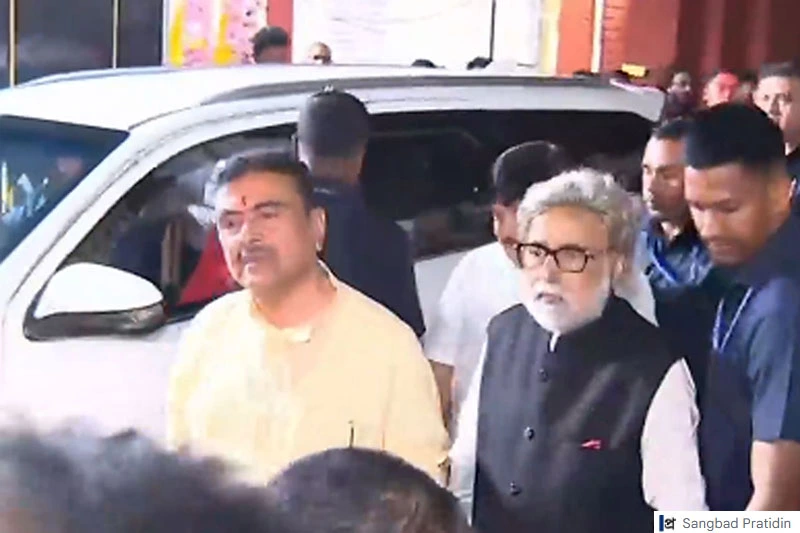
Chief Minister Suvendu Adhikari’s visit to Sudip Bandyopadhyay’s residence for Lakshmi Puja has added fuel to the debate. Adhikari attended the household celebration, offered prayers and ate naru. He described the visit as a matter of courtesy, saying that Sudip had invited him earlier.
There is a dramatic twist to this story. Chief Minister Suvendu Adhikari ate naru at Sudip Bandyopadhyay’s Lakshmi Puja. But Sudip’s hospitality, served with naru, is nothing new. We have seen this before. When Kunal Ghosh was singing in a decidedly hostile tune, he too went to Sudip’s house and ate naru.
Naru is an excellent sweet, lovingly made in Bengali homes. But the way this humble sweet gets entangled with politics at Sudip’s house would make our grandmothers, even if they were sitting in heaven, faint with astonishment!
Watch Sudip’s nostalgia.
There is no reason to treat a festival visit, by itself, as proof of an electoral deal. Politicians meet one another for many reasons, and a social courtesy need not amount to a political commitment. Adhikari also said that he would not discuss political matters at the gathering and pointed to the BJP’s state leadership as the proper authority on the election question.
The visit came amid public speculation over whether NCPI would receive a share of seats in the upcoming civic elections. When political leaders meet just before an election, people naturally ask whether the meeting has any wider significance.
NDTV reported that Adhikari visited Sudip’s residence amid speculation about a possible BJP-NCPI understanding. The Chief Minister maintained that it was a courtesy visit and said he would not discuss political matters there.
Sudip is not a newcomer to political hospitality. His residence has hosted political figures from different camps. Kunal Ghosh has also visited him in the past, despite differences and criticism within the political family. Such visits may reflect personal relations, political calculation or both; outsiders should not pretend to know what was discussed privately.
Adhikari’s explanation was that Sudip is now an NDA partner and that Prime Minister Narendra Modi has also shared breakfast with him. He further said he knew of no instance of Sudip mistreating BJP workers, adding that leaders such as Tapas Roy or Sajal Ghosh might be better placed to comment on such matters.
That statement does not settle the question. The experience of party workers cannot be measured simply by whether one senior leader personally knows of a case. Nor should a courtesy visit be used to suggest that the BJP has already agreed to an alliance. The party’s public position on the civic polls remains the more relevant evidence.
The visit may have been exactly what Adhikari said it was: a courtesy call. But in politics, courtesy can create speculation even when no agreement has been reached.
For readers who want to see the news coverage, Anandabazar Patrika’s report also records the Chief Minister’s explanation and his response to questions about a possible civic-poll alliance.
Sudip: A Master of Political Survival?
Sudip Bandyopadhyay has survived several changes in Bengal politics. His political journey has included links with Congress leaders, a long association with Trinamool Congress and, now, a place in NCPI after the breakaway of rebel MPs. He has also maintained contact with political figures outside his immediate party.
One may see this as political adaptability. Critics may see something else: an ability to remain relevant whichever way the political wind blows. The judgement depends on one’s political perspective, but the question is fair. What does Sudip want from the Kolkata civic election?
At his age and stage of political life, it is reasonable to ask whether he is primarily concerned with his own future or with securing a political foothold for associates and loyalists. That is speculation, not an established fact. Still, the demand for a share of civic seats naturally raises the question of who would benefit from such an arrangement.
If NCPI receives tickets, those tickets will not be abstract symbols of national-level cooperation. They will belong to individual candidates who could otherwise have been considered by the BJP. Every seat given to an NCPI nominee could become a source of discontent among BJP aspirants.
The larger question is whether NCPI can even maintain unity within its own ranks. In early October, The New Indian Express reported that 10 of the 20 rebel TMC MPs skipped an NCPI meeting. That episode raised questions about the cohesion of the group.
If a party is struggling to keep its own members together, how confidently can it claim to transfer their political influence to another party’s candidates in a municipal election?
Sudip may believe that his party’s position within the NDA gives it a legitimate claim to participate in the civic polls. But national-level access does not guarantee local acceptance. The BJP’s workers and voters will judge the arrangement by what it means for Kolkata, not by the place NCPI occupies in Delhi.
Mamata’s Old Decision May Haunt Her
There is another political irony here. Mamata Banerjee had once removed Tapas Roy from the post of North Kolkata district president and brought Sudip Bandyopadhyay into a more prominent organisational role. The two leaders have followed different political paths at a later stage.
After the 2026 Assembly defeat and the split within Trinamool Congress, Mamata may have reason to reconsider some of her past organisational choices. A leader who once helped maintain a party’s influence can later become part of the challenge facing it. Politics rarely offers permanent loyalties.
But Mamata’s difficulties do not automatically make an NCPI-BJP arrangement sensible. The BJP has its own interests, its own workers and its own political identity to protect. It cannot base its candidate selection only on the desire to accommodate people who have fallen out with the TMC.
The real question is whether the BJP can turn its electoral victory into a stable organisation without repeating the very practices it once criticised. If former TMC leaders are given tickets because of their political connections rather than their local support and credibility, the BJP risks looking less like an alternative and more like a new home for the old political establishment.
A change of party label is easy. Winning the confidence of voters who remember a leader’s past is a different matter altogether.
Read: Why Mamata’s Trusted Aides Shockingly Quit.
Will BJP and NCPI Fight Together?
For now, the public signals point towards the BJP contesting the Kolkata civic election independently. Its leaders have said that the party will field candidates across the 209 wards and have rejected the idea of a formal seat-sharing arrangement with NCPI.
That does not mean every question about individual candidates has been settled. Candidate lists and final decisions will show whether the leadership sticks to its declared position. There may also be attempts by individual politicians to secure BJP tickets or support, but such possibilities should not be confused with a confirmed alliance.
My assessment is that a formal BJP-NCPI alliance is unlikely, given the repeated statements from the BJP’s state leadership. It remains possible that individual NCPI loyalists could seek BJP tickets, but whether any are accepted will depend on the party’s final decisions. Until the candidate list is announced, that remains a possibility—not a fact.
Sudip may hope for a political arrangement that gives NCPI a foothold in Kolkata’s civic body. The BJP, however, has little reason to give away seats merely to satisfy that expectation. If it believes it can contest alone, it should have the courage to do so and accept responsibility for the result.
The BJP must also be clear about one thing: its local workers cannot be treated as expendable whenever a new political calculation emerges. If the party wants to recruit former opponents, it must do so on transparent terms and without pushing loyal workers aside.
Key Takeaways: The Battle Behind the Civic Polls
- The BJP’s stated position is clear: its leaders have said they intend to contest the 209 KMC wards independently rather than enter a formal seat-sharing arrangement with NCPI.
- NCPI wants a role in the civic polls. Its leaders argue that their place in the NDA should translate into participation, but national-level cooperation does not automatically create a local electoral alliance.
- BJP workers have a legitimate concern. They will not welcome a situation in which former TMC leaders receive tickets at the expense of people who built the BJP organisation.
- Suvendu Adhikari’s visit is not proof of a deal. He described it as a courtesy visit, though its timing has naturally raised political questions.
- Sudip’s political calculation remains open to debate. Whether he seeks a broader role for NCPI or opportunities for associates will become clearer only when concrete decisions are made.
- The candidate list will matter more than the speculation. It will show whether the BJP follows through on its promise to contest independently and prioritise its own organisation.
- Political loyalty cannot be taken for granted. A party that sidelines its own workers to accommodate newcomers risks creating resentment that may affect its electoral prospects.
The Real Question: Will the Election Be Free and Fair?
Suvendu Adhikari has set an ambitious target for the BJP in Haldia, declaring that the party must win all 30 seats there. Such a target is not evidence of wrongdoing. Political parties routinely set sweeping goals before elections. But it does make the conduct of the civic polls an important matter to watch.
Bengal has seen enough bitter electoral disputes for voters to demand more than victory speeches. The Kolkata Corporation Election must be judged not only by who wins, but also by whether candidates can campaign freely, whether voters can cast their ballots without intimidation and whether the administration acts impartially.
Read: BJP’s Record Win: Is Suvendu Really Happy?
The BJP has repeatedly accused the previous government of misusing power. Now that it governs the state, it cannot ask for trust on the strength of its old accusations alone. It must demonstrate the difference in practice. A government that claims to have changed Bengal’s political culture should welcome scrutiny rather than dismiss questions about the fairness of an election.
The alliance debate may dominate headlines today. The fight over tickets may occupy party offices tomorrow. But neither issue is as important as the freedom of the voter. A party that expects to win all the seats must also be ready to prove that the contest was fair.
Bengalis should therefore watch the campaign, the candidate selection and the conduct of the administration closely. The question is not simply whether the BJP will go it alone or whether NCPI will get a foothold in Kolkata.
The question is how free and fair the election will be—and whether the party now in power will uphold the standards it once demanded from its opponents.
Watch related video coverage: Suvendu Adhikari’s visit to Sudip Bandyopadhyay’s residence and the political debate over a possible civic-poll understanding.