The India Alliance: Shattered in 2026
Jun 13, 2026 - By Ashutosh Roy Current AffairsNational NewsNational PoliticsPoliticsWest Bengal Politics
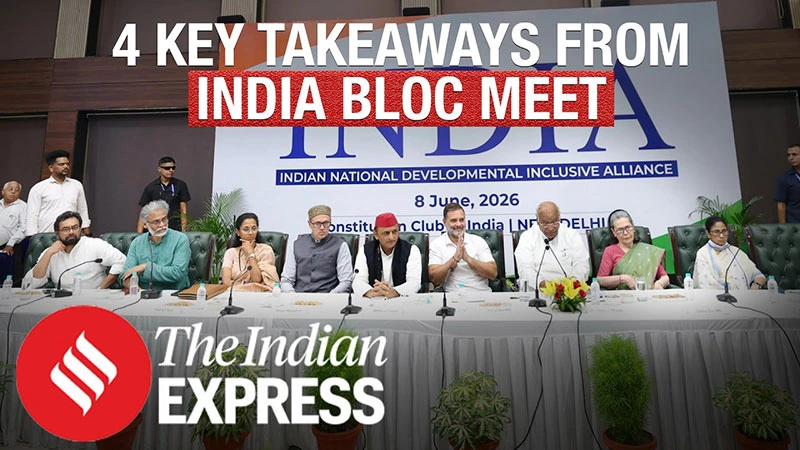
Is The India Alliance Falling Apart in 2026?
The India Alliance operates as little more than a glittering illusion, visually striking but structurally brittle and unfit for any real purpose. Prime Minister Narendra Modi famously mocked this setup, labeling it a strategy of “friendship in Delhi, warfare in the states”.
Today, that sharp critique feels completely accurate as the political coalition fractures along regional fault lines. Opposition Alliance Split is vividly visible now.
Let us admit the basic fact that today Congress, the big brother, is in power with absolute majority only in Himachal Pradesh, Telengana and Karnataka. It had been ruling in 14 states in 2014.
Why is the Congress vs Left Clash Creating Voter Confusion?
The fundamental double standard of the opposition bloc stands completely exposed in South India. In Kerala, top Congress leadership actively campaigns against the CPI(M) government. This bitter rivalry creates massive confusion for the electorate.
| Political Arena | Nature of Alliance | Real-World Action |
|---|---|---|
| National Level (Delhi) | Friendly Allies | Sharing stages at high-profile summits |
| State Level (Kerala & Bengal) | Bitter Rivals | Actively fighting each other for seats |
This deep hypocrisy severely damages the credibility of the anti-BJP front:
- Delhi Diplomacy: Top party leaders share premium snacks and corporate boardrooms at luxury hotels.
- Ground Reality: Local party cadres engage in fierce, daily political combat on the streets. As reported by The Hindu, Congress leader Rahul Gandhi explicitly attacked Chief Minister Pinarayi Vijayan during the Kerala state campaigns, accusing the Left leadership of an authoritarian mindset and an unethical understanding with BJP.
- Ideological Conflict: The leadership demands national unity while local units scream for mutual destruction.
How Did Mamata Banerjee Predict the Collapse?
The structural failure of The India Alliance was evident right from its inception. In West Bengal, Trinamool Congress (TMC) supremo Mamata Banerjee completely destroyed the idea of a united opposition ahead of the crucial state elections.
According to media reports from The Indian Express, she flatly rejected any local seat-sharing formula, choosing instead to fight entirely alone.
Key Context: The foundation of the grand coalition was flawed from day one. A glaring example of this deep-seated mistrust occurred when Mamata Banerjee explicitly refused to accept Nitish Kumar as the central face or convener of the alliance.
This superficial unity proves that the grand coalition was merely a cosmetic arrangement, entirely incapable of surviving the harsh realities of regional Indian politics.
Is The India Alliance a Golden Mirage Destined to Shatter?
The India Alliance functions as a grand but fragile illusion. It looks magnificent on paper, but it crumbles under the slightest political pressure. Rather, Opposition Alliance Split is the obvious outcome in today’s context.
The recent boycott of key opposition meetings by the CPI(M) and the absolute rejection of the front by the DMK make this structural breakdown undeniable.
This internal friction is a natural reaction to deep-seated betrayal. The regional contradictions within the anti-BJP front are too severe to ignore.
Why is Rahul Gandhi’s Campaign Fueling Left Anger?
The resentment within the CPI(M) is completely justified. During the state election campaigns, Congress leader Rahul Gandhi elevated his political rhetoric against the Left to an intensely personal level.
This aggressive approach destroyed any semblance of trust between the two national partners.
| Regional Battleground | Alliance Friction Points | Real-World Consequences |
|---|---|---|
| Kerala & National Formations | Rahul Gandhi’s personal attacks on Left leadership | CPI(M) boycotted top-level The India Alliance meetings |
| Tamil Nadu Alliances | Congress drifting toward Vijay’s TVK party | DMK treats the move as an outright betrayal |
| Jharkhand & Bihar Pockets | Unfair seat allocations by Congress & RJD | Severe alienation of Hemant Soren’s JMM party |
The situational excuses offered by the Congress & TMC leadership simply do not hold water:
- The “Pappu” Narrative is Dead: Rahul Gandhi cannot hide behind political ignorance anymore. He knows exactly how his words damage local allies.
- The Bayron Biswas Precedent: During The India Alliance meetings, Trinamool Congress chief Mamata Banerjee openly avoided the Bayron Biswas defection case. When Congress accused TMC of poaching their lone West Bengal MLA, the excuse given was that it was merely a “local committee matter”. No logical voter believes such defensive statements.
How Do Regional Realities Destroy National Unity?
The structural cracks extend far beyond West Bengal and Kerala. The tactical mistakes made by the dominant coalition partners have triggered a chain reaction across multiple Indian states:
The Tribal Heartland Fracture: In Jharkhand, the combined high-handedness of Rahul Gandhi and RJD leader Tejashwi Yadav in squeezing out Hemant Soren’s JMM party during seat-sharing talks proved to be a fatal strategic error.
Furthermore, Arvind Kejriwal’s Aam Aadmi Party (AAP) has consistently maintained a strict distance from the Congress across multiple state units. These rigid regional compulsions make absolute unification impossible.
When local survival is at stake, a cohesive national front becomes a mathematical myth. The common citizens see right through this opportunism, leaving the ultimate credibility of The India Alliance completely shattered.
What is the Core Ideology of The India Alliance?
The most significant question regarding this superficial coalition is simple: What is their actual governing agenda? Their entire political platform revolves around a single, negative narrative: “Remove Modi“.
While opposing a leader can serve as a temporary election campaign strategy, it can never substitute for a cohesive, long-term political ideology.
History proves that alliances built entirely without a shared philosophical foundation are destined to collapse internally. We can see this exact trend playing out in regional politics today.
For instance, the absolute vacuum of stable leadership within the Trinamool Congress (TMC) in West Bengal demonstrates how quickly an opportunistic setup fractures once electoral pressures mount.
While Mamata Banerjee is showing desperation after TMC Split 2026, didn’t she play a larger role of Opposition Alliance Split in the past?
Nevertheless, The India Alliance has to remember that they are up against Narendra Modi, a leader of formidable stature, near-invincible aura and wielding mighty power.
Core Political Objective & Foundational Ideology
| Category | Agenda / Position | Key Details |
|---|---|---|
| Core Objective | Opposition Unity | Unite multiple parties to challenge the BJP-led NDA in the 2024 Lok Sabha elections |
| Ideological Base | Development + Inclusivity + Social Justice | Emphasis on welfare, equity, and inclusive growth |
| Democratic Framework | Protect Institutions | Safeguard judiciary, Election Commission, media independence |
| Constitutional Focus | Federalism | Oppose centralisation; strengthen state rights |
| Economic Agenda | Jobs & Inflation | Address unemployment, rising prices, economic distress |
| Welfare Measures | Pro-poor Policies | Subsidies, social schemes, possible urban employment programs |
| Social Justice | Reservation Expansion | Focus on SC/ST/OBC rights and equitable representation |
| Electoral Strategy | Seat Sharing | Avoid vote splitting through coordinated candidate selection |
| Campaign Strategy | Unified Messaging | Joint rallies, common slogan (“Judega Bharat, Jeetega INDIA”) |
| Organizational Setup | Coordination Committee | Strategy planning, The India alliance management, campaign execution |
Alas! the allies would remember the above.
How Does History View Single-Agenda Coalitions?
Indian political history provides clear warnings about the fragility of unstructured, multi-party alliances. Whenever diverse political groups united solely to remove a single powerful leader, their governance models collapsed within months.
| Historical Era | Central Leadership | Primary Negative Agenda | Ultimate Political Outcome |
|---|---|---|---|
| 1977 Janata Experiment | Morarji Desai & Jayaprakash Narayan | “Indira Hatao, Desh Bachao” (Remove Indira) | Collapsed rapidly due to fierce internal personal ambitions. |
| 1989 National Front | Vishwanath Pratap (V.P.) Singh | “Rajiv Hatao” (Remove Rajiv) | The highly brittle government collapsed in just 11 months. |
| 2024 Opposition Bloc | The India Alliance Leadership | “Modi Hatao” (Remove Modi) | Facing immediate paralysis over severe state-level conflicts. |
The structural lessons from past political experiments highlight a repeating pattern of instability:
- The 1977 Failure: The post-Emergency Janata Party government under Morarji Desai held a massive democratic mandate. However, because they lacked a unified policy framework beyond opposing Indira Gandhi, intra-party squabbles brought the administration down in less than three years.
- The 1989 Collapse: Similarly, the V.P. Singh administration relied on outside support from ideologically opposed extremes. Lacking a positive governing consensus, the front dissolved under pressure within a year, leading to a severe leadership crisis.
Will the Electorate Accept This Double Standard?
The Core Paradox: An alliance cannot claim national cohesion when its constituent units actively attempt to destroy each other in state capitals. Political survival dictates that regional compulsions will always override a superficial national pact.
Indian voters have consistently matured over successive electoral cycles. They demand stable governance, predictable economic roadmaps, and ideological clarity.
A coalition that lacks a constructive common minimum program, and functions instead as an ornamental, brittle arrangement, struggles to gain long-term public trust.
As history repeats itself, the structural hypocrisy embedded within The India Alliance leaves its future stability highly questionable in the eyes of the public.
What Happens Next If The India Alliance Wins Power?
The India Alliance functions as little more than a polished mask. It looks shiny and unified from the outside, but it remains completely broken, hollow, and unsustainable on the inside.
Let us imagine a hypothetical scenario where Prime Minister Narendra Modi is removed from power. The critical question that arises immediately is: What happens the very next day?
The opposition bloc has absolutely no concrete blueprint for the nation’s future. In addition, we will find a rat race for the Prime Minister’s Chair. They completely lack a coherent plan to address the structural economic challenges facing the country:
- Economic Growth: No alternative macroeconomic framework or industrial policy has ever been discussed.
- Job Creation: There is zero roadmap to resolve the compounding youth unemployment crisis.
- Policy Paralyzes: Behind the closed doors of air-conditioned rooms, while enjoying premium hospitality, the actual substance of their discussion remains non-existent.
Slogans like “Save the Constitution” and “Save the Nation” sound excellent in high-decibel television debates. However, they fail to deliver a constructive alternative message to the common citizens of India.
Can Presentation Slides Replace Real Grassroots Action?
Congress leader Rahul Gandhi frequently wins over journalists in press rooms with elaborate presentations alleging voter manipulation. However, history warns us about the dangers of prioritizing media optics over real organizational capability.
During the critical period of the 1975-1977 Emergency, former Chief Election Commissioner T. Swaminathan oversaw the suspension and postponement of democratic processes. Will the current Congress leadership remember those historical lessons?
Relying on defensive press briefings regarding voting irregularities might create temporary social media buzz, but it yields zero practical political advantage on the ground.
| Political Actor | Public Strategy Post-Defeat | Real-World Impact on the Ground |
|---|---|---|
| Rahul Gandhi | Detailed presentations on institutional bias | Temporary media narrative with weak grassroots mobilization. |
| Mamata Banerjee | Allegations of large-scale voter manipulation | Triggers internal structural collapse within the state unit. |
Why Did Mamata Banerjee’s Rejection Strategy Fail in Bengal?
The consequences of this narrative failure are fully visible following the 2026 West Bengal Assembly Elections. After suffering a historic electoral defeat against a surging BJP, Trinamool Congress (TMC) chief Mamata Banerjee adopted the exact same strategy of blaming institutional manipulation.
The Leadership Crisis: Her unprecedented decision to firmly refuse resignation despite losing her own seat has drawn immense public criticism. This refusal to accept the democratic mandate is widely seen as a primary driver behind the rapid, structural disintegration of the TMC across West Bengal.
According to reports by WION News, Mamata Banerjee’s sudden enthusiasm for reviving national coalition talks is merely a reflection of deep political isolation. Her sudden pivot back to The India Alliance dynamics is a clear sign of desperation.
It serves as a desperate attempt to shield her fracturing state unit from complete political oblivion, proving once again that the grand alliance is nothing more than a temporary shelter for crumbling regional powers.
Conclusion: Will the Indian Electorate Reject This Optical Unity?
In the final analysis, it is undeniable that The India Alliance operates as a deeply compromised, artificial coalition. It remains an unstable political front that can never achieve genuine, long-term unification.
The fundamental problem is a total lack of policy cohesion and a complete absence of an alternative governance blueprint for the nation.
A political strategy based on fighting bitter electoral wars at the state level while offering sweet words of unity at the national level is completely unsustainable. The common citizens see right through this operational contradiction.
Parties That Left the INDIA Alliance
| Party | Leader | Base State | Year of Exit | Reason / Development |
|---|---|---|---|---|
| Janata Dal (United) | Nitish Kumar | Bihar | 2024 | Rejoined NDA; exited opposition bloc |
| Rashtriya Lok Dal | Jayant Chaudhary | Uttar Pradesh | 2024 | Joined NDA citing political differences |
| Apna Dal (Kamerawadi) | Pallavi Patel | Uttar Pradesh | 2024 | Broke away; aligned separately with other groups |
| Janvadi Party (Socialist) | Sanjay Chauhan | Uttar Pradesh | 2024 | Ended ties amid alliance disagreements |
| Hindustani Awam Morcha | Jitan Ram Manjhi | Bihar | 2023 | Shifted back toward NDA politics |
| Aam Aadmi Party | Arvind Kejriwal | Delhi / Punjab | 2025 | Formally disengaged after 2024 elections |
Why Is Regional Conflict Fatal to the Coalition’s Integrity?
The bitter reality is that local party survival will always override any superficial national pact. The deep-seated ideological animosity between the regional players makes a cohesive national front impossible to sustain.
| The Coalition Paradigm | The Optical Projection | The Structural Reality |
|---|---|---|
| Policy Cohesion | A united anti-BJP front | Zero consensus on economic, industrial, or social policies. |
| Operational Strategy | Joint national press conferences | Fierce local street battles for regional political dominance. |
| Public Trust Factor | Claiming to safeguard democracy | Perceived by voters as a marriage of pure convenience. |
This deep operational hypocrisy carries severe political consequences:
- Voter Disillusionment: The electorate refuses to support parties that brand each other as corrupt tyrants in state capitals like Kolkata or Thiruvananthapuram, yet hug each other on stages in New Delhi.
- Grassroots Demoralization: Local party cadres cannot be motivated to sacrifice their lives fighting a regional rival on the ground when their central leadership demands absolute compromise at the top.
The Ultimate Power Lies with the People
The Golden Rule of Indian Democracy: Leaders must never forget that in a democratic republic, the final and absolute authority rests solely with the citizens. Public mandates cannot be manufactured through clever media presentations or cosmetic boardroom huddles.
As the political landscape fractures along regional lines, the structural flaws of The India Alliance stand completely exposed. Without a shared ideological spine or a constructive vision for India’s future, this ornamental arrangement is destined to be rejected by an increasingly discerning electorate, leaving the grand coalition permanently shattered.
10 Key Takeaways
- Superficial National Unity: The India Alliance operates merely as a polished, cosmetic arrangement that lacks a solid foundation and collapses under regional political pressures.
- The Operational Paradox: The coalition suffers from a deep double standard, projecting an image of “friendship in Delhi” while its units engage in bitter, open “warfare in the states”.
- Grassroots Disillusionment: Bitter local rivalries severely damage cadre morale and create massive voter confusion when national partners launch intense, personal attacks on the ground.
- Severe Left Fallout: Political trust between the Congress and Left parties has completely broken down, culminating in the CPI(M) explicitly boycotting key national coordination meetings.
- Rejection by Regional Giants: Major state-level heavyweights, including the DMK, have openly rejected the bloc, proving that local survival always overrides a superficial national pact.
- Bengal’s Isolated Stance: The “Solo” policy adopted by TMC supremo Mamata Banerjee ahead of crucial elections confirms that the anti-BJP front has been flawed and deeply divided since its inception.
- Flawed Power Sharing: Dominant coalition partners of The India Alliance have committed fatal strategic blunders by aggressively squeezing out vital regional players like Hemant Soren’s JMM during seat-sharing talks.
- No Governance Blueprint: The alliance completely lacks a positive common program, offering zero concrete alternative policies for macroeconomic growth, industrial development, or youth unemployment.
- Single Negative Agenda: The entire platform relies strictly on the slogan of “Remove Modi”, which serves as a temporary election tactic but can never substitute for a cohesive, long-term political ideology.
- The Warnings of History: This crisis mirrors the rapid collapses of the 1977 Janata Party and 1989 National Front, reminding a mature electorate that single-agenda coalitions inevitably dissolve into internal chaos.
[…]The India Alliance: Shattered in 2026 Is the opposition crumbling? Explore the hidden double standards, fierce state-level clashes, and internal friction shattering the India Alliance in 2026.[…]
[…]The India Alliance: Shattered in 2026 Is the opposition crumbling? Explore the hidden double standards, fierce state-level clashes, and internal friction shattering the India Alliance in 2026.[…]