BJP Ahead: How Far Are Exit Polls Reliable?
Apr 30, 2026 - By Ashutosh Roy Current AffairsElection AnalysisPoliticsRegional UpdatesWest Bengal Politics
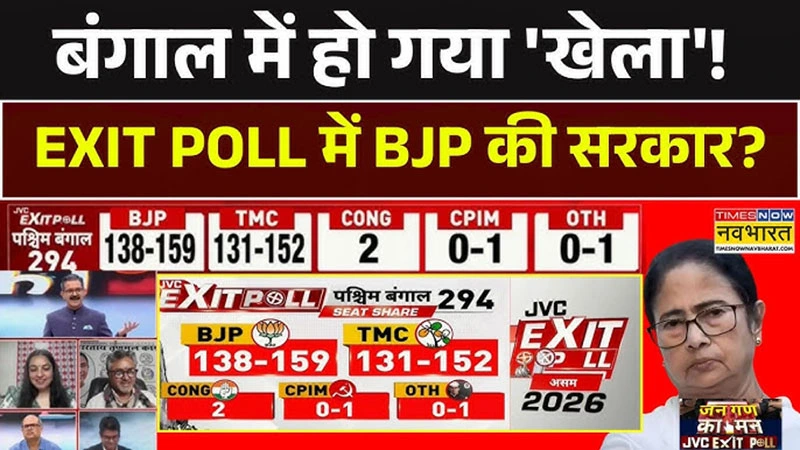
Will BJP rule West Bengal finally?
While the final verdict remains locked in the EVMs until May 4th, several exit polls, including P-MARQ and Matrize, have created a stir by keeping the BJP Ahead in the 2026 West Bengal Assembly elections.
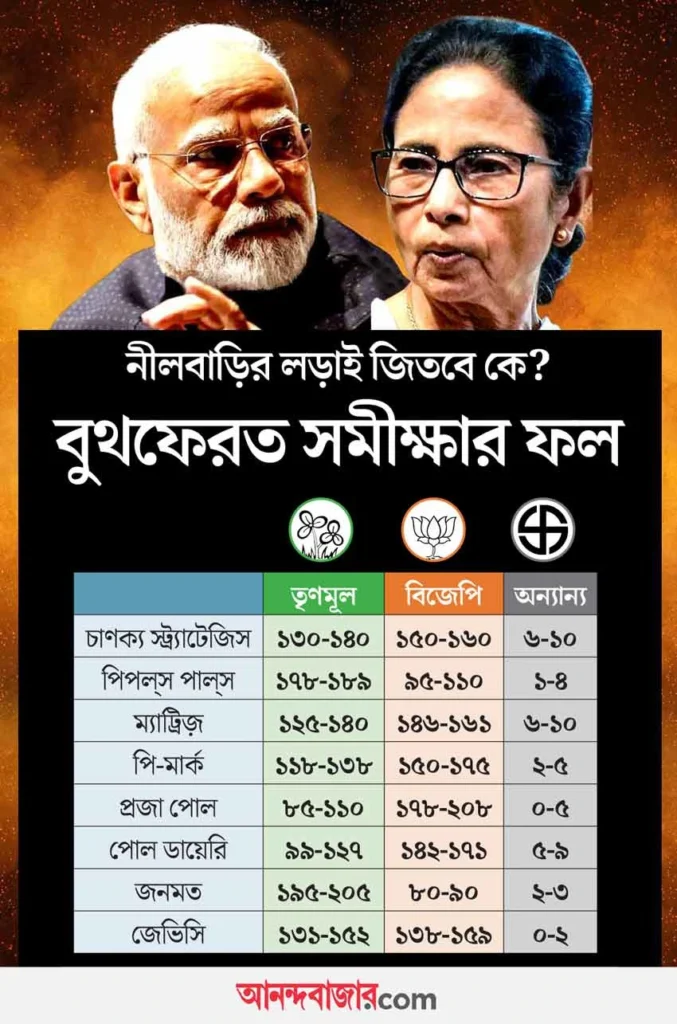
Major Exit Polls: West Bengal Assembly Election 2026
| Exit Poll Agency | BJP / NDA | TMC | Congress + Left | Others | Predicted Winner |
|---|---|---|---|---|---|
| P-MARQ | 150 – 175 | 118 – 138 | 5 – 12 | 0 – 3 | BJP Lead |
| Matrize | 146 – 161 | 125 – 140 | 6 – 10 | 0 – 2 | BJP Lead |
| Poll Diary | 142 – 171 | 99 – 127 | 10 – 18 | 0 – 3 | BJP Lead |
| People’s Pulse | 110 – 130 | 150 + (majority) | 5 – 10 | – | TMC Lead |
| Poll of Polls (Aggregate) | 142 – 208 | 99 – 140 | 5 – 15 | – | BJP Advantage |
Do the Exit Polls Show a Heathy Signal of Democracy?
Undoubtedly, Yes. In fact, West Bengal by its tradition shows almost clean sweeps of one party in election. Thus, such an abysmal presence of the oppositions often turn to electoral autocracy. While the poll of polls keeps BJP ahead in the race, the TMC remains as a strong opposition. Knowledge Mart emphasizes, tt is certainly a good signal for the democracy.
What About the Credit of Election commissioner?
We must say without a doubt that Bengal Elections 2026 has shown a new direction. Additionally, tt has shown that Bengali Voters can come out to vote if they gets an enabling atmosphere.
Thus, we must reiterate that the credit goes to the Election Commission for presenting Bengal such an enabling atmosphere.
Additionally, no political party can raise allegations against the oppositions. Moreover, none can accuse of booth-jamming or any malpractices in Bengal Elections 2026.
What Are the Reasons for Keeping BJP Ahead?
Multiple polling agencies suggest that a combination of the following has given the BJP a competitive edge:
- Tactical shifts
- Voter sentiment
- High-intensity realistic campaigning
Here are the key factors driving these predictions:
1. The Nandigram Strategy in Bhabanipur
The BJP’s decision to field Suvendu Adhikari directly against Chief Minister Mamata Banerjee in Bhabanipur has turned a TMC stronghold into a high-pressure battleground.
- Symbolic Challenge: By pinning the CM down in her own seat, the BJP aims to create a perception of vulnerability.
- Narrative Shift: This move mirrors the 2021 Nandigram battle, keeping the BJP at the center of the political discourse.
2. Record-Breaking Voter Turnout
The first phase of the election saw a staggering 93.2% voter turnout. Traditionally, pollsters interpret such a massive surge in two ways:
- Anti-Incumbency: High turnout often signals a desire for change (Poribortan), suggesting that silent voters may have come out to vote against the 15-year-old TMC regime.
- Polarization: Moreover, agencies believe the high numbers reflect a sharp consolidation of votes, which they project is currently working in favor of the BJP.
The West Bengal Election history shows that 2011 Assembly Elections also witnessed such a record-breaking voter turnout.
3. Focus on Security and Law & Order
The BJP’s campaign leaned heavily on emotional and security-related issues.
- The RG Kar Factor: By fielding the mother of the RG Kar victim from Panihati, the BJP turned women’s safety into a central electoral plank also.
- Sandeshkhali Echoes: In addition, Issues regarding local atrocities were used to challenge the TMC’s grip on rural South Bengal.
4. Tactical Campaign Adjustments
Unlike previous elections, the BJP adopted a more localized and strategic approach:
- Avoidance of Personal Attacks: The party however shifted focus away from personal attacks on the Chief Minister to avoid a sympathy wave.
- Booth-Level Management: Increased reliance on central forces and disciplined booth management gave voters in sensitive areas more confidence to cast their ballots, which pollsters believe benefited the opposition also.
5. Consolidation of the Majority Vote
Pollsters like P-MARQ suggest that the BJP has successfully consolidated over 60% of the majority community vote in key districts.
- The UCC & NRC Debate: The promise to implement the Uniform Civil Code (UCC) and concerns over demographic changes (SIR/Electoral roll revisions) appear to have resonated with a significant section of the electorate.
- Breaching Bastions: Agencies predict the BJP is making significant inroads into the industrial belts and urban pockets of South Bengal, areas previously considered Didi’s Den.
courtesy: Ananda Bazar Online
Key Notes:
While these factors keep the BJP Ahead in several projections, the reliability of these polls is still debated. Historically, Bengal has surprised pollsters, and the high turnout could also represent a pro-incumbency surge for the TMC’s welfare schemes.
Will history repeat itself, or is a historic shift coming? All eyes are on the official results this May 4th.
To understand how these high-stakes predictions became a national obsession, we must look back at the evolution of psephology in India.
What is the History of Exit Polls in India?
The science of predicting elections in India has traveled a long way from academic papers to prime-time television.
Who pioneered the concept?
The Indian Institute of Public Opinion (IIPO) introduced the concept of polling in India during the 1960s. Figures like Eric da Costa led these early efforts. At that time, polls were not about breaking news. Instead, they were academic studies designed to understand voter behavior rather than predicting who would win which seat.
When did modern methodology begin?
- 1980: This year marked a turning point. Analysts began using modern tools like sampling and swing to make major predictions for the Lok Sabha elections.
- 1989: The state broadcaster, Doordarshan, aired the first televised exit poll. Conducted by the Center for the Study of Developing Societies (CSDS), this event moved election analysis from niche journals to living rooms across India.
- 1996: Exit polls became a mainstream sensation. New agencies like C-Voter and ORG-MARG entered the field, turning election night into a massive media event.
How Accurate Were The Major Exit Poll Predictions in the Past?
| Election Year | Exit Poll Prediction | Actual Result | Status |
|---|---|---|---|
| 2004 | NDA win (240-275 seats) | UPA formed govt | Major Miss |
| 2009 | Close contest/UPA lead | UPA win (262 seats) | Partially Correct |
| 2014 | NDA majority (270-285) | NDA landslide (336) | Correct (underestimated) |
| 2019 | NDA landslide (300+) | NDA (353 seats) | Correct |
| 2024 | NDA supermajority (370+) | NDA (293 seats) | Significant Overestimate |
Who are the Founding Fathers of Indian Psephology?
If Indian exit polls had a founding team, it would be Prannoy Roy, Ashok Lahiri, and British political scientist David Butler. In the 1980s, they transformed election data into a national passion.
How did the Roy-Lahiri-Butler partnership work?
In the early 80s, Roy (an economist) and Lahiri (who later became India’s Chief Economic Adviser) teamed up with Butler to apply scientific modeling to the First Past the Post system. They solved two major puzzles:
- The Index of Opposition Unity (IOU): They created this model to calculate how a divided or united opposition would affect the dominant Congress party.
- The 1980 Turning Point: Working with India Today, they conducted the first modern opinion polls that accurately captured the national mood.
What were their biggest milestones?
- The 1984 Forecast: Roy and Lahiri famously predicted over 400 seats for Rajiv Gandhi’s Congress, a bold call that proved incredibly accurate.
- The Bible of Elections: Between 1984 and 1995, they published India Decides, a compendium that became the ultimate guide for election junkies.
- Televised Evolution (1989): Roy brought live swing analysis and seat projections to Doordarshan, changing how Indians consumed election news forever.
Why Do Exit Polls Sometimes Fail?
Despite scientific methods, exit polls are not always right. History shows that even the best models can miss the mark.
What happened in the Shining Miss of 2004?
One of the most famous failures occurred in the 2004 General Elections. Almost every major poll predicted a comfortable win for the BJP-led NDA under the India Shining campaign. However, the actual results shocked the nation, leading to a Congress-led UPA government.
Are there legal restrictions on polls?
To prevent polls from influencing voters while they are still at the booths, the government introduced Section 126A of the Representation of the People Act (1951). This law makes it illegal to publicize exit polls from the start of the first phase of polling until 30 minutes after the final phase ends.
What is the Legacy of Early Pollsters?
Today, even with the rise of Big Data and AI, most modern agencies still use the Roy-Lahiri-Butler framework as their foundation.
- Swing Analysis: They popularized the idea that a specific percentage of vote swing leads to a predictable change in seats.
- Sophisticated Sampling: They moved beyond crude guesses to use multi-stage stratified random sampling, ensuring representation across castes, religions, and economic backgrounds.
While Ashok Lahiri moved into governance and Prannoy Roy built NDTV, their methods remain the gold standard. Interestingly, in 2024, Roy returned to his roots by launching DeKoder, a digital platform that uses AI to simplify the same election complexities he first started decoding 40 years ago.
Exclusive for Knowledge Mart Readers:
The accuracy of these exit polls remains uncertain, and the true verdict will only be clear on 4th May 2026. Until then, it is important to remain patient and respect the democratic process. Still the news of BJP ahead will keep the party energetic.
Regardless of which party ultimately forms the government, the real expectation from the people is a strong focus on genuine development and inclusive governance.
Knowledge Mart strongly vouches that at the same time, all stakeholders must ensure that the state gets a relief from post-poll violence, with no room for retaliation or violence against those on the losing side.
Upholding law and order in this crucial phase is not just the responsibility of authorities, but a collective duty to preserve the democratic fabric of West Bengal even if BJP ahead.
10 Key Takeaways of Knowledge Mart:
- Historic Voter Turnout: The first phase reached a staggering 93.2% turnout. Historically, such high numbers signal strong anti-incumbency and a collective drive for Poribortan (change).
- The Nandigram 2.0 Strategy: The BJP fielded Suvendu Adhikari against CM Mamata Banerjee in Bhabanipur. This move pinned TMC leadership to a single seat and fueled a narrative of vulnerability.
- Security as a Core Issue: The BJP centered its campaign on women’s safety and law and order. Specifically, the party leveraged incidents in Sandeshkhali and RG Kar to connect with both rural and urban voters. So, is really BJP ahead?
- Election Commission Oversight: Observers praised the 2026 elections for an enabling atmosphere. For the first time in years, the process remained largely free from booth-jamming and malpractice.
- Consolidation of Majority Votes: P-MARQ suggests the BJP captured over 60% of the majority community vote, which pushes BJP Ahead. This trend stems primarily from debates over the Uniform Civil Code (UCC) and demographic shifts.
- Strategic Campaign Shift: The BJP avoided personal attacks on the Chief Minister to prevent a sympathy wave. Instead, they focused on localized booth management and central force deployment.
- TMC’s Welfare Resilience: In contrast, agencies like People’s Pulse still predict a TMC majority (150+). They cite the deep reach of welfare schemes and pro-incumbency support.
- Historical Poll Context: While polls provide insight, history warns of inaccuracies like the 2004 India Shining miss. Ultimately, the final verdict rests within the EVMs.
- Focus on Post-Poll Peace: Public demand for an end to post-poll violence remains high regardless of the May 4th result. Therefore, citizens are prioritizing a peaceful transition and inclusive governance.
- Ultimate Result on 4th May: These exit-polls are mere predictions. We need to wait and watch the actual results on 4th May.
People Also Ask (PAA):
1. Who is predicted to win the West Bengal Assembly Election 2026?
Most major exit polls released after the final phase on April 29, 2026, give a slight edge to the BJP. While agencies like P-MARQ and Matrize predict a BJP ahead (145–175 seats), others like People’s Pulse suggest the TMC could retain power with a decisive 150+ seats. The Poll of Polls indicates a neck-and-neck fight, making a hung assembly a mathematical possibility.
2. When will the West Bengal 2026 election results be declared?
The official counting of votes is scheduled for May 4, 2026. The Election Commission of India will begin the process at 8:00 AM, with clear trends expected by noon.
3. What was the final voter turnout in West Bengal?
The 2026 elections saw a record-breaking overall turnout of 92.47% across both phases, the highest recorded since Independence. Phase 1 saw 93.2%, while Phase 2 (covering South Bengal and Kolkata) recorded approximately 91.66%. So, BJP ahead remains as an optimistic view as on date.
4. Why is the Bhabanipur seat so significant this year?
Bhabanipur became the epicenter of the election because the BJP fielded Suvendu Adhikari directly against CM Mamata Banerjee. This mirrored the high-stakes 2021 Nandigram battle, forcing the TMC to focus heavily on defending its leader’s home turf.
5. What were the key issues influencing voters in 2026?
- Safety & Security: Issues like the RG Kar incident and Sandeshkhali were central to the BJP’s campaign.
- Anti-Incumbency vs. Welfare: The desire for Poribortan (change) after 15 years of TMC rule clashed with the popularity of welfare schemes like Lakshmir Bhandar.
- Electoral Integrity: The Special Intensive Revision (SIR) of electoral rolls and the high presence of central forces were major points of debate even if BJP Ahead remains true.
6. Are exit polls reliable in West Bengal?
Exit polls in Bengal have a mixed track record. In 2021, many polls overestimated the BJP, only for the TMC to win a landslide. Conversely, in the 2024 Lok Sabha elections, many agencies significantly overestimated the NDA’s performance nationwide. Analysts advise it’s better to raise the slogan BJP ahead after waiting for the actual EVM count on May 4th.