Ultimate Modi in All 294 Seats: Too Risky?
Apr 16, 2026 - By Ashutosh Roy Current AffairsElection AnalysisPoliticsRegional UpdatesWest Bengal Politics
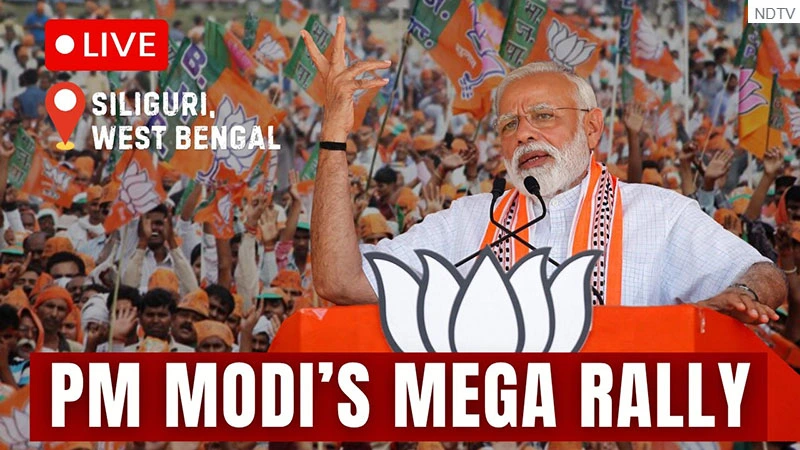
Ultimate Modi Brand- Can it be BJP’s Triumph Card?
Ultimate Modi brand! For the 2026 Bengal elections, the BJP has played its final card. Modi has said that vote for Modi in every constituency.
First, Bengal is a state where long-term governments usually stay in power. Next, the BJP fights elections while excluding nearly one third of the voters (the Muslim community). Indeed, Muslim Votes in Bengal may split in this West Bengal Assembly Election 2026.
Moreover the organization strength of BJP in the state is weak. Consequently, relying only on the Modi brand might be too risky in this situation.
However, the voters of Bengal will provide the answer. We will know the truth on May 4. Meanwhile, we can discuss it from various perspectives now. The Key discussion is Modi in 294 seats in 2026 Bengal Elections.
Is the Meteoric rise of BJP due to Brand Modi Only?
Even the fiercest enemies of the BJP or Narendra Modi will admit one thing. Since 2014, the meteoric rise of the BJP has been driven by Vibrant Gujarat and Brand Modi.
Consequently, even when senior leaders like Advani or Murli Manohar Joshi were moved to the advisory Margdarshak Mandal, everyone in the party had to accept it.
Over the last 12 years, Brand Modi and the Modi Guarantee have helped the party capture power. Specifically, they have won control, both directly and indirectly, in many states in India besides the Parliament.
Furthermore, the BJP has successfully formed governments in numerous non-BJP states after 2014.
Spectacular Growth of BJP in India’s State Politics
| State | Year | Type of Entry | Mode of Power | First Time After 2014? |
|---|---|---|---|---|
| Haryana | 2014 | Direct Majority | Won majority | Yes |
| Maharashtra | 2014 | Largest Party | Formed govt with allies | Yes (as lead party) |
| Jharkhand | 2014 | Coalition | BJP-led govt | Yes |
| Assam | 2016 | Coalition | BJP-led NDA govt | Yes |
| Arunachal Pradesh | 2016 | Defections + Coalition | Govt formed after political shift | Yes |
| Manipur | 2017 | Coalition | Post-poll alliance | Yes |
| Goa | 2017 | Coalition | Formed govt despite fewer seats | Yes (post 2014 formation) |
| Meghalaya | 2018 | Coalition | Partner in govt | Yes |
| Nagaland | 2018 | Coalition | NDA alliance govt | Yes |
| Tripura | 2018 | Majority | BJP-IPFT alliance | Yes |
| Bihar | 2017 | Alliance Shift | Govt formed after alliance change | Returned |
| Uttar Pradesh | 2017 | Majority | Landslide win | Returned |
| Uttarakhand | 2017 | Majority | Strong comeback | Returned |
| Himachal Pradesh | 2017 | Majority | Won election | Returned |
| Karnataka | 2019 | Political Shift | Govt formed after defections | Returned |
| Madhya Pradesh | 2020 | Political Shift | Govt formed after collapse of rival govt | Returned |
| Odisha | 2024 | Majority | First-ever BJP govt | Yes |
| A Detailed Seat-wise Growth is furnished at the end of this article | ||||
As a result, their success is visible almost everywhere in India, except for a few Southern states and Bengal.
Ultimately, the party has seen extraordinary growth due to its own strength, strategic alliances, or the collapse of the Congress or Congress-led coalitions.
Only Bengal remained. During the long Left rule, people labeled the BJP as communal. Consequently, Bengalis never gave the BJP the right to rule.
However, Shyama Prasad Mukherjee was a Bengali himself. Perhaps this is why they want to jump in with all their strength this time. Additionally, it is possible that due to age, this is the last chance for Brand Modi to conquer Bengal.
Is the BJP Bengal strategy 2026 to counter the popular face Mamata Banerjee in Bengal?
The Modi Storm is not just for the central government; it exists in many states across the country. In fact, Modi is often more famous abroad than India itself.
Currently, the recent political strategy of BJP is to avoid naming a Chief Ministerial candidate before state elections. Following this plan, they are not projecting a specific face in Bengal either.
On the other hand, they face the extremely powerful Mamata Banerjee.
She is more than just the leader of the Trinamool Congress; she effectively represents both the government and the party herself.
However, Political Analyst, Biswnath Chakraborty explains how the Brand Modi has made 2026 Bengal Elections tougher for Mamata Banerjee.
According to the Senior Political Journalist Suman Chattopadhyay, Mamata Banerjee is panic-stricken .
Furthermore, every recent opinion poll shows that Mamata Banerjee remains far more popular than any other local leader. Consequently, the BJP has likely decided to bet on their most reliable face, Narendra Modi.
Ultimately, this move leaves no room for doubt: the central leadership is more determined than ever to capture this state, moving far beyond any TMC-BJP setting theories.
Why Ultimate Modi Brand is Risky?
So, ultimate Modi Brand – is it risky? BJP Bengal strategy 2026 may have potential risks.
10 Key Points regarding the risks for the BJP Bengal strategy 2026:
- Voter Gap: The BJP excludes nearly 30% of Muslim voters. Consequently, they lose influence in 90 to 110 seats, where the Bengal Muslim Vote Bank can influence.
- Fear Factor: Mamata Banerjee uses the BJP threat to unite Muslim voters. As a result, this group remains fearful and votes as a solid block.
- Inorganic Growth: The rise of BJP in Bengal is not natural or organic. Instead, they gained ground only because the Left Front became weak and lost its voters.
- Weak Organization: The local structure of the party remains very fragile. Furthermore, internal fights have hurt them, even though Shamik Bhattacharya has reduced the conflict recently.
- Liberal Hesitation: Many liberal Hindus still doubt the party. Specifically, they view the BJP as a communal organization rather than a political alternative.
- Emotional Narrative: Mamata Banerjee turned the Special Intensive Revision (SIR) suffering into a powerful story and also created a political spectacles. Consequently, she connected with the public on a deep, emotional level.
- Failed Movements: State leaders failed to lead strong protests. Specifically, they did not build effective movements around important social issues in last 5 years except Suvendu Adhikari.
- Reverse Growth: The BJP usually grows in cities first. However, in Bengal, their growth started in villages, which is the opposite of their national trend.
- Candidate Selection: The party ignores diversity in its lists. Notably, they fail to give enough importance to Muslim and female candidates.
- Poor Outreach: Public relations remain weak at the grassroots level. For instance, leaders are not promoting the new Sankalp Patra (manifesto) effectively in local blocks.
That is precisely why betting on Ultimate Modi Brand at the very last moment has become a high-stakes gamble for the BJP.
Can the Impact of Bengal Election be Damaging?
The impact of the Bengal election could be huge. First, if the BJP wins, it will not be entirely new. Consequently, it will confirm what Modi said after winning Bihar, that the River Ganga flows from Bihar to Bengal. Modi in 294 seats of Bengal Elections 2026 is certainly the masterstroke of BJP Bengal strategy 2026.
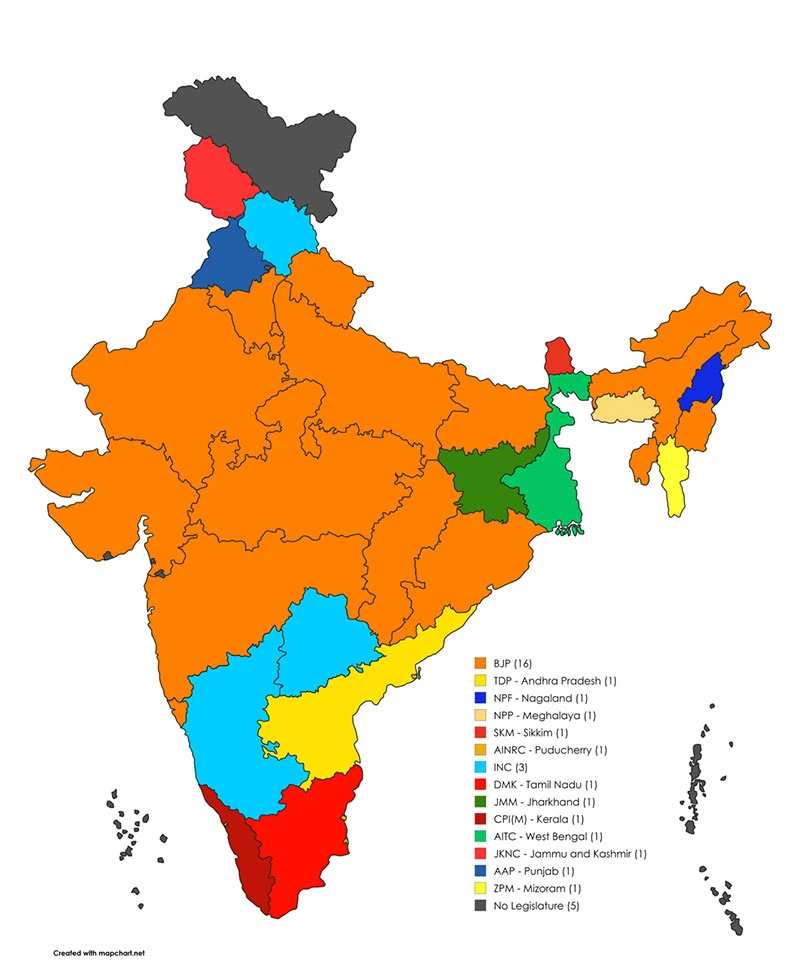
State/UT by governing parties and alliance: Courtesy: Wikipedia
However, Modi is already the undisputed leader of the BJP. Therefore, adding another victory won’t change his status much.
But if the BJP loses in Bengal, it will stain Brand Modi. Specifically, it would be similar to how the reputation of Mamata Banerjee as a vote-catcher was damaged after failing to defeat Suvendu Adhikari in Nandigram 2021 election.
Furthermore, a loss would send a message to other Indian states that Brand Modi can be defeated. Since elections often depend on perception, losing the invincible tag would hurt the BJP. Ultimately, while the reputation of Mamata Banerjee might grow internationally, a defeat would be a significant setback for the image of BJP.
Final Thoughts
The BJP has finally played its trump card: Brand Modi. In response, Mamata Banerjee quickly seized the opportunity. She challenged him, saying he should first resign from the post of the Prime Minister, if he wants to be the face of the state election.
Now, everyone is watching to see what the shrewd politician Mamata Banerjee does next to counter this move. Ironically, it was once with her support that the BJP first gained a foothold in Bengal.
Ultimately, we must wait for May 4 to see whether BJP Bengal strategy 2026 is successful.
Keynotes of Knowledge Mart
Meanwhile, recent Supreme Court hearings and orders have made it clear that the 2026 Bengal elections will not be delayed. Specifically, voting will take place in two phases on April 23 and April 29, with the results being announced on May 4.
Presence of BJP in State-Level Politics
| State | Pre-2014 Seats | 2014–2018 Phase | 2019–2021 Phase | 2022–2025 Phase | Latest Seats | First BJP Govt After 2014 | Category |
|---|---|---|---|---|---|---|---|
| Uttar Pradesh | 47 (2012) | 312 (2017) | – | 255 (2022) | 255 | No (pre-2014 govt existed) | Core Stronghold |
| Madhya Pradesh | 165 (2013) | 109 (2018) | – | 163 (2023) | 163 | No | Core Stronghold |
| Rajasthan | 163 (2013) | 73 (2018) | – | 115 (2023) | 115 | No | Core Stronghold |
| Chhattisgarh | 49 (2013) | 15 (2018) | – | 54 (2023) | 54 | No | Stronghold |
| Uttarakhand | 31 (2012) | 57 (2017) | – | 47 (2022) | 47 | No | Stronghold |
| Himachal Pradesh | 26 (2012) | 44 (2017) | – | 25 (2022) | 25 | No | Alternating Stronghold |
| Gujarat | 115 (2012) | 99 (2017) | – | 156 (2022) | 156 | No | Core Stronghold |
| Maharashtra | 122 (2014) | 105 (2019) | – | 132 (2024) | 132 | No (first BJP govt 1995) | Major Gain |
| Goa | 21 (2012) | 13 (2017) | – | 20 (2022) | 20 | No | Stronghold |
| Haryana | 4 (2009 base) | 47 (2014) | 40 (2019) | 48 (2024) | 48 | Yes – 2014 | Major Gain |
| Punjab | 12 (2012 alliance) | 3 (2017) | – | 2 (2022) | 2 | No | Weak Presence |
| Delhi | 31 (2013) | 3 (2015) | – | 8 (2020) | 8 | No | Urban |
| Bihar | 91 (2010 NDA phase) | 53 (2015) | 74 (2020) | ~78 (2025) | ~78 | No | Alliance State |
| Jharkhand | 37 (2014) | 25 (2019) | – | ~32 (2024) | ~32 | No (first govt 2000) | Major Gain |
| West Bengal | 3 (2011) | 6 (2016) | 77 (2021) | – | 77 | No | Emerging Major |
| Odisha | 10 (2014) | 23 (2019) | – | 78 (2024) | 78 | Yes – 2024 | Emerging → Major Gain |
| Karnataka | 104 (2013) | 105 (2018) | – | 66 (2023) | 66 | No (first govt 2008) | Southern Base |
| Tamil Nadu | 0 (2011) | 0 (2016) | 4 (2021) | – | 4 | No | Emerging |
| Telangana | 5 (2014) | 1 (2018) | – | 8 (2023) | 8 | No | Emerging |
| Kerala | 1 (2016) | – | 0 (2021) | – | 0 | No | Weak Presence |
| Andhra Pradesh | 4 (2014) | 0 (2019) | – | 8 (2024) | 8 | No | Limited |
| Assam | 5 (2011) | 60 (2016) | 60 (2021) | – | 60 | Yes – 2016 | Major Gain |
| Tripura | 0 (2013) | 36 (2018) | – | 32 (2023) | 32 | Yes – 2018 | Major Gain |
| Manipur | 0–21 (2012–17 phase) | 21 (2017) | – | 37 (2022) | 37 | Yes – 2017 | Major Gain |
| Arunachal Pradesh | 11 (2014) | 41 (2019) | – | 46 (2024) | 46 | Yes – 2016 | NE Stronghold |
| Nagaland | Alliance presence | 12 (2018) | – | 12 (2023) | 12 | Yes – 2018 (alliance) | Regional |
| Meghalaya | Minor | 2 (2018) | – | 2 (2023) | 2 | Yes – 2018 (alliance) | Limited |
| Mizoram | Minor | 1 (2018) | – | 2 (2023) | 2 | No | Limited |
| Sikkim | Minimal | – | – | 0 (2024) | 0 | No | Minimal |
10 Key Takeaways
- Final Strategy: The BJP has officially launched its last major card, Brand Modi, to win the 2026 Bengal elections.
- Meteoric Rise: Since 2014, the BJP has grown rapidly across India by using the Modi Guarantee. As a result, they have successfully captured power in many states where they previously had no presence.
- Expansion Record: The party has formed governments in several states including North-Eastern regions. However, West Bengal remains one of the few major states they have yet to conquer.
- Voter Deficit: The BJP currently fights in Bengal while excluding nearly 30% of the electorate (the Muslim community). Specifically, this creates a massive challenge in 90 to 110 seats.
- Inorganic Growth: Much of the strength of BJP in Bengal came from the collapse of the Left Front. Therefore, the foundation of the party is built on shifting voters rather than a long term organic roots.
- Local Rivalry: They face a powerful opponent in Mamata Banerjee. In fact, current opinion polls show she remains far more popular as a Chief Ministerial face than any BJP leader.
- Organization Gaps: The state BJP still struggles with weak local organization. Additionally, many liberal voters still hesitate to support the party due to its communal image.
- Strategic Risk: Betting everything on the Modi brand is dangerous. If the BJP loses, it will damage the invincible reputation of the Prime Minister and embolden the opposition in other states.
- Missed Movements: The state leadership has failed to turn social issues and corruption cases into successful mass protests. Furthermore, public anger is rising because many central agency (CBI/ED) investigations remain unfinished.
- Final Deadline: Ultimately, voters will cast their ballots on April 23 and 29, and we will see the final result on May 4, 2026.
People Also Ask (PAA)
1. Is Brand Modi enough for the BJP to win the 2026 West Bengal elections?
While the Modi brand is the strongest asset of BJP, experts suggest it is a high-stakes gamble. The party faces challenges like weak local organization and a significant voter gap. Therefore, relying solely on a national face against a strong regional leader like Mamata Banerjee remains a risky strategy.
2. Why is the 2026 Bengal election considered a last card for the BJP?
Many analysts believe this is the final opportunity for the current central leadership to conquer Bengal. Due to the age factor of top leaders and the need to break the invincible tag of the TMC, the BJP is putting all its energy into this specific battle.
3. What is the impact of the Muslim vote on the 2026 West Bengal polls?
Muslim voters make up nearly 30% of the electorate in Bengal and act as a deciding factor in 90 to 110 seats. Because the BJP typically struggles to gain support from this community, they must win an overwhelming majority of other votes to secure a victory.
4. When are the West Bengal Assembly Election 2026 dates?
The Election Commission has scheduled the voting in two phases: April 23 and April 29, 2026. The final results and counting will take place on May 4, 2026.
5. How does Mamata Banerjee counter the strategy of BJP in Bengal?
Mamata Banerjee often uses a regional pride narrative to counter the national focus of BJP. Specifically, she portrays herself as the sole protector of Bengali culture against outsiders. Furthermore, she has recently challenged Narendra Modi to resign as PM if he wants to be the face of the state election.
6. What are the main weaknesses of the BJP in West Bengal?
The primary weaknesses include a lack of a strong local Chief Ministerial face, internal infighting, and a weak grassroots organization. Additionally, the party has struggled to sustain long-term social movements compared to the ruling TMC.
[…]Ultimate Modi in All 294 Seats: Too Risky? The BJP goes with the Ultimate Modi Brand across 294 constituencies. Discover why this high-risk final card strategy is defining the 2026 Bengal elections.[…]
[…]Ultimate Modi in All 294 Seats: Too Risky? The BJP goes with the Ultimate Modi Brand across 294 constituencies. Discover why this high-risk final card strategy is defining the 2026 Bengal elections.[…]