Madrasah Education: The Ultimate Analysis
Oct 30, 2025 - By Ashutosh Roy Education & TechSocietyWest Bengal Politics
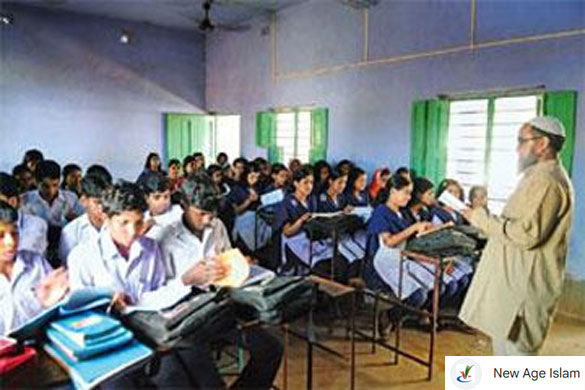
A History and Analysis of Madrasah Education in West Bengal
In 1780, Warren Hastings, the first Governor-General of the British East India Company in Bengal, established the Calcutta Madrasah. That marked the beginning of state-supported Madrasah education in Bengal. This decision was a direct response to a petition from respected Muslim scholars and leaders in Calcutta. Notably, we are talking of an age, when British had taken over India, but did not have adequate manpower to support.
This is also true that the communal polarization could not spread its far reaching tentacles in the society so brutally at that time.
Initial Motivation and Evolution
The British administration had practical reasons for opening the Madrasah. There had been several rules, deeds and accounts, written in various other languages than English. Moreover interpretation of laws had been critical as the Muslim laws differ a lot from that of British.
The initial aim was to use it as a means to increase administrative efficiency by producing highly educated interpreters.
These interpreters had to be proficient in Islamic law, Persian, and Arabic. These languages were essential for the functioning of the colonial legal and administrative systems.. Notably, even British did not want to bring about radical changes in the legal system.
Furthermore, the British struggled to gain the trust and support of the Muslim elite after the decline of the Mughal Empire. Thus, their authority could not receive widespread acceptance and trust during that time.
The British showed respect for Muslim traditions and created a path for Muslims to enter government service through the Madrasah.
Their aim was to regain the confidence of this influential community. This helped them run the administration more smoothly. Its important to gain the trust and confidence for the Britishers for long term governance.
Over time, the curriculum evolved beyond religious and linguistic studies. The introduction of the new subjects such as arithmetic, geometry, astronomy, and medicine, By the early 19th century, brought about a revolutionary change in Madrasah Educations. The goal was to make education more practical and suitable for the changing administrative needs of British-ruled territories.
Madrasah Education in Independent India
West Bengal was the first state in India to formally recognize madrasas and convert their governing body into a statutory entity. The Government established West Bengal Board of Madrasah Education in 1927 and continues to regulate madrasah education in the state.
Madrasah education exists in other states like Uttar Pradesh, which has its own board. However, it remains especially prominent in West Bengal. This is worthy mentioning that there are some Khariji Madrasah or unrecognized Madrasah even today.
Dual Curriculum and Inclusivity
Madrasas affiliated with the West Bengal Board teach a dual curriculum that combines modern, secular subjects with traditional religious studies. Students study core secular subjects such as Bengali or Urdu, English, Mathematics, Physical Science, Life Science, History, and Geography.
They also may read religious subjects like Arabic and Islamic Theology (Hadith, Tafsir, and Fiqh). Integration of these subjects at higher levels, such as the Alim stage; would enhance their scope of studies allowing students to choose electives. The objective was also to bring them to the modern main-stream education system.
When the focus is to bring the Madrasah Education as one of the valid education system, the differences with the main-stream education has to be minimized.
Significantly, West Bengal’s affiliated madrasas operate as secular and inclusive institutions. The Government focuses to bring it to the equivalent education system.
They are open to students and staff of all religions to generalize and bring a gamut of other communities other than restrictive Muslim community only. The data shows a considerable number of non-Muslim students and teachers have become the part of the system.
The push for the modernization of madrasa education has been fueled by the need to address the socioeconomic backwardness of the Muslim minority in the state, a concern highlighted by reports like the Sachar Committee.
The madrasas also continue their traditional role in preserving the religious and cultural identity of the community by providing education in Islamic theology, history, and culture. The problem remains there, whereby the difference with the main-stream education has been vivid. Now, it has become more a political motivation as a part of appeasement policy.
For the 2025-26 fiscal year, West Bengal’s budget allocates Rs 5,602.29 crore to the Minority Affairs and Madrasah Education Department.
Controversies and Current Challenges in Madrasah education
Madrasah education has not been without controversy, often becoming a flashpoint for political and social debate.
Security and Allegations
A significant controversy arose following a terror attack on the American Center in Kolkata. The then-Chief Minister, Buddhadeb Bhattacharya, publicly alleged the involvement of some unrecognized madrasas in anti-national activities.
He claimed these activities were sponsored by Pakistan’s Inter-Services Intelligence (ISI), though he clarified that not all madrasas were involved.
This claim came into the surface after a high level meeting of Buddhadev Bhattacharya with the then-Home Minister, L. K. Advani.
Such a sensible statement ignited a major backlash from the Muslim community and even within his own party. Widespread protests soon erupted. One of the largest was led by Maulana Twaha Siddique and drew a crowd of a few lakhs.
The protests were a reaction to what people saw as an insult to the entire community. Eventually, the pressure prompted the Chief Minister to go back from his statement.
Buddhadev Bhattacharya with his vision of a modern Bengal has faced several barriers during his tenure. Though, he was successful in modernizing the Madrasah Education system, he failed to prohibit the unrecognized ones. His vision for industrialization had also failed due to various reasons.
Funding and Recognition Issues
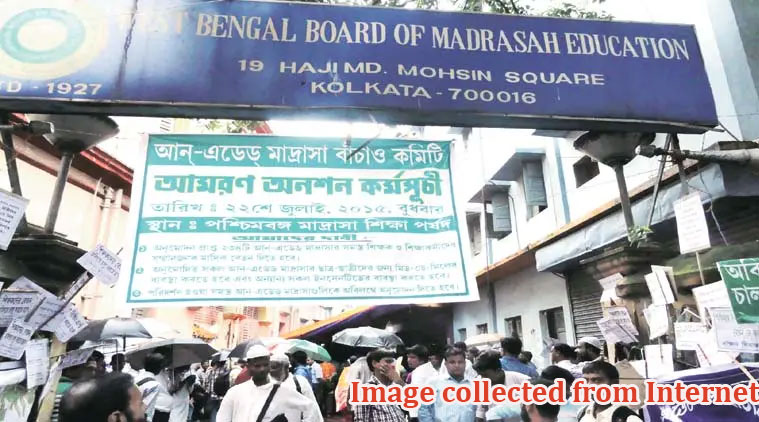
More recently, the issue of funding and support for un-aided institutions has led to protests. For instance, madrasa teachers in Kolkata have held protests and an indefinite hunger strike demanding government aid for un-aided madrasas and better pay and benefits. This strike came out shortly after Mamata Banerjee showcased her government’s work for the minority community.
The Question of a Parallel System
The existence of a parallel education system, such as the madrasah system, over 75 years after India’s independence raises fundamental questions:
- Is a parallel system necessary merely for the preservation of religious and cultural identity? Is this reason alone sufficient to justify its continuation? Though now, it has paved the way for other communities, still they hesitate to join Madrasah.
- While the certificate from the West Bengal Board of Madrasah Education is considered equivalent to those from formal boards, concerns persist regarding the quality control of education, particularly in the reported 235 un-aided madrasas that are beyond the state board’s regulation. Even when the recognized Madrasahs are concerned, can the Government provide adequate manpower to monitor the quality?
- Critics argue that allowing a largely unregulated, parallel system, especially one without full integration into modern curricula and oversight, risks depriving the Muslim community of access to the mainstream education system of West Bengal. Perhaps the answer of such a grave question lies in the political will of the rulers.
Conclusion: Madrasah Education
While certificates from the West Bengal Board of Madrasah Education are officially equivalent to those of other state boards, the quality and uniformity of education remain uncertain.
The absence of oversight risks creating an educational underclass, one that is doubly marginalized, both by poverty and by exclusion from mainstream academic and professional opportunities.
Madrasas were once born out of political necessity and cultural pride. But in today’s India, the challenge is to ensure they don’t become symbols of educational segregation. Preserving faith and heritage should never come at the cost of progress and participation.
The real test for West Bengal, lies in striking that fine balance between identity and inclusion, between heritage and horizon.
[…] the Madrasah Education system has also facing challenges […]