Why Opinion Polls Are Now Lying?
Apr 02, 2026 - By Ashutosh Roy Current AffairsElection AnalysisNational NewsNational PoliticsPoliticsRegional UpdatesWest Bengal Politics
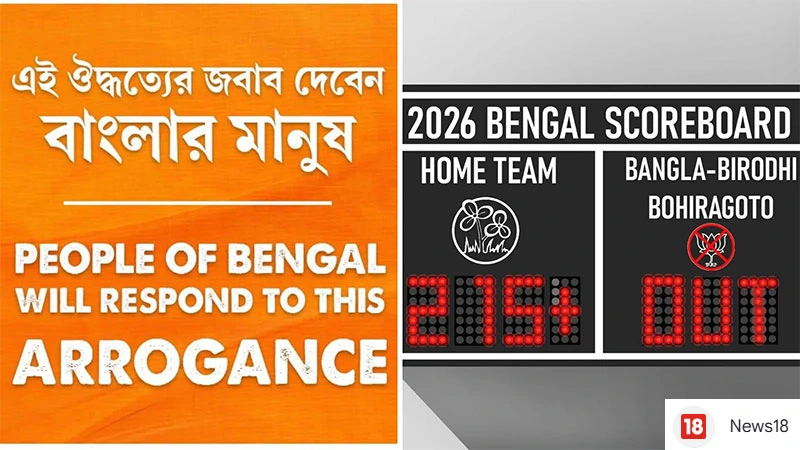
Opinion Polls or Perception Management?
In today’s digital age, electoral perception management has shifted from a science to a strategy. Many argue that unbiased opinion polls have vanished, replaced by media-driven narratives designed to shape, rather than measure, voter sentiment.
As we look at the landscape of 2026 Bengal Elections, understanding the difference between raw data and algorithmic influence is essential for anyone trying to find the truth behind the numbers.
Small Case Studies of Recent Success and Failure
| Election | Poll Performance | Why? |
| 2024 General Election | Major Overestimate | Most exit polls predicted 350–400+ seats for the NDA; the actual result was 293. They missed the surge of the I.N.D.I.A. bloc in key states like UP and Rajasthan. |
| 2021 West Bengal | Underestimated TMC | Many polls predicted a “neck-and-neck” race or a BJP win. The actual result was a landslide for TMC (213 seats). |
| 2023 MP/Rajasthan/CG | Mixed | Polls generally caught the BJP’s momentum in Rajasthan but were surprised by the scale of their victory in Madhya Pradesh and Chhattisgarh. |
| 2022 Uttar Pradesh | Highly Accurate | Most major pollsters (like Axis My India) correctly predicted a return for the BJP with a comfortable majority. |
Furthermore, 2004 stands out as a landmark year. Most leading agencies used opinion polls to raise expectations to sky-high levels. Ultimately, however, Atal Bihari Vajpayee lost his position as Prime Minister.
Do Opinion Polls Still Reflect Public Mood in the Age of Social Media?
We do not want to question the scientific basis of opinion polls. Also, we do not intend to debate their methodology or algorithms.
However, we want to observe a clear trend in today’s digital world.
- Today, we live in the era of social media explosion.
- Therefore, hundreds of opinion polls take place regularly.
- Yet, many of these polls fail to match the actual results.
As a result, people are starting to doubt their reliability.
Is Media Polarization Influencing Opinion Poll Results even before Bengal Election 2026?
We must not forget an important reality.
- Today, strong political polarization exists in the news media.
- Similarly, social media platforms also show deep divisions.
- Because of this, opinion polls sometimes seem less focused on understanding public sentiment.
Instead, it often appears that some polls try to influence public opinion.
Consequently, trust in survey outcomes may decline among citizens. That’s how the people do not take the opinion polls for Bengal Elections 2026 seriously.
Are Paid Opinion Polls Legal in India?
It is also important to understand the legal aspect.
- In India, paid opinion polls are considered a punishable offence.
- Therefore, authorities can take legal action against such practices.
Hence, maintaining transparency and ethical standards in opinion polling is essential.
What Are the Main Scientific Factors Behind Opinion Polls?
Generally, everyone knows that opinion polls depend on several key foundations.
These factors play a major role in determining their accuracy and credibility.
- First, pollsters use random sampling to collect responses.
- Second, they consider the sample size, which directly affects reliability.
- Moreover, they apply social science methodologies to analyse public opinion.
- Most importantly, they check the quality of sampling.
In other words, pollsters must reach different sections of society. Therefore, they need to ensure that opinions from all demographic groups are properly reflected.
How Do Questions and Margin of Error Affect Poll Results?
Opinion poll numbers usually depend on answers to specific questions. However, the person who designs these questions also influences the outcome.
- The expertise and neutrality of the question-maker matter greatly.
- Even a slight bias in wording can change public responses.
Furthermore, every opinion poll carries a margin of error of around 3%. As a result, the final prediction may not perfectly match the actual election result.
Can Major Political Events Change Poll Predictions in Bengali Election 2026?
Large political developments can strongly influence voter behaviour, especially just before elections.
For example:
- During the 1991 Lok Sabha election, voting took place in phases.
- Before the brutal assassination of Rajiv Gandhi, elections were held in 211 seats.
- At that stage, the Indian National Congress performance remained limited.
- However, after his death, voting occurred in 332 additional seats.
- Consequently, the Congress party performed much better in those later phases.
Therefore, such sudden events clearly highlight the limitations of opinion polls. We must accept that poll predictions cannot fully capture emotional or unexpected political shifts.
| Factor | How It Impacts Elections in India | Example |
|---|---|---|
| Economic Conditions | Inflation, unemployment, fuel prices strongly affect voter mood | Rural distress was a key issue in the 2019 Indian General Election |
| Caste & Community Dynamics | Voting often influenced by caste alliances and religious identity | Mandal politics after Mandal Commission Implementation |
| Political Alliances | Pre-poll or post-poll alliances can completely shift vote arithmetic | 2015 Bihar Legislative Assembly Election (Grand Alliance victory) |
| Leadership Factor | Strong leaders can create wave elections | 2014 Indian General Election (leadership-centric campaign) |
| National Security Events | Boosts nationalist sentiment and incumbency advantage | Pulwama Attack |
| Welfare Schemes (Freebies) | Direct benefit schemes influence large voter bases | Schemes like PM-KISAN |
| Media & Social Media | Narrative-building and misinformation can sway voters | Influence via WhatsApp, FaceBook and YouTube |
| Voter Turnout | High turnout in rural/urban areas changes results significantly | High youth turnout in recent elections |
| Local Issues | State-specific concerns (jobs, infrastructure, law & order) matter a lot | Seen in 2021 West Bengal Legislative Assembly Election |
| Communal Polarization | Religious tensions can consolidate votes | Observed in multiple state elections |
| Candidate Selection | Strong local candidates can outweigh party popularity | “Winnability” factor in ticket distribution |
| Election Management | Booth-level strategy and ground mobilization are crucial | Role of Election Commission of India |
Why Is It Difficult to Convert Vote Share Into Seat Predictions?
Another major challenge lies in calculating the difference between vote percentage and seat count.
- In reality, reaching accurate seat projections is almost impossible.
- This happens because political polarization does not eliminate smaller players.
- Third parties, regional groups, and independent candidates can cut into the vote share unpredictably.
For instance:
- A regional leader like Humayun Kabir may attract a section of votes in Murshidabad.
- However, it is extremely difficult to determine whether those votes will affect Trinamool Congress or the Indian National Congress.
Hence, these uncertainties make precise election forecasting very challenging.
Did Opinion Polls Fail to Predict the 2024 Election Results?
If we closely examine the 2024 opinion polls, we can clearly see a pattern. Most polling agencies gave inaccurate forecasts.
- Many surveys overestimated or underestimated party performance.
- As a result, people started to question the overall credibility of poll predictions.
- Therefore, it becomes difficult to believe that multiple agencies made the same mistake unintentionally.
This situation naturally raises serious doubts about polling accuracy and methodology. It’s not only 2024, we can find some similar results in the recent past also.
Why Did a Reputed Agency Like Axis My India Face Criticism?
After the 2024 elections result, a viral moment drew huge public attention.
- The emotional reaction of Pradeep Gupta, associated with Axis My India, spread widely on social media.
- However, the bigger question still remains unanswered.
Despite having a strong past track record,
- how could such a large and experienced polling organisation make such a major error?
- Till now, a clear and convincing explanation has not emerged.
Consequently, public debate around exit poll reliability intensified further.
Which Political Analysts Made Accurate or Inaccurate Predictions in 2024?
Interestingly, some political observers gave sharply different forecasts.
- Political analyst Yogendra Yadav predicted that Bharatiya Janata Party would not cross 240 seats.
- Surprisingly, the party’s final seat tally remained around that mark, creating what many see as a striking coincidence.
On the other hand:
- Poll Strategist Prashant Kishor forecast that the BJP could win around 300 or slightly more seats.
- However, this projection did not match the final outcome.
How Did Past Election Predictions Influence Public Perception?
Prediction debates did not begin in 2024 alone.
For example, during the 2021 West Bengal Assembly election:
- Prashant Kishor had confidently stated that the BJP would not reach a three-digit seat count.
- Eventually, despite massive campaign momentum and loud political claims, the Bharatiya Janata Party stopped at 77 seats.
Therefore, such mixed forecasting records shape public perception about political surveys and expert analysis.
Overall, these examples show that opinion polls and political predictions remain uncertain tools.
Hence, voters and observers should treat them as indicators, not final truths.
Why Do People Show Curiosity About Election Predictions in 2026 Election?
In reality, many people try to know their future by consulting astrologers. Similarly, during elections, political parties and ordinary citizens feel strong curiosity about possible results.
- People often ask: What will happen in this election?
- Therefore, this curiosity creates a huge demand for opinion polls.
- As a result, many survey agencies step forward to fill this space.
Consequently, election forecasting becomes both a political tool and a public fascination.
Why Are So Many New Opinion Poll Agencies Emerging?
Unlike some countries such as Kenya, India does not have strict punishment specifically for unauthorized opinion polls.
- Because of this regulatory gap, new polling organisations continue to emerge frequently.
- Many of these agencies lack long-term credibility or proven track records.
- Therefore, voters often find it difficult to remember or trust their names.
This rapid growth has increased competition but also confusion in the polling space.
How Has the Opinion Poll Industry Changed Over Time?
In earlier decades, people were more familiar with a few established research agencies.
- For example, firms like ORG-MARG and AC Nielsen were widely known.
- However, today numerous new agencies conduct surveys, making the landscape more crowded and complex.
As a result, public confidence in poll consistency has become more mixed.
Do Major TV Channels Influence Public Opinion Through Polls?
Large media houses also play an important role in popularising opinion polls.
- Leading channels such as India Today and ABP Ananda regularly conduct polls before elections.
- These surveys generate debate, discussion, and political excitement.
However, the reality remains clear:
- Sometimes poll predictions match the final election outcome.
- At other times, they fail to reflect the actual voting results.
Therefore, opinion polls should be seen as trend indicators rather than guaranteed forecasts.
Why Can Small Opinion Poll Agencies Create Concerns?
The real problem often begins when small and less-known agencies conduct opinion polls. In most cases, they do not have adequate manpower or strong infrastructure.
- Therefore, such agencies can become vulnerable to political influence.
- Political parties may sometimes try to shape survey outcomes according to their interests.
- As a result, the credibility of polling data comes under serious public scrutiny.
Moreover, during elections in India, huge amounts of money flow into campaign activities. This is widely seen as an unwritten political reality.
Can Opinion Polls Influence Voters Through Media Reach?
Many television channels and digital platforms enjoy strong viewer engagement.
Because of this wide reach:
- Even influencing a small section of viewers can benefit political parties.
- Opinion polls shown repeatedly may shape perceptions about likely winners.
- Consequently, this perception can indirectly affect voter behaviour in close contests.
Thus, media-driven poll narratives often become part of election strategy.
Should Opinion Polls Come Under Stricter Legal Regulation?
In our view, opinion polls should continue in a democratic system. However, they should also operate under clear and strict legal guidelines.
- The government could bring polling practices under tougher regulatory laws.
- Authorities may also consider stopping the publication of opinion polls at least 15 days before voting.
- Such steps could reduce last-minute voter influence and misinformation risks.
Therefore, an important question arises: Will lawmakers seriously consider stronger rules for opinion polls in the future?
Key Takeaways
- Opinion polls depend on random sampling, sample size, and proper social science methods.
- However, many polls fail to match actual election results, especially in recent elections.
- Media and social media polarization can influence how polls are designed and presented.
- Sudden political events and emotional waves can change voter behaviour beyond poll predictions.
- Converting vote share into accurate seat projections remains extremely difficult.
- The rise of small and less-credible polling agencies increases the risk of manipulation.
- Political parties may try to use opinion polls to shape public perception.
- Large media platforms amplify poll narratives due to their strong audience reach.
- Rapid growth of polling agencies has reduced public trust in survey consistency.
- Stronger legal regulation and a pre-election blackout period for polls could improve transparency.
People Also Ask (FAQ)
What is an opinion poll in elections?
An opinion poll is a survey that tries to understand voter preferences before an election. It uses sampling methods and questionnaires to predict possible outcomes.
Why do opinion polls sometimes give wrong predictions?
Opinion polls can be inaccurate because of:
- Limited or biased sample selection
- Sudden political events or emotional waves
- Margin of error in survey results
- Influence of regional or independent candidates
Can opinion polls influence voters?
Yes, opinion polls can shape public perception about likely winners. Repeated media coverage may create psychological momentum in favour of certain parties.
Are opinion polls legally regulated in India?
Opinion polls are allowed in India, but there are rules about publication during election phases. However, many experts believe stricter regulation and transparency are still needed.
Why is it difficult to predict seat numbers from vote share?
India’s electoral system means small changes in vote percentage can produce big seat differences. Also, regional parties and independent candidates can cut votes unpredictably.
Should opinion polls be stopped before voting?
Some analysts suggest banning or restricting polls at least 10–15 days before elections. They argue this could reduce misinformation and voter influence at the last moment