A Reliable probe of 2011 Assembly election
Oct 25, 2025 - By Ashutosh Roy Election AnalysisPoliticsRegional UpdatesWest Bengal Politics
2011 Assembly election: An Overview
Mamata Banerjee’s plebiscitary appeal to the people to decide the West Bengal’s future; thwarted CPM from the power in 2011 assembly election, is a politically incorrect statement. In contrary, a strong anti-incumbency factor due to prolonged ruling forced a well-oiled political giant to bow down.
The unwarranted authoritarian political intervention in every sphere of life fueled the commoners’ wrath. One could find the party intervention had gone even into the level of internal family conflicts.
The indomitable desire to control everything in West Bengal had certainly irritated the people at large. Their desperation reached at a level so that not even a leaf will move without their will
The regime’s ruthless political oppression and the politically motivated killings in places like Nandigram and Netai deeply angered the people.
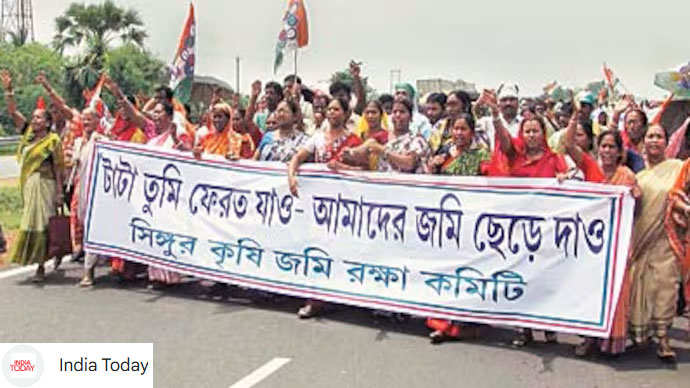
The political movement in Singur against land acquisition sparked anger among commoners. Moreover, The failure of the administration to tackle the issue ensured the final nail in the grave.
The ideological conflicts in the party had reached to the hilt. Such conflicts in the inner within prevented the Krishak Shova to play their active roles. Even the clearly upset Jyoti Basu had to say, What are our farmer wings doing at Singur.
This defeat ended the Left Front’s 34-year-long rule, the longest-serving democratically elected communist government in the world.
Ball Players in 2011 assemble election
Nobody can deny the uprising anti-incumbency factor against the rulers are historical. Moreover, the brutality of Singur and Nandigran issues sparked controversies. Such anti-incumbency factor stirred primarily the intellectuals and dwellers of city and urban areas. Their demonstration becomes widespread through the 24×7 media channels.
The powerful role of the media could stir emotions and ignited a storm in people’s mind. Ironically, most of the so-called intellectual reaped the benefit during the Trinamool regime. As a result, their voices have disappeared even after a string of mishaps, which have been taking places in West Bengal.
The unquestioned driving force of the united opposition played a crucial role. Mamata Banerjee’s Trinamool Congress shook hands with the national Congress due to a blunder decision of the then CPM leader Prakash Karat regarding the nuke deal.
Even SUCI, PDS, Maoists joined the same political podium. The Maoists, who by principles remain behind the vote politics, also joined the fray. The police force, overwhelmed by fear, quivered and their confused state of mind failed to decide whom to become loyal.
Elections of 2008 and 2009 in association with the organized march of the intellectuals flooding the main roads apparently signaled the change of power. The resistance against the ruler’s autocracy became unmistakably clear; without it, drafting the obituary of a decades-long electoral powerhouse would have been nearly impossible.
Political upheavals on the eve of 2011 assembly election
Buddhadeb Bhattacharya dreamt of a West Bengal with big industries and corporate houses, which can end the era of continuously growing unemployment problems and brain-drain. Their patronage and arrogance completely alienated them from the public. As a consequence, the land acquisition problem came to surface during Singur and Nandigram episodes.
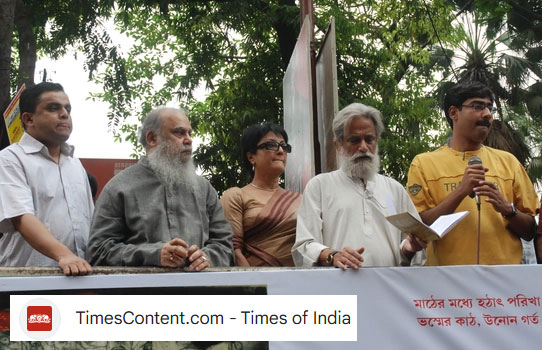
Such a political turmoil became a catalyst for Mamata Banerjee. Mamata with her strong anti-CPM image didn’t spare such a golden opportunity. She skillfully turned widespread public resentment into a powerful opposition force. The CPM’s long-standing support among countrymen and workers gradually faded away.
The Nandigram and Singur events, in particular, cost the party the crucial support of rural voters. The “cadre raj” of Left Front was accused of using political violence and intimidation to maintain its power at the local level. So, a host of such problems reinforced the public’s desire for political change and the united opposition forum prevented the vote split.
Finally, a paradigm shift in 2011 assembly election reflects the state of despair of a gamut of people.
A Caution for Mamata Banerjee
The silent revolution of the voters on the question whether CPM or NO CPM crushed the CPM, a steamroller in the political arena, in 2011 assembly election.
The result can send a caution to Mamata Banerjee also that plebiscitary politics bypass the apparently unshakable political machine and canon fodders. The result of 2026 may be devious enough to make even the sharpest poll analysts look like fools.
[…] Prakash Karat. The critics may show excuses like anti-incumbency or weak administration for the debacle of Buddhadeb Bhattacharya Government in 2011, but the history will cry in silence. Had Prakash Karat not withdrawn support from the UPA […]
[…]A Reliable probe of 2011 Assembly election Shocking truth revealed! This deep analysis exposes the real crisis, hidden agendas, and what it meant for 2011 assembly election. The article is Must-read now.[…]
[…]A Reliable probe of 2011 Assembly election Shocking truth revealed! This deep analysis exposes the real crisis, hidden agendas, and what it meant for 2011 assembly election. The article is Must-read now.[…]
[…]A Reliable probe of 2011 Assembly election Shocking truth revealed! This deep analysis exposes the real crisis, hidden agendas, and what it meant for 2011 assembly election. The article is Must-read now.[…]
[…]A Reliable probe of 2011 Assembly election Shocking truth revealed! This deep analysis exposes the real crisis, hidden agendas, and what it meant for 2011 assembly election. The article is Must-read now.[…]
[…]A Reliable probe of 2011 Assembly election Shocking truth revealed! This deep analysis exposes the real crisis, hidden agendas, and what it meant for 2011 assembly election. The article is Must-read now.[…]
[…]A Reliable probe of 2011 Assembly election Shocking truth revealed! This deep analysis exposes the real crisis, hidden agendas, and what it meant for 2011 assembly election. The article is Must-read now.[…]
[…]A Reliable probe of 2011 Assembly election Shocking truth revealed! This deep analysis exposes the real crisis, hidden agendas, and what it meant for 2011 assembly election. The article is Must-read now.[…]
[…]A Reliable probe of 2011 Assembly election Shocking truth revealed! This deep analysis exposes the real crisis, hidden agendas, and what it meant for 2011 assembly election. The article is Must-read now.[…]
[…]A Reliable probe of 2011 Assembly election Shocking truth revealed! This deep analysis exposes the real crisis, hidden agendas, and what it meant for 2011 assembly election. The article is Must-read now.[…]